
What Time Spent on Social Media Means for SME Marketing in the UK
Table of Contents
UK adults spend an average of 4 hours and 30 minutes a day online, and just over half of that time sits with two companies. On the social platforms themselves, the measured figures are lower than most business owners expect: 51 minutes a day on YouTube, 43 minutes on Facebook and Messenger, 28 minutes among TikTok users, and 20 minutes on Instagram, according to Ofcom’s Online Nation 2025 report. The global average across all social platforms is 2 hours 21 minutes a day, or 18 hours 36 minutes a week.
Most business owners guess these numbers wrong, usually on the low side for their own customers and the high side for any single platform. That gap has a direct cost: budget spent on the wrong platform, at the wrong time of day, in the wrong format. This guide sets out what the current data actually says about time spent on social media across platforms and age groups, with a focus on UK and Irish usage patterns that global reports tend to flatten out, and what it should change about how an SME plans its content, video, and advertising spend.
Global vs UK Time Spent on Social Media: Why the Gap Matters for Budgets
Worldwide, average time spent on social media sits at 2 hours 21 minutes a day, pulled upward by very high usage in markets such as the Philippines, Brazil, and Colombia, according to DataReportal’s Digital 2026 Global Overview. That figure has drifted down slightly from 2023, which suggests users have hit an attention ceiling rather than a platform ceiling. For a business planning where to spend, a flat global average is the least useful number here. The platform and age splits underneath it are what change a media plan, and they are the numbers ProfileTree’s social media marketing team works from when setting priorities with SME clients across Northern Ireland and Ireland.
Campaigns built around global benchmarks routinely overestimate how much time British and Irish audiences give to any single platform. An SME planning a content calendar around “average” global engagement figures is planning around the wrong average. Ofcom’s UK measurement is passive rather than self-reported, which makes it a stronger reference point for anyone selling into this market.
Time Spent on Social Media in the Republic of Ireland
Usage patterns in the Republic of Ireland broadly mirror the UK, though ComReg and industry survey data point to slightly higher engagement on Instagram and TikTok among Irish 18 to 34-year-olds compared with the UK average. Northern Ireland does not have its own separately published breakdown; it is folded into wider UK figures. That is a genuine gap in the published research, and one worth flagging for anyone quoting UK-wide numbers as if they applied evenly across every region.
Time Spent on Social Media by Platform: Where SME Attention (and Budget) Should Go
Time spent on social media is not distributed evenly across networks, and the differences are large enough to change a media plan. The table below sets out Ofcom’s measured UK figures from May 2025, published in December 2025. Reach is the share of UK online adults using each service in a month.
| Platform | Avg. daily minutes (UK users) | Monthly reach (UK online adults) | What the time is used for |
|---|---|---|---|
| YouTube | 51 minutes | 94% | Long-form video, tutorials, search |
| Facebook and Messenger | 43 minutes | 93% | Community, groups, local business pages |
| TikTok | 28 minutes | 56% | Short-form video, in-app search |
| 20 minutes | 78% | Reels, visual content, discovery | |
| 17 minutes | 90% | Messaging and direct customer contact | |
| 4 minutes | Rising sharply year-on-year | Discussion, advice, product research |
Two things in that table tend to surprise people. YouTube leads on both reach and time, and it is not close. And Reddit, despite holding attention for only four minutes a day, has become one of the most quoted sources in AI-generated search answers, which means its influence on buying decisions runs well ahead of its time-on-app number.
TikTok and the Rise of Social Media Search
TikTok’s UK numbers are driven almost entirely by younger users. Ofcom found 56% of online adults visited TikTok in May 2025, with 18 to 34-year-olds averaging 49 minutes a day against the 28-minute all-user average. Daily visitor numbers grew 37% year-on-year, the sharpest rise of any major platform.
Passive scrolling only explains part of that. A growing share of TikTok sessions involve active search: users typing queries directly into the app to find local restaurants, product reviews, tutorials, and service recommendations. ProfileTree’s UK TikTok statistics breakdown covers how quickly that behaviour has grown.
For SMEs, this changes the brief for video content. A 60-second TikTok that answers a specific question a customer is already typing performs very differently from a 60-second brand video made purely for awareness. That distinction sits at the centre of good social media marketing on the platform.
YouTube: The Platform That Rewards Video Production
YouTube’s usage time often gets grouped in with social media, but the platform behaves more like a search engine. People arrive with a specific goal: how to fix something, how to learn a skill, how to compare two products. That intent-driven behaviour makes YouTube one of the highest-converting platforms for a business that publishes genuinely useful video content, which is precisely where video production quality starts to matter more than posting frequency.
The UK trend is worth noting on its own. YouTube’s average daily time rose from 47 minutes in 2024 to 51 minutes in 2025, and its monthly reach now covers 94% of UK online adults, roughly 46.3 million people. It also remains underused relative to its potential among SMEs in Northern Ireland and Ireland. The decision between a quick, frequent upload schedule and fewer, better-produced videos is covered in more depth in short-form vs long-form video strategies for YouTube growth, and it is a decision worth making deliberately rather than by default.
Ciaran Connolly, founder of ProfileTree, puts it plainly: “Most SME owners still think of social media as somewhere to post updates. The data shows it has become a search engine for younger customers and a shortlist tool for professional buyers. If your content is not built for that, you are invisible before the customer ever reaches your website.”
Instagram and Facebook: Matching the Platform to the Audience
Facebook and Messenger hold 43 minutes of UK attention a day against Instagram’s 20, which runs counter to how most SMEs rank the two. Facebook’s reach also grew 6% year-on-year to 93% of online adults. What that headline hides is real variation underneath it: usage among under-35s continues to soften, while the 45-and-over group stays highly engaged, particularly in community groups and local business pages. Instagram’s time figure is lower, but its monthly reach grew 7% and skews strongly toward the under-35s that Facebook is losing.
For an SME choosing between the two, the decision should follow the audience rather than the platform’s overall popularity. A business targeting younger consumers in Dublin or Belfast will get more from Instagram Reels. A business serving older homeowners or rural communities across Ireland will usually see better results from Facebook groups and local business pages. Neither answer is universal, which is exactly why social media strategy has to come before content production, not after it.
LinkedIn: Short Sessions, High Commercial Intent
Ofcom does not publish a separate UK time figure for LinkedIn, and industry estimates place it among the lowest of the major platforms for daily time on the app. Those sessions carry unusually high commercial intent, though. People logging into LinkedIn are typically in a professional mindset: evaluating suppliers, researching agencies, or working through a purchasing decision. For a B2B business, fifteen focused minutes from a decision-maker is worth considerably more than an hour of passive TikTok scrolling.
Belfast and Dublin both show above-average LinkedIn engagement relative to UK and Irish averages, which lines up with the concentration of professional services firms and tech companies in both cities. If LinkedIn is part of your plan, it is worth reading ProfileTree’s piece on how social media is shaping modern business networking alongside this data.
Time Spent on Social Media by Generation: Who You’re Actually Reaching
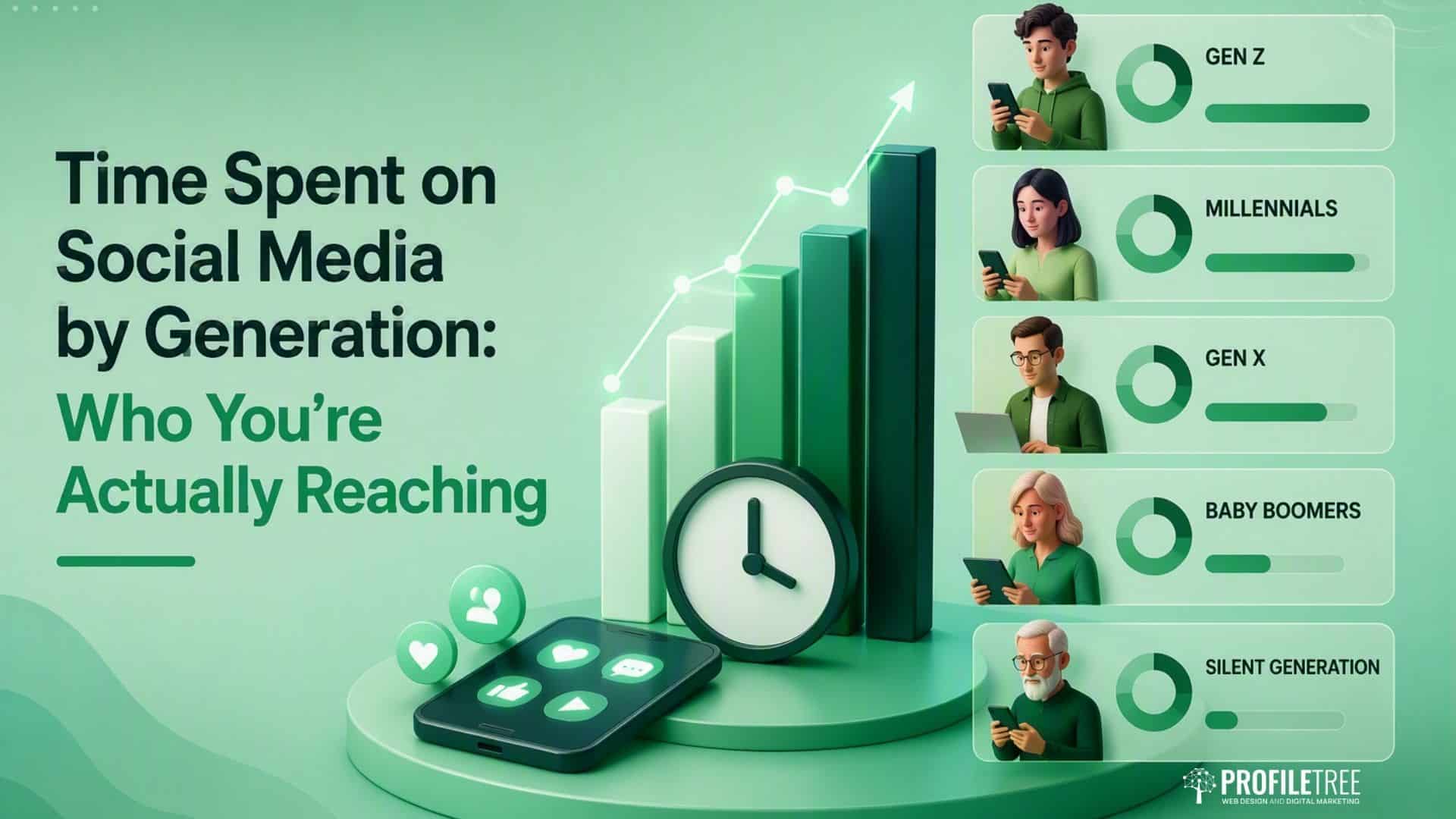
Age shapes time spent on social media more than almost any other variable. Ofcom’s UK figures for total daily time online show the spread clearly: 18 to 24-year-olds average 6 hours 20 minutes a day, while the over-65s average 3 hours 20 minutes. The social-media-specific splits below come from GWI’s 2026 global panel data. They represent averages, and individual usage varies a good deal within each group.
| Generation | Avg. daily social media use | Top platforms | Key pattern |
|---|---|---|---|
| Gen Z (16 to 28) | ~3 hours 12 minutes | TikTok, YouTube, Instagram | Heaviest users; in-app search now routine |
| Millennials (29 to 44) | Close to the all-user average of 2 hours 21 minutes | Instagram, Facebook, LinkedIn | Balancing personal and professional use |
| Gen X (45 to 60) | Below the all-user average | Facebook, YouTube, LinkedIn | Growing YouTube and LinkedIn use |
| Baby Boomers (61+) | ~1 hour 30 minutes | Facebook, YouTube | Fastest-growing segment on both platforms |
Gen Z and the Move to Social Media Search
Gen Z spends around 3 hours 12 minutes a day on social media, roughly double the Baby Boomer figure and well above the all-user average. The bigger change is how that time is being used. A meaningful proportion of Gen Z users now turn to TikTok or Instagram before Google when they are searching for local recommendations, product reviews, or how-to content. ProfileTree’s Gen Z social media statistics page covers this shift in more detail, including how it varies across categories.
For a business targeting younger audiences across Ireland and the UK, that shift means social content is no longer just about awareness; it is about appearing in results when someone searches for what you do inside TikTok or Instagram. The brief, the format, and the publishing schedule all need to reflect that. Many owners already know they need to be on social media but have not updated their approach to match how the platforms are actually being used.
Millennials: Still the Most Commercially Valuable Audience
Millennials combine high social media use with genuine purchasing power and, in many SMEs, actual decision-making authority. They remain the most commercially valuable social media audience for most B2B and B2C businesses across the UK and Ireland. Instagram and Facebook are both strong choices for this group, while LinkedIn is particularly effective for reaching millennial business owners and marketing managers directly.
Gen X and Baby Boomers: An Underserved Social Media Marketing Opportunity
A business that dismisses Facebook and YouTube as “older platforms” is making a real strategic error. Both Gen X and Baby Boomer usage is growing year-on-year, with YouTube seeing particularly strong gains among the 55-and-over group. Ofcom’s data backs this up: time online among the over-65s rose again in 2025, and Facebook’s UK reach grew across the board rather than only among younger users.
These audiences tend to be less saturated with advertising than younger demographics, so a business that commits to well-produced video and a consistent Facebook presence often faces noticeably less competition for their attention than it would chasing an 18 to 24-year-old audience on TikTok.
From Scrolling to Searching: What the Social Media Search Shift Means for Your Content
The most significant change in social media usage patterns over the past two years is the growth of search inside the platforms. Users are spending a smaller share of their time on passive discovery and a larger share on active, intent-driven queries.
That distinction matters because passive browsing and active searching call for different content strategies. A short-form video optimised for TikTok search behaves more like an SEO asset than a traditional social post: it needs to address a specific query, deliver a clear answer quickly, and be structured so the platform’s algorithm can surface it for the right searches.
A business that treats social content and SEO as separate disciplines with separate budgets is increasingly working against itself, since a growing number of platforms now reward exactly the same signals: clarity, relevance, and a direct answer to what someone typed.
The same shift is now visible in general search. Ofcom found that around 30% of UK Google searches returned an AI-generated summary in 2025, and 53% of UK adults said they saw those summaries regularly. Reddit’s position is the clearest illustration of where this leads. It holds attention for four minutes a day, yet it has become one of the most frequently cited sources in AI answers across Google, Perplexity, and ChatGPT. Visibility and time-on-app have come apart, and businesses that plan around engagement metrics alone will miss it.
Social Media Search as a Local Discovery Tool
One of the clearer behavioural shifts through 2025 and 2026 has been the growth of social media as a local discovery tool. Users across the UK and Ireland increasingly turn to TikTok, Instagram, and even Facebook to find local restaurants, tradespeople, retailers, and service providers, often before they check Google Maps or run a traditional search. This is most visible among under-35s: someone in Belfast looking for a coffee shop is as likely to search TikTok for “coffee Belfast” as they are to search Google, and a Dublin resident will do the same for “best brunch Dublin”. A homeowner researching kitchen fitters might watch three or four short videos on Instagram before visiting a single company website.
That has a direct consequence for local SMEs: social media presence is no longer just about brand awareness or community engagement; it is a factor in whether a potential customer considers you at all. A business without visible, searchable social content is simply absent from that decision-making stage, however good its website is.
Building Content That Surfaces in Social Media Search
The content requirements for social media search differ from traditional SEO, but the underlying principle is the same: a business needs to be findable when someone is actively looking for what it does. In practice, that means publishing content that uses the language customers actually search for, covers specific locations and services clearly rather than generically, and is shaped for the format each platform rewards. A clear social media content strategy is what turns that principle into a repeatable publishing schedule rather than a one-off effort.
Turning Time Spent on Social Media Data Into a Social Media Marketing Strategy
The usage data set out above is not background reading; it is the foundation of a plan. Before committing budget to any social media platform, a business should be able to answer three questions: does my audience use this platform, how much time do they actually give it, and what are they doing while they are there?
A retailer targeting 18 to 30-year-olds in Belfast has strong grounds to invest in TikTok and Instagram Reels, given the 49-minute daily average among 18 to 34s and the active search behaviour in that age group. A professional services firm targeting 40 to 55-year-old business owners has stronger grounds to invest in LinkedIn and YouTube instead.
Neither is right for every business, and a plan built on vanity metrics rather than actual audience behaviour tends to waste more budget than it generates. Platform choice is one of the first questions a digital marketing strategy should settle, before any content gets produced. ProfileTree’s guide to social media marketing for SMEs sets out a more detailed framework for making that call.
Most SMEs cannot resource every platform the data points to, which is where the same material has to work harder across channels. A single customer interview can become a YouTube video, a set of TikTok clips, and a LinkedIn post, and a partner business serving the same audience can extend its reach further again. The tactics for that are covered in ProfileTree’s guide to cross-promotion strategies for UK and Irish SMEs.
Why Social Media Training Matters for SME Teams
Time spent on social media during working hours is a genuine concern for UK employers, and while precise figures vary by study, the pattern is consistent: unmanaged personal use during work hours reduces focused work time, particularly for employees without structured task management. The more useful response is not to ban platforms outright, but to help staff understand which platforms and use cases are actually high-value during the working day.
LinkedIn, used for prospecting or professional development, is a different activity entirely from TikTok, used for entertainment, and helping a team make that distinction is a digital literacy question as much as a policy one.
That is exactly what structured social media training is for: giving staff a working understanding of which platform serves which task, rather than a blanket rule that treats every app the same way. ProfileTree’s digital training programmes for SME teams across Northern Ireland and Ireland cover this directly: platform selection, content creation, and social media planning as part of a wider digital skills curriculum.
Quality Beats Volume in AI-Curated Feeds
The platforms driving the biggest gains in daily usage time share one thing: AI-powered recommendation feeds. TikTok’s “For You” page, YouTube’s suggested queue, and Instagram’s Reels feed all use machine learning to serve content that keeps individual users watching for longer.
For a business publishing on these platforms, that means organic reach is no longer primarily about follower count; it is about whether watch time, completion rate, saves, and shares tell the algorithm your content is worth surfacing to people who do not already follow you. A small business in Belfast with 400 followers can genuinely outperform a brand with 40,000 if its content holds attention better.
At the same time, low-effort, templated content has flooded social feeds through 2025 and 2026, and platforms are actively adjusting their algorithms to push it down. For SMEs, that creates a real opening: a business investing in original, well-produced content, whether that is short-form video shot on location, a properly structured LinkedIn article, or a YouTube tutorial drawn from real project experience, is competing against a lower baseline of quality than it was two years ago.
What This Means for Your Next Marketing Decision
Time spent on social media shifts a little every year, but the underlying principle does not: your audience’s attention is finite, and your marketing budget should follow the platforms and formats that hold it longest. For SMEs across Northern Ireland, Ireland, and the UK, that means making platform decisions based on measured usage data rather than assumptions or habits. The Ofcom figures in this article are the most reliable UK reference point available, and they point somewhere most SMEs are not currently looking: YouTube and Facebook, not Instagram.
If you would like help turning this kind of data into a plan for your business, get in touch with the ProfileTree team.
FAQs
How much time does the average person spend on social media per day?
Globally, the average is 2 hours 21 minutes a day, or 18 hours 36 minutes a week, according to DataReportal’s Digital 2026 report. In the UK, Ofcom measures platform by platform rather than publishing a single social media total: UK adults spend 51 minutes a day on YouTube, 43 minutes on Facebook and Messenger, and 20 minutes on Instagram.
Which platform has the highest daily usage time?
In the UK, YouTube leads on both time and reach, at 51 minutes a day among 94% of online adults. Facebook and Messenger come second at 43 minutes. TikTok users average 28 minutes a day, though that rises to 49 minutes among 18 to 34-year-olds.
How much time does Gen Z spend on social media?
Gen Z users average around 3 hours 12 minutes of social media use a day across all platforms, roughly double the Baby Boomer average and well above the all-user figure of 2 hours 21 minutes. This group is also the most likely to use social platforms as search engines for local recommendations and product discovery.
Is social media search replacing Google search?
Not outright. For many queries, particularly local recommendations and product discovery among younger users, social media search is now a genuine alternative starting point. Google remains dominant for most other search types, though around 30% of UK Google searches now return an AI-generated summary, which changes how results get read even when the search itself has not moved.
How can an SME decide which social media platform to invest in?
Start with the platform your specific audience actually uses and how they use it, rather than the platform with the highest overall usage figures. Time-on-platform data by age group is a more reliable guide than general popularity, and the UK splits differ enough from global averages to be worth checking before any budget is committed.