
Digital Marketing Training Impact on Northern Ireland SMEs
Table of Contents
A groundbreaking dissertation by Natalia Thomas, MSc Digital Marketing & Analytics at Dublin Business School, has provided concrete evidence that digital marketing training improves innovation capacity amongst Northern Ireland’s small and medium-sized enterprises. This research, which examined SMEs participating in ProfileTree’s digital marketing training programmes, offers valuable insights for business owners, marketing managers, and decision-makers considering investment in digital skills development. The findings demonstrate measurable improvements in marketing effectiveness, entrepreneurial confidence, and business growth outcomes.
Northern Ireland hosts the highest concentration of SMEs amongst all UK regions, making this research particularly relevant for the local business community. The study employed qualitative research methods through semi-structured interviews with participating businesses, providing rich insights into how training translates into practical business outcomes.
Training Impact Results
The research assessed whether digital marketing training influences Northern Ireland SMEs’ capacity to innovate in their marketing approaches. Before participating in ProfileTree’s training programmes, businesses faced significant challenges with digital marketing knowledge gaps. Most maintained a limited online presence, with marketing efforts either outsourced to external agencies or conducted sporadically without strategic direction.
The primary motivation for SMEs to engage with training programmes stemmed from funding support provided by local city councils. This highlights a critical enabler: without public sector backing, many small businesses lack the financial resources to invest in professional development. Government bodies play a pivotal role in democratising access to digital skills training.
Measurable Business Outcomes
Following training completion, participating SMEs reported tangible improvements across multiple metrics:
Marketing Effectiveness
- Implementation of social media analytics for data-driven decision making
- Systematic competitor analysis informing strategic positioning
- Deployment of paid advertising campaigns with measurable ROI
- Diversification of content formats and channels
- Improved targeting and audience segmentation
Commercial Results
- Direct sales increases are attributed to improved marketing
- New customer acquisition from previously untapped channels
- Enhanced lead generation through optimised digital touchpoints
- Better conversion rates from existing traffic sources
Strategic Confidence
- Greater willingness to test new marketing approaches
- Increased ownership of brand direction and messaging
- More ambitious business expansion plans
- Higher levels of creative experimentation in campaigns
The study also identified contextual factors influencing outcomes, including industry competitiveness levels, competitors’ digital maturity, and entrepreneurs’ previous business experience. However, regardless of these variables, training consistently emerged as a significant driver of innovation capability.
Content Marketing Training Impact
Participating SMEs gained practical skills in content marketing strategy, learning to create valuable content that attracts and retains customers. This training covered blog writing, video production planning, social media content calendars, and content distribution tactics. Businesses reported feeling equipped to develop content marketing approaches rather than relying solely on external agencies.
The research specifically noted improvements in how SMEs approached content creation. Rather than producing content reactively, trained business owners adopted strategic planning methods, understanding audience needs, search intent, and content formats most likely to drive engagement and conversions.
Innovation in Practice
Digital marketing training for SMEs delivered innovative outcomes across five key dimensions, each representing a shift from traditional marketing approaches to more sophisticated digital strategies.
Enhanced Marketing Effectiveness Through Analytics
Trained SMEs moved beyond vanity metrics to focus on meaningful performance indicators. They learned to interpret website analytics, understand customer journey data, and adjust campaigns based on evidence rather than intuition. This analytical approach allowed businesses to allocate limited marketing budgets more effectively, focusing resources on channels and tactics delivering genuine returns.
Social media analytics training proved particularly valuable. Business owners gained skills to assess engagement patterns, identify optimal posting times, understand audience demographics, and recognise content types generating the strongest responses. This data literacy transformed social media from a peripheral activity into a core marketing channel.
Competitive Intelligence and Market Positioning
Competitor analysis training equipped SMEs with frameworks to assess rival businesses’ digital presence systematically. Rather than informal observations, participants learned structured approaches to evaluating competitors’ websites, content strategies, social media activity, and paid advertising approaches.
This competitive intelligence informed smarter positioning decisions. Businesses identified market gaps, differentiation opportunities, and underserved customer segments. These insights proved invaluable for SMEs operating in crowded markets for standing out without competing solely on price.
Experimentation With Digital Channels
Training participants demonstrated increased willingness to experiment with new digital marketing channels and techniques. This included:
- Search engine optimisation to improve organic visibility
- Content marketing approaches beyond basic social media posting
- Email marketing campaigns with segmentation and automation
- Paid advertising on platforms previously untested
- Video content production for YouTube and social platforms
The research found that many SMEs confined their digital marketing before training to basic Facebook posting or occasional website updates. Post-training, these same businesses explored multiple channels, testing approaches to identify what worked best for their specific audience and industry.
“The findings of this report shed valuable light on the benefits that training participants reap upon completing our digital marketing training programmes. These insights reinforce the effectiveness of our training, as we observe NI SMEs gaining marketing expertise that leads to business success.” — Ciaran Connolly, Founder of ProfileTree
Diverse Content Creation and Formats
Participants expanded beyond text-based content to explore video, infographics, interactive elements, and multimedia formats. This diversification allowed businesses to reach different audience segments and cater to varying content consumption preferences.
Video production training particularly resonated with SMEs. Businesses learned that professional video content does not require expensive equipment or production teams. With smartphones and accessible editing software, trained entrepreneurs produced product demonstrations, customer testimonials, behind-the-scenes content, and educational videos that humanised their brands.
Customer Engagement and Interaction
Training fostered more proactive approaches to customer engagement. SMEs moved from broadcasting messages to genuine two-way communication. This included:
- Responsive social media management with timely replies
- Interactive campaigns encouraging user-generated content
- Personalised email marketing based on customer behaviour
- Community building around brand values and interests
- Feedback collection and public response to customer input
This shift from monologue to dialogue strengthened customer relationships and brand loyalty. Business owners recognised that digital platforms offer opportunities for authentic connection rather than simply promotional channels.
Expert Academic Insights
Dr Ieva Masevic, Digital Marketing and Research Methods Lecturer at Dublin Business School, provided academic context to the research findings:
“This research proves the integral and influential role of digital marketing training on small and medium-sized enterprises’ successful ability to innovate. More specifically, this research provides noteworthy industry insights and recommendations by highlighting how digital marketing training boosts an SME’s marketing effectiveness as well as entrepreneurial confidence to explore new opportunities.”
The academic rigour applied to this research strengthens its credibility. Rather than anecdotal evidence or marketing claims, the dissertation employed established qualitative research methodologies, ensuring findings reflect genuine experiences of participating businesses.
Research Methodology and Rigour
Natalia Thomas employed semi-structured interviews as the primary data collection method. This approach allowed for detailed exploration of participants’ experiences whilst maintaining consistency across interviews for comparative analysis. The qualitative design proved appropriate for capturing nuanced insights about innovation, confidence, and behavioural change—factors difficult to measure through purely quantitative methods.
The research design acknowledged potential confounding variables whilst isolating the training’s specific impact. By focusing on Northern Ireland SMEs who participated in ProfileTree programmes, the study controlled for regional economic factors, training quality consistency, and demographic characteristics.
Implications for Digital Skills Policy
The research carries significant implications for policymakers concerned with regional economic development and SME competitiveness. Digital marketing capability increasingly determines business success, yet many small businesses lack the resources to develop these skills independently.
The study recommends that policymakers actively support SME digital marketing adoption through continued funding of training programmes. This investment yields returns through business growth, job creation, and enhanced regional economic resilience. As Northern Ireland hosts the UK’s highest proportion of SMEs, digital skills development represents a strategic priority for sustaining the region’s economic vitality.
The research validates existing investment in business training programmes for local government bodies, highlighting opportunities to expand reach and impact. Funding support emerges as the critical enabler allowing resource-constrained SMEs to access professional development that would otherwise remain financially prohibitive.
ProfileTree Training Approach
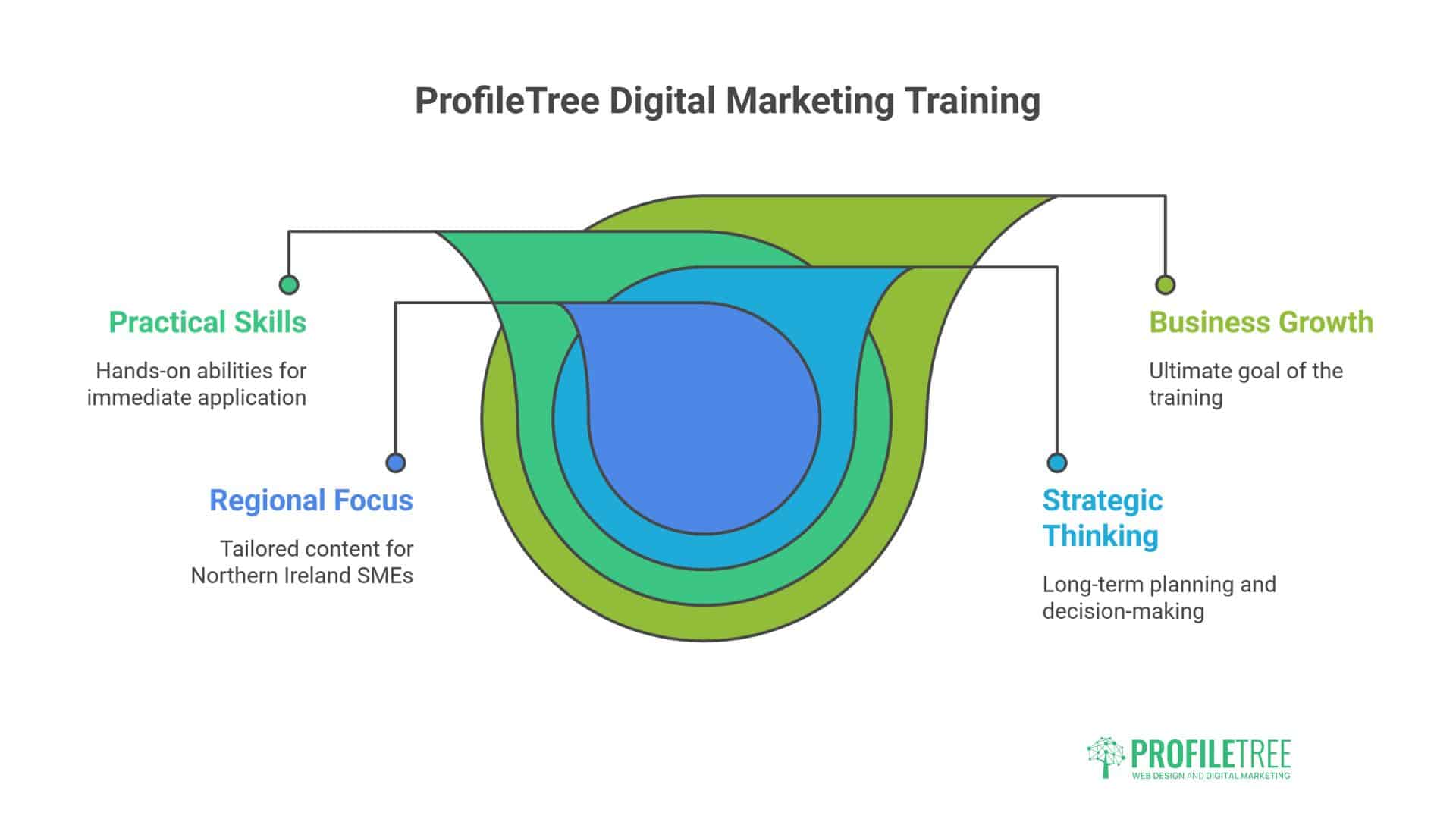
ProfileTree designs digital marketing training specifically for Northern Ireland SMEs, addressing the unique challenges and opportunities facing regional businesses. Our programmes combine practical skills development with strategic thinking, ensuring participants can immediately apply learning to their business contexts.
Web Design and Development Training
Our training covers website fundamentals crucial for effective digital marketing. Participants learn how websites should be structured for user experience and search engine visibility. This includes understanding responsive design principles, mobile optimisation, page speed factors, and accessibility standards.
Business owners gain insight into WordPress, the platform powering most SME websites. Training demystifies content management, basic customisation, and maintenance tasks requiring external support. This knowledge allows for more agile website updates and better collaboration with development professionals when needed.
Critically, our approach emphasises websites as business tools rather than digital brochures. Training participants learn to build websites focused on ranking in search results, generating traffic, capturing leads, and driving sales—the metrics that determine business outcomes.
Search Engine Optimisation Skills
SEO training forms a core component of our programmes, reflecting the importance of search visibility for business growth. Participants learn local SEO for targeting Northern Ireland customers and broader organic search strategies for reaching the UK and Irish markets.
Training covers keyword research relevant to specific industries, on-page optimisation techniques, content creation for search intent, link building fundamentals, and performance measurement. Business owners leave equipped to improve their search rankings independently or brief SEO specialists more effectively.
Local SEO training proves particularly valuable for Northern Ireland SMEs serving regional markets. Participants learn to optimise Google Business Profiles, build local citations, encourage customer reviews, and create location-specific content that captures searches with geographic intent.
Content Marketing and Strategy Development
Content marketing training moves beyond basic blogging to a comprehensive content strategy. Participants learn audience research methods, content planning frameworks, format selection, distribution tactics, and performance analysis.
Video production training addresses a growing marketing priority. Business owners learn scripting, filming with accessible equipment, basic editing, YouTube optimisation, and video distribution across social platforms. This practical approach produces immediate results, with participants often publishing their first videos during training programmes.
Animation training introduces another content format, gaining traction for explaining complex services or products. While full animation production requires specialist skills, our training helps businesses plan animated content, effectively brief designers, and understand where animation offers advantages over live video or static content.
AI Implementation for Marketing Efficiency
ProfileTree specialises in introducing AI tools to SMEs, where many Northern Ireland businesses lag behind competitors. Our AI training focuses on practical applications rather than theoretical concepts, showing business owners how to implement AI tools immediately.
Training covers AI for content creation assistance, social media scheduling and analytics, customer service chatbots, email marketing personalisation, and data analysis. Critically, we address AI ethics and quality control, ensuring businesses use these tools to enhance rather than replace human creativity and judgement.
For SMEs with limited marketing resources, AI implementation offers significant efficiency gains. Tasks that previously consumed hours—such as social media content scheduling, basic graphic design, or email campaign personalisation—become manageable with AI assistance, allowing business owners to focus on strategy and customer relationships.
Digital Marketing Strategy Sessions
Beyond tactical skills, our training emphasises strategic thinking. Participants work through frameworks for setting marketing objectives, identifying target audiences, selecting appropriate channels, allocating budgets, and measuring success.
Strategy sessions address common SME challenges, such as competing with larger businesses, differentiating in crowded markets, building brand recognition with limited budgets, and balancing immediate sales needs with long-term brand building. Business owners leave with customised strategies reflecting their specific circumstances rather than generic best practices.
This strategic component distinguishes our training from purely technical courses. While skills matter, knowing which skills to apply, when, and why determines marketing effectiveness. Our programmes develop this strategic judgement alongside practical capabilities.
Funding Support and Accessibility
The research identified funding as the primary enabler for SME training participation. ProfileTree works closely with local councils and business support organisations to make training accessible regardless of business size or financial resources.
Various funding mechanisms support digital marketing training in Northern Ireland:
Local Council Support: Many councils offer business development grants covering training costs. These schemes typically require businesses to demonstrate training relevance to growth plans and commit to implementing learning.
Skills Development Initiatives: Government-backed programmes periodically offer subsidised or fully-funded training for specific sectors or businesses. These schemes respond to identified skills gaps within the regional economy.
Business Support Organisations: Groups such as local chambers of commerce, business associations, and sectoral bodies sometimes arrange group training at reduced rates or provide bursaries for member businesses.
Apprenticeship Levy: Larger SMEs paying into the apprenticeship levy can redirect funds toward employee training, including digital marketing skills development.
Business owners seeking training should first explore these funding options. ProfileTree maintains current knowledge of available schemes and can guide businesses toward appropriate support mechanisms. This reduces financial barriers and ensures training investment delivers maximum value.
Practical Implementation After Training
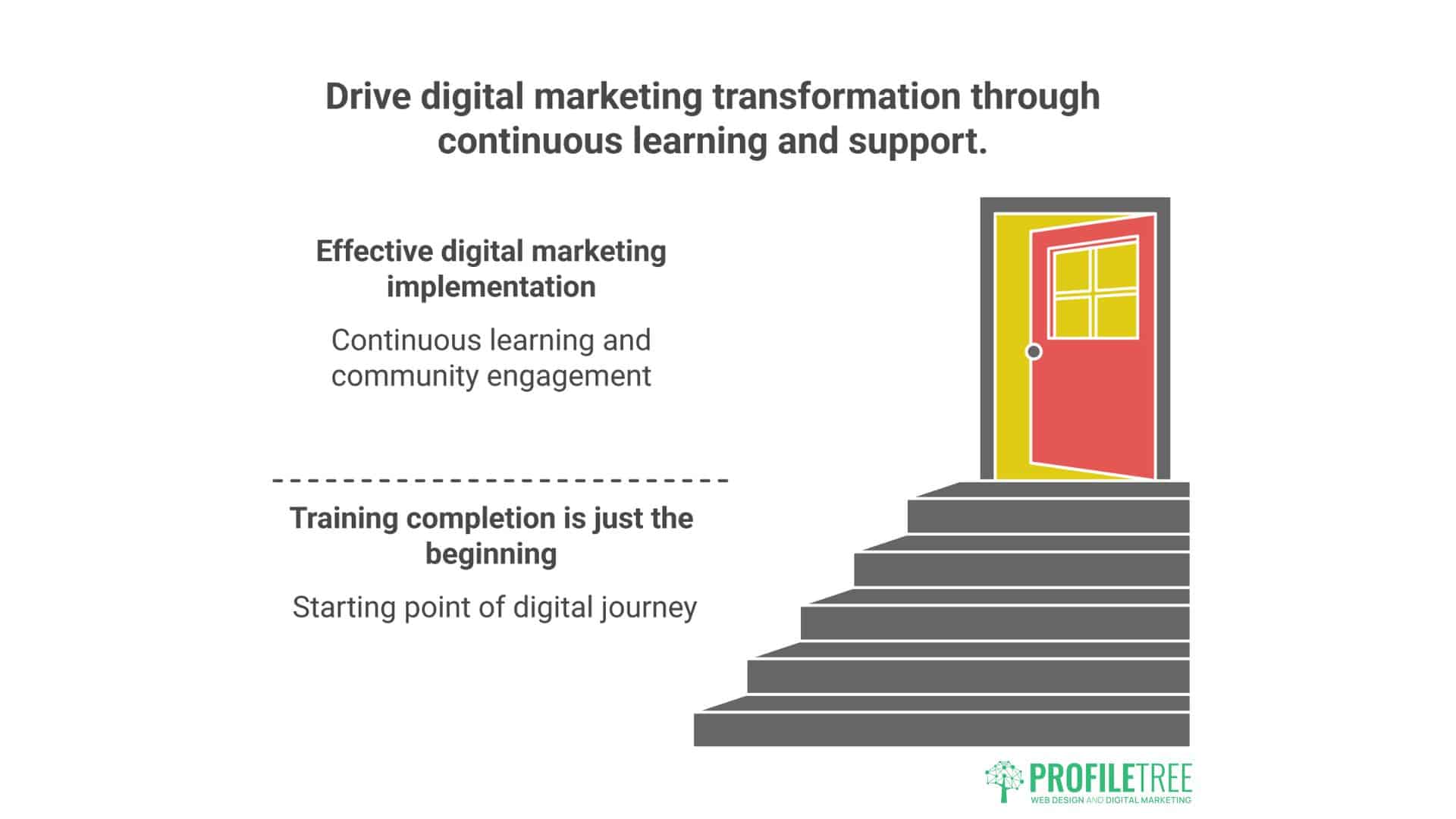
Training completion represents the beginning rather than the end of digital marketing transformation. The research found that successful implementation requires ongoing support, community connection, and continued learning.
Building Digital Marketing Routines
Trained SMEs benefit from establishing consistent digital marketing routines. These might include weekly content planning sessions, daily social media engagement windows, monthly analytics reviews, and quarterly strategy assessments. Routine creation embeds new skills into business operations rather than treating digital marketing as an occasional activity.
Business owners report that scheduled marketing time prevents digital activities from being perpetually postponed for more urgent operational demands. Blocking specific hours for marketing work, as one would schedule important meetings, ensures consistent effort that compounds over time.
Networking Within Northern Ireland’s Digital Community
The research highlighted the value of networking in maintaining momentum after training. Northern Ireland hosts digital marketing meetups, business networking events, and online communities where SME owners share experiences, challenges, and successes.
ProfileTree encourages training participants to engage with these networks. Peer learning and mutual support help businesses navigate implementation challenges, discover new opportunities, and maintain motivation during difficult periods. Community connection also facilitates partnerships, referrals, and collaborative marketing opportunities.
Continuous Learning and Skill Development
Digital marketing evolves rapidly, with new platforms, algorithm updates, and consumer behaviour shifts requiring ongoing adaptation. The research found that successful SMEs treat initial training as a foundation for continuous learning rather than complete education.
ProfileTree offers advanced modules and refresher sessions addressing new developments. Business owners also benefit from following industry publications, attending webinars, and experimenting with emerging platforms and techniques. This learning mindset distinguishes businesses that sustain competitive advantage from those whose digital marketing stagnates.
Measuring Progress and Adjusting Approaches
Trained businesses learn to establish baseline metrics before implementing new strategies, then track progress systematically. This data-driven approach allows objective assessment of what works and what requires adjustment.
Key metrics vary by business type and objectives, but typically include website traffic volumes and sources, conversion rates, customer acquisition costs, social media engagement rates, email open and click rates, and ultimately revenue attributed to digital marketing efforts. Regular measurement prevents wasted effort on ineffective tactics whilst doubling down on successful approaches.
Taking Action on Digital Marketing Training
The research demonstrates that digital marketing training delivers measurable benefits for Northern Ireland SMEs—improved marketing effectiveness, entrepreneurial confidence, and innovation capacity that translate to sales growth, customer acquisition, and lead generation.
For business owners and decision-makers, digital marketing skills development represents a strategic investment rather than a discretionary expense. The businesses studied reported tangible returns through improved performance and growth.
ProfileTree continues to develop training programmes addressing evolving digital marketing challenges. Our focus remains on practical, immediately applicable skills that Northern Ireland SMEs can implement regardless of business size or sector. By combining web design, SEO, content marketing, AI implementation, and digital training expertise, we equip businesses to compete effectively in increasingly digital markets.
Digital marketing capability is becoming increasingly critical for business success. Northern Ireland SMEs that invest in these skills position themselves advantageously against competitors who delay digital transformation. The research proves that businesses with minimal digital presence can innovate their marketing and achieve meaningful commercial results with appropriate training support.
FAQs
How does digital marketing training improve SME innovation?
Training provides SMEs with knowledge, skills, and confidence to experiment with new marketing approaches. Rather than relying on familiar but outdated tactics, trained business owners test different channels, content formats, and engagement strategies. This experimentation culture drives innovation in how businesses attract, convert, and retain customers. Training also exposes participants to case studies and examples from other industries, sparking ideas adaptable to their contexts.
What digital marketing skills matter most for Northern Ireland SMEs?
Search engine optimisation, content marketing, social media management, and basic web analytics are most SMEs’ core skillset. Local SEO proves particularly valuable for businesses serving Northern Ireland markets, helping them appear in local search results. Video content creation increasingly matters as consumers prefer visual formats. Email marketing skills remain relevant for customer retention and repeat business. The priority depends on business type, target audience, and digital maturity.
How long does it take to see results from digital marketing training?
Initial improvements often appear within weeks, particularly for businesses with a minimal digital presence. Quick wins include improved website functionality, more consistent social media posting, and a better understanding of existing analytics. Substantial business impact—such as significant traffic increases, lead generation improvements, or measurable sales growth—typically emerges over three to six months as trained business owners implement strategies consistently.
Can small businesses compete digitally with larger companies?
Absolutely. Digital channels actually level the competition in many ways. SMEs can often move more quickly than large competitors, testing new platforms and responding to market shifts with agility. Content marketing allows smaller businesses to demonstrate expertise and build authority without massive budgets. Local SEO helps SMEs dominate specific geographic markets regardless of competitor size. The key lies in strategic focus—targeting particular niches, customer segments, or geographic areas rather than competing broadly.