
Social Media Detox: How to Step Back and Feel Better
Table of Contents
A social media detox means deliberately stepping away from social platforms for a set period, whether that’s 24 hours, a week, or longer. People take them to reduce stress, break compulsive scrolling habits, and reclaim time for things that matter more. If you’ve noticed that opening Instagram or X leaves you feeling worse than when you started, you’re not imagining it. The research on social media and self-esteem is fairly consistent on that point.
This guide covers what a social media detox actually involves, the signs that you need one, and practical steps to make it stick. It also covers what businesses and marketers should understand about social media fatigue among their audiences.
What Is a Social Media Detox?
A social media detox is a conscious break from social media platforms. That typically means removing the apps from your phone, logging out of accounts, and going a set number of days without checking feeds, stories, or notifications.
It’s different from a social media break in one key way. A break usually means stepping away from specific platforms, perhaps muting Twitter for a few days while staying active on LinkedIn. A detox involves cutting off all social media use for the duration you’ve set yourself.
How Long Should a Social Media Detox Last?
There’s no universal answer. Seven days is long enough to notice a real change in your habits and mood without feeling like an unrealistic commitment. Thirty days gives you enough time to build new routines in place of the time you’d normally spend scrolling.
If a full detox feels too drastic, time-limited restrictions work well. Blocking social apps before 9am and after 9pm, or removing them from your phone while keeping desktop access only, are both practical ways to reduce compulsive use without going cold turkey. Starting with a partial social media detox is a legitimate approach; the important thing is that you’re making a deliberate choice rather than defaulting to whatever the app wants you to do.
What Counts as Social Media?
Instagram, TikTok, Facebook, X (formerly Twitter), LinkedIn, Snapchat, Pinterest, Reddit, and YouTube all qualify. Messaging apps like WhatsApp and Telegram sit in a grey area; many people keep those running during a detox because they serve a genuine communication function rather than passive consumption.
The test is simple: does the platform primarily exist to show you other people’s content in a feed? If yes, it counts.
Why People Take a Social Media Detox
Understanding why social media affects people the way it does makes it easier to decide whether a break is worth taking.
The Comparison Problem
Social media presents a highly edited version of other people’s lives. Researchers have consistently linked heavy use to increased social comparison, particularly among younger users. When you scroll through a feed of achievements, holidays, and filtered photographs, you’re measuring your everyday reality against everyone else’s highlight reel. That’s a comparison that rarely favours you.
The data on social media isolation statistics shows that platforms designed to connect people can end up making individuals feel more alone. That’s partly a structural problem; the more time people spend engaging with curated content online, the less time they spend in direct, reciprocal human contact.
Dopamine and the Scroll Loop
Social platforms are built around variable reward mechanisms, the same psychological principle that makes slot machines difficult to walk away from. Pulling down to refresh a feed, checking for new likes on a post, opening an app to see whether anything has changed: these are all examples of variable reward behaviour. The reward is unpredictable, which makes the checking compulsive.
When a post gets positive engagement, dopamine is released. The brain logs that as a rewarding experience and prompts you to repeat the behaviour. This is not accidental; it’s the product of years of design work by teams of engineers, psychologists, and behavioural scientists employed specifically to increase time-on-platform.
The knock-on effect is documented in time spent on social media statistics: average daily use continues to rise year on year, even as people report feeling worse for it.
The Attention Drain
Constant notification interruptions fragment your attention. Research on attention span statistics in the digital age suggests that frequent context-switching, jumping between a task and a phone notification, makes sustained focus increasingly difficult over time. A social media detox removes the most frequent source of that interruption.
Privacy Concerns
For some people, a detox is a deliberate response to growing awareness of how personal data is collected and used. Social platforms track far more than most users realise: location data, browsing behaviour outside the app, purchasing patterns, and even the content of private messages on some platforms. Stepping away, even temporarily, reduces the data trail you’re generating. Mental health charity Mind offers guidance on managing your relationship with social media if privacy anxiety is part of what’s driving your discomfort.
Signs You Might Need a Social Media Detox
Most people don’t decide to take a detox from a position of calm reflection. Something pushes them to it. Here are the most common signs that your relationship with social media has tipped from useful to draining.
You Check Your Phone First Thing in the Morning
If the first thing you do after waking up is check a social media app, that’s a habit that’s running on autopilot. The content you consume in the first 20 minutes of your day shapes your mood and mental state for hours afterwards. Starting with a feed of news, opinions, and other people’s activity is rarely a good foundation for the day ahead.
Scrolling Leaves You Feeling Worse
This is the clearest indicator. If you consistently open an app feeling neutral and close it feeling anxious, irritable, or inadequate, that’s a signal worth taking seriously. The American Psychological Association has published extensive research linking heavy social media use to increased rates of anxiety and depression, particularly in adolescents and young adults.
You Feel Competitive About Your Content Performance
Checking follower counts, obsessing over engagement rates, or feeling deflated when a post underperforms: these are signs that the platform’s reward mechanisms have taken hold. For individuals who don’t manage social accounts professionally, this kind of performance anxiety serves no useful purpose.
You Can’t Get Through a Meal or Conversation Without Checking
If social media is intruding on time that should be spent on other things, such as eating, spending time with people you care about, or getting work done, it has moved from a tool to a compulsion.
What Happens to Your Mind and Body During a Social Media Detox
People who complete even a short social media detox consistently report similar patterns. Within the first 24 to 48 hours, most people experience a strong urge to check their phone, particularly during moments of boredom or transition: waiting for something, finishing a task, waking up. That urge tends to peak around day two or three, then diminish.
Sleep Improvements
One of the most commonly reported benefits is better sleep. Blue light from screens suppresses melatonin production, making it harder to fall asleep. The content itself is arguably more disruptive than the light: emotionally activating posts, heated comment threads, and algorithmically-served outrage content prime the nervous system for alertness rather than rest. Removing that input in the hour before bed tends to reduce the time it takes to fall asleep and improve overall sleep quality.
Improved Focus and Reduced Anxiety
Within a week, many people find that their ability to concentrate on a single task for an extended period improves noticeably. The nervous system is no longer being interrupted by a constant stream of micro-stimulation. Anxiety levels often drop too, particularly for people whose pre-detox use involved frequent checking of notifications or their own post-performance metrics.
A Shift in How You Measure Your Day
This is one of the more interesting psychological changes a social media detox can produce. When the constant external feedback loop of likes, comments, and shares disappears, some people find it disorienting at first. Without those external signals, they have to find other ways to gauge how their day went. Most people report that this eventually produces a more grounded sense of their own time and worth.
How to Do a Social Media Detox: Step by Step
The mechanics are straightforward. The difficulty is psychological, so the preparation matters as much as the execution.
Start Small: A 12-Hour Experiment
If the idea of a week-long detox feels too daunting, start with 12 hours. Delete the apps from your phone (not your accounts, just the apps) from, say, 7pm one evening to 7am the following morning. Notice what you reach for your phone for during that window. Notice whether you feel any different when you wake up without having scrolled before bed. That small experiment gives you real data about your own habits before you commit to something longer.
Remove the Apps, Not Just the Accounts
Keeping the app installed while telling yourself you won’t open it relies entirely on willpower. Remove the apps from your phone so that accessing social media requires a deliberate action rather than a reflexive tap. You can always reinstall them when the detox period ends. The friction of having to reinstall is usually enough to prevent casual use.
Tell Someone
Accountability helps. Tell a friend or family member that you’re taking a detox and for how long. Let them know they can still reach you by phone or message. Externalising the commitment makes it more real and gives you someone to check in with if you’re finding it difficult.
Replace the Time With Something Specific
Detox attempts fail most often when people remove social media without replacing it with anything. The time and the habit are still there; they just have no outlet. Plan what you’ll do instead. Reading, walking, cooking, calling a friend, working on a personal project: any activity that involves genuine engagement rather than passive consumption is a worthwhile replacement. The goal isn’t to eliminate downtime; it’s to make downtime feel restorative rather than draining.
Use Screen Time Controls as a Backup
Both iOS Screen Time and Android Digital Wellbeing allow you to set daily limits per app or category. Set social media apps to zero during your detox period and use a passcode (known to someone else if you don’t trust yourself to bypass it) to prevent overrides. These tools don’t replace intention, but they reduce the temptation for impulsive use.
Don’t Count the Days, Fill Them
People who tick off days on a calendar until they can get back to their phone are doing a fast, not a detox. The objective is to build a new relationship with your attention, not to survive a countdown. If you’re spending the time thinking about what you’re missing, try redirecting that energy into the replacement activities you’ve planned.
After the Detox: Returning to Social Media Differently
A detox is only worthwhile if it changes something about how you use social media when you return. Otherwise, it’s a temporary interruption rather than a genuine reset.
Set Clear Rules Before You Return
Decide in advance what “healthy use” looks like for you. That might mean checking platforms at set times rather than continuously, turning off all notifications, removing apps from your phone and accessing platforms only from a desktop, or unfollowing accounts that consistently make you feel worse. Write the rules down before you reinstall the apps.
Audit What You Follow
Use the return from your detox as an opportunity to be selective about what you follow. If an account consistently produces content that triggers comparison, anxiety, or outrage, unfollow it. You’re not obligated to consume content that doesn’t serve you.
Ciaran Connolly on Intentional Social Media Use
[DRAFT FOR APPROVAL] Ciaran Connolly, founder of Belfast digital agency ProfileTree, notes that the businesses he works with get far better results from social media when they approach it with a clear purpose: “The SMEs that struggle most with social media are usually those who feel they have to be on every platform, posting constantly. The ones that do well have made deliberate decisions about where their audience actually is and what they want to say. That same thinking applies to personal use. Intention beats volume every time.”
Social Media Detox for Businesses and Marketers
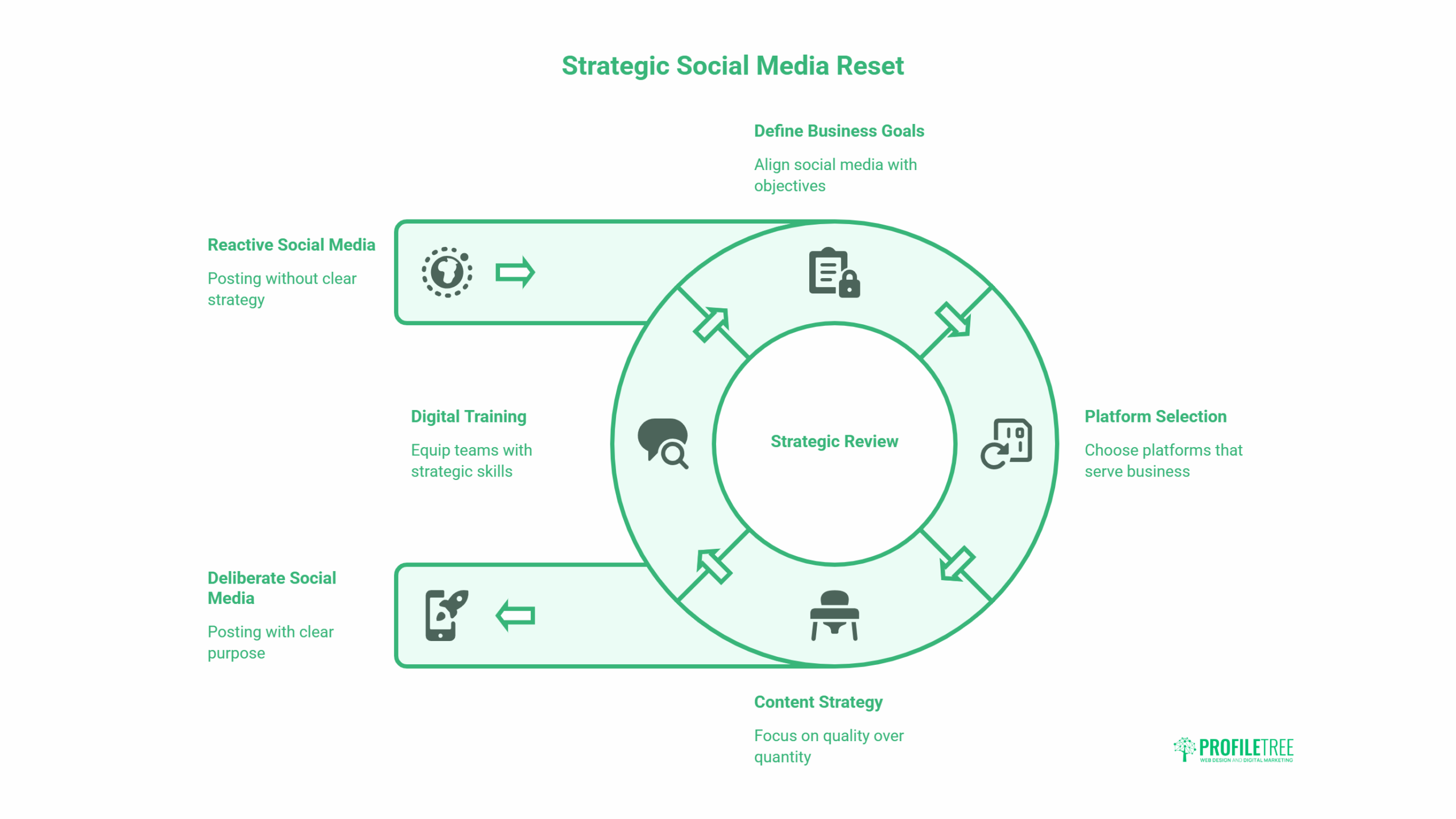
If you manage social media professionally, a personal detox is one thing; a strategic review of your brand’s social presence is another. But the underlying question is similar: are you getting a genuine return from the time and resource you’re putting in?
When Your Brand Might Need a Reset
If your social media activity has become reactive rather than strategic, posting to avoid going quiet rather than to deliver something of value, that’s a signal worth acting on. A planned pause combined with a strategic review often produces better long-term results than continued low-quality output.
ProfileTree’s social media marketing team works with SMEs across Northern Ireland and the UK to build social strategies that are deliberate rather than compulsive. That involves deciding which platforms actually serve the business, what content format fits the audience, and what success looks like beyond follower counts.
Content Quality Over Content Volume
The shift from quantity to quality in social content reflects the same principle behind a personal detox. Fewer, better posts consistently outperform daily content that has nothing useful to say. A clear digital strategy sets the parameters for what you publish and why, which removes the compulsion to fill the calendar for its own sake.
Producing content that actually serves your audience rather than just occupying their feed is the job of a considered content marketing approach. That means knowing what questions your potential customers are asking, what format is most useful for answering them, and what action you want people to take after engaging with your content.
Digital Training for Teams
For marketing teams, understanding why social media platforms are designed to maximise engagement at the expense of user wellbeing is professionally useful, not just personally relevant. ProfileTree’s digital training programmes cover social media strategy, content planning, and platform literacy for business teams who want to use these tools deliberately rather than reactively.
The NHS mental wellbeing guidance also covers screen time and social media as part of broader mental health management, which is worth sharing with teams who manage high-volume social accounts.
Frequently Asked Questions
How long should a social media detox last?
For most people, seven days is a good starting point. It’s long enough to break the automatic habit of reaching for your phone and to notice how your mood and focus change without constant social input. Thirty days is more effective at producing lasting change in habits. If a full detox feels unmanageable, starting with 12-hour windows at the beginning and end of the day is a practical alternative that still produces noticeable results.
Is a social media detox actually good for mental health?
The evidence suggests yes, particularly for people who are heavy users and who already notice negative emotional responses after using social platforms. Research published by the American Psychological Association consistently links reduced social media use to lower levels of anxiety, better sleep, and improved mood. The benefits are most pronounced when the detox is accompanied by deliberate replacement activities rather than simply leaving a void.
Do I have to delete my accounts to do a social media detox?
No. Deleting apps from your phone while keeping your accounts active is sufficient for most people. If you’re worried about logging in via a browser, you can change your password to something random and store it somewhere inconvenient, or ask a trusted person to hold it temporarily. Full account deletion is an option, but most detox benefits come from changing your access patterns rather than permanently leaving platforms.
How do I stop going back to social media during a detox?
Remove the apps from your phone rather than relying on willpower. Use your device’s built-in screen time controls to block access as a backup. Tell someone you’re detoxing so there’s an accountability factor. Most importantly, have a specific plan for what you’ll do with the time you’d normally spend scrolling. Boredom is the most common reason people abandon a detox early; if you’ve pre-planned your replacement activities, the urge to reach for social media has fewer opportunities to win.
What’s the difference between a social media detox and a digital detox?
A social media detox specifically targets social platforms: Instagram, TikTok, Facebook, X, LinkedIn, and similar sites. A digital detox is broader and may include stepping back from all screens, including television, streaming services, and general internet browsing. Most people find a social media detox more achievable because it targets the most compulsive usage patterns without eliminating tools that are genuinely useful for work or communication.
Can businesses benefit from a social media reset?
Yes. Businesses that post reactively, without a clear strategy or defined purpose, often see diminishing returns from their social media investment. A planned pause combined with a strategic review of which platforms to use, what content to produce, and how to measure success can significantly improve the return on effort. This is distinct from a personal mental health detox, but the underlying principle of intentionality over compulsion applies in both contexts.