
Customer Win-Back Strategies: Re-engaging Lost Customers
Table of Contents
Losing a customer is rarely the end of the conversation. For most SMEs across Northern Ireland, Ireland, and the UK, the question is not whether to pursue lapsed customers, but how to do it in a way that is worth the effort and avoids the most common mistakes.
Customer win-back strategies are the structured programmes businesses use to re-engage customers who have stopped buying, gone quiet, or switched to a competitor. Done well, they are among the most cost-effective marketing activities available. According to research published by Bain & Company, a 5% increase in customer retention can increase profits by 25% to 95%. Harvard Business Review has reported that acquiring a new customer costs five to 25 times more than retaining an existing one, depending on the industry.
Yet most businesses treat win-back as an afterthought: a “we miss you” email sent to everyone who hasn’t purchased in six months. That approach rarely works. What does work is a structured, data-led system that identifies the right customers to pursue, deploys the right messages through the right channels, and tracks what is actually bringing people back.
This guide covers six proven customer win-back strategies for SMEs, the legal framework UK and Irish businesses need to follow, and the digital infrastructure that makes these campaigns repeatable rather than one-off.
Why Most Win-Back Campaigns Fail
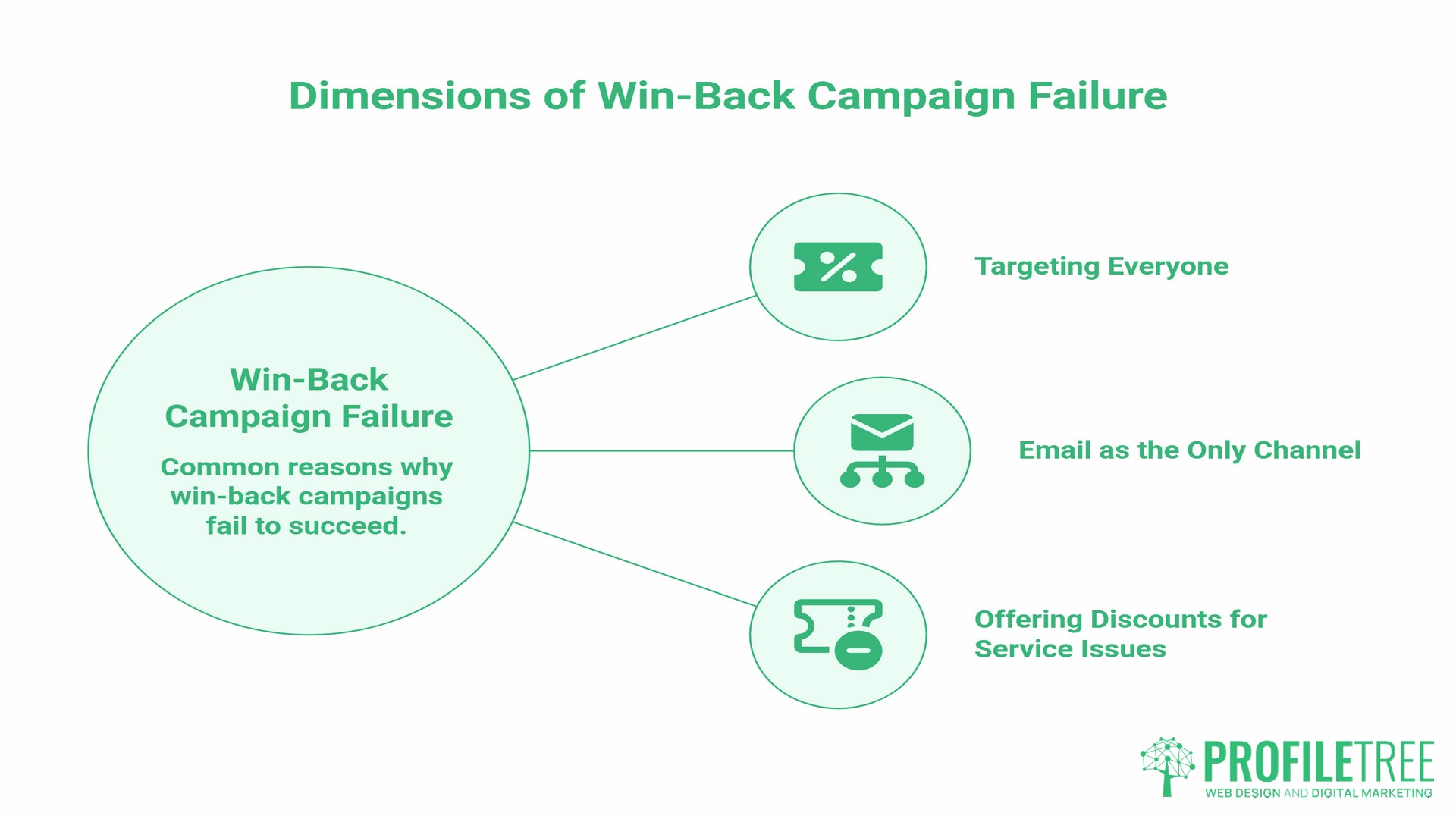
The most common failure is targeting everyone. When a business exports its full lapsed customer list and sends the same discount offer to all of them, it burns marketing budget on customers who left for good reasons, flags its domain as a spam risk, and trains its own audience to ignore re-engagement messages.
The second most common failure is treating email as the only channel. Email is central to most customer win-back strategies, but a customer who never opened your last 12 newsletters will not suddenly open a “come back” message. Multi-channel campaigns that combine email, social retargeting, direct outreach, and content consistently outperform single-channel customer win-back strategies.
The third failure is offering a discount when the customer left because of a service problem. If someone stopped working with an agency because projects kept running late, a 20% reduction does not address the issue. Understanding why customers left is a prerequisite for deciding how to approach them.
Segmenting Your Churned Customers: Who Is Worth Pursuing?
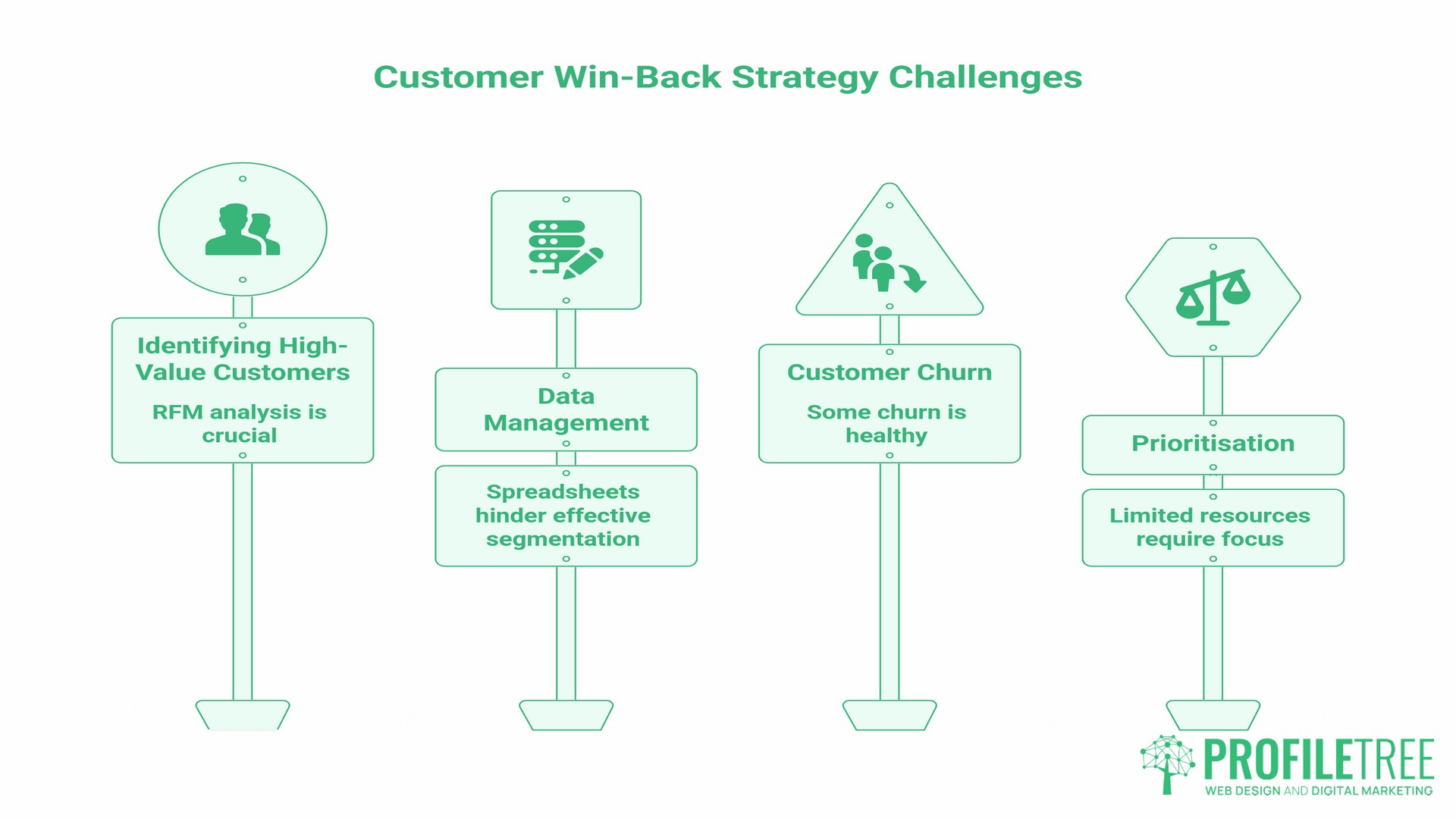
Not every lapsed customer is a win-back candidate. One of the most important decisions in any set of customer win-back strategies is choosing who to target in the first place. Attempting to recover all of them wastes resources and can damage your reputation with customers who left intentionally.
Identifying High-Value Inactive Customers
The most useful segmentation model for service businesses is RFM analysis: Recency, Frequency, and Monetary value.
- Recency: How recently did the customer last engage with your business?
- Frequency: How often did they use your services or buy from you?
- Monetary value: What was their total spend, and what was their likely future value?
Customers who score highly across all three, but went quiet within the last 12 months, are your primary win-back targets. Customers who had a low spend, engaged infrequently, and left over two years ago are rarely worth the campaign investment.
Your CRM data is the starting point for this analysis. If that data is currently sitting in spreadsheets rather than a structured system, building a proper customer segmentation framework is the necessary first step before any win-back campaign can run effectively.
When to Let a Customer Go
Some churn is healthy. A customer who was consistently late paying, generated disproportionate support requests, or left negative feedback that was never resolved is not someone you want back at any cost.
A useful test: if that customer re-engaged tomorrow at the same price and with the same behaviours, would it be a net positive for your business? If the answer is no, remove them from your win-back list and redirect that budget toward customers with genuine long-term potential.
This is one of the gaps in most published guides on customer win-back strategies: they assume every lapsed customer is worth pursuing. For SMEs with limited marketing resources, prioritisation is not optional.
6 Proven Customer Win-Back Strategies for SMEs
1. Data-Driven Email Automation and Personalisation
Email remains the most cost-effective channel for customer win-back strategies, but the difference between a campaign that works and one that doesn’t comes down to segmentation and sequencing.
A basic win-back email sequence for a service business might run over five weeks:
- Week 1: A soft re-engagement message acknowledging the gap and highlighting what has changed or improved in your offering since the customer last worked with you. No hard sell.
- Week 2: A value-led message: a useful guide, case study, or insight relevant to the customer’s industry or the challenge they originally came to you with.
- Week 3: A direct message acknowledging they may have had concerns and offering a conversation to address them.
- Week 4: A specific, time-limited offer or added value (an audit, a complimentary review, an extended service period) rather than a blanket discount.
- Week 5: A final message that closes the loop. If there is no response after this, move the contact to a long-term nurture list rather than continuing active win-back outreach.
Personalisation beyond the customer’s name makes a real difference. Variable content blocks that reference the specific service they previously used, or the industry they work in, significantly improve engagement rates compared to generic messaging. For guidance on the mechanics of setting this up, automated email sequences can be configured within most modern CRM and email platforms.
2. Strategic Content as the Re-engagement Tool
One of the gaps in most customer win-back guidance is the assumption that re-engagement always means an offer or discount. For B2B businesses and higher-ticket service providers, leading with useful content is often more effective and avoids devaluing your brand.
A Belfast-based accountancy firm, for example, might re-engage lapsed clients not with a promotional offer but with a relevant guide to changes in HMRC reporting requirements. A digital agency might re-engage former clients with a practical breakdown of how website performance standards have shifted and what that means for their organic visibility.
This approach works because it re-establishes your authority and relevance before making any ask. It also gives the customer a reason to engage that is not dependent on them being in a buying mindset at that exact moment. ProfileTree’s content marketing services are built around exactly this principle: content that earns attention rather than demanding it.
3. Video for High-Value B2B Win-Back
For high-ticket accounts or long-standing former clients, a personalised video message from an account manager or senior team member outperforms any written communication. It is harder to ignore, harder to dismiss as automated, and it demonstrates a level of effort proportionate to the value of the relationship.
This does not require a full production budget. A short, well-framed video recorded directly in a CRM tool or sent via LinkedIn is sufficient for personalised outreach. For broader re-engagement campaigns, a professionally produced short video that speaks directly to the challenges your lapsed customers are likely facing can anchor an email sequence and considerably improve click-through rates.
ProfileTree’s video production services help businesses build video assets that work across multiple channels, including retention and win-back campaigns.
4. Direct Outreach for High-Value B2B Accounts
For clients who represented significant revenue, a personal phone call or LinkedIn message from a senior contact is almost always worth more than any automated sequence. This is not about scripts or hard selling. It is about reconnecting as a professional, acknowledging the gap, and finding out where the customer is now.
The conversation should be curiosity-led: what have they been working on, what challenges are they navigating, and where is their business heading? Win-back is rarely a single touchpoint for B2B relationships. It is a reactivation of a professional relationship, and it takes time.
LinkedIn is the most appropriate platform for this kind of outreach in a professional services context. Engaging with a former client’s content, congratulating them on a milestone, or sharing something directly relevant to their industry before making any direct approach is often more effective than a cold message.
5. Incentive Layering: Value Before Discounts
The instinct to offer a discount is understandable, but it creates a problem: it signals that your pricing was inflated, and it trains customers to wait for a reduction before buying. For service businesses, especially, blanket discounting can undermine the pricing integrity you have spent time establishing.
A more considered approach is incentive layering: starting with value additions rather than price reductions. This might mean offering a free audit, a complimentary review session, an extended support period, or early access to a new service. If a price-based incentive is appropriate, tiering it against a commitment (a reduced rate for a six-month contract rather than a one-off purchase) protects margin while still creating a reason to re-engage.
The general principle: the first incentive you offer should make the customer feel valued, not discount-hunted.
6. The Exit Survey and Feedback Loop
The single most underused tool in customer win-back strategies is simply asking why the customer left. An exit survey, sent within 30 days of a customer becoming inactive or cancelling, generates two things: the intelligence needed to improve your service, and an opportunity to address specific concerns before the relationship has fully lapsed.
Keep exit surveys short: three to five questions, with at least one open text field. The questions that yield the most useful information are:
- What was the main reason you stopped working with us?
- Was there a specific moment where your expectations were not met?
- What would need to change for you to consider working with us again?
The responses inform not just win-back campaigns but broader service improvements. A pattern of similar answers across multiple lapsed customers points to a systemic issue worth addressing. Understanding why customers leave is the prerequisite for effectively winning them back.
The Legal Framework: GDPR and PECR in UK Win-Back Campaigns
This section is absent from most published guides on customer win-back strategies because the majority are written for the US market. For businesses operating in the UK and Ireland, it is not optional reading.
Under GDPR and the Privacy and Electronic Communications Regulations (PECR), you cannot simply email all lapsed customers because you once had their details. The rules that govern whether you can contact them depend on how they were originally added to your list and how long ago they last engaged.
Note: PECR has been updated by the Data (Use and Access) Act 2025, which received Royal Assent on 19 June 2025. The ICO’s full updated guidance reflecting the Act is expected later in 2026. The core rules below reflect the current ICO position as published.
The key principles:
- Soft opt-in applies when a customer has given you their email in the course of purchasing a product or service, and you are contacting them about similar products or services. Under the ICO’s published guidance, this is the most common basis for B2C win-back emails. You must also have given the customer a clear opportunity to opt out when you first collected their details, and in every subsequent message.
- Legitimate interest can apply in B2B contexts where you are emailing a corporate subscriber (such as a limited company email address), but it requires a documented balancing test and does not remove the need to provide a clear opt-out mechanism.
- Consent is required for electronic marketing to individuals where neither of the above applies. Contacts who have been dormant for an extended period should be reviewed before inclusion in any campaign.
- Unsubscribed contacts must never be included in win-back sequences, regardless of their previous value to the business. The ICO advises maintaining a suppression list rather than deleting unsubscribed contacts, to prevent accidental re-addition.
For businesses unsure about the compliance position of their contact database, a data audit before launching any win-back campaign is strongly advisable. ProfileTree’s guide to GDPR-compliant web forms and data collection covers some of the underlying principles in plain language.
Technical Execution: CRM, Automation, and the Digital Infrastructure
The businesses that run customer win-back strategies effectively are not doing it manually. They have a CRM that captures customer activity, an email platform integrated with it, and automated workflows that trigger the right message at the right time without anyone having to remember to send it.
The typical technical stack for an SME running structured win-back campaigns includes:
- A CRM that tags customers by last activity date, spend, and service type
- An email automation platform that triggers sequences based on inactivity thresholds
- A social retargeting integration that shows relevant paid content to lapsed customer segments
- A feedback tool for exit surveys
Setting this up requires an initial investment of time and, in many cases, professional support. But the return is a system that runs continuously rather than a campaign that requires effort each time. For SMEs interested in understanding what marketing automation looks like in practice, business automation statistics provide useful context on adoption rates and outcomes.
“The businesses we see running the most effective win-back campaigns are the ones that treated it as a system rather than a campaign. They set up the triggers, built the sequences, and connected their email platform to their CRM. After that, the process runs itself, and they come back to optimise it rather than rebuild it every time,” says Ciaran Connolly, founder of ProfileTree.
Measuring Success: What to Track
Win-back rate is the primary metric: the percentage of lapsed customers you successfully re-engaged over a given period. The calculation is straightforward.
Win-back rate = (customers re-engaged / total lapsed customers targeted) × 100
Supporting metrics worth tracking:
- Cost per win-back: Total campaign spend divided by the number of customers re-engaged
- Lifetime value of recovered customers: Are the customers you win back staying and spending, or churning again quickly?
- Time to re-engagement: How many messages or touchpoints did it take before a customer responded?
- Churn reason by segment: Do customers who left for service reasons have a different win-back rate than those who left for price reasons?
Tracking these metrics across multiple campaigns allows you to refine your customer win-back strategies by adjusting trigger timing, testing different incentive types, or identifying which customer segments are genuinely worth pursuing.
Running a Multi-Channel Win-Back Campaign
The most effective customer win-back strategies coordinate across multiple channels rather than relying on a single channel. A practical structure for an SME:
| Channel | Role in the Sequence | Timing |
|---|---|---|
| Primary communication; sequences and educational content | Days 1, 7, 14, 21, 28 | |
| Paid social retargeting | Keeps your brand visible to lapsed customers between emails | Concurrent with email |
| LinkedIn (B2B) | Direct personal outreach for high-value accounts | Days 3-5 after no email response |
| Phone or video call | For highest-value accounts only | After two rounds of email and LinkedIn |
| Direct mail | For specific segments where physical mail has cut-through | Week 3 or 4 |
Consistency across channels matters. If a customer receives an email about a free audit and then sees a social ad offering a discount, the mixed message undermines both. Map the offer and the message before the campaign launches and hold to it across all touchpoints.
ProfileTree is a Belfast-based digital agency working with SMEs across Northern Ireland, Ireland, and the UK on web design, digital marketing strategy, content creation, and video production. To discuss building a structured customer retention programme for your business, contact the team.
FAQs
How do you calculate a win-back rate?
Divide the number of lapsed customers you successfully re-engaged by the total number of lapsed customers you targeted, then multiply by 100. For example, if you targeted 200 lapsed customers and 30 re-engaged, your win-back rate is 15%. Tracking this rate across campaigns over time is more useful than any single figure, as it shows whether your approach is improving.
What is the best time to start a win-back campaign?
The trigger point depends on your typical purchase or service cycle. For retail businesses with frequent transactions, 30 to 60 days of inactivity is a reasonable threshold. For service businesses with longer project cycles, 90 days is more appropriate. Starting too soon risks annoying active customers; waiting too long allows the relationship to cool past the point where re-engagement is realistic.
Is it legal to email inactive customers under GDPR?
It depends on the basis on which you originally collected their contact details. The soft opt-in rule under PECR allows you to email past customers about similar products or services, provided you gave them a clear opportunity to opt out when you first collected their details, and they have not unsubscribed. Contacts who have been dormant for an extended period should be reviewed before inclusion in any campaign. When in doubt, a re-permissioning campaign that explicitly asks customers to confirm they want to hear from you is the safest approach. PECR is currently under review following the Data (Use and Access) Act 2025; check the ICO website for the latest guidance before launching any campaign.
What makes a win-back email actually work?
The most effective win-back emails lead with a relevant, specific reason to re-engage rather than a generic “we miss you” message. Referencing the specific service a customer previously used, acknowledging a gap in communication, or sharing something directly useful to their situation, outperforms promotional copy. The subject line should be clear and specific, not clickbait.
How many emails should a win-back sequence include?
A five-email sequence over four to five weeks is a reasonable structure for most service businesses. Three emails are the practical minimum; more than six risks damaging your sender reputation and annoying customers who are clearly not interested. After the sequence ends with no response, move the contact to a long-term low-frequency nurture list rather than leaving them in an active campaign.
What role does AI play in customer win-back strategies?
AI tools within modern CRM and email platforms can identify at-risk customers before they formally lapse, suggest send times based on individual engagement history, and personalise content blocks at scale. For most SMEs, the practical starting point is not bespoke AI development but making full use of the automation and segmentation features already built into platforms such as HubSpot and Mailchimp. ProfileTree’s AI training and implementation services help SME teams understand what is genuinely applicable to their business rather than what is theoretically possible.