
SEO Training: A Practical Guide for Business Owners
Table of Contents
Search engine optimisation has one of the most obvious skills gaps in digital marketing. Businesses know they need it. They see competitors ranking above them. They just can’t quite work out whether to hire a specialist, train someone already on the team, or bring in outside expertise for a defined period.
This guide is written for SME owners and marketing managers working through that question. It covers what SEO training actually teaches in 2026, the main formats available, and how to decide which approach makes sense for your business.
What Does SEO Training Cover in 2026?
SEO has changed significantly over the past two years. Any training worth taking should reflect that. The core disciplines haven’t disappeared, but their relative importance has shifted, and a new layer around AI search has become essential.
On-Page SEO and Content Fundamentals
This covers how to structure a page so that search engines understand what it’s about and why it should rank. Title tags, meta descriptions, heading hierarchy, internal linking, and content depth are all covered here. The important shift in 2026 is that on-page SEO now includes understanding how Google’s AI Overviews extract content, which changes how you write introductions, structure sections, and answer questions within an article.
Good training will also cover what Google’s Helpful Content updates have penalised: thin content, AI-generated text published without editing, and pages that say nothing a searcher couldn’t find elsewhere. This matters for anyone managing a company blog or website.
Technical SEO
Technical SEO covers the foundations that allow a site to be found, crawled, and indexed properly. Core skills include page speed optimisation, mobile usability, structured data markup, XML sitemaps, and crawl budget management. Training should equip your team with the knowledge to identify technical issues and brief developers accurately, even if they won’t be implementing fixes themselves.
For SMEs, this typically means learning to use Google Search Console confidently, understanding what a site audit report is flagging, and knowing which technical problems are urgent versus cosmetic.
Local SEO
For businesses serving a defined geographic area, local SEO is often the highest-return discipline. Training covers Google Business Profile optimisation, local citation management, review acquisition, and structuring location-specific content. Northern Ireland businesses have a particular advantage here: the dual-market positioning created by the Windsor Framework means a Belfast business can make a credible case for visibility in both the UK and the Republic of Ireland markets, which cross-border competitors can’t easily replicate.
Off-Page SEO and Digital PR
Link acquisition, brand mentions, and third-party coverage all contribute to a site’s authority in search engines’ eyes. Training in this area covers outreach strategy, digital PR principles, and how to earn coverage from credible publications without resorting to paid link schemes that now carry genuine algorithmic risk. For UK businesses, this includes understanding ASA/CAP Code considerations in outreach campaigns and GDPR-compliant email prospecting.
AI Search and Generative Engine Optimisation
This is the newest discipline, and the one in which training programmes have been slowest to integrate. AI Overviews on Google and citations in tools like ChatGPT and Perplexity now drive genuine commercial traffic. The principles are different from traditional SEO: structured, self-contained content sections, entity clarity, and genuine expertise signals matter more than keyword density. Training should cover how to write content that AI systems cite, not just how to rank in organic results.
In-House Training Versus Off-the-Shelf Courses
The most common question businesses ask before investing in SEO training is whether to use an existing course platform or work directly with a specialist.
Off-the-shelf courses from platforms like Semrush Academy, HubSpot Academy, and Google’s own certification programme are free or low-cost and well-structured for beginners. They’re a sensible starting point for someone who needs to understand SEO basics before taking on more strategic work. The limitation is that they’re built for a global audience and teach general principles rather than applying them to your specific business, sector, or market.
A marketing manager at a Belfast solicitors’ firm will get limited value from a Semrush Academy course that uses American e-commerce examples throughout. The principles may be sound, but the gap between principle and application persists, so the skills often don’t translate into changed output.
Bespoke agency training starts from your actual website, your existing rankings, your target customers, and your team’s current capability level. A good training session will audit your site before it starts, identify the three or four areas with the most growth potential, and address those gaps directly. The cost per hour is higher, but the time to useful output is significantly shorter.
Ciaran Connolly, founder of ProfileTree, describes the difference this way: “Most businesses don’t need a comprehensive SEO education. They need to know why their site isn’t appearing for the searches that matter to them, and what to change. That’s a much more targeted conversation than any course can have.”
For businesses with a small marketing team, bespoke training also creates accountability that self-directed courses rarely produce. When someone has committed to working through your specific challenges with you, the learning tends to stick.
How to Evaluate an SEO Training Provider
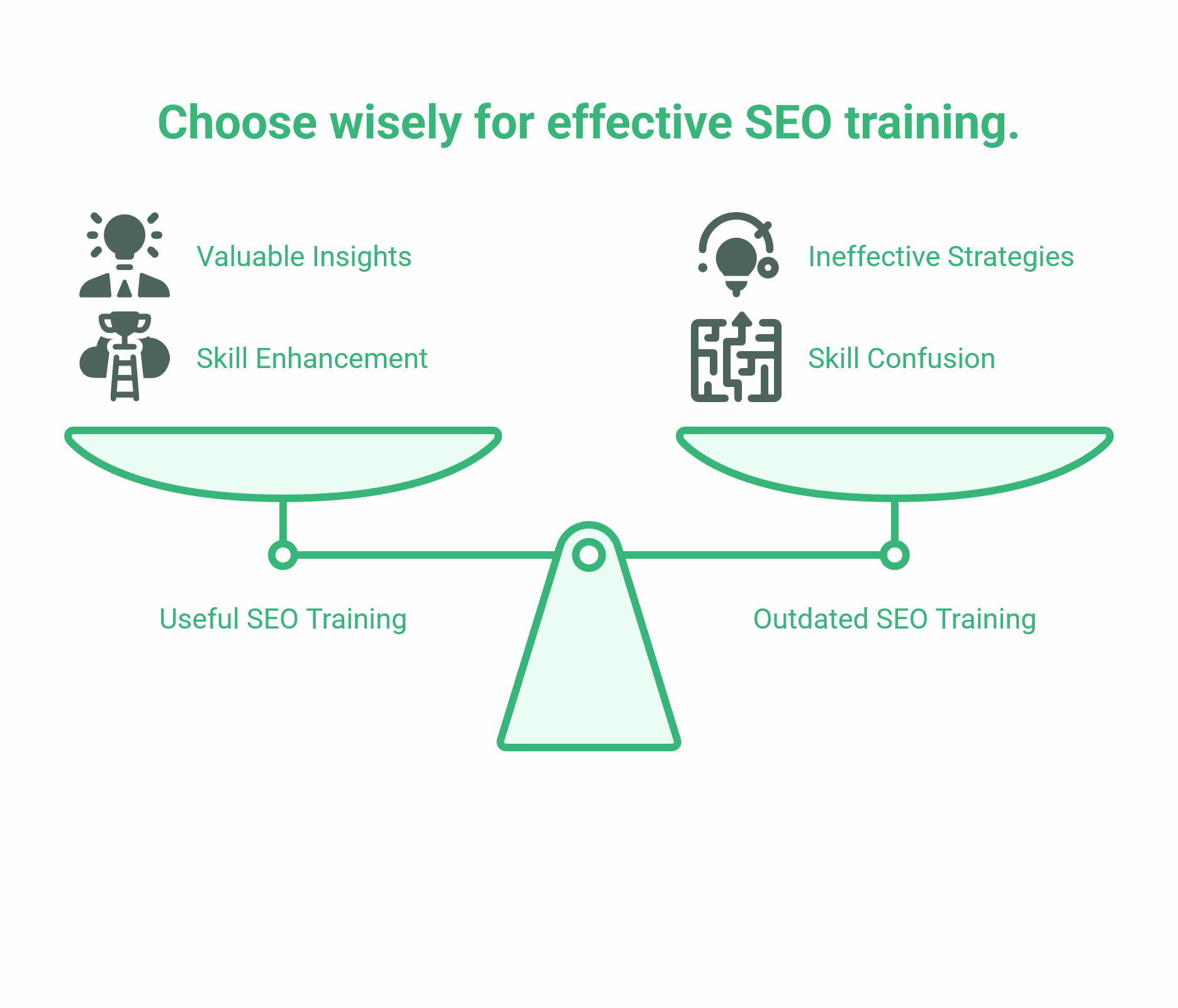
Not all SEO training is equivalent. The sector lacks a formal qualification framework, so the quality of what’s on offer ranges from genuinely useful to dangerously outdated.
Ask about the curriculum’s date
SEO from 2021 is not the same as SEO from 2026. Any training that doesn’t cover AI Overviews, Google’s Helpful Content updates, or entity-based search is teaching you to optimise for a search engine that no longer exists in quite the same form. Ask specifically what has been updated in the curriculum in the last 12 months.
Ask for a pre-training audit
A training provider worth working with should want to understand your current situation before they start teaching. If they’re offering the same session regardless of what your site looks like, that’s a signal they’re running a standardised course rather than delivering targeted expertise.
Check the trainer’s own rankings
This sounds obvious, but it’s often overlooked. Does the agency offering SEO training rank well for its own target keywords? A digital marketing company that can’t be found for digital marketing terms in its own city is not a compelling case study for its methods. You can check this in just a few seconds with a simple Google search.
Look at case studies from similar businesses
Results for an e-commerce retailer don’t necessarily translate to a professional services firm. Ask whether the provider has worked with businesses similar to yours in size, sector, or location, and whether they can show specific outcomes.
Verify their understanding of the UK and Irish market specifics
UK and Irish SEO has genuine nuances that global training programmes tend to gloss over. GDPR-compliant outreach, the Nominet domain framework, ASA/CAP Code constraints on content claims, and Making Tax Digital context for accountancy-adjacent content all affect how SEO is practised here. A trainer who can’t speak to these specifics is likely to be importing American best practices without adaptation.
What ProfileTree’s SEO Training Covers
ProfileTree delivers SEO training for businesses across Northern Ireland, Ireland, and the UK. Sessions are tailored to the client’s specific situation rather than delivered from a fixed curriculum.
Training is available in three formats: half-day workshops for teams that need a practical introduction to a specific discipline (typically on-page SEO or Google Search Console); full-day intensives that cover the core skill set end to end; and ongoing advisory arrangements in which a specialist works with an in-house team over several months.
All sessions begin with an audit of the client’s existing search presence, ensuring the training is grounded in real data from the outset. Where relevant, Northern Ireland-specific context is built in, including cross-border search opportunities, UK-specific regulatory considerations, and local link-building approaches suited to the Belfast and wider Northern Ireland markets.
Teams that complete ProfileTree’s training leave with an action list specific to their site, a basic working knowledge of Google Search Console, and the ability to brief developers and content writers more effectively. For businesses in sectors like manufacturing, professional services, or hospitality — where in-house marketing teams are small and generalist — this is often the right level of capability to build.
For businesses that decide, during the training conversation, that they’d rather outsource SEO entirely than develop in-house skills, ProfileTree’s SEO services in Northern Ireland are a direct alternative.
The Business Case for In-House SEO Skills
For most SMEs, the argument for training comes down to a simple observation: the people who know your product, your customers, and your market best are already on your payroll. An agency can apply SEO frameworks. Your team can combine those frameworks with knowledge that no outsider has.
This doesn’t mean every business should try to do everything in-house. Technical SEO, and in particular link acquisition, often benefits from specialist resources. But content strategy, keyword intent, and the ability to brief accurately and evaluate output — these are skills that compound in value when they’re embedded in the business.
The businesses that see the best long-term organic growth tend to have someone internal who understands SEO well enough to own the channel, even if they use external help for specific tasks. Training is the fastest way to get to that position.
What to Expect From Your First SEO Training Session
Many businesses delay investing in SEO training because they’re not sure what the process entails. The reality is straightforward, and knowing what to expect helps you prepare properly and get more from the time.
Before any session begins, a good trainer will ask for access to your Google Search Console account and a basic brief covering your target customers, your main services or products, and any specific areas where you feel the site is underperforming. This pre-work allows the session itself to be spent on practical application rather than background explanation.
The initial audit
Most bespoke training starts with a brief walkthrough of the site’s current search performance. This covers which pages are generating impressions and clicks, which keywords you’re appearing for, where technical issues are suppressing visibility, and where the biggest gaps sit between your target queries and your actual rankings. For businesses that have never systematically reviewed this data, this part of the session tends to be the most clarifying. It replaces assumptions with evidence.
Prioritising what to fix first
One of the most common frustrations with self-directed SEO learning is the sheer volume of things you could theoretically improve. Training should help you cut through that. Based on your site’s specific situation, a trainer should be able to identify the two or three changes most likely to produce measurable results within 60 to 90 days. That might be improving title tags and meta descriptions on high-impression pages with poor click-through rates. It might be cleaning up duplicate content across service pages. It might be building out a local landing page structure that doesn’t currently exist. The answer will be different for every business.
Building a repeatable process
The goal of a training session isn’t just to fix a list of issues. It’s to give your team a repeatable way of thinking about search. By the end of a well-run session, participants should be able to evaluate a piece of content before it’s published, identify when a technical problem needs to be escalated to a developer, and read their Search Console data without needing to ask someone else what it means. That shift from dependency to capability is where the long-term value of training sits.
SEO Training Versus Ongoing SEO Support: Knowing When to Use Each
Training and ongoing SEO support are often presented as alternatives. In practice, they serve different purposes, and many businesses benefit from both at different stages.
When training is the right starting point
Training tends to deliver the most value when a business has capable marketing staff who simply haven’t yet developed SEO-specific skills. If your team is already producing content, managing social channels, and handling digital communications, they have the foundational discipline. What they need is a structured way to apply SEO thinking to work they’re already doing. Training converts a generalist marketing team into one that can produce content with genuine search intent, brief developers around technical priorities, and track performance meaningfully. The return on that investment compounds over time because the skills stay with the business.
It’s also the right option when a business wants to reduce its dependency on external agencies. Some SMEs have found themselves paying monthly SEO retainers for work they could largely handle internally with a modest investment in skills. Training makes sense as an audit of whether that dependency is necessary.
When ongoing support makes more sense
Some SEO tasks don’t transfer well to in-house teams, regardless of training. Link acquisition at scale, technical site migrations, and structured data implementation typically require specialist resources that are impractical to develop internally unless SEO is a significant business priority. For these areas, working with an agency on a defined scope tends to produce better results than attempting to train for depth that may only be needed occasionally.
There’s also a timing consideration. Training produces capability, but capability takes time to translate into rankings. For a business launching a new service, entering a competitive market, or recovering from a Google core update, the timeline for training-led improvement may not align with commercial needs. In those situations, outsourcing SEO while training proceeds in parallel is a practical approach.
A combined model that works for many SMEs
The arrangement that tends to work well for businesses at the scale ProfileTree typically works with is this: in-house staff handle content production, on-page optimisation, and Search Console monitoring, informed by training; an external specialist conducts periodic technical audits, leads link-building efforts, and advises on strategic changes. This keeps costs proportionate while ensuring the business isn’t wholly dependent on one agency relationship for all its search visibility. ProfileTree’s digital marketing training programmes are designed with this model in mind, as are the SEO services available for businesses that want specialist support alongside their in-house capability.
Conclusion
SEO training makes the most sense when it’s tied to your actual website, your real search data, and the market you’re trying to reach. Generic courses build awareness. Targeted training builds capability. For SME owners in Northern Ireland and Ireland looking to develop genuine in-house SEO skills, the starting point is a conversation about your current search performance, not a syllabus.
To find out more about ProfileTree’s SEO training and digital marketing training programmes, get in touch with our team.
FAQs
What is SEO training for businesses?
SEO training teaches business owners and marketing teams how to improve their website’s visibility in search engines. For SMEs, it typically covers on-page content, technical basics, local search, and tools like Google Search Console — applied to your actual website rather than abstract theory.
How much does SEO training cost in the UK?
Free self-directed courses are available from Google and HubSpot Academy. Bespoke training from a specialist agency typically runs from a few hundred pounds for a half-day session to several thousand for a multi-day programme with ongoing support.
How long does it take to see results from SEO training?
Measurable ranking improvements are possible within 2 to 4 months, depending on keyword competitiveness and the consistency with which the skills are applied. Technical and metadata fixes tend to show faster results than content-based changes.
Is SEO training better than hiring an SEO agency?
Training makes sense when you want to build long-term in-house capability. An agency makes sense when you need results faster than training allows, or when the required skills are too specialised to develop internally. Many businesses use both.