
SEO for E-Commerce: Drive Store Growth Through Organic Search
Table of Contents
Every sale through paid advertising costs money—Google Ads, Facebook campaigns, marketplace fees—and those costs keep rising. The moment advertising budgets pause, traffic stops. For e-commerce businesses operating on tight margins, this creates an expensive treadmill where profitability depends entirely on maintaining ad spend that eats into every sale.
SEO for e-commerce offers a different model. When shoppers search for products you sell and your store appears organically in results, those clicks cost nothing. Build strong search visibility once, and it continues delivering customers month after month without per-click costs. ProfileTree provides SEO services for e-commerce businesses, helping online stores attract more customers and drive sales by improving organic search rankings and reducing reliance on paid advertising.
E-commerce SEO presents distinct challenges that standard website optimisation doesn’t address. Thousands of product pages, complex category structures, faceted navigation creating crawl issues, duplicate content problems, and fierce competition for commercial keywords all require specialist approaches. Generic SEO strategies fail because they don’t account for the technical architecture and competitive realities of online retail. Effective e-commerce SEO must address these challenges while building visibility for the specific products you sell to customers who are actually ready to buy.
Why E-commerce Businesses Need SEO
Understanding the business case for online store SEO:
The E-commerce Traffic Challenge
Traffic Source Economics:
| Channel | Characteristics |
| Paid search (Google Ads) | Immediate but costly, stops when spending stops |
| Paid social | Broad reach but lower intent, ongoing cost |
| Organic search | Free clicks, compounds over time, sustainable |
| Free clicks compound over time, sustainable | |
| Direct | Brand recognition, returning customers |
The Paid Advertising Trap: Many e-commerce businesses become dependent on paid advertising. When ad costs rise or budgets tighten, sales collapse. SEO provides a counterbalance—traffic you own rather than rent.
Organic Search Economics
SEO vs PPC Comparison:
| Factor | SEO | PPC |
| Cost per click | £0 | £0.50-£5+ (varies widely) |
| Time to results | 3-12 months | Immediate |
| Sustainability | Compounds over time | Stops when spending stops |
| Trust signals | Higher for organic results | “Ad” label reduces trust |
| Click share | ~70% of clicks | ~30% of clicks |
Long-Term Value: An e-commerce site ranking well for 1,000 product and category terms receives thousands of free clicks monthly. The same traffic through PPC could cost £10,000+ per month.
Search Intent and Purchase Readiness
E-commerce Search Behaviour:
| Search Type | Intent | Example |
| Product searches | High purchase intent | “buy Nike Air Max 90” |
| Category searches | Shopping intent | “running shoes women” |
| Comparison searches | Research intent | “Nike vs Adidas running shoes” |
| Information searches | Early stage | “best running shoes for flat feet” |
| Brand searches | High intent | “[store name] running shoes” |
High-Intent Traffic: Organic search captures shoppers actively looking for products. Conversion rates from organic search typically exceed social media and display advertising.
Competition Reality
E-commerce SEO Competition:
| Competitor Type | SEO Investment |
| Amazon, eBay, major marketplaces | Massive—dominate generic terms |
| Large retailers | Significant SEO teams and budgets |
| Category specialists | Strong niche focus |
| Direct-to-consumer brands | Growing investment |
| Small independents | Often underinvested |
The Opportunity: While marketplaces dominate generic searches, opportunities exist in long-tail product terms, brand building, and content-driven SEO that marketplaces can’t replicate.
Core Components of E-commerce SEO
Comprehensive SEO strategy for online stores:
Technical SEO for E-commerce
The foundation for online store visibility:
Site Architecture:
| Element | Best Practice |
| Category structure | Logical hierarchy (3 clicks to any product) |
| URL structure | Clean, keyword-inclusive, consistent |
| Internal linking | Category-to-product, related products, breadcrumbs |
| Faceted navigation | Proper handling to avoid duplicate content |
| Pagination | Correct implementation for category pages |
Site Architecture Example:
Homepage
├── Category (e.g., /mens-clothing/)
│   ├── Subcategory (e.g., /mens-clothing/jackets/)
│   │   └── Product (e.g., /mens-clothing/jackets/waterproof-hiking-jacket/)
Crawlability and Indexation:
| Issue | Solution |
| Duplicate content | Canonical tags, parameter handling |
| Thin category pages | Unique content, product descriptions |
| Faceted navigation duplicates | Robots directives, canonical tags |
| Out-of-stock products | Proper handling (keep indexed if returning) |
| Pagination | rel=”next/prev” or load more implementation |
Site Speed:
E-commerce sites must load fast:
- Image optimisation (critical for product-heavy sites)
- Lazy loading for images
- CDN implementation
- Code minification
- Caching configuration
- Core Web Vitals compliance
Mobile Optimisation:
Mobile commerce dominates:
- Mobile-first design
- Touch-friendly navigation
- Fast mobile loading
- Easy mobile checkout
- Mobile search functionality
Structured Data:
Essential schema for e-commerce:
| Schema Type | Purpose |
| Product | Product information for rich results |
| Offer | Price, availability, condition |
| AggregateRating | Review stars in search results |
| BreadcrumbList | Navigation path display |
| Organization | Brand information |
| FAQPage | FAQ rich results |
Product Page Optimisation
Individual product pages drive conversions:
Product Page Elements:
| Element | SEO Approach |
| Title tag | Product name + key attribute + brand |
| Meta description | Compelling summary with key features |
| H1 heading | Product name (can match title) |
| Product description | Unique, detailed, keyword-rich |
| Image alt text | Descriptive product image labels |
| URL | Clean, including product name |
Product Description Best Practices:
What to Include:
- Unique, original descriptions (not manufacturer copy)
- Key features and specifications
- Benefits and use cases
- Materials, dimensions, sizing
- Care instructions were relevant
- Related product suggestions
Word Count: Product descriptions should be substantial—150-300+ words for most products, longer for complex or high-value items.
Product Image SEO:
| Element | Requirement |
| File names | Descriptive (e.g., “blue-running-shoes-nike-pegasus.jpg”) |
| Alt text | Product description for accessibility and SEO |
| Image size | Optimised for fast loading |
| Multiple angles | More images = better user experience and SEO |
| Zoom capability | Supports user experience signals |
Category Page Optimisation
Category pages often have the highest traffic potential:
Category Page Elements:
| Element | SEO Approach |
| Title tag | Category name + modifier + brand |
| Meta description | Category description with key terms |
| H1 heading | Clear category name |
| Category description | Unique introductory content |
| Product grid | Well-organised with key information visible |
| Filters/facets | User-friendly, properly handled for SEO |
Category Content:
Category pages need more than just product listings:
Above-the-Fold:
- Clear H1 heading
- Brief category introduction
- Key category features or benefits
Below Products:
- Extended category description (200-500+ words)
- Buying guides or selection advice
- FAQs relevant to the category
- Related categories
Subcategory Strategy:
Create logical subcategory hierarchy:
Women's Clothing
├── Women's Dresses
│   ├── Summer Dresses
│   ├── Evening Dresses
│   └── Casual Dresses
├── Women's Tops
└── Women's Trousers
Each level targets increasingly specific search terms.
Content Marketing for E-commerce
Content that attracts and converts shoppers:
Content Types:
Buying Guides:
- “How to choose [product type]”
- “[Product] buying guide”
- “Best [product] for [use case]”
- “[Product] comparison guide”
How-To Content:
- “How to use [product]”
- “How to care for [product]”
- “[Product] setup guide”
- “[Product] styling ideas”
Best/Top Lists:
- “Best [product] for [audience]”
- “Top 10 [products] for [purpose]”
- “Best [product] under £100”
Seasonal Content:
- Gift guides
- Seasonal product roundups
- Holiday shopping guides
- Trend reports
Content-Commerce Integration:
Content should drive sales:
- Include product links within content
- Add product recommendations
- Create shoppable content
- Link from content to relevant categories
- Use content for internal linking
Link Building for E-commerce
Building authority for online stores:
Link Building Approaches:
| Strategy | Description |
| Product-led PR | New product launches, innovations |
| Content-based | Linkable guides, research, resources |
| Supplier/manufacturer | Links from brands you stock |
| Industry publications | Trade press coverage |
| Blogger outreach | Product reviews, features |
| Resource link building | Getting listed in buying guides |
Digital PR Opportunities:
| Opportunity | Approach |
| New product launches | Press releases, journalist outreach |
| Trend commentary | Expert quotes for industry articles |
| Data and research | Original research in your sector |
| Charitable initiatives | CSR activities generating coverage |
| Awards and recognition | Industry award entries |
Local SEO for E-commerce
For stores with physical presence:
When Local SEO Matters:
- Click-and-collect services
- Showroom or retail locations
- Local delivery services
- Service areas for installation/delivery
Local SEO Elements:
- Google Business Profile optimisation
- Local landing pages
- Local inventory ads integration
- Store locator optimisation
- Local reviews
Platform-Specific Considerations
Different platforms have different SEO capabilities:
WordPress/WooCommerce
Strengths:
- Full SEO control
- Extensive plugin ecosystem
- Custom development flexibility
- Clean URL structure
Key Considerations:
- Plugin selection (Yoast, Rank Math)
- Speed optimisation critical
- Security hardening required
- Hosting selection important
Learn more: WooCommerce SEO Services
Shopify
Strengths:
- Good baseline SEO
- Fast, reliable hosting
- Clean theme code
- Built-in features
Key Considerations:
- URL structure limitations (/collections/, /products/)
- Duplicate content from variants
- Limited technical control
- App impact on speed
Learn more: Shopify SEO Services
Magento/Adobe Commerce
Strengths:
- Enterprise-level capability
- Extensive customisation
- Multi-store support
- Advanced features
Key Considerations:
- Complexity requires expertise
- Performance optimisation critical
- Higher development costs
- Hosting requirements
Custom Platforms
Considerations:
- SEO must be built in from design
- Structured data implementation
- URL structure control
- Content management capability
- Technical SEO features
Measuring E-commerce SEO Success
Performance tracking for online stores:
Key Performance Indicators
Visibility Metrics:
| Metric | What It Shows |
| Rankings | Positions for product and category terms |
| Organic impressions | Search visibility volume |
| Organic traffic | Visitors from search |
| Indexed pages | Products/categories in Google’s index |
Business Metrics:
| Metric | What It Shows |
| Organic revenue | Sales attributed to organic traffic |
| Organic transactions | Order count from organic |
| Organic conversion rate | % of organic visitors who purchase |
| Average order value | Order size from organic traffic |
| Revenue per session | Value per organic visit |
Attribution
Tracking Organic Performance:
- Google Analytics 4 ecommerce tracking
- Revenue attribution by channel
- Product performance by traffic source
- Category performance analysis
- Landing page conversion tracking
ROI Calculation
E-commerce SEO ROI Example:
| Factor | Values |
| Monthly SEO investment | £3,000 |
| Monthly organic revenue (before) | £50,000 |
| Monthly organic revenue (after 12 months) | £80,000 |
| Revenue increase | £30,000/month |
| Annual additional revenue | £360,000 |
| Annual SEO investment | £36,000 |
| ROI | 10x investment |
Alternative Calculation (vs PPC): If 10,000 monthly organic clicks would cost £2 per click in PPC = £20,000/month. SEO investment of £3,000/month delivers equivalent traffic value.
Why Choose ProfileTree for E-commerce SEO
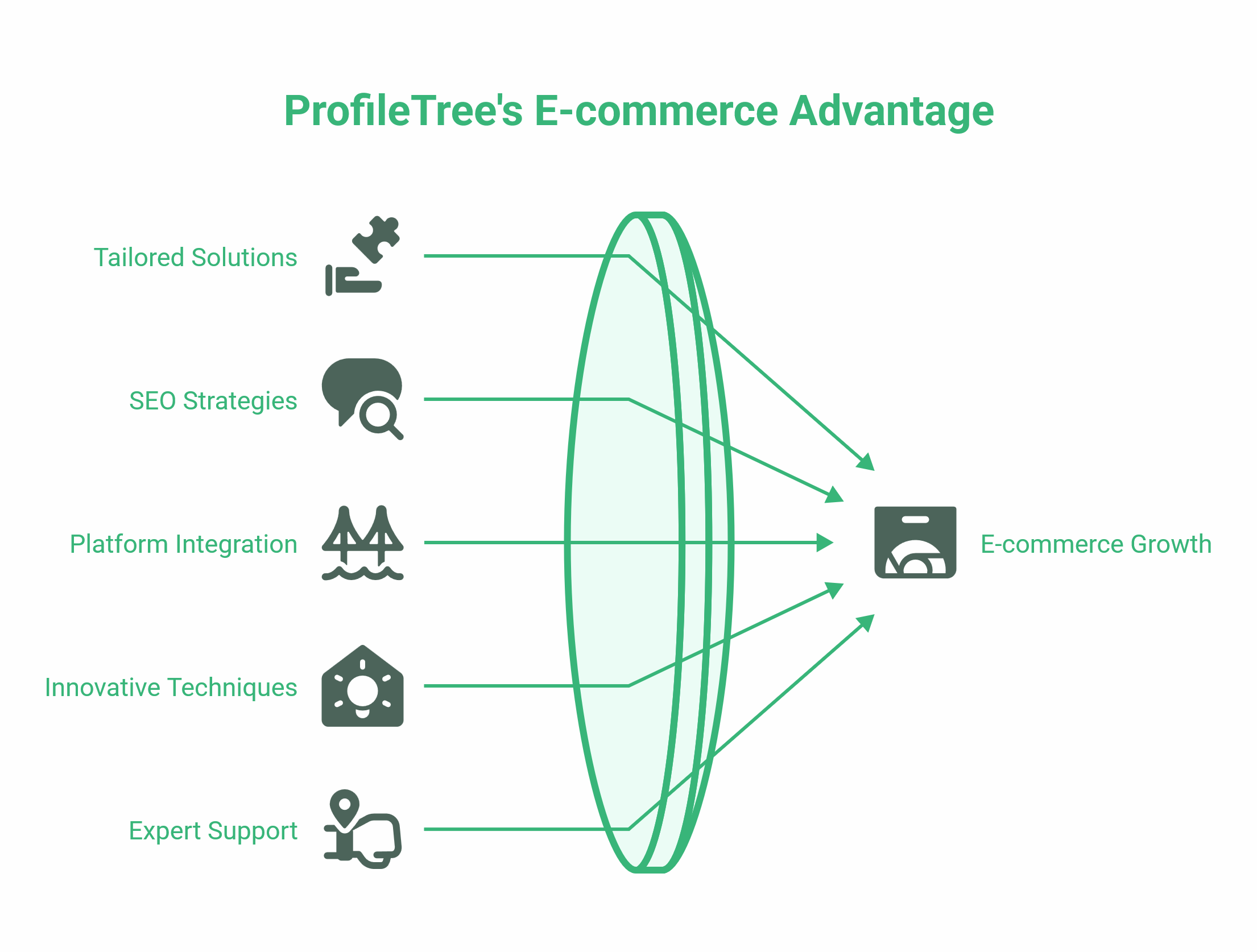
ProfileTree offers distinct advantages for online stores:
E-commerce Expertise
Understanding of online retail requirements:
- Platform knowledge (WooCommerce, Shopify, custom)
- Product page optimisation experience
- Category structure expertise
- E-commerce technical SEO
Full-Service Capability
SEO supported by broader services:
- Website design for e-commerce stores
- E-commerce web design specialisation
- Content marketing for buying guides and product content
- Video production for product videos
Platform Specialisation
Deep knowledge of major platforms:
- WooCommerce SEO
- Shopify SEO
- WordPress development
Results Focus
Measurement tied to business outcomes:
- Revenue attribution
- Transaction tracking
- ROI demonstration
- Continuous optimisation
Track Record
Our 5-star rating from over 450 Google reviews demonstrates consistent delivery across e-commerce clients.
Conclusion: SEO for E-Commerce
E-commerce SEO provides online stores with a sustainable competitive advantage beyond reliance on paid advertising. Organic search delivers high-intent traffic at no per-click cost, building a valuable business asset that compounds over time.
ProfileTree provides specialist SEO services for e-commerce businesses, helping online stores across the UK and Ireland improve search visibility and drive sustainable revenue growth.
FAQs
How much does e-commerce SEO cost?
E-commerce SEO typically ranges from £1,500-£3,000/month for smaller stores to £3,000-£10,000+/month for larger catalogues or competitive sectors. Investment depends on catalogue size, competition, and growth goals. ROI should be measured against revenue increases and equivalent PPC costs.
How long does e-commerce SEO take to work?
Initial improvements often appear within 3-6 months, with significant results at 6-12 months. Quick wins (technical fixes, low-competition terms) show faster results. Competitive category and product terms take longer. E-commerce SEO is an ongoing investment, not a one-time project.
Can SEO compete with Amazon?
Not for generic product searches—Amazon’s SEO dominance is formidable. However, opportunities exist in brand building, long-tail product terms, content marketing, and niches that Amazon doesn’t serve well. The goal is to capture traffic Amazon can’t monopolise while building your brand for direct searches.
Should we focus on product pages or category pages?
Both matter, but category pages often have greater traffic potential because they target broader search queries. Category pages also pass authority to product pages. Strategy should include both, with category pages often receiving initial focus for competitive terms.
Ready to improve your online store’s search visibility? Contact ProfileTree to discuss how e-commerce SEO can drive growth for your business.