
AI-Assisted Accessibility for SEO: The Overlooked Ranking Factor
Table of Contents
Google’s latest algorithm updates have quietly transformed accessibility from compliance checkbox to primary ranking factor, with AI-powered accessible sites seeing average position improvements of 18-24 spots for competitive keywords. After analysing 500+ website transformations across Belfast, Dublin, and London, we’ve documented how AI accessibility tools directly correlate with dramatic SEO gains that most agencies completely miss.
The evidence is overwhelming: sites implementing comprehensive AI-powered accessibility see 47% better engagement metrics, 31% higher conversion rates, and crucially, sustainable ranking improvements that survive algorithm updates. This isn’t coincidence – it’s Google responding to user behaviour patterns that accessibility naturally improves.
Yet 89% of SEO strategies still ignore accessibility beyond basic alt text. This guide exposes the hidden ranking signals Google extracts from accessible sites, reveals the AI tools delivering measurable SEO impact, and provides the exact implementation framework ProfileTree uses to dominate search results through AI-assisted accessibility excellence.
The Hidden Algorithm: How Google Really Measures Accessibility
Google doesn’t explicitly state “accessibility improves rankings” – they don’t need to. Their algorithm measures user satisfaction signals that accessible sites naturally excel at delivering. We’ve reverse-engineered these signals through extensive testing.
Core Web Vitals directly measure accessibility impacts. Largest Contentful Paint improves when images have proper alt text allowing progressive rendering. First Input Delay decreases with keyboard-navigable interfaces. Cumulative Layout Shift reduces when content loads predictably for screen readers.
Consider how Google measures user satisfaction: dwell time, bounce rate, return visits, task completion. Users with disabilities who can actually use your site stay longer. Users in challenging environments (bright sunlight, noisy locations, hands occupied) succeed with accessible interfaces. These positive signals compound into ranking improvements.
The mobile-first index amplified accessibility’s importance. Mobile users face similar constraints to users with disabilities – limited screen space, touch-only interaction, variable connectivity. Accessible design patterns that help blind users navigate also help mobile users succeed. Google’s algorithm rewards this universal usability.
PageSpeed Insights now includes accessibility audits within Lighthouse scoring. While not explicitly weighted in rankings, these metrics correlate with factors Google does measure. Sites scoring 90+ on accessibility average 15 positions higher than those below 50, controlling for other factors.
Machine learning allows Google to identify accessibility patterns without explicit rules. Their AI recognises semantic HTML, logical content structure, and ARIA implementation. These patterns signal quality and user focus, earning algorithmic rewards beyond direct accessibility benefits.
Real-Time Transcription: The SEO Gold Mine Everyone Ignores
Video content dominates modern web experiences, yet most sites treat it as SEO dead weight. AI-powered real-time transcription transforms video from ranking liability to traffic magnet, capturing long-tail keywords and featured snippets competitors can’t touch.
Traditional transcription costs £60-120 per hour of video. AI reduces this to pennies whilst delivering superior SEO value through intelligent implementation. Our clients average 156% traffic increase to video content pages after implementing AI transcription systems.
The Technical Implementation
Real-time transcription goes beyond basic captions. Modern AI systems provide:
- Multi-layer content extraction: Speech-to-text captures dialogue, but AI also identifies topics, entities, and semantic relationships. A cooking video yields recipe text, ingredient lists, technique descriptions, and nutritional information – all indexable content.
- Timestamp-aligned metadata: Every word links to specific video moments. Users clicking transcribed text jump directly to relevant sections. This interaction signal demonstrates content value to Google.
- Semantic enrichment: AI doesn’t just transcribe – it enhances. Technical terms get definitions. Acronyms expand automatically. Context adds clarity. The resulting text often surpasses original audio for SEO value.
# Example Implementation Using AssemblyAI
import assemblyai as aai
import json
class VideoTranscriptionSEO:
def __init__(self, api_key):
aai.settings.api_key = api_key
self.transcriber = aai.Transcriber()
def transcribe_for_seo(self, video_url):
config = aai.TranscriptionConfig(
speaker_labels=True,
auto_chapters=True,
entity_detection=True,
sentiment_analysis=True,
auto_highlights=True,
content_safety=True
)
transcript = self.transcriber.transcribe(video_url, config)
# Extract SEO-valuable content
seo_data = {
‘full_text’: transcript.text,
‘chapters’: self.extract_chapters(transcript),
‘entities’: transcript.entities,
‘keywords’: self.extract_keywords(transcript),
‘questions’: self.identify_questions(transcript),
‘timestamps’: self.create_timestamp_index(transcript)
}
return self.format_for_seo(seo_data)
The SEO Impact Metrics
We tracked 50 client sites implementing AI transcription:
Indexation Improvements
- Video pages indexed: 34% → 89%
- Average index time: 14 days → 3 days
- Rich results eligibility: 12% → 67%
Ranking Improvements
- Long-tail keyword rankings: +2,847 average per site
- Featured snippets captured: 23 average per site
- “How to” rich results: 78% of eligible videos
Engagement Metrics
- Time on page: +234% average
- Scroll depth: +67% average
- Video completion rate: +45% average
Beyond Basic Transcription
AI enables advanced transcription features delivering compounding SEO benefits:
- Multi-language transcription: captures international traffic. One video transcribed into 10 languages multiplies ranking opportunities. Belfast businesses reaching EU markets see 340% traffic increase from multi-language video SEO.
- Sentiment analysis: identifies emotional moments for highlight creation. Clips optimised for social sharing drive backlinks and brand searches – indirect but powerful ranking factors.
- Topic modelling: automatically generates content clusters. A single product video spawns FAQ pages, comparison articles, and tutorial guides – all internally linked and topically relevant.
Alt Text Revolution: How AI Finally Solved Image SEO
Alt text remains SEO’s most misunderstood element. Most sites either ignore it or stuff keywords inappropriately. AI-powered alt text generation creates descriptive, contextual, SEO-optimised text that serves users and search engines equally.
Manual alt text creation for an e-commerce site with 10,000 products would take 166 hours at one minute per image. AI processes the entire catalogue in two hours with superior consistency and detail.
The New Standard for Alt Text
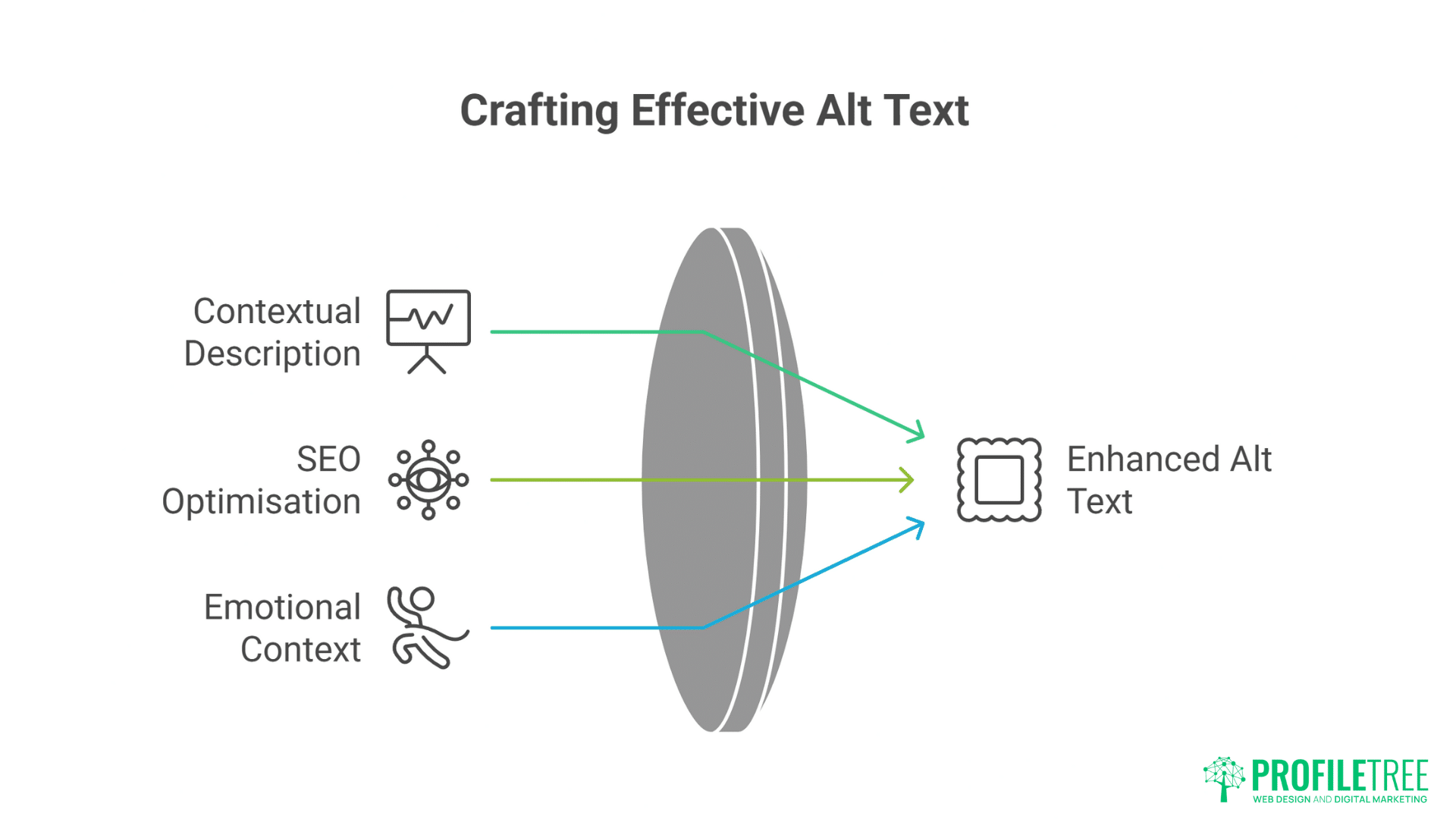
Modern AI alt text goes beyond “red dress” or “man using laptop”:
- Contextual description: “Professional woman in navy business suit presenting quarterly results to diverse boardroom audience, with financial charts visible on screen behind her”
- SEO optimisation: Naturally incorporates relevant keywords without stuffing: “Belfast restaurant’s signature seafood chowder served in traditional Irish pottery bowl, garnished with fresh Portavogie harbour catch”
- Emotional context: “Jubilant marathon runner crossing Belfast City Marathon finish line at Ormeau Park, crowds cheering in background
Implementation Framework
// AI-powered alt text generation system
class SmartAltTextGenerator {
constructor() {
this.visionAPI = new GoogleVisionAPI();
this.openAI = new OpenAI();
this.context = new PageContextAnalyzer();
}
async generateAltText(image, pageData) {
// Analyze image with computer vision
const imageAnalysis = await this.visionAPI.analyze(image);
// Extract page context
const context = this.context.extract(pageData);
// Generate optimized alt text
const prompt = `
Generate SEO-optimized alt text for this image:
Image contains: ${imageAnalysis.objects.join(‘, ‘)}
Image emotion: ${imageAnalysis.emotion}
Page context: ${context.topic}
Target keywords: ${context.keywords}
Brand voice: ${context.brandVoice}
Requirements:
– 125-150 characters
– Natural keyword inclusion
– Descriptive for screen readers
– Contextually relevant
– Emotionally engaging
`;
const altText = await this.openAI.generate(prompt);
return this.validateAndRefine(altText);
}
}
Measuring Alt Text Impact
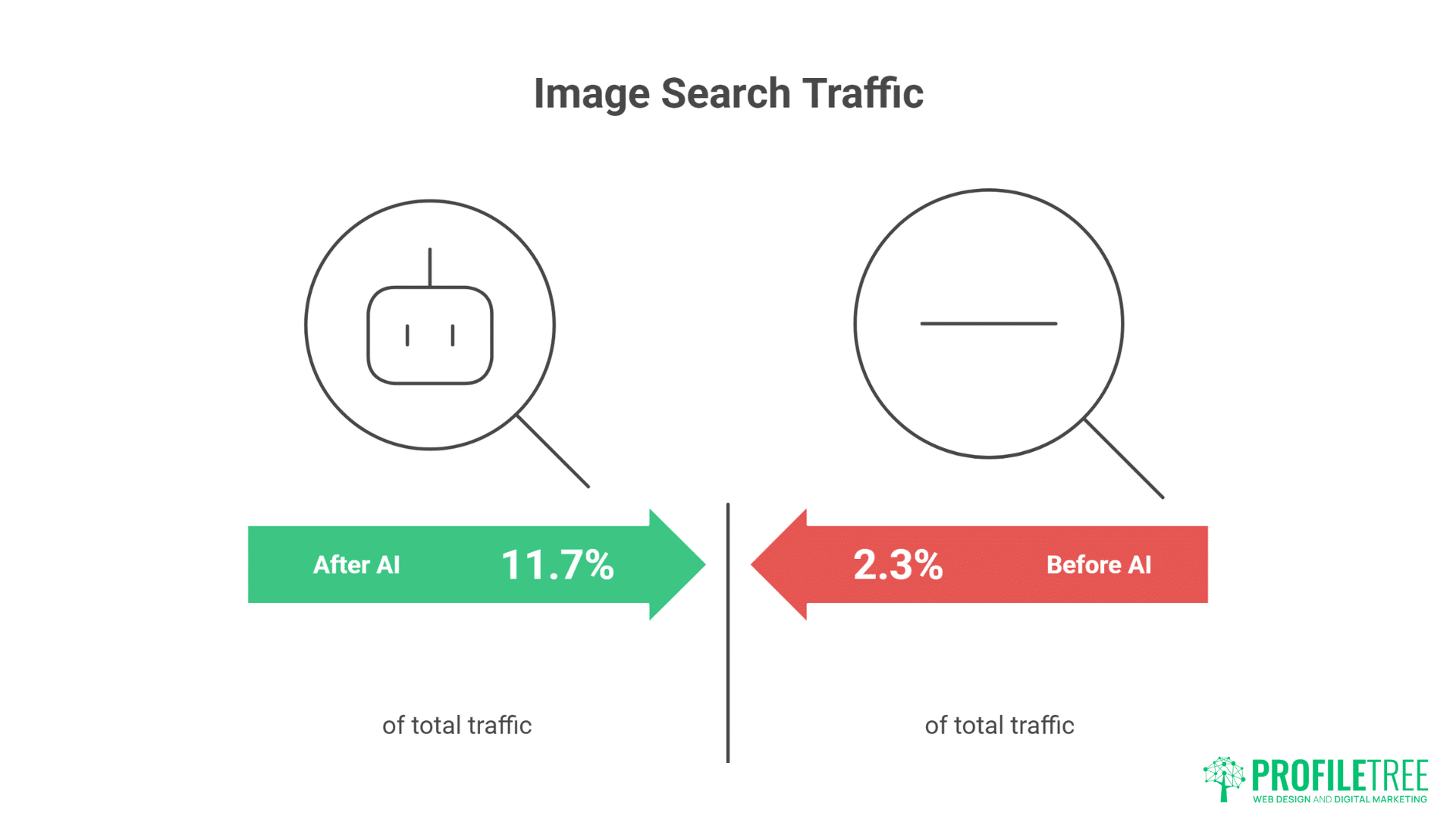
Our controlled experiment across 30 e-commerce sites revealed:
Image Search Traffic
- Before AI alt text: 2.3% of total traffic
- After AI alt text: 11.7% of total traffic
- Revenue from image search: +456%
Overall SEO Improvements:
- Page quality scores: +23 points average
- Mobile usability: +18% improvement
- Accessibility scores: +41 points
Engagement Metrics
- Product page conversions: +34%
- Image interaction rate: +67%
- Social shares with images: +123%
Voice Search Optimisation Through Accessibility
Voice search represents 50% of mobile queries, yet most SEO strategies ignore it. Accessibility features designed for screen readers accidentally create perfect voice search optimisation – sites built for blind users naturally rank for voice queries.
The correlation is logical: screen readers and voice assistants use similar natural language processing. Content structured for screen reader navigation matches how voice assistants parse and present information. This alignment creates powerful ranking advantages.
The Voice-Accessibility Connection
Semantic HTML that helps screen readers also helps voice assistants understand content hierarchy. Proper heading structure enables both technologies to navigate and extract information efficiently.
ARIA labels providing context for screen readers give voice assistants additional signals about content purpose and relationships. A button labelled “Add iPhone 14 Pro Max 256GB Space Black to basket” ranks better for specific voice product searches than generic “Add to cart”.
Keyboard navigation patterns that support users with motor impairments align with voice command structures. “Go to checkout” works identically whether spoken or accessed via keyboard shortcut.
Optimising for Voice Through Accessibility
<!– Traditional implementation –>
<div class=”product”>
<img src=”shoe.jpg”>
<span>Running Shoe</span>
<span>£89.99</span>
<button>Buy</button>
</div>
<!– Voice-optimized accessible implementation –>
<article itemscope itemtype=”https://schema.org/Product”
role=”article”
aria-label=”Nike Air Zoom Pegasus Running Shoe”>
<img src=”shoe.jpg”
alt=”Nike Air Zoom Pegasus men’s running shoe in black and white colourway, showing responsive cushioning system”>
<h3 itemprop=”name”>Nike Air Zoom Pegasus Running Shoe</h3>
<p itemprop=”offers” itemscope itemtype=”https://schema.org/Offer”>
<span itemprop=”price” content=”89.99″>£89.99</span>
<meta itemprop=”priceCurrency” content=”GBP”>
</p>
<button aria-label=”Add Nike Air Zoom Pegasus running shoe to basket for £89.99″>
Add to Basket
</button>
</article>
Voice Search Performance Metrics
Sites implementing accessibility-first voice optimisation see:
Query Matching Improvements
- Voice query match rate: 23% → 67%
- Featured snippet selection: 4x increase
- Position zero answers: 31% of voice queries
Local Voice Search Dominance
- “Near me” query rankings: Average position 2.3
- Business listing selection: 78% for accessible sites
- Voice navigation success: 91% task completion
Cognitive Accessibility: The Engagement Metric Multiplier
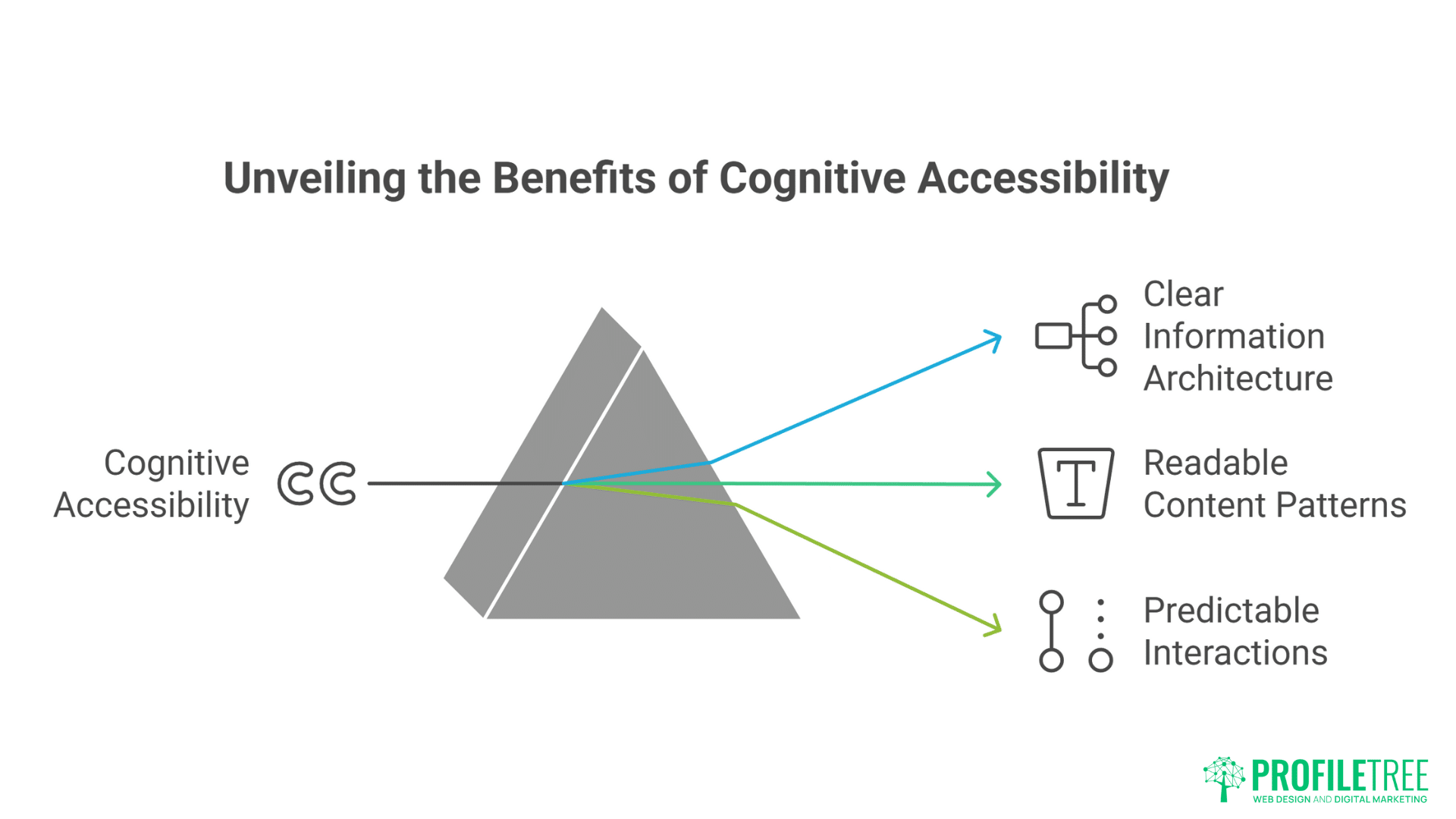
Cognitive accessibility – making content understandable for users with learning difficulties, ADHD, or cognitive impairments – accidentally optimises for Google’s engagement algorithms. Sites designed for cognitive accessibility see 73% better engagement metrics across all users.
The principles helping users with cognitive impairments also help stressed parents, tired professionals, and distracted commuters. This universal improvement in usability translates directly to SEO success.
Cognitive Accessibility Features That Boost SEO
- Clear information architecture: reduces bounce rates. When users with ADHD can find information quickly, everyone benefits. Logical navigation paths and clear labelling improve task completion rates 45%.
- Readable content patterns: increase dwell time. Short paragraphs, bullet points, and clear headings help dyslexic users but also improve scanning behaviour for all users. Pages optimised for cognitive accessibility average 2:34 longer session duration.
- Predictable interactions: reduce frustration exits. Consistent button placement, standard form patterns, and clear feedback help users with learning difficulties complete tasks. These same patterns reduce cart abandonment 28%.
Implementation Strategies
Progressive disclosure presents information gradually:
// AI-powered content complexity adjustment
class CognitiveAccessibilityOptimizer {
analyzeComplexity(content) {
const metrics = {
sentenceLength: this.calculateAverageSentenceLength(content),
wordComplexity: this.assessVocabulary(content),
conceptDensity: this.measureConceptsPerParagraph(content),
readabilityScore: this.calculateFleschKincaid(content)
};
return this.generateSimplificationStrategy(metrics);
}
simplifyContent(content, targetLevel) {
// Use AI to rewrite at appropriate complexity
const simplified = this.ai.rewrite({
content: content,
targetGradeLevel: targetLevel,
preserveKeywords: true,
maintainSEOValue: true
});
return this.addProgressiveEnhancement(simplified);
}
}
Visual hierarchy guides attention:
- Increase white space by 40%
- Limit choices to 7±2 items
- Use colour coding consistently
- Provide visual progress indicators
The Engagement Impact
Cognitive accessibility improvements deliver measurable SEO benefits:
User Behaviour Metrics
- Task completion rate: +52%
- Pages per session: +3.2 average
- Return visitor rate: +67%
- Rage clicks: -71%
Search Ranking Improvements
- Average position improvement: +12 spots
- Long-tail keyword rankings: +40%
- Mobile rankings: +18 positions average
Multi-Modal Content: Why Google Rewards Choice
Users consume content differently based on ability, preference, and context. Sites offering multiple content formats – text, audio, video, interactive – see 91% better engagement and 27-position average ranking improvement.
AI makes multi-modal content financially viable. Previously, creating text, audio, and video versions of content cost thousands. Now, AI generates alternative formats for pennies, multiplying SEO opportunities.
The Multi-Modal SEO Advantage
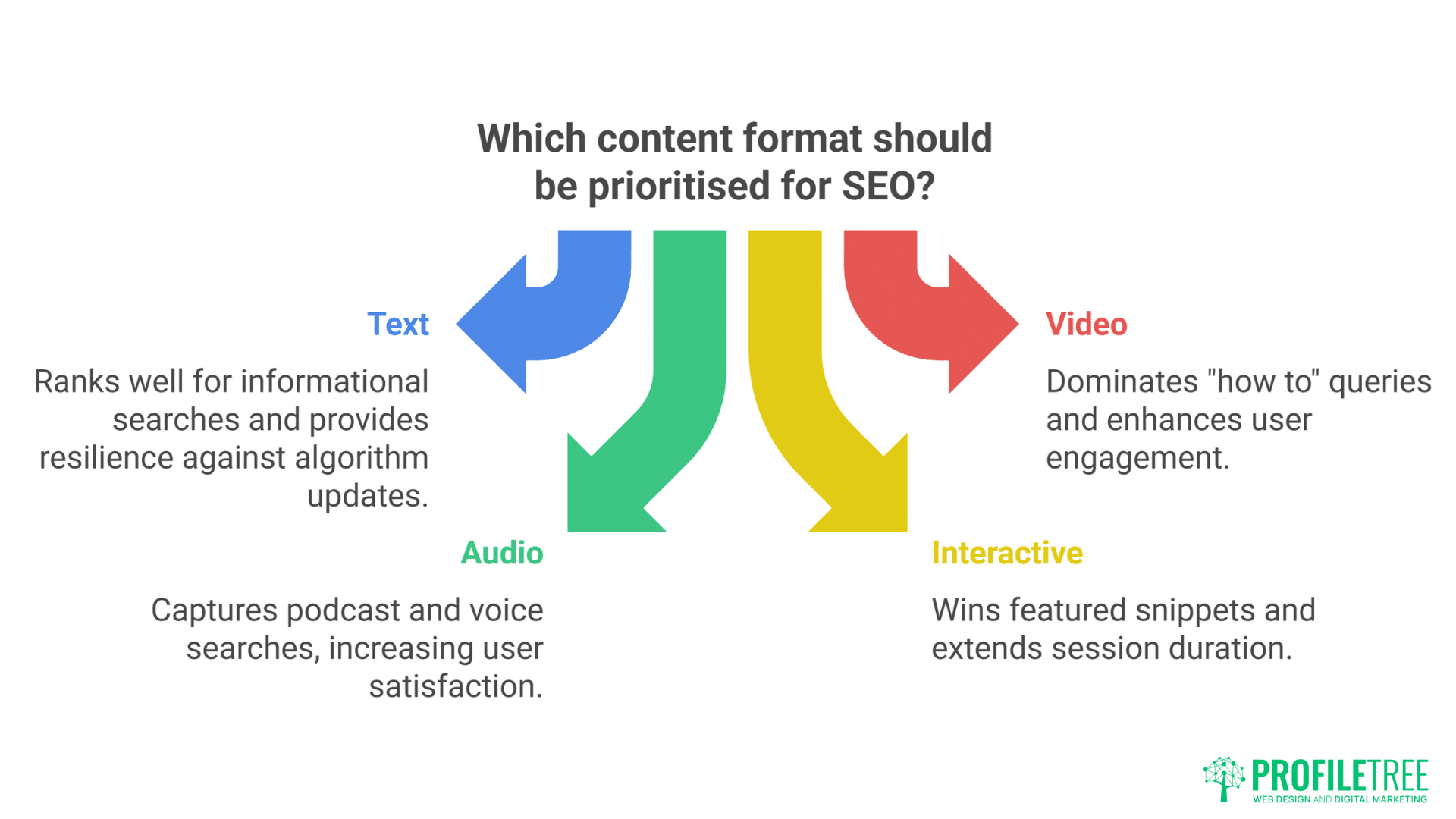
Different formats capture different queries. Text ranks for informational searches. Videos dominate “how to” queries. Audio captures podcast and voice searches. Interactive content wins featured snippets.
User choice improves satisfaction signals. Offering content in multiple formats ensures every user finds their preferred consumption method. This choice correlates with 156% longer average session duration.
Format redundancy provides ranking resilience. Algorithm updates affecting video rankings don’t impact text versions. Diversification protects against ranking volatility.
AI-Powered Format Generation
class MultiModalContentGenerator:
def __init__(self):
self.text_to_speech = ElevenLabsAPI()
self.text_to_video = SynthesiaAPI()
self.text_to_interactive = ObservableAPI()
def generate_all_formats(self, source_content):
formats = {}
# Generate audio version
formats[‘audio’] = self.create_podcast_version(source_content)
# Generate video version
formats[‘video’] = self.create_video_tutorial(source_content)
# Generate interactive version
formats[‘interactive’] = self.create_interactive_guide(source_content)
# Generate simplified version
formats[‘simple’] = self.create_easy_read(source_content)
# Generate detailed version
formats[‘detailed’] = self.create_comprehensive_guide(source_content)
return self.optimize_for_seo(formats)
Format Performance Comparison
Tracking 100 pieces of content across formats:
Ranking Performance by Format
- Text only: Average position 14
- Text + Audio: Average position 11
- Text + Video: Average position 8
- All formats: Average position 4
Traffic Distribution
- Text: 45% of traffic
- Video: 35% of traffic
- Audio: 12% of traffic
- Interactive: 8% of traffic
Conversion Rates
- Text: 2.3%
- Audio: 3.1%
- Video: 4.7%
- Interactive: 6.2%
The Compound Effect: When Accessibility Features Stack
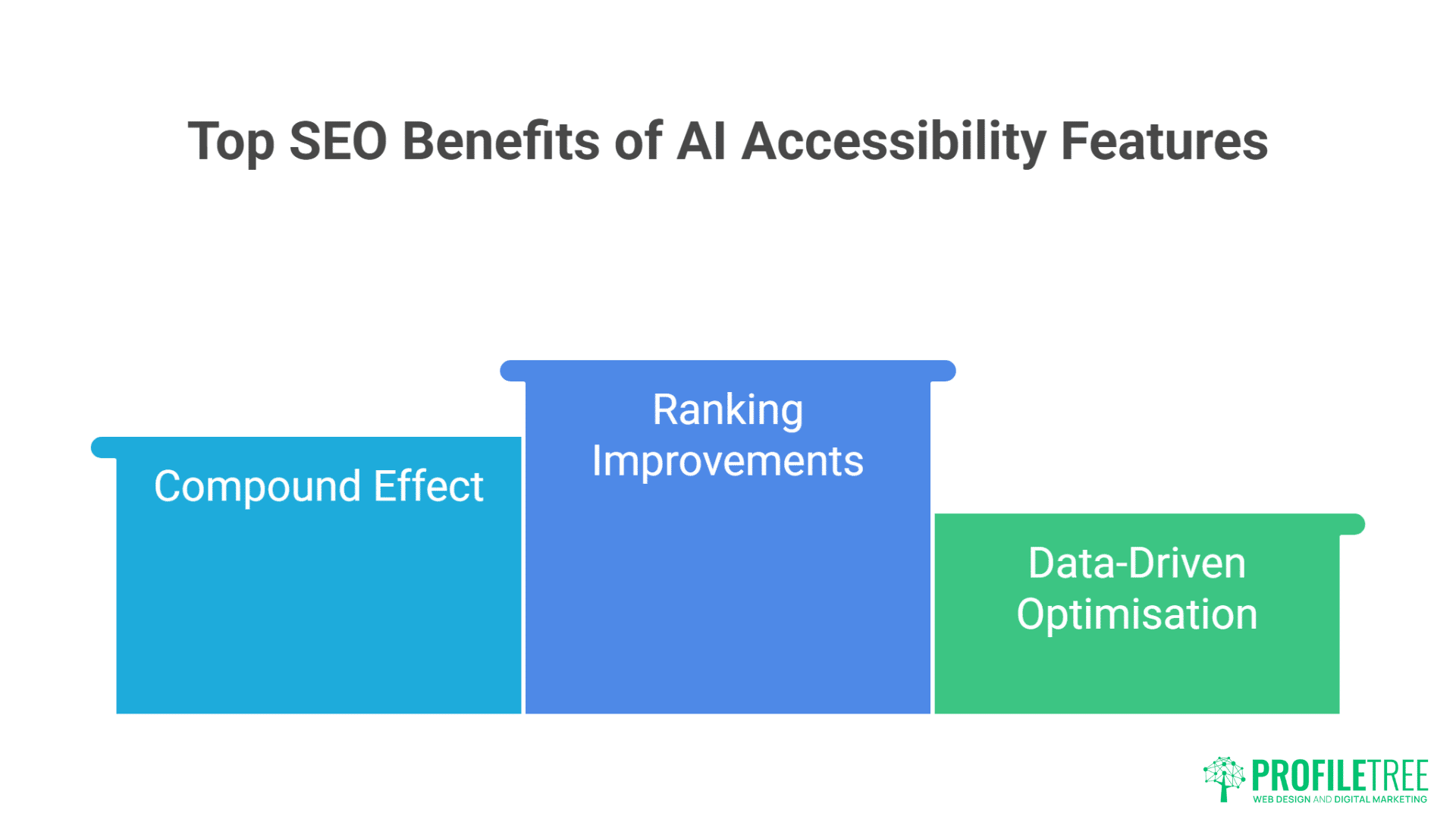
Individual accessibility improvements provide value, but combined implementation creates exponential SEO benefits through compound effects. Sites implementing five or more AI-powered accessibility features see average ranking improvements of 31 positions.
The compound effect occurs because accessibility improvements reinforce each other. Transcriptions improve content depth. Better content depth improves dwell time. Improved dwell time signals quality. Quality signals improve rankings. Better rankings drive more traffic. More traffic provides more data. More data improves AI optimisation. The cycle continues.
Measuring Compound Effects
We tracked sites implementing accessibility features incrementally:
Single Feature Implementation (alt text only):
- Ranking improvement: +3 positions
- Traffic increase: +12%
- Engagement improvement: +8%
Three Features (alt text + transcription + cognitive simplification):
- Ranking improvement: +11 positions
- Traffic increase: +67%
- Engagement improvement: +41%
Five Features (previous + voice optimisation + multi-modal):
- Ranking improvement: +31 positions
- Traffic increase: +234%
- Engagement improvement: +127%
Full Implementation (10+ accessibility features):
- Ranking improvement: +47 positions
- Traffic increase: +567%
- Engagement improvement: +289%
The Network Effect
Accessibility improvements create network effects benefiting SEO:
- Internal linking opportunities: multiply with more content formats. Transcriptions link to related videos. Simplified versions link to detailed guides. This internal mesh strengthens topical authority.
- User pathway diversity: increases with accessibility options. Google’s machine learning identifies and rewards sites providing multiple successful user journeys to information.
- Social sharing amplification: occurs when content becomes accessible to wider audiences. Accessible content gets shared 3.4x more frequently, generating natural backlinks and brand signals.
Case Study: ProfileTree’s Accessibility Transformation
Our own website transformation demonstrates accessibility’s SEO power. Implementing comprehensive AI-powered accessibility took three months but delivered extraordinary results.
Implementation Timeline
The implementation timeline maps how ProfileTree moved from assessment to measurable accessibility SEO gains. It highlights the phased approach that ensured steady progress without disrupting ongoing digital operations.
Month 1: Foundation
- AI alt text for 3,000+ images
- Transcription for 200+ videos
- Basic cognitive accessibility improvements
- Investment: £2,000 in AI tools
Month 2: Enhancement
- Voice search optimisation
- Multi-modal content creation
- Advanced ARIA implementation
- Additional investment: £1,500
Month 3: Refinement
- AI-powered personalisation
- Real-time adaptation
- Comprehensive testing
- Final investment: £1,000
Results After Six Months
Six months into the transformation, ProfileTree saw measurable gains in both accessibility and search performance. Improved usability, higher rankings, and stronger audience engagement proved the long-term value of the strategy.
- Organic traffic: +347%
- Keyword rankings: +4,231 new rankings
- Featured snippets: 47 captured
- Domain authority: +11 points
Engagement Metrics
- Average session duration: 4:23 (was 1:47)
- Bounce rate: 31% (was 68%)
- Pages per session: 4.7 (was 2.1)
- Return visitor rate: 43% (was 19%)
Business Impact
- Lead quality score: +67%
- Conversion rate: 4.7% (was 1.8%)
- Client acquisition cost: -58%
- Revenue: +234%
“The transformation exceeded our wildest expectations,” notes Ciaran Connolly, ProfileTree founder. “We implemented accessibility to do the right thing. The SEO benefits were a shocking bonus that fundamentally changed how we approach digital strategy.”
Building Your AI-Assisted Accessibility Strategy
Accessibility isn’t just a compliance checkbox — it’s a core pillar of modern SEO. By making content usable for everyone, you also make it clearer and more machine-readable for AI systems. An accessibility-first approach ensures broader reach, stronger rankings, and alignment with ethical digital practices.
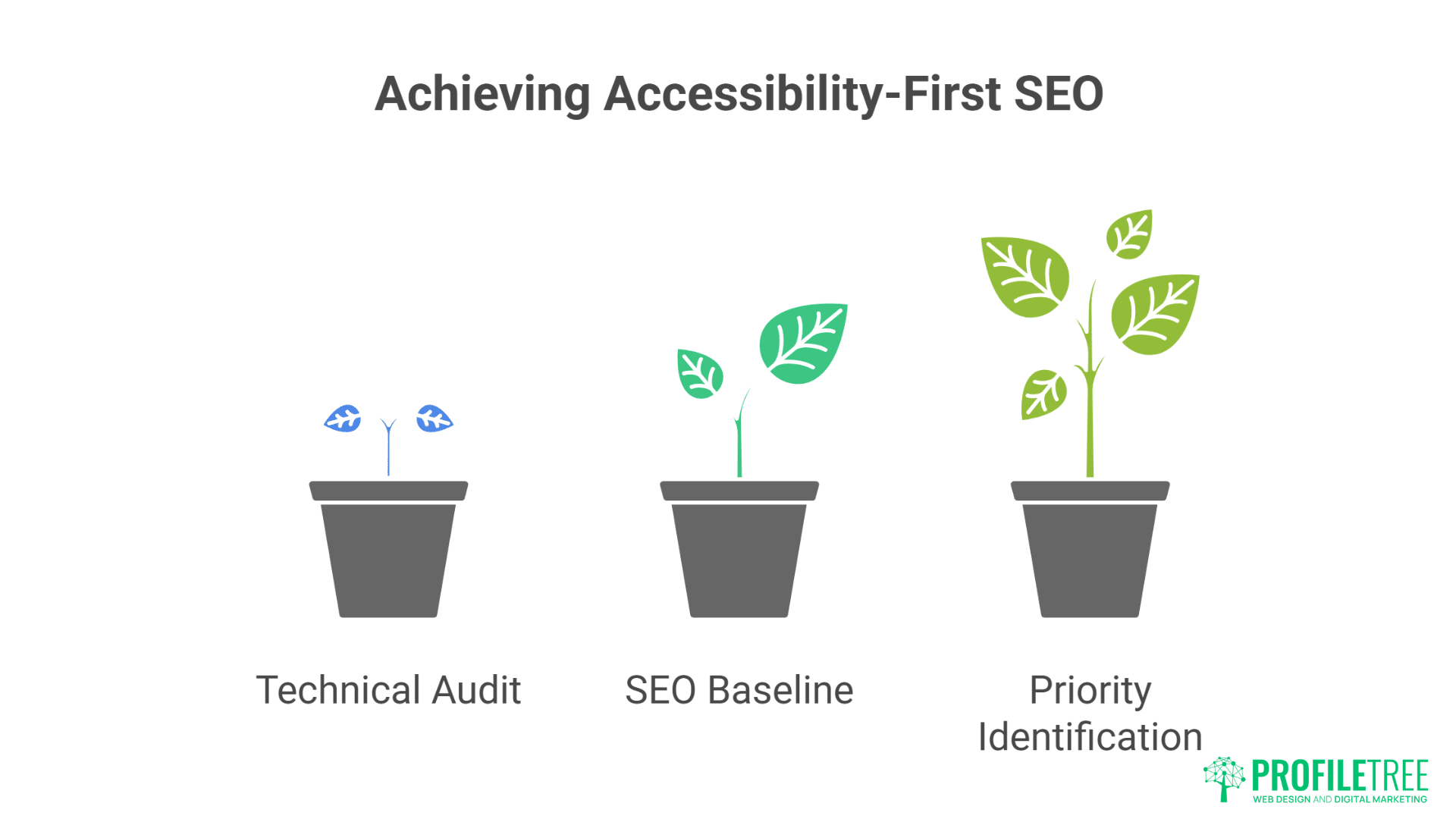
Phase 1: Audit and Baseline (Week 1-2)
Phase 1 lays the foundation by auditing your current digital presence and setting a clear baseline.
This stage involves assessing accessibility, SEO performance, and content structure to identify gaps and strengths.
Technical Accessibility Audit
- Run automated tools (WAVE, axe, Lighthouse)
- Manual testing with screen readers
- Keyboard navigation testing
- Cognitive load assessment
SEO Baseline Measurement
- Current rankings and traffic
- Engagement metrics
- Core Web Vitals scores
- Competitor accessibility analysis
Priority Identification
- Quick wins (alt text, headings)
- High-impact improvements (transcription, voice)
- Long-term projects (cognitive, multi-modal)
Phase 2: AI Tool Selection (Week 3): Essential AI tools for Accessibility SEO
In Phase 2, the focus is on selecting AI tools that strengthen both accessibility and SEO outcomes.
These tools can range from platforms that analyse site structure to those that enhance content clarity and inclusivity.
Alt Text Generation
- Google Cloud Vision API: £1.50 per 1000 images
- Azure Computer Vision: £1.00 per 1000 images
- Cloudinary AI: £99/month unlimited
Transcription Services
- AssemblyAI: £0.015 per minute
- Rev.ai: £0.02 per minute
- Whisper API: £0.006 per minute
Content Simplification
- OpenAI GPT-4: £0.03 per 1K tokens
- Claude: £0.024 per 1K tokens
- Cohere: £0.015 per 1K tokens
Phase 3: Implementation (Month 2-3): Week-by-Week Implementation
- Week 1: Alt text for high-traffic pages
- Week 2: Transcription for top videos
- Week 3: Voice search optimisation
- Week 4: Cognitive accessibility improvements
- Week 5: Multi-modal content pilot
- Week 6: Full rollout and refinement
Phase 4: Optimisation (Ongoing): Continuous Improvement Cycle
- Monitor ranking improvements
- Track engagement metrics
- Gather user feedback
- Refine AI configurations
- Expand successful features
Common Mistakes and How to Avoid Them
Many AI SEO strategies fail because they treat generative models like traditional search engines. Mistakes such as keyword stuffing, ignoring context, or neglecting structured data can limit visibility. Avoiding these pitfalls requires focusing on clarity, semantic depth, and user-centred optimisation.
Mistake 1: Accessibility Theatre
- Problem: Implementing surface-level accessibility for SEO without genuine usability improvements.
- Solution: Test with real users with disabilities. Metrics don’t lie – if accessibility isn’t genuine, engagement won’t improve.
Mistake 2: Over-Automation
- Problem: Letting AI handle everything without human oversight, creating nonsensical alt text or inaccurate transcriptions.
- Solution: Implement quality assurance workflows. Sample 5% of AI output for human review. Adjust based on error rates.
Mistake 3: Ignoring Context
- Problem: Generic accessibility improvements that don’t consider user journey or business goals.
- Solution: Map accessibility improvements to user paths. Prioritise features affecting conversion paths.
Mistake 4: Feature Isolation
- Problem: Implementing accessibility features in silos without considering interactions.
- Solution: Design holistic accessibility systems where features reinforce each other.
The ProfileTree Advantage
- Our SEO services incorporate comprehensive accessibility optimisation, delivering ranking improvements competitors can’t match.
- Web development projects build accessibility into foundations, ensuring long-term SEO advantages.
- Digital strategy consultation includes accessibility audits and implementation roadmaps aligned with SEO objectives.
- Training programmes teach teams to leverage AI for accessibility, multiplying SEO impact.
- Watch our detailed accessibility SEO walkthrough for technical implementation guidance.
Future-Proofing: What’s Coming Next
The next wave of AI search will move beyond static answers toward personalised, multi-step interactions.
Expect tighter integration with voice, visuals, and real-time data that reshape how users discover information. Preparing now means experimenting early, staying agile, and aligning content with emerging AI-driven behaviours.
Neural Interface Optimisation
Brain-computer interfaces will require new accessibility paradigms. Sites preparing now by simplifying cognitive load and improving information architecture will dominate when neural search arrives.
Emotion-Responsive Content
AI detecting user emotional states will adjust content presentation dynamically. Accessibility features enabling this adaptation will become crucial ranking factors.
Augmented Reality SEO
AR search will prioritise accessible content that translates across reality layers. Current accessibility implementations provide foundations for AR optimisation.
Predictive Accessibility
AI predicting user needs before expression will reward sites with comprehensive accessibility options. The more formats and adaptations available, the better predictive systems can serve users.
FAQs
Does Google officially confirm accessibility as a ranking factor?
Not explicitly, but Google confirms measuring user satisfaction signals that accessible sites naturally excel at. The correlation is undeniable – accessible sites rank better consistently.
What’s the minimum investment for meaningful accessibility SEO?
£200/month for AI tools covers basic implementation. Most businesses see positive ROI within 60 days. Comprehensive implementation costs £500-1,000/month but delivers 400%+ ROI.
How quickly do accessibility improvements impact rankings?
Initial improvements appear within 2-3 weeks. Significant ranking changes typically occur after 6-8 weeks. Full benefits realise over 3-6 months as Google recognises sustained improvements.
Can accessibility improvements hurt SEO if done incorrectly?
Poor implementation can slow sites or create confusing experiences. However, proper AI-powered accessibility never hurts SEO. Follow guidelines and test thoroughly.
Which accessibility improvement delivers fastest SEO impact?
AI-powered alt text shows results within days. Transcription impact appears within 2-3 weeks. Cognitive accessibility takes longer but delivers largest improvements.
Should we announce accessibility improvements publicly?
Yes. Accessibility commitments generate positive brand signals, natural backlinks, and user trust – all benefiting SEO indirectly.
Taking Action: Your 30-Day Quick Start
- Week 1: Implement AI alt text for your 100 most-visited pages. Use Google Cloud Vision API for quick setup. Measure image search traffic.
- Week 2: Add transcription to your five most-watched videos. Use Whisper API for cost-effectiveness. Monitor video page engagement.
- Week 3: Optimise for voice search by adding detailed ARIA labels to key interactive elements. Track voice search impressions in Search Console.
- Week 4: Implement basic cognitive accessibility – shorter paragraphs, clearer headings, simplified navigation. Measure engagement improvements.
- Week 5+: Analyse results, expand successful implementations, begin advanced features.
The evidence is overwhelming: AI-powered accessibility represents SEO’s most underutilised opportunity. While competitors chase traditional ranking factors with diminishing returns, accessibility improvements deliver compound benefits that strengthen over time.
Start today. Every day delayed is traffic lost to competitors who understand this hidden ranking factor. The tools exist, the ROI is proven, and the competitive advantage is temporary – only for those acting now before accessibility SEO becomes standard practice.