
Top Analytics Tools and the SEO KPIs That Actually Matter
Table of Contents
Most analytics setups measure the wrong things. A dashboard full of rising session counts feels reassuring, but it says nothing about whether the work pays for itself. The question that matters to a business owner is simpler: are these efforts producing leads, enquiries, and revenue? Answering it means looking past raw rankings and toward the metrics that connect search visibility to commercial outcomes. The right top analytics tools turn scattered numbers into decisions you can defend in a budget meeting. This guide covers the tools worth using, the key performance indicators that prove return on investment, and how to set tracking up so the data you act on is actually trustworthy.
Why Measuring SEO Performance Decides Where Your Budget Goes
Measurement exists to answer one question: is this worth continuing? Search algorithms shift constantly and competition rarely stands still, so a strategy without measurement is guesswork dressed up as activity. The top analytics tools give you the evidence to keep investing, cut what fails, and reallocate effort toward the pages and queries that bring in business. ProfileTree, the Belfast digital agency, treats measurement as the first step in any campaign rather than an afterthought, because the data dictates the work.
Justifying the Spend to Decision Makers
Executives question SEO returns when conversions are not tracked back to revenue. Show improvement in organic leads or sales and the financial case makes itself, which is what keeps budgets in place. That evidence comes directly from your top analytics tools rather than from optimistic estimates.
Finding the Wins and the Weak Spots
A campaign might rank a page third for a target term yet convert almost nobody, usually because the content or the call to action is misaligned with intent. Analytics data exposes that gap so you can fix the page rather than chase another keyword. Spotting these patterns early is exactly what separates a working programme from a stalled one.
Staying Steady Through Algorithm Updates
When a core update lands, sites with solid measurement see the effect within days and adapt. If rankings fall for a cluster of queries, good tracking helps you pinpoint whether the cause is a content gap, a technical fault, or a links issue. Reacting from data beats reacting from panic every time.
The SEO KPIs That Prove Return, Not Just Activity
Not every metric deserves a place on your report. The useful ones tie search performance to money or to behaviour that reliably leads to money. Vanity figures such as raw impressions look impressive but rarely change a decision, so the top analytics tools earn their place by making the useful KPIs unmissable. The KPIs below are the ones worth defending, and the top analytics tools you choose should make all of them easy to read at a glance.
Organic Traffic and Sessions
Start with how many people arrive from search. Analytics platforms segment this as organic search, and over time you want steady growth or stable volume on your key landing pages. A sudden dip points to an indexing or ranking problem worth investigating quickly, and slow server responses traced through website hosting management are a frequent cause.
Conversions and Conversion Rate
Visits matter less than what visitors do. Set up goals or e-commerce tracking so you can see how many sign up, enquire, or buy. If traffic climbs but conversions stay flat, the issue is usually content relevance or user experience rather than visibility, which is often a website development fix rather than a search one.
Keyword Rankings in Context
Rank tracking has value, but position alone is a poor scorecard. A first-place ranking for a low-intent term can earn less than a fifth-place ranking for a strong commercial query, since intent and a clear conversion path set by good website design decide what a visit is worth. Read positions alongside the leads or sales they actually generate, and let the top analytics tools surface that link for you.
Engagement and Return Visits
Time on page, pages per session, and return visits show whether content holds attention and earns trust. A reader who explores a second article or comes back later is a stronger signal of value than a single quick bounce. Across the top analytics tools, these behavioural metrics often predict conversion before conversion happens.
Top Analytics Tools to Track Performance
The market splits into free platforms from Google, paid SEO suites, and a newer wave of AI-assisted tools. Most businesses need a small, well-chosen stack rather than every tool on the list. The top analytics tools below cover the ground a UK SME actually needs, from indexing health to competitor visibility, and the right combination depends on whether you sell online, generate leads, or both.
Google Analytics 4
GA4 uses an event-driven model that tracks user journeys across devices more cleanly than its predecessor. It includes predictive metrics and built-in anomaly detection, which help surface unusual changes without manual hunting. Setup repays care: map your conversions properly, define events consistently, and link Google Ads if you run paid campaigns.
Google Search Console
Search Console shows how Google crawls and indexes your site, including impressions, clicks, and average position for every query. It flags coverage problems, mobile usability issues, and Core Web Vitals, which makes it the first place to look when rankings move, and Google Search Central documents how each report is generated. Among the top analytics tools, this one is non-negotiable because it reports the search side that GA4 does not.
Paid SEO Suites
When free tools reach their limits, paid platforms add depth across keywords, backlinks, and site audits. Each leans toward a particular strength, so the choice depends on what you measure most.
- SEMrush for keyword and competitor analysis, site audits, and backlink tracking.
- Ahrefs for strong backlink analysis, keyword research, and rank monitoring.
- Moz Pro for domain authority metrics and on-page grading.
- Screaming Frog for deep technical crawls covering broken links and canonical checks.
A single suite usually covers an SME’s needs, and layering it on top of the free Google tools gives a complete picture without overspending.
AI-Assisted Analytics Tools
Newer tools apply machine learning to content gaps, user signals, and competitor outlines, then suggest where to improve. They can highlight semantic topics a page is missing or forecast which queries are likely to repay effort. They also flag unusual movements automatically, such as a sudden traffic drop on one query or a bounce-rate spike on a single landing page, which removes a layer of manual monitoring.
These tools also measure engagement on content formats such as video marketing that standard reports treat shallowly. Used with judgement, these top analytics tools shorten the analysis step rather than replacing the analyst, which is one reason ProfileTree builds practical AI use into its digital training for teams who want to read their own data faster. The same skills feed into wider AI in marketing work, where measurement data becomes the input that internal models learn from.
Choosing the Right Stack for Your Business
The best combination depends on what you sell and how decisions get made. A lead-generation business leans on Search Console and GA4 conversion tracking, while an online retailer needs enhanced e-commerce reporting and a suite that watches competitor pricing pages. Picking top analytics tools is therefore a question of fit, not feature count, and the smallest stack that answers your real questions is usually the right one. Adding tools you never read wastes both money and attention, so start lean and expand only when a genuine gap appears.
Setting Up Tracking So the Data Can Be Trusted
Accurate measurement starts with a clean setup. A misconfigured tag or an inconsistent event name quietly distorts every report that follows, and decisions made on bad data cost more than no data at all. Before relying on any of the top analytics tools, confirm the foundations below are solid, because everything downstream depends on them.
Define Your GA4 Property and Data Streams
Set up separate data streams for web and app where relevant, and use a tag manager to handle event-based tracking. Confirm that lead forms and e-commerce events fire correctly before you start reporting on them. A short verification pass here saves weeks of misreading later, because every report from your top analytics tools inherits whatever the data stream captures.
Set Meaningful Goals and Conversion Events
Define events that map to real outcomes, such as a contact form submission, a newsletter sign-up, or a completed checkout. Label them consistently and switch on conversion tracking so the numbers mean the same thing every month. Consistent naming is what makes month-on-month comparison possible.
Use UTM Parameters and Enhanced Tracking
Tag promotional links with UTM parameters so you can separate organic search from social, paid traffic, and email marketing campaigns. For e-commerce, enhanced tracking follows product views, cart additions, and checkout steps so you can see exactly where buyers drop off. This level of detail is what lets a sound digital strategy services shift budget toward the channels that actually convert.
Turning KPIs Into Decisions
Data only earns its keep when it changes what you do next. The point of the top analytics tools is not the dashboard, it is the action the dashboard prompts. The patterns below are the ones worth acting on, and each points to a specific fix rather than a vague sense that something needs attention.
Position Versus Conversion
Do not chase top spots for every term. A first-place ranking on a low-intent keyword can deliver little, while a fifth-place ranking on a strong commercial query drives steady enquiries. Judge each position by the revenue or leads behind it.
Landing Page Performance
Pull your top organic landing pages and look for high bounce rates or low dwell time. Those pages usually need clearer intent matching, stronger internal links, or an on-page conversion aid such as AI chatbots, and two thin pages competing for the same query are often better merged into one. Fixing the worst performers tends to lift the whole cluster.
Seasonal and Device Patterns
Review weekly and monthly data for cycles, such as a January spike on a seasonal query, and plan content ahead of the demand. Check device and location breakdowns too, since a slow mobile experience traced to responsive web design or missing local content quietly suppresses results. Acting on these patterns early is cheaper than reacting once the season has passed.
Common Pitfalls That Distort SEO Measurement
Even good tools mislead when used carelessly. Most reporting errors trace back to a handful of repeat mistakes, and avoiding them matters more than adding another platform to the stack. The top analytics tools cannot save a report built on misaligned goals or unclean data, so the discipline sits with the analyst rather than the software.
Measuring the Wrong Goal
A B2B software firm cares about qualified leads, not raw session counts, yet many reports still lead with traffic volume. Anchor every report to the KPI that maps to business success, whether that is booked demos or completed enquiry forms, and configure your top analytics tools to lead with it. Teams that struggle here benefit from structured analytics training courses. The wrong headline metric makes a failing campaign look healthy.
Unclean or Delayed Data
Recently installed tracking often shows incomplete or inaccurate figures because of missing tags or inconsistent event names. Test the setup, verify tag placement, and confirm event naming matches across platforms before trusting a single chart. Regular audits keep the data reliable as the site changes.
Overlooking Indirect Effects
Stronger rankings raise brand awareness, which shows up later as direct visits and social media marketing referrals rather than organic ones. A rise in direct traffic after an SEO win is a sign of that halo effect, and ignoring it undervalues the work. Good reporting accounts for the brand lift, not just the last click.
Building a Reporting Cadence That Sticks
A consistent reporting rhythm keeps a programme honest. Report too often and you overreact to normal fluctuation; report too rarely and you miss problems while they are still cheap to fix. The cadence below balances both, and it scales from a sole trader to a marketing team without much change.
Weekly Spot Checks
Review rank movements for priority keywords once a week to catch sharp drops early. A weekly glance is enough to stay informed without mistaking ordinary SERP noise for a trend. Most top analytics tools can automate that weekly check, so daily tracking rarely earns its time for most businesses.
Monthly Analysis
Compile a fuller monthly view covering organic sessions against the prior period, top landing pages, conversions from search, notable link changes, and any technical fixes shipped. This is where most decisions are made, so keep it focused on what changed and why. A tidy monthly report is the backbone of any defensible programme.
Quarterly Strategy Reviews
Step back each quarter to read the bigger trend: is authority rising, are new query clusters appearing, are some campaigns underperforming? Adjust the roadmap from that view rather than from any single month, the level at which a wider digital marketing roadmap is shaped. This longer lens is where strategy gets refined, and where expert support such as ProfileTree’s search engine optimisation services often adds the most value.
Benchmarking and Forecasting With Your Data
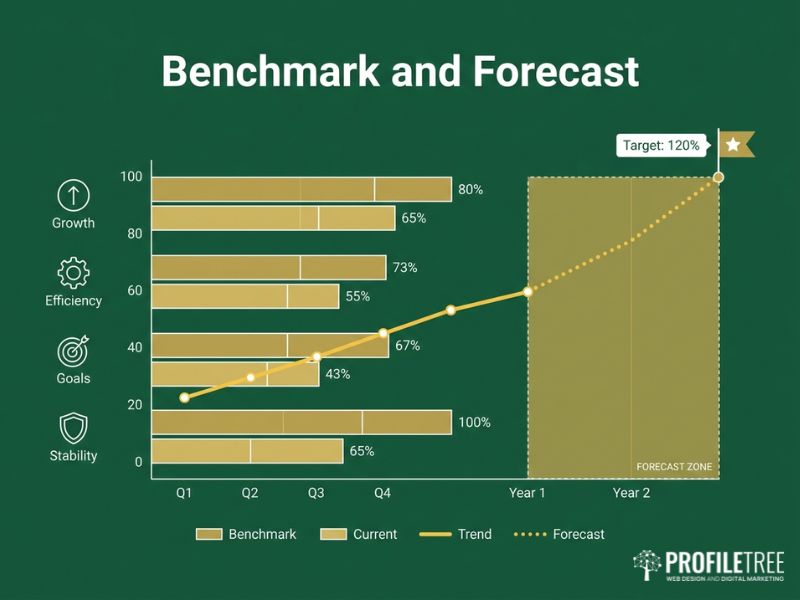
Measurement gets more useful once you compare against something. A KPI in isolation tells you a number; a KPI against last quarter, against a competitor, or against a forecast tells you whether you are winning. The top analytics tools all support some form of benchmarking, and the discipline of setting a baseline before a campaign begins is what makes later results believable. Without that baseline, any improvement is just a claim.
Set a Baseline Before You Start
Record current organic sessions, conversions, and positions for your priority queries before any new work ships. That snapshot becomes the reference point every later report is measured against. It also protects the programme during a core update, since you can show where performance sat before the volatility began.
Use Forecasts With Caution
Several top analytics tools now project future traffic or lead volume from historical patterns, competitor movement, and seasonality, an area where AI-enhanced marketing increasingly assists. Treat these as planning aids rather than promises, because no model fully captures a brand’s context or a sudden shift in demand. A forecast is most useful for allocating effort, not for setting a target you will be judged against.
Compare Against Competitors, Not Just Yourself
Paid suites let you watch a competitor’s visibility on shared queries, which puts your own movement in perspective. Rising while a competitor falls is a stronger signal than rising in a vacuum. This view also surfaces query clusters a competitor owns that you could realistically contest, which is where focused content work earns its place.
Ciaran Connolly, founder of ProfileTree, puts the principle plainly: “KPIs keep an SEO strategy grounded in real outcomes such as leads, sales, and brand growth, not vanity metrics that look good and change nothing.”
Make Your Measurement Work Harder
Measuring SEO well is not about collecting more numbers, it is about collecting the right ones and acting on them. Choose a small stack of top analytics tools, track the KPIs that map to revenue, set the foundations up cleanly, and report on a steady cadence. The top analytics tools are only ever as good as the questions you bring to them. Done consistently, that turns guesswork into clear decisions and steady commercial growth. If you would rather have a partner build and run that measurement framework, ProfileTree works with businesses across Northern Ireland, Ireland, and the UK to do exactly that.
FAQs
What are the best top analytics tools for a small business?
Google Analytics 4 and Google Search Console cover most needs for free. Add one paid suite such as Ahrefs or SEMrush only when you need deeper keyword and backlink data.
Which SEO KPI matters most?
Conversions tied to revenue or leads. Rankings and traffic only matter insofar as they produce those outcomes.
How often should I report on SEO?
Weekly spot checks for rankings, a full report monthly, and a strategy review each quarter.
Is Google Analytics 4 enough on its own?
It covers on-site behaviour and conversions well, but it does not report search impressions or position. Pair it with Search Console for the full picture.
Do AI analytics tools replace the standard ones?
No. They speed up analysis and surface gaps, but they sit on top of GA4 and Search Console rather than replacing them.