
Local SEO for E-commerce: Optimising Online Stores for Local Searches
Table of Contents
Local SEO for e-commerce is one of the most underused growth levers available to UK and Irish online retailers. Most businesses assume it only applies to shops with a physical presence a restaurant, a salon, a hardware store. That assumption is costing them traffic.
Google now surfaces local results for product searches, service-area queries, and “near me” intent even when no physical counter is involved. Businesses that have set up their local signals correctly are capturing that visibility; those that have not are losing ground to competitors who have.
For SMEs selling online across Northern Ireland, Ireland, and the wider UK, this creates a real opportunity. The top-ranking content on this topic is almost entirely US-centric, referencing Zip Codes, Yelp, and American directories that are largely irrelevant to a business trading in Belfast, Dublin, or Edinburgh. This guide covers the fundamentals through the lens of the UK and Irish market, including the specific directories, schema formats, and logistical signals that actually matter here.
Why Local SEO Matters for Online Stores Without a Physical Shop
The assumption that local SEO only helps businesses with a shopfront is outdated. Google’s algorithm now recognises Service Area Businesses (SABs) companies that operate from a fixed location but serve customers across a defined geographic region. An e-commerce retailer based in Belfast that ships across Northern Ireland can qualify. So can a Dublin-based Shopify store that targets Irish customers. So can a home-based craft business in Edinburgh that ships UK-wide.
The commercial case is straightforward. Customers searching for products within their region often convert at higher rates than those arriving through generic national queries, because the perceived friction of ordering concerns about delivery, returns, and customs is lower when the seller signals local proximity. For Northern Ireland businesses in particular, clearly communicating that orders are dispatched domestically removes a conversion barrier that has become meaningful since Brexit introduced uncertainty around NI-to-GB and Republic-to-NI shipping.
Local SEO also builds domain authority that supports broader national rankings. A well-maintained Google Business Profile, consistent citation data, and locally relevant content all contribute to the trust signals Google uses to evaluate a site’s reliability, whether or not those signals drive map pack clicks.
Setting Up Google Business Profile Without a Physical Address
The most common sticking point for pure-play e-commerce businesses is the Google Business Profile (GBP) address requirement. Google requires address verification for most business types, but it does not require you to display that address publicly a distinction many business owners miss entirely.
Setting up as a Service Area Business
When creating or editing your GBP listing, select “I deliver goods and services to my customers” and then hide your address. You can then define your service area by postcode, city, county, or region. A Belfast-based retailer might define their service area as Northern Ireland and certain counties in the Republic of Ireland. A Manchester business might set UK-wide coverage. Google will use this service area when deciding whether to surface your listing for local queries in those regions.
To complete verification without a public address, Google typically sends a postcard to the business address, which you then confirm in Search Console. The address remains on file with Google but does not appear in search results. This protects residential addresses while still giving Google the location data it needs to serve your listing.
Virtual offices and PO Boxes
Avoid both. Google’s guidelines explicitly prohibit PO Box addresses and the use of virtual offices for GBP verification. While technically possible in some cases, this practice carries a real risk of suspension if Google determines the address does not represent a genuine business location. For established brands, the risks outweigh any benefits.
Hybrid models: showroom plus online
If your business has any kind of physical presence, a studio, workshop, click-and-collect point, or trade counter, use it. Even a space that is only occasionally open to customers can qualify as a verified address, and a verified physical address carries more local authority than a service area entry alone.
Keyword Research for Local E-commerce
Generic e-commerce keyword research targets transactional queries such as “buy leather wallet” and “men’s running shoes.” Local keyword research layers geography onto that intent: “buy leather wallet Northern Ireland,” “running shoes Belfast delivery,” “craft gin Ireland online.”
The practical approach is to start with your core product or category terms and systematically apply location modifiers. For UK businesses, these modifiers include city names, county names, regional identifiers (the Midlands, the Highlands), and country-level terms (UK, England, Scotland, Wales, Northern Ireland, Ireland). For Irish businesses, adding county-level modifiers is particularly worthwhile because Irish consumer search behaviour often includes county identifiers in product queries, a pattern less common in England.
Tools worth using
Google Search Console’s “Queries” report is the most direct source of real data for this. Filter for queries that already contain location terms and check whether those pages are ranking in positions that warrant optimisation. Google’s autocomplete and People Also Ask results for your core product terms will surface the specific location phrasing your potential customers actually use.
For longer-term research, Google Keyword Planner allows geographic filtering. Set it to show data for specific regions, not the UK-wide view, to find the local variants with realistic volume for a targeted content plan.
Long-tail local queries and voice search
Voice search and mobile-first queries tend to produce longer, more conversational phrases: “where can I buy handmade candles in Belfast,” “online homeware shops that deliver to Ireland.” These phrases rarely carry high volume individually, but they convert well when a page is genuinely optimised for them — and they face far less competition than head terms.
The UK and Ireland Citation Ecosystem
A citation is any online reference to your business name, address, and phone number (NAP). Consistency across citations is a meaningful local ranking factor: if your business is listed as “ProfileTree Ltd” on one directory and “ProfileTree” on another, with a Belfast postcode in one and no postcode in the other, those inconsistencies dilute your local authority.
For UK and Irish businesses, the relevant directories are not the same ones cited in most US-focused guides. Yelp has limited traction in the UK. Yellow Pages, as a standalone brand, has largely been replaced by Yell.com, which remains a relevant citation source. The directories that actually carry local signal weight for UK and Irish businesses include:
- Yell.com — the primary UK directory; worth maintaining an accurate listing
- Thomson Local — legacy but still indexed; worth claiming if your business is already listed
- Scoot — aggregated directory with UK coverage
- Yelp UK — lower-priority but worth a consistent entry
- Foursquare/Swarm — still a citation source for business categories
- Bing Places for Business — often overlooked; Bing’s local data feeds Microsoft’s AI search products and should not be ignored
- Apple Maps Connect — growing in importance as iPhone users rely on Apple Maps by default
- Golden Pages (Ireland) — the Irish equivalent of Yell; essential for the Republic of Ireland targeting
- Kompass Ireland — relevant for B2B and trade-facing businesses
For businesses in Northern Ireland, it is worth maintaining listings on both UK and Irish directories, since NI businesses often serve both markets and may rank for queries originating in both jurisdictions.
Eircodes and UK postcodes in schema
If your business operates in the Republic of Ireland, use Eircodes (the seven-character Irish postcode format, e.g. D02 X285) in your LocalBusiness schema markup rather than leaving the postal code field blank. Many schema guides written for US or UK audiences omit this entirely, leaving Irish e-commerce businesses with incomplete structured data. Including a properly formatted Eircode signals to Google that the business is genuinely located in Ireland and improves localisation accuracy for Irish search results.
On-Page Localisation for Product and Category Pages
Category pages are the most impactful on-page opportunity for local e-commerce SEO. A category page titled “Handmade Ceramics” targets a generic transactional query. A category page titled “Handmade Ceramics Made in Northern Ireland, Delivered Across Ireland and the UK” targets both the generic query and the localised variant, and it communicates a shipping signal that is commercially meaningful to customers in the region.
Product descriptions
Write product descriptions that include location-relevant context where it genuinely applies. A food producer in County Down does not need to force Belfast into every product description, but naming the region of origin, the local suppliers used, or the specific market where the product was first sold all serve a dual purpose: they are honest, specific, and they contain location signals that contribute to local relevance.
Title tags and meta descriptions
For category and product pages where local intent is relevant, include location terms in the title tag where they fit naturally. “Handmade Candles | Belfast Gift Shop” is a title tag that targets both the product query and the local variant. The meta description can extend this by referencing delivery specifics: “Handmade soy candles, made in Belfast. Free delivery across Northern Ireland and Ireland on orders over £30.”
Local landing pages
If your business genuinely serves multiple distinct geographic markets, for example, a Northern Ireland retailer with a meaningful customer base in the Republic and a desire to target Irish search queries, a dedicated location landing page can be worthwhile. The requirement is that the content must be genuinely differentiated: different delivery information, different product emphasis, different local context. A page that simply swaps “Belfast” for “Dublin” in a template will not rank and may be penalised.
The web design decisions that affect local page performance, URL structure, breadcrumb implementation, and internal link architecture are worth reviewing during any local SEO audit. ProfileTree’s website design services include these structural elements as part of how the team approach to commercial site builds.
Shipping as a Local Trust Signal
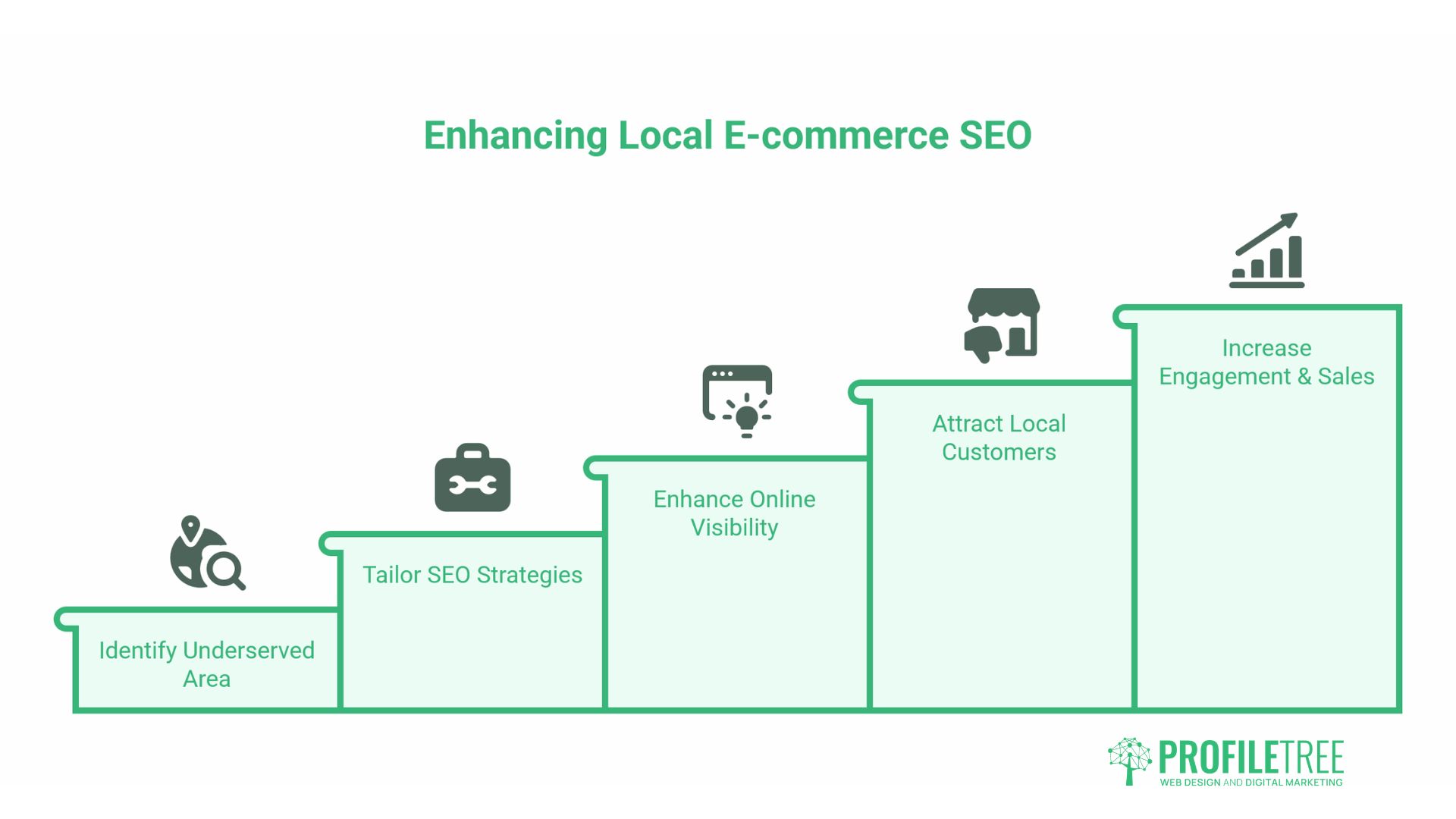
This is the most underserved area in local e-commerce SEO content, and it is particularly relevant to businesses operating in the UK and Ireland.
Customers in Northern Ireland, the Scottish Highlands, the Channel Islands, and rural areas of the Republic of Ireland have learned through experience to check whether a seller will deliver to them at a standard rate before completing a purchase. Many UK online retailers exclude Northern Ireland or the Highlands from free delivery, charge surcharges, or simply do not ship there. For businesses based in those regions, clearly communicating that delivery is domestic and straightforward is a genuine conversion advantage, and that communication can and should appear as an on-page signal that Google can index.
Practical approaches:
- Include a dedicated “Delivery” page that clearly lists all serviced regions, rates, and timescales, using specific place names rather than generic “UK and Ireland” copy
- On category and product pages, include a brief delivery callout with specific regional references
- In your GBP listing, include your service area at regional granularity rather than just “United Kingdom”
- In your FAQ content, directly answer “Do you deliver to Northern Ireland?” and “Do you ship to the Republic of Ireland?” These are real search queries with transactional intent
The Brexit customs context is worth addressing directly for businesses shipping between Great Britain and Northern Ireland. Under the Windsor Framework, most consumer parcel movements within the UK internal market now proceed without customs documentation for most product categories. Stating this plainly on a delivery page removes a purchase barrier for NI customers who may be uncertain.
Building Local Backlinks for E-commerce
Local backlinks, links from other websites with a geographic connection to your market, carry a different quality signal than generic editorial links. A link from a Northern Ireland business association, a Belfast news site, or a Republic of Ireland trade body tells Google something specific about where you operate and who recognises your business as legitimate.
Partnerships with complementary local brands
An e-commerce business selling locally made food products might partner with a Northern Ireland food tourism publication. A Belfast-based homeware brand might co-produce content with a local interior design blog. These partnerships earn topically and geographically relevant backlinks, which is the combination that most benefits the local authority. The link-exchange potential of existing external links in the original article should be reviewed before any are removed (see the editorial notes below).
Local press and industry bodies
Press coverage in regional publications such as the Belfast Telegraph, Irish Times, and BusinessFirst Northern Ireland generates high-quality local backlinks that are difficult to replicate through any other method. Invest NI, Enterprise Ireland, and local chambers of commerce all maintain business directories that function as authoritative citation sources. Getting listed on these is straightforward for eligible businesses and worth prioritising.
Community engagement
Local online communities, Facebook groups for Northern Ireland businesses, LinkedIn groups for Irish e-commerce founders, and regional subreddits offer opportunities to share genuinely useful content in context. These rarely produce direct followed backlinks, but they generate referral traffic, brand mentions, and indirect authority signals that support local rankings over time.
ProfileTree’s SEO services include local link building and citation management as part of broader search engine optimisation engagements for SMEs across Northern Ireland, Ireland, and the UK.
Content Marketing for Local E-commerce Audiences
Blog and editorial content are practical tools for capturing local search intent that product and category pages cannot directly target. A clothing retailer cannot build a product page around “what to wear to a GAA match”, but an article on that topic, well-written and genuinely useful, will rank for queries that its target customers are actually making, and it can link naturally to relevant product categories.
The content calendar approach works well here. Map your editorial content to genuinely local occasions and contexts: the All-Ireland championships, the Twelfth, St Patrick’s Day, Belfast Pride, Christmas gifting in Ireland, the Irish wedding season. These are not manufactured hooks; they are real seasonal moments when your customers are looking for relevant products and when locally targeted content has a natural information gain advantage over generic national guides.
For businesses running this kind of content marketing programme in-house, the ProfileTree Academy’s digital training covers content strategy, keyword research, and publishing workflows designed for SME teams without in-house SEO expertise.
Social signals and geo-tagged content
Social media does not directly influence search rankings in a confirmed way, but geo-tagged posts, location-specific hashtags, and content that generates local engagement do create brand signals that, over time, support local authority. Instagram and Facebook allow location tagging at the post level. For businesses targeting Northern Ireland or specific Irish counties, consistent use of local location tags builds a geographic signal that complements the technical local SEO work.
Technical SEO Foundations for E-commerce Local Visibility
Technical foundations determine whether the local signals you build elsewhere can actually be read and used by search engines. Two areas have the most direct impact for e-commerce sites.
LocalBusiness schema markup
Schema markup communicates structured information about your business directly to search engines in a format they can reliably parse. For e-commerce businesses with local intent, the LocalBusiness schema type — or the more specific OnlineStore subtype — allows you to specify your business name, service area, postcode, phone number, and opening hours in a format that Google can extract for rich results and AI Overviews.
A basic LocalBusiness JSON-LD implementation for a Northern Ireland e-commerce business looks like this:
{
  "@context": "https://schema.org",
  "@type": "OnlineStore",
  "name": "Your Business Name",
  "url": "https://yourdomain.com",
  "telephone": "+44-28-XXXX-XXXX",
  "address": {
    "@type": "PostalAddress",
    "addressLocality": "Belfast",
    "addressRegion": "Northern Ireland",
    "postalCode": "BT1 1AA",
    "addressCountry": "GB"
  },
  "areaServed": [
    "Northern Ireland",
    "Ireland",
    "United Kingdom"
  ],
  "priceRange": "££"
}
For Republic of Ireland businesses, set "addressCountry": "IE" and use the correctly formatted Eircode in the postalCode field.
Site speed and mobile performance
Page speed remains a confirmed ranking factor for mobile search, and mobile accounts for the majority of local search queries. The standard benchmark is a Largest Contentful Paint (LCP) of under 2.5 seconds and a Cumulative Layout Shift (CLS) score below 0.1. For e-commerce sites with large product image catalogues, image compression and lazy loading are the most accessible performance improvements.
ProfileTree’s website development team routinely audits Core Web Vitals performance as part of e-commerce build and optimisation projects.
Site architecture and crawlability
Category pages need to be accessible within two or three clicks from the homepage. Location-specific pages, where they exist, should be included in the XML sitemap and linked from relevant category pages rather than existing as orphaned URLs. Google Search Console’s Coverage report will flag any indexation issues that might be suppressing local pages from appearing in results. The impact of AI on e-commerce conversion rates is increasingly tied to whether search engines can efficiently extract and present structured content, as site architecture directly affects this.
Managing Reviews for Local E-commerce Trust
Customer reviews are a direct local ranking factor for Google Business Profile visibility and a meaningful conversion signal for e-commerce customers choosing between a local seller and a national retailer.
The most effective review generation approach is post-purchase email automation: a follow-up message sent three to five days after confirmed delivery, with a direct link to your Google Business Profile review page. Keep the request brief and the link visible. Avoid incentivised review requests. Google’s guidelines prohibit offering discounts or gifts in exchange for reviews, and the risk of profile suspension outweighs the short-term benefit.
“For smaller e-commerce businesses in Northern Ireland and Ireland, a well-managed Google Business Profile with genuine customer reviews is often the single most cost-effective local visibility tool available,” says Ciaran Connolly, founder of Belfast digital agency ProfileTree. “Customers searching for local product sources want to see that someone nearby has bought from you and had a good experience. That social proof shortcut matters more than most technical SEO changes for businesses at the early stages of building local authority.”
Respond to all reviews, positive and negative. For negative reviews, a calm, factual response that acknowledges the issue and outlines what was done to address it carries more weight with prospective customers than a defensive reply. On Trustpilot, the review response also appears as a snippet in search results in some cases.
Multi-location review management
If your business operates from more than one location, or if you plan to expand to a second warehouse or fulfilment centre, each location should have its own GBP listing and accumulate reviews independently. Do not attempt to consolidate reviews from multiple locations onto a single listing; Google treats each verified address as a distinct entity.
Measuring Local SEO Performance for E-commerce
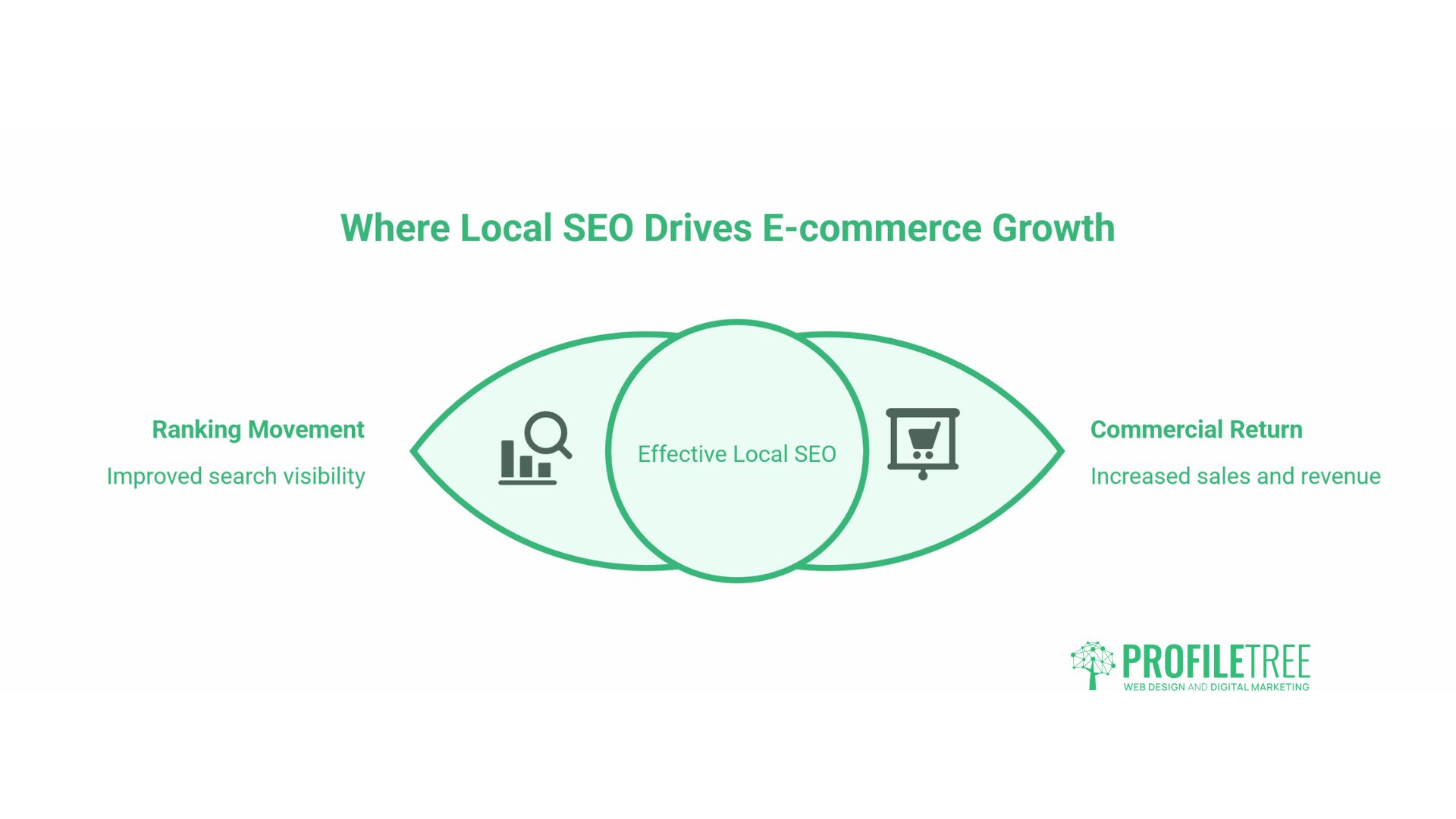
Tracking the right metrics tells you whether your local SEO activity is generating real commercial return or simply moving rankings around. These three areas give the clearest picture for e-commerce businesses.
Google Search Console
The Performance report in Google Search Console shows impression and click data filtered by query. For local SEO, the useful view is to filter queries by location modifier terms (your city, county, region) and check which pages are capturing that traffic. Pages with high impressions but low click-through rates on local queries are candidates for meta title and description optimisation.
The Coverage report will flag any indexation issues. The Core Web Vitals report shows page experience performance by URL group, which helps prioritise technical fixes for the most commercially important pages.
Google Business Profile Insights
GBP’s built-in analytics shows how customers are finding your profile (direct vs discovery search), what actions they are taking (website clicks, directions requests, phone calls), and where they are located. For an e-commerce business, website clicks from GBP Insights are the primary metric they show how many customers moved from your local search listing to your store.
Tracking local keyword rankings
Position tracking for location-modified keywords gives a cleaner picture of local SEO progress than domain-level ranking data. A dedicated position-tracking tool, such as Google Search Console, Ahrefs, or SE Ranking, lets you monitor specific keywords and location combinations over time. Set baselines before making significant changes and allow six to eight weeks before evaluating the impact of structural changes like schema implementation or citation audits.
30-Day Local E-commerce SEO Audit Checklist
- Claim and verify your Google Business Profile as a Service Area Business
- Define your service area at regional granularity (counties or named areas, not just “UK”)
- Ensure your NAP data is consistent across your website, GBP, and all directory listings
- Add or update your listing on Yell.com, Bing Places, Apple Maps Connect, and Golden Pages (if targeting Ireland)
- Implement LocalBusiness or OnlineStore JSON-LD schema on your homepage and key category pages
- Add Eircode or UK postcode to schema markup for all relevant locations
- Review your top five category pages for location signals in title tags, meta descriptions, and page copy
- Create or update a Delivery page with specific regional coverage, including Northern Ireland, Scottish Highlands, and the Republic of Ireland
- Set up a post-purchase review request email with a direct link to your GBP review page
- Run Google Search Console Coverage report and fix any indexation issues
- Check Core Web Vitals for your highest-traffic product and category pages
- Audit existing citations for NAP consistency and correct any discrepancies
- Identify three to five local content topics tied to regional occasions or seasonal buying intent
- Review your internal linking structure to confirm local landing pages are linked from relevant category pages
- Set up position tracking for five to ten location-modified keyword targets
Conclusion: Local SEO for E-commerce
Local SEO is not a set-and-forget task, but it is one of the more measurable investments an e-commerce business can make. A verified Google Business Profile, consistent citation data across UK and Irish directories, and product pages that speak directly to regional customers all compound over time. For businesses in Northern Ireland and Ireland, particularly, the opportunity is sharper than most: the top-ranking content on this topic largely ignores your market, which means well-executed regional specificity is a genuine competitive edge rather than a marginal gain.
FAQs
Can I do local SEO without a physical shop?
Yes. Google’s Service Area Business setting lets you verify a GBP listing without displaying a public address. Define your service regions, and Google uses that data to assess your relevance for local queries.
Will local SEO limit my reach to only my local area?
No. Local signals a complete GBP, consistent citations, regionally relevant content, build domain authority that supports broader national rankings alongside local visibility.
What is the most important local ranking factor for e-commerce?
GBP completeness and review volume are most directly tied to map pack visibility. For organic local rankings, consistent NAP citation data and relevant on-page content carry the most weight.
How do I handle local SEO if I have multiple warehouses across the UK?
Each verified address qualifies for its own GBP listing. Separate listings allow each location to build local authority independently. Do not create duplicate listings for the same address.