
Tailoring Training Programs for Different Generations: Proven Tips
Table of Contents
Tailoring training programs for different generations is now a core people-management task, because up to five age groups share the same workplace and learn in different ways. Baby Boomers tend to favour structured, in-person instruction. Gen Z expects on-demand, digital, gamified content. A single format leaves most of the room behind.
Ciaran Connolly, founder of ProfileTree, puts it plainly: “The mistake we see most often is treating training as one broadcast to a mixed audience. The content might be fine, but if the format only suits one generation, you’ve already lost the rest of the room before anyone has learned anything.”
This guide covers the generational differences that matter, the practical challenges of a mixed-age workforce, and the strategies that make training land across every group.
Understanding Generational Differences
Each generation carries different expectations into the workplace, shaped by the technology and working norms it grew up with. Designing for those differences is the first step toward training that holds attention rather than filling a calendar slot.
The gap is wider than most managers assume. Someone who started their career filing paper records and someone who grew up with a smartphone in hand approach a learning module from completely different starting points. Neither is harder to train; they simply need the material delivered on their terms. Get this right and a single programme can serve a 24-year-old and a 60-year-old equally well.
Key Generations in the Workforce
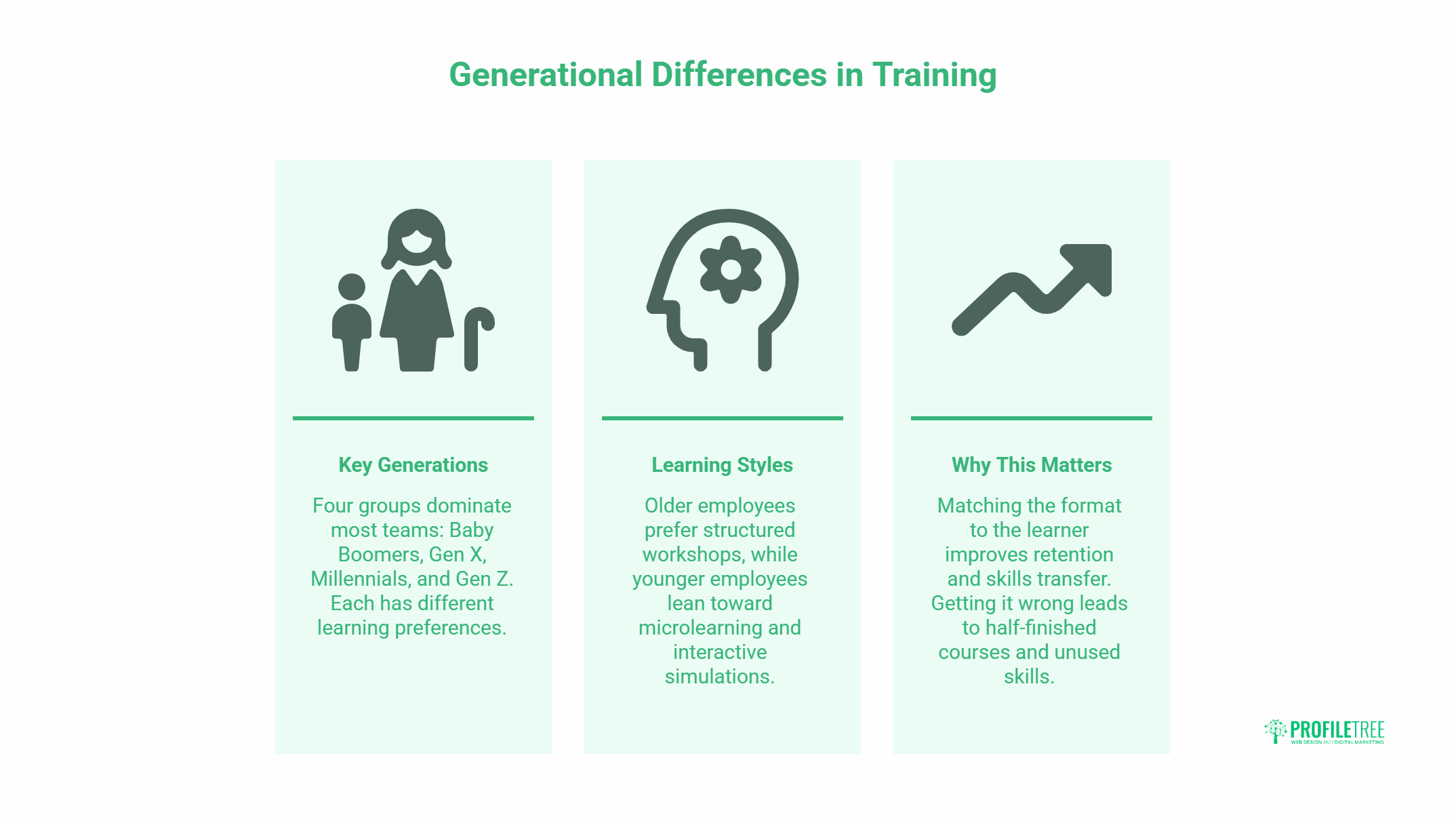
Four groups dominate most teams. Baby Boomers value structured learning and in-person mentorship. Gen X prefers independence and hands-on, practical sessions. Millennials respond to collaboration and technology-led formats. Gen Z wants personalised, on-demand content with digital tools and gamification.
Mapping who sits where is what makes a training plan realistic rather than generic. A team that is 70% Gen X and Millennial needs a different default than one weighted toward recent graduates. Start with a simple headcount by age band before you choose any platform or format.
How Learning Styles Differ
Older employees often prefer structured workshops and classroom sessions with clear instructions and time to absorb material. Younger employees, raised on phones and apps, lean toward microlearning, short videos, and interactive simulations they can complete between other tasks.
One useful signal: attention span varies sharply by age group, and ProfileTree’s own search data shows steady interest in “average attention span by generation”, which tells you shorter formats earn their place for younger staff. That doesn’t mean dumbing content down. It means breaking it into self-contained pieces that each deliver one clear point.
Why This Matters for Skills
When the format matches the learner, retention improves, and skills actually transfer to the job. A team that plans content this way will usually see better completion rates than one running a single mandatory module for everyone.
The cost of getting it wrong is quiet but real: half-finished courses, skills that never reach daily work, and staff who treat training as a box to tick. The same principle applies to any digital upskilling work, which is why structured digital skills training and digital training sessions are built around the audience rather than the topic alone.
Challenges in a Multigenerational Workforce
Mixed-age teams create friction that a uniform programme cannot solve. Three problems come up repeatedly, and each one quietly drags down engagement if you ignore it.
Differing Technological Proficiency
Millennials and Gen Z are usually comfortable with new platforms; some Baby Boomers and Gen X staff are not. A glossy e-learning system can stall an entire cohort if half the room cannot navigate it, and the people who struggle rarely say so out loud.
Blended delivery, short tech-orientation sessions, and a named person to ask all help close the gap. A ten-minute walkthrough of the platform before the real training starts removes most of the early drop-off. Pair less confident staff with a digitally fluent colleague for the first module, and the problem usually solves itself.
Varied Communication Preferences
Older staff often want written guides and face-to-face explanations. Younger staff prefer messaging, short videos, and forums. Offering the same material in two or three formats removes the “this wasn’t built for me” reaction that quietly kills engagement.
This is less work than it sounds. A single session can be recorded, summarised in a one-page written guide, and posted as a short clip, covering three preferences from one piece of content. The point is choice, not duplication for its own sake.
Conflicting Feedback Expectations
Baby Boomers tend to expect scheduled, formal reviews. Gen X wants direct, constructive feedback. Millennials and Gen Z prefer frequent, real-time check-ins. A training programme that bakes in regular, lightweight feedback usually satisfies more of the room than one annual review does.
Short pulse checks after each module work better than a single end-of-programme survey, because they catch problems while there’s still time to fix them. For teams running ongoing campaigns, the same logic carries into social media marketing, where younger staff often lead, and older staff need quick, frequent context.
Strategies for Tailoring Training Programs
You don’t need a separate programme per generation. You need flexible delivery that lets each group learn in the way that suits it, drawn from the same core material.
Customise Content Delivery
Blended learning, combining in-person sessions with self-paced digital modules, gives every group a route in. Microlearning suits Millennials and Gen Z; detailed, structured lessons suit Baby Boomers and Gen X. Offering video, live workshops, and self-paced courses side by side is the single most effective change for a mixed team.
Build the content once, then package it in multiple formats rather than writing separate programmes. A strong content marketing approach uses exactly this multi-format thinking, and the same discipline applies to internal training. According to the CIPD’s learning and skills research, employers increasingly favour blended approaches that combine digital and in-person delivery.
Use Technology Sensibly
Gamification, badges, and leaderboards engage younger learners by adding light competition. Intuitive, low-friction platforms keep older staff comfortable and willing to return. The trick is matching the tool to the learner rather than chasing the newest feature.
AI tools can now adapt pace and difficulty to the individual, which suits a mixed-age team well because the system does the tailoring automatically. Businesses exploring this can start with AI training before rolling anything out company-wide.
Offer Personalised Learning Paths
Self-paced tracks suit independent learners; structured mentorship supports those who want guidance. Tying training to clear career-development goals raises participation across every age group, because people engage when the learning visibly connects to their progression.
A short conversation linking each module to someone’s next role does more for completion rates than any platform feature. Where video is the right medium, planned video marketing production keeps quality consistent across modules, so the format never becomes an obstacle.
Benefits of Tailoring Training Programs
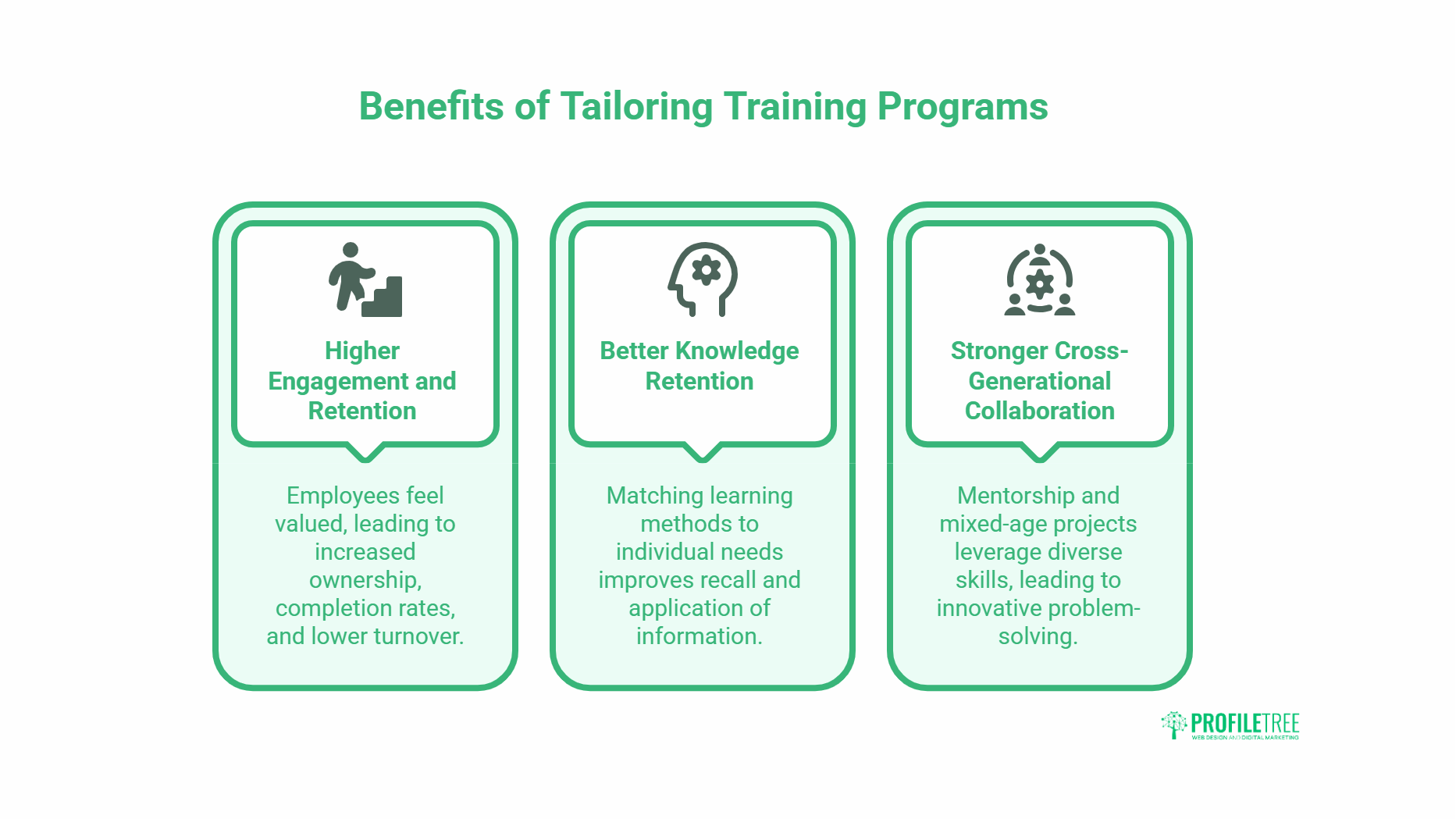
Done well, tailored training improves engagement, retention, and collaboration at the same time, and the gains compound over a year rather than appearing all at once.
Higher Engagement and Retention
Employees who feel a programme was built with them in mind take more ownership of it. That tends to show up as higher completion rates and lower turnover, because staff who can see a development path are more likely to stay.
Retention matters most for the people you can least afford to lose: experienced staff weighing retirement and ambitious younger staff weighing a move elsewhere. Training that speaks to both keeps more of them.
Better Knowledge Retention
Matching the method to the learner improves recall. Microlearning and gamification help younger staff absorb material in short bursts; scenario-based workshops give older staff applied practice they can use immediately. Follow-up assessments reinforce both and surface anything that didn’t stick.
Stronger Cross-Generational Collaboration
Mentorship pairings and mixed-age project work turn generational difference into an advantage. Older staff pass on judgment built over years; younger staff share digital fluency. The result is a team that solves problems from more angles than any single age group could manage alone.
Conclusion
Tailoring training programs for different generations is now standard practice for any business with a mixed-age team. Match the format to the learner, offer content in more than one way, and tie it to career progression. The payoff is better engagement, stronger retention, and a workforce that keeps pace with change. If you’d like help building digital skills across your team, see how ProfileTree’s digital training works.
FAQ
What Does Tailoring Training Programs for Different Generations Mean?
It means adapting the format, delivery, and feedback style of training to suit each age group in the workforce, rather than using one fixed approach for everyone.
How Many Generations Are in the Workplace Today?
Up to five, though four dominate most teams: Baby Boomers, Gen X, Millennials, and Gen Z.
Do I Need a Separate Programme for Each Generation?
No. Offering the same material in multiple formats, such as video, written guides, and live sessions, usually covers the whole team without separate programmes.
Which Generation Prefers Digital Learning?
Millennials and Gen Z generally prefer digital, on-demand, and gamified formats, while older groups often favour structured or in-person sessions.