
WordPress Reigns Supreme: UK Business CMS Guide
Table of Contents
More than 43% of all websites on the internet run on WordPress, and that figure has grown every year since the platform launched in 2003. It’s why WordPress reigns supreme not just in market share statistics, but in the day-to-day choices made by developers, agencies, and business owners across the UK and Ireland.
For any organisation evaluating a content management system today, understanding what puts WordPress so far ahead of every alternative is the right starting point. This guide covers the data, the technical arguments, the GDPR and data ownership considerations, and the honest comparison with AI site builders that many decision-makers are now asking about.
Why WordPress Reigns Supreme: The 2026 Numbers
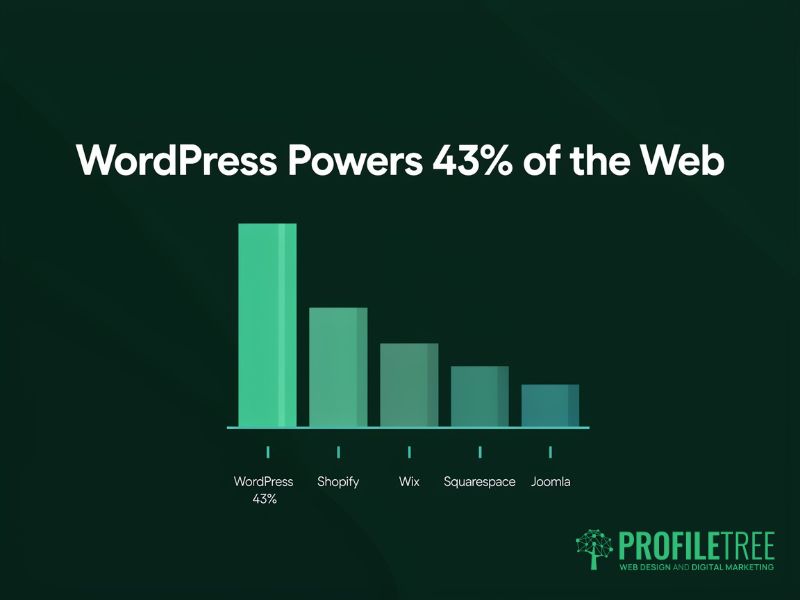
Understanding why WordPress reigns supreme starts with the numbers, but the scale only becomes meaningful when you put the content management system market in context. WordPress does not just lead the CMS category; it outperforms every other platform combined across website types, business sectors, and company sizes. The figures below draw on W3Techs CMS market share data for 2025.
| CMS Platform | Market Share % | SEO Flexibility | Data Exportability | UK Agency Support |
|---|---|---|---|---|
| WordPress | 43.6% | Full control | Complete, portable | Extensive |
| Shopify | 4.4% | Limited (e-commerce focus) | Product data only | Moderate |
| Wix | 2.7% | Moderate, improving | Restricted | Limited |
| Squarespace | 2.7% | Basic | Restricted | Limited |
| Joomla | 1.8% | Good with plugins | Mostly portable | Moderate |
When Wix and Squarespace launched with aggressive marketing campaigns aimed at small businesses, industry observers predicted a shift away from open source solutions. That shift didn’t arrive. The reason is structural: WordPress solves problems that subscription-based builders cannot, particularly for businesses that expect to grow, change strategy, or need granular control over how their content management system performs in search. WordPress’s 43.6% share is more than the next ten platforms combined, and it’s still growing year on year.
For businesses working with professional web development services, starting on WordPress means every pound invested in development, content, and SEO stays fully accessible and portable. No other CMS delivers that combination at scale. From simple web design projects to complex enterprise platforms, WordPress is the consistent professional choice.
WordPress Reigns Supreme for UK and Irish Businesses: Ownership and GDPR
The global statistics matter, but the reasons WordPress reigns supreme become more specific when you look at what UK and Irish businesses actually need from a content management system. Three areas stand out consistently: data sovereignty, public sector adoption, and the open source transparency that makes GDPR compliance straightforward to document and demonstrate.
Data Sovereignty and GDPR Compliance
UK businesses operating under UK GDPR and Irish businesses subject to EU GDPR face the same core challenge: knowing where their customer data lives and who has access to it. A self-hosted WordPress installation puts that decision entirely in your hands. You’re in control of where your data lives and who can access it. You choose the hosting provider and therefore the server location, selecting a UK-based data centre, an EU-based provider, or whichever jurisdiction your compliance team specifies.
SaaS platforms like Wix and Squarespace do not offer the same control. Your data lives on their infrastructure, in data centres you cannot specify, under their terms of service. For businesses handling customer data, processing payments, or operating under sector-specific data regulations, that distinction matters considerably. Because WordPress is open source, your legal and compliance teams can audit the code, verify the data flows, and document processing activities in the precise way that GDPR accountability obligations require.
The UK Public Sector: A WordPress Stronghold
Some of the most security-conscious and accessibility-aware organisations in the UK run on WordPress. NHS England uses WordPress for several public-facing information sites. Dozens of local authorities across England, Scotland, and Wales have adopted it for council and community portals, drawn by its open source transparency, active security community, and the relative ease of meeting WCAG 2.1 accessibility standards through well-maintained themes and plugins.
The public sector’s adoption is a meaningful signal for private sector decision-makers. When institutions with strict procurement, accessibility, and security requirements choose this content management system at scale, it confirms that WordPress is mature, auditable, and fit for professional use at every level.
Whether you’re working with a digital strategy agency to plan a site rebuild or launching a new venture, the question of platform control comes up early. WordPress’s open source ownership model wins that conversation consistently across Northern Ireland, Ireland, and the wider UK.
WordPress Reigns Supreme Against AI Site Builders
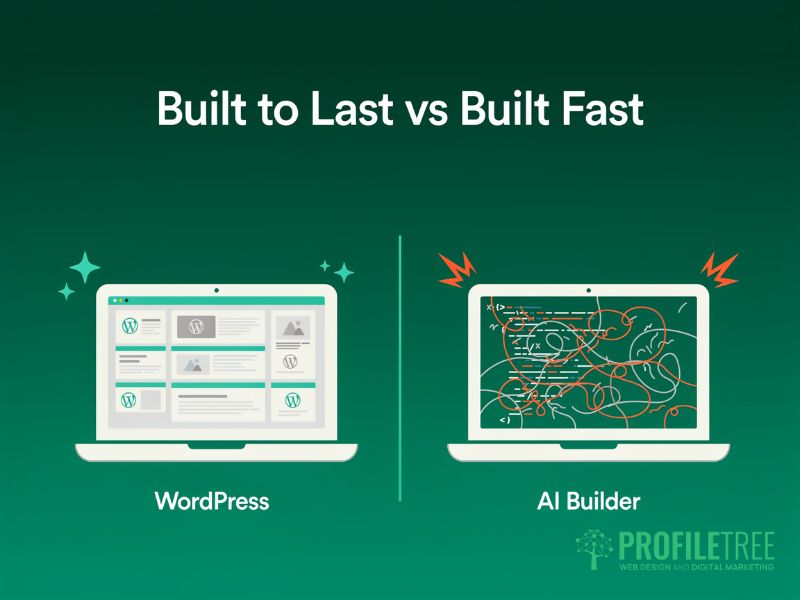
WordPress reigns supreme in a market that now includes a wave of AI-powered site builders promising to generate a working website from a text prompt in minutes. Understanding why the content management system still wins that comparison isn’t complicated, but it does require an honest look at what AI builders actually deliver and where they fall short for businesses with serious growth plans.
Why Easy Does Not Mean Better for Long-Term SEO
Ciaran Connolly, founder of ProfileTree, is direct on this point: “AI builders generate a site quickly, but the code they produce is often bloated and difficult to optimise. When we audit sites built this way, we consistently find structural issues that create a ceiling on how well they can perform in search. WordPress gives developers the control they need to build something that genuinely competes.”
The SEO ceiling problem is specific and worth understanding. AI-generated code tends to be verbose, relying on inline styles and generic class names that make it difficult to implement clean schema markup, precise Core Web Vitals optimisation, or the structured internal linking that search engines reward. A WordPress site built by an experienced developer starts without those constraints. The open source nature of the platform means every element is inspectable, adjustable, and optimisable.
For businesses focused on organic growth, the value of a well-structured WordPress CMS compounds over time. Every search engine optimisation improvement you make is fully under your control, with no platform restrictions on what you can change or how deeply you can intervene in the code.
Avoiding the Digital Sharecropping Trap of SaaS
Digital sharecropping describes the situation where a business builds its entire online presence on infrastructure owned by someone else. The term applies directly to SaaS website builders: you pay a monthly subscription to use their platform, their hosting, and their tools. If the provider raises prices, changes features, or shuts down, your options are severely limited. Because WordPress is open source, that risk does not exist.
The total cost of ownership comparison over five years makes the financial case clear:
| Cost Factor | WordPress (Self-Hosted) | Shopify (Standard Plan) | Wix (Business Plan) |
|---|---|---|---|
| Monthly platform fee | None | ~£69/month | ~£25/month |
| Transaction fees | None | 0.5–2% | None |
| Hosting (annual) | £100–£500 | Included (no choice) | Included (no choice) |
| Data portability | Complete at any time | Products only; design lost | Very limited |
| 5-year total (estimate) | £1,200–£3,000 | £5,000+ excl. transaction fees | £2,500+ |
The numbers favour WordPress across any extended period, and the gap widens as transaction volumes increase on Shopify. When a WordPress business wants to move hosting providers, redesign the site, or change development agencies, everything is portable. The content, the code, the WooCommerce product data, and the SEO equity all transfer with it.
Technical Strengths: Web Design, WooCommerce, and Why the WordPress Platform Wins
WordPress reigns supreme technically because it has kept pace with how web development has changed, rather than locking businesses into yesterday’s architecture. The open source model means thousands of developers worldwide contribute improvements, security patches, and new capabilities continuously. The result is a content management system that supports everything from a startup’s first landing page to enterprise deployments handling millions of monthly visitors.
The Gutenberg Evolution and Full Site Editing
The Gutenberg block editor, introduced in 2018, transformed how non-technical users build pages in WordPress. Full Site Editing, available since WordPress 5.9, extends that block-based approach to headers, footers, sidebars, and templates. A marketing team member can now update the global layout of a CMS-powered site without touching a line of code, while developers retain complete control over the underlying structure when precision matters.
This dual-access model is what makes WordPress workable for organisations at every level of technical sophistication. You don’t have to choose between ease of use and developer control. The open source plugin library, currently exceeding 59,000 extensions, means the content management system can be extended to cover almost any requirement without custom development. From booking calendars and membership portals to advanced analytics dashboards, there’s a maintained, peer-reviewed plugin for it.
WooCommerce and E-Commerce Scalability
WooCommerce powers approximately 29% of all global e-commerce sites (E-Commerce Tech Stats, 2023), making it the world’s most widely used open source e-commerce platform. Its integration within WordPress means businesses do not need to migrate to a separate content management system when they decide to start selling online. Adding WooCommerce to an existing WordPress site is a configuration change, not a rebuild.
WooCommerce supports UK payment gateways, including Stripe, PayPal, and Sage Pay, natively. It handles everything from a handful of products on a local artisan site to thousands of SKUs with variant pricing, subscription billing, and wholesale tiers. Because it is open source, the WooCommerce codebase is fully auditable and extensible, with no transaction fees beyond those charged by your chosen payment processor.
Businesses in Northern Ireland and Ireland considering e-commerce can review ProfileTree’s web design services to understand how WooCommerce builds are structured for long-term scalability within the WordPress CMS. Web design decisions made at this stage, from URL structure to page templates, have a lasting effect on both SEO and conversion rates.
The SEO Advantage: Why WordPress Reigns Supreme in Search
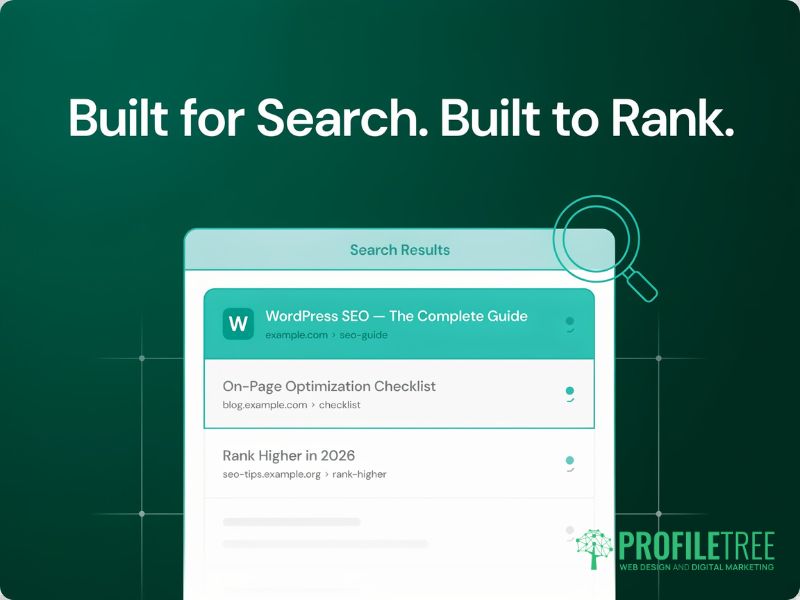
WordPress reigns supreme in organic search, not because of its market share, but because of the technical foundation it provides for SEO work. The content management system’s clean permalink structure, native schema markup support, and compatibility with leading SEO plugins mean the right foundations are already in place before a developer writes a single line of custom code. Three factors separate well-built WordPress sites in competitive UK search results.
Core Web Vitals and Page Experience
Google’s page experience signals: Largest Contentful Paint, Interaction to Next Paint, and Cumulative Layout Shift. These are all addressable in WordPress through a combination of quality hosting, caching plugins, image optimisation, and clean theme code. The degree of control available on a self-hosted open source installation is simply not replicable on a closed SaaS platform, where you cannot inspect or modify the underlying code that determines how fast your pages load.
UK businesses investing in SEO need that level of control. When a Core Web Vitals audit surfaces a specific issue, a WordPress developer can fix it precisely. On Wix or Squarespace, you are limited to whatever the platform exposes in its settings panel.
Schema Markup and AI Citation
Schema markup integration is one of the clearest areas where WordPress reigns supreme over closed platforms. For UK businesses targeting local and national search queries, this matters directly. Plugins like Rank Math allow precise schema deployment across the content management system: FAQPage for question-and-answer content, Article for blog posts, LocalBusiness for service pages targeting UK geographic queries. Structured data improves how search results are displayed and increases the likelihood of citation in AI-generated answers from Google, Bing, and ChatGPT.
Pages covering multiple related sub-questions within a topic are 161% more likely to appear in AI Overviews (Ahrefs, 2024). WordPress’s flexibility to structure content precisely, with clean heading hierarchies, self-contained sections, and proper schema, gives publishers the tools to meet that standard consistently. No other CMS provides the same combination of accessibility and technical depth at this price point.
For businesses working on their organic visibility, ProfileTree’s SEO services are built around WordPress-native optimisation techniques that work with the open source platform’s architecture rather than around its limitations.
Internal Link Architecture
WordPress makes it straightforward to build the hub-and-spoke internal linking structure that concentrates topical authority across a content cluster. This matters increasingly as search engines and AI systems evaluate whether a site demonstrates genuine expertise across a subject area rather than covering it superficially. A well-structured WordPress CMS, with a consistent URL architecture, logical category structure, and deliberate internal linking, signals exactly that kind of topical depth.
For businesses building out their content strategy alongside their technical SEO, ProfileTree’s content marketing services are designed to work within WordPress’s open source architecture and maximise the authority signals it generates.
Making the Right CMS Choice for Your Business
WordPress reigns supreme because it solves the right problems for the right reasons. The content management system gives businesses full ownership of their digital assets, genuine flexibility to grow and change, and the open source technical foundation that both search engines and AI systems reward. Its 43%+ global market share is not the product of inertia; it reflects consistent delivery across every type of business website for more than two decades.
For UK and Irish businesses specifically, the combination of data residency control, GDPR flexibility, WooCommerce e-commerce capability, and a well-established local agency network makes WordPress the defensible long-term choice. SaaS platforms and AI builders serve a purpose for the simplest use cases, but they introduce constraints and costs that don’t go away. WordPress doesn’t work that way: the longer you invest in it and the more content you build on it, the more authority and SEO equity it accumulates.
ProfileTree has worked with businesses across Northern Ireland, Ireland, and the UK since 2011, delivering WordPress CMS projects ranging from SME web design and service sites to enterprise content hubs. To discuss how WordPress web design or website development can serve your organisation, our team is ready to help.
FAQs
1. What percentage of the internet runs on WordPress in 2026?
WordPress powers approximately 43.6% of all websites globally, according to W3Techs CMS market share data for 2025. That figure represents more than ten times the market share of Shopify, its nearest rival at 4.4%. The content management system’s dominance spans every website category, from personal blogs to major media publishers, government institutions, and large e-commerce operations running on WooCommerce.
2. Is WordPress better than Shopify for UK e-commerce?
For most UK businesses, WordPress with WooCommerce offers a more cost-effective and flexible e-commerce solution than Shopify over the medium to long term. Shopify charges transaction fees on top of monthly subscription costs unless you use Shopify Payments. WooCommerce doesn’t charge platform transaction fees, supports UK payment gateways including Stripe and Sage Pay natively, and gives you complete control over the checkout experience. Because WooCommerce is open source, it’s fully auditable, and there is no lock-in if you want to change providers or migrate to a different host.
3. Does WordPress handle GDPR compliance better than Wix for UK businesses?
WordPress offers greater GDPR compliance flexibility because it is open source and self-hosted: you choose where your data lives, which processors handle it, and how cookies are managed. Wix and similar SaaS platforms host your data on their infrastructure, in data centres you cannot specify, under their terms of service. For UK businesses subject to UK GDPR, or Irish businesses under EU GDPR, the ability to select a UK or EU-based server and configure your own data processing agreements is a material compliance advantage that a self-hosted content management system provides and a SaaS platform cannot.
4. Is WordPress too difficult for non-technical users in 2026?
WordPress has become considerably more accessible for non-technical users since the Gutenberg block editor replaced the classic editor in 2018. Full Site Editing, introduced in version 5.9, allows marketing teams to manage global page layouts using a drag-and-drop interface without developer involvement. For businesses that want a CMS their whole team can use, WordPress and Gutenberg now deliver that without sacrificing the technical depth that developers need for SEO and performance work. The Gutenberg editor has effectively closed the ease-of-use gap with closed platforms while keeping the open source flexibility that makes WordPress worth choosing.
5. Can an AI site builder replace WordPress for a growing business?
AI site builders can produce a functional website quickly, but they are not a direct replacement for WordPress as a content management system for businesses with growth ambitions. The code generated by AI builders tends to be bloated and difficult to optimise for Core Web Vitals. Most AI builders also operate as SaaS platforms, which means you do not own the underlying infrastructure and carry the lock-in risks described above. For any business planning to invest in SEO, content marketing, or WooCommerce e-commerce, WordPress remains the stronger open source foundation by a considerable margin.