
What Is Creative Strategy? Performance Framework for Modern Marketing
Table of Contents
A creative strategy is the documented plan that connects your business goals to every piece of content, design, and advertising you produce. ProfileTree, a Belfast-based digital agency, builds creative strategies for SMEs across Northern Ireland, Ireland, and the UK — and the consistent finding is the same: businesses with a defined creative direction outperform those that post reactively, regardless of budget. Without a strategy, marketing decisions become guesswork. With one, your web design, video, SEO, and content all pull in the same direction.
What is Creative Strategy?
A creative strategy is the overall plan that guides how a business communicates its brand, products, and services to its target audience. It defines the tone, the message, the channels, and the creative approach for all marketing and advertising activity.
It sits between brand strategy (which defines who you are) and creative tactics (the individual ads, posts, and pages you produce). Creative strategy is the layer in the middle: it tells your team how to win, not just who you are or what you’re making today.
Creative strategy meaning: A creative strategy is a documented plan that aligns your business objectives with the messages, channels, and formats used across your marketing and advertising. It translates business goals into creative decisions, ensuring every campaign, piece of content, and design choice serves a specific commercial purpose.
Why Creative Strategy Matters
The most common mistake businesses make is investing in digital services without a strategy to connect them. A new website gets built without a content plan. A video gets produced without a brief. Social posts go out without any agreed messaging framework. Each individual piece might look fine in isolation. None of them work together.
Creative strategy is what stops that happening. When it exists, a web designer, a video producer, an SEO specialist, and a content writer can all work from the same brief and produce output that reinforces the same message. Without it, you’re spending money on disconnected assets.
For UK and Irish SMEs in particular, budget constraints make this even more important. You can read more in our guide to digital marketing strategy for business growth about how strategy should drive every channel decision you make.
Creative Strategy vs Marketing Strategy vs Brand Strategy
These three terms are frequently confused, and the confusion leads to real problems: companies either skip the strategy layer entirely or conflate it with the brand work they did when they launched.
| Component | Brand Strategy | Creative Strategy | Creative Tactics |
|---|---|---|---|
| Focus | The Identity — who we are | The Approach — how we win | The Execution — what we make |
| Timeframe | Long-term (3–10 years) | Mid-term (quarterly/campaign) | Short-term (daily/weekly) |
| Key Question | What do we stand for? | How do we get them to care? | Does this ad feel right? |
| Who Owns It | Leadership/Brand team | Strategy or agency lead | Creative or content team |
| Deliverable | Brand guidelines, mission | Campaign brief, messaging hierarchy | Videos, copy, banners, web pages |
Think of brand strategy as the foundation of your business — it rarely changes. Creative strategy is the adaptable framework that responds to your current market position, campaign goals, and audience behaviour. Tactics are the daily executions: the social posts, the landing page copy, the video thumbnails.
The critical point is that creative tactics without a strategy are just guesswork. You might produce a video that looks good but communicates nothing useful. You might run ads that generate clicks but attract the wrong audience. Strategy is what makes the creative decisions defensible.
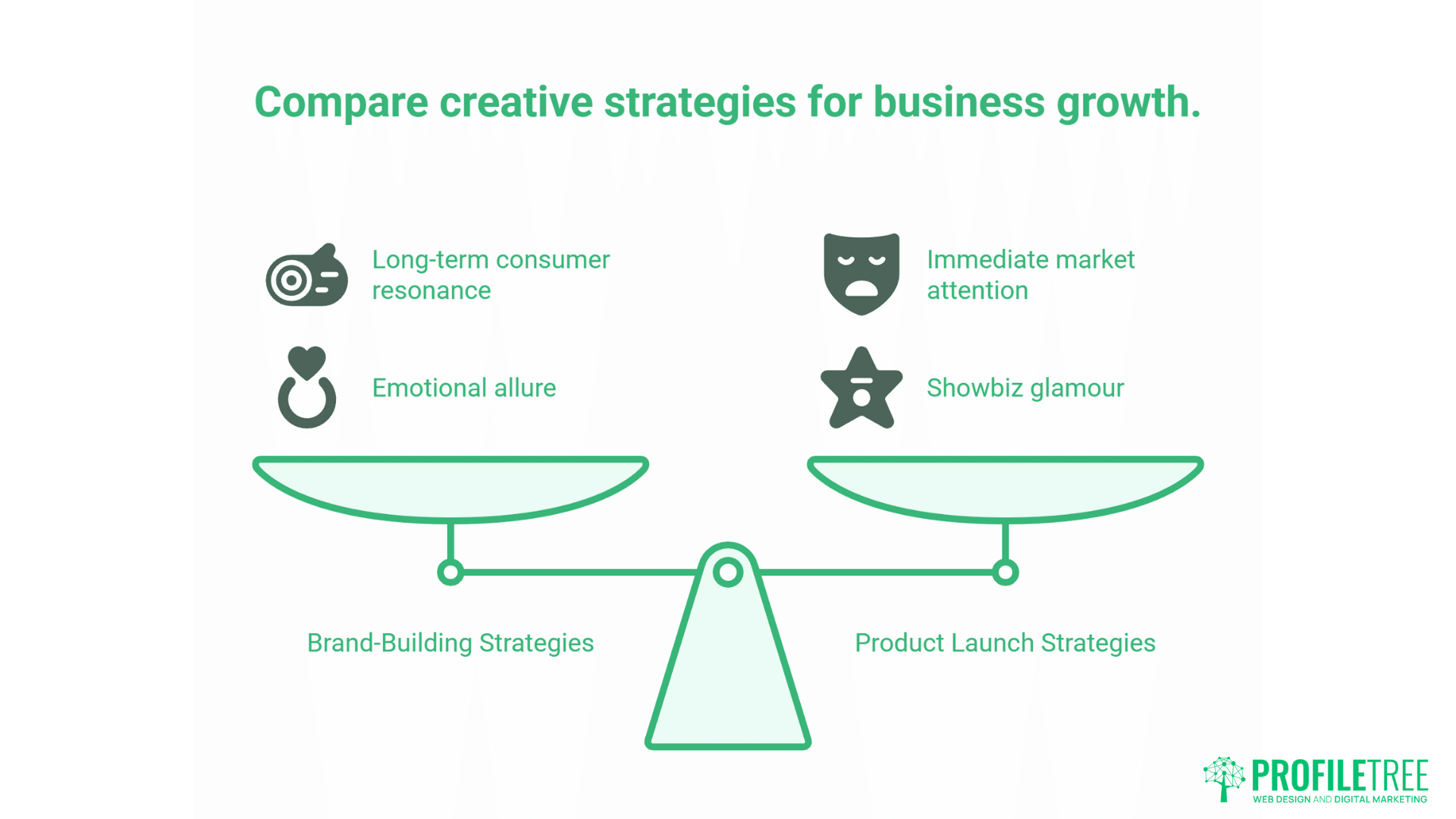
Creative strategies encompass various approaches suited to different business objectives. Here are the key types:
- Brand-Building Strategies: Crafting an iconic brand identity and storyline that establishes long-term consumer resonance. Example – DeBeers’ enduring ‘A Diamond is Forever’ campaign that has defined the emotional allure of diamonds since 1948.
- Product Launch Strategies: Raising the curtain on new products/services with show-stopping campaigns that capture market attention. Example – Apple’s headline-grabbing product launches oozing showbiz glamour and spectacle.
- Customer Engagement Strategies: Building two-way conversations and communities around brands via interactive campaigns. Example – Charmin’s #TweetFromTheSeat campaign urged people to engage with their fun, witty content.
- Influencer Marketing Strategies: Partnerships with influencers to expand reach and credibility among relevant niches. Example – Daniel Wellington embraced influencer marketing early on to rise as a leading digital watch brand.
Creative Strategy vs a Content Plan vs a Marketing Plan
These three documents serve different purposes, but most SMEs either conflate them or use one in place of all three. The confusion is understandable — they overlap — but treating them as interchangeable creates real gaps.
A marketing plan defines your overall commercial goals, target markets, budget allocation, and channel mix for a given period. It answers the question: where are we spending, and why?
A content plan is an operational document. It schedules what gets published, on which platform, and when. It answers: what are we producing, and when does it go out?
A creative strategy sits above both. It defines the audience insight, the core message, the visual and tone direction, and the channel fit that should inform every piece of content and every marketing decision. It answers: what are we saying, to whom, in what voice, and why should they care?
The practical consequence of conflating these is that businesses often have a full content calendar and no clear message. Posts go out consistently. Nothing lands. The content plan is working; the creative strategy is missing.
The 4 Core Elements of a Creative Strategy

Every effective creative strategy, regardless of business size or sector, is built on four components. Get these four right and the creative decisions that follow become significantly easier.
1. Target Audience
Not a generic demographic description. A clear picture of the specific person you’re trying to reach, including what they’re trying to achieve, what’s stopping them, and where they look for information. For B2B businesses across Northern Ireland and Ireland, this usually means defining the decision-maker role (owner, marketing manager, operations lead) as well as the business type and size.
2. Key Message
The single most important idea you want your audience to take away. Not a list of features. Not a tagline. One clear, specific claim that differentiates your offer. For an SME, this is often where the most valuable strategic thinking happens, because it forces a choice: you cannot say everything to everyone.
3. Objective
A measurable outcome that defines what success looks like for a given campaign or period. “Increase brand awareness” is not an objective. “Generate 40 qualified enquiries from professional services businesses in Belfast during Q2” is. Clear objectives are what make it possible to evaluate creative work objectively rather than based on personal preference.
4. Distribution Channels
The platforms and formats through which your message reaches your audience. This decision shapes everything downstream. A strategy aimed at LinkedIn requires different creative from one aimed at YouTube. A website-led strategy requires different content from an email-led one. Channel choice should follow audience behaviour, not the channels your competitors happen to use.
How to Build a Creative Strategy Without a Large Agency Budget
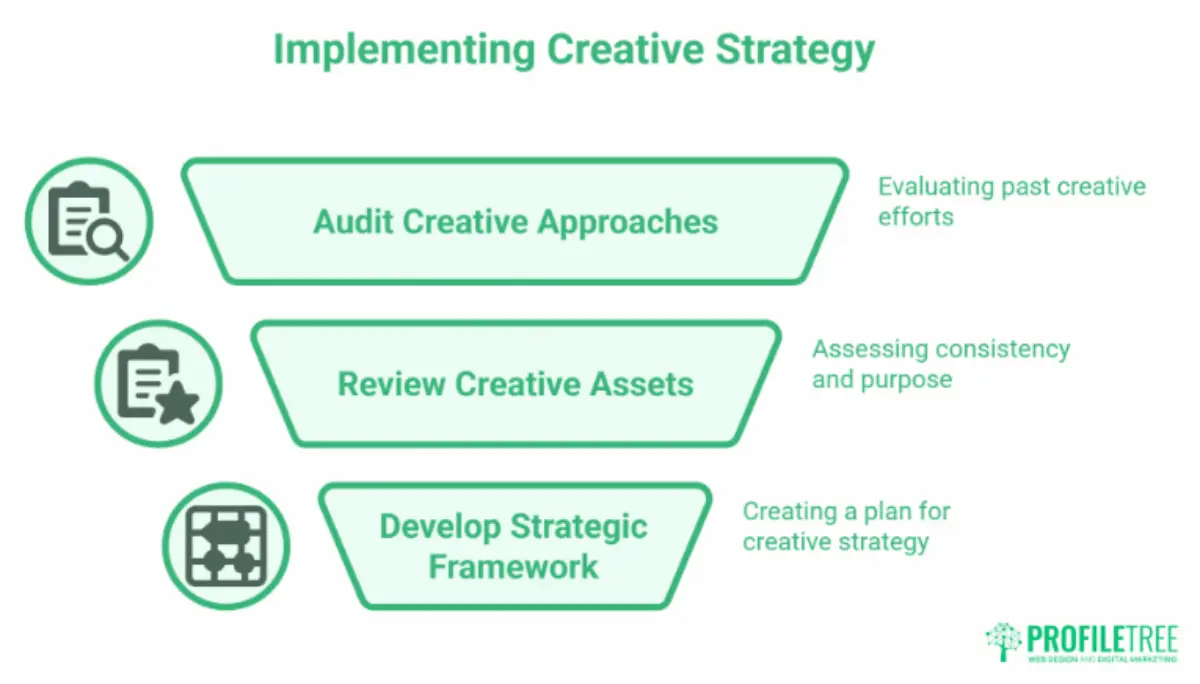
A creative strategy does not require a six-figure retainer or a specialist strategy team. What it requires is structured thinking and a willingness to make decisions — specifically, the decision to commit to a message, an audience, and a tone rather than trying to appeal to everyone.
The following process is designed for SME owners and marketing managers working without dedicated creative strategy resource.
Step 1: Write down who you are not trying to reach. Most SMEs define their audience too broadly. The discipline of exclusion is more useful than the aspiration of inclusion. If your service business in Belfast works best with professional services clients at the 10–50 employee mark, write that down explicitly. Every piece of creative that follows should be evaluated against that definition.
Step 2: Identify one problem you solve better than anyone else. Not a list of services. One specific problem, stated in the language your clients use when they describe it, not the language you use internally. This becomes the foundation of your core message.
Step 3: Decide on a tone and stick to it. Formal or conversational? Data-led or story-led? Local and specific or broad and authoritative? The wrong answer is “it depends on the post.” Inconsistent tone is one of the clearest signals that no creative strategy exists.
Step 4: Choose two channels and ignore the rest for now. The pressure to maintain a presence across every platform is one of the main reasons SME content becomes reactive and unfocused. Two channels, used with genuine strategic intent, will outperform six channels used without direction.
Step 5: Write it on one page. A creative strategy brief does not need to be a lengthy document. For a Northern Ireland service business, it might look like this:
Audience: Owner-managers of professional services firms in Belfast and the wider NI market, 10–50 employees, buying decisions made by the owner or a senior partner.
Core message: We help professional services businesses look credible online without the complexity and cost that larger agencies bring.
Tone: Direct, plain English, no jargon. Confident but not corporate. Local references where relevant.
Primary channels: LinkedIn (thought leadership and referral) and organic search (service pages and guides).
What success looks like this quarter: 15 qualified enquiries from professional services businesses.
That is a creative strategy. It took 20 minutes to write and it will inform every content and design decision for the next three months.
The Connectivity Gap: Why Creative Strategy Fails Without Execution
Strategy without execution is just a document. Execution without strategy is just spending. The gap between the two is where most SME marketing budgets get wasted.
Consider how this plays out in practice. A business hires a web design agency to build a new site. The site looks professional. The navigation is clean. But nobody briefed the agency on what the target audience needs to see in the first five seconds, or which pages should convert enquiries versus which should build trust. Three months after launch, the bounce rate is high and the phone isn’t ringing. The problem isn’t the website. The problem is that no creative strategy existed to brief the website against.
The same issue occurs with video production. A business invests in a company video. It looks impressive. But nobody defined what the viewer should do after watching it, or what specific message would resonate with the target customer, or where in the buyer journey the video sits. The result is a polished piece of content that serves no measurable purpose.
Creative strategy is what makes these digital investments work. At ProfileTree, our web design service begins with a strategic conversation, not a design conversation, because the brief has to exist before the pixels do. The same applies to our animated video production work: the script, the hook, the call to action, and the placement all flow from a strategic brief, not creative instinct alone.
The role that sits at the centre of this is the creative strategist. In larger organisations, this is a dedicated position. For most SMEs, it’s a responsibility that typically falls between the business owner and whoever they’ve hired to do the creative work — and that gap, more often than not, is why campaigns underperform.
If your designers never see the results of their work, you don’t have creative strategy. If your marketing spend is driven by “what looks good” rather than “what the data tells us works”, you don’t have creative strategy. The fix is a brief: a document that connects the business objective to the creative decision.
Creative Strategy for UK and Irish Businesses: What’s Different
Most guides to creative strategy are written with a US or global audience in mind. For businesses operating in the UK and Ireland, there are specific factors that genuinely change how creative strategy should be developed and applied.
Compliance: ASA and CAP Codes
Advertising in the UK is governed by the Advertising Standards Authority (ASA) and the UK Advertising Codes (CAP). All marketing communications, including digital advertising, social media content, and email campaigns, must comply with standards around honesty, substantiation of claims, and treatment of vulnerable audiences. Creative strategy for UK businesses needs to account for this at the brief stage, not as an afterthought in the approval process.
The core CAP principle is that ads must be “legal, decent, honest and truthful.” In practice, this means any performance claim in your creative needs to be verifiable, and any testimonial or case study requires substantiation. For Northern Ireland businesses running activity on both sides of the border, content must also comply with the Broadcasting Authority of Ireland’s (BAI) codes for any broadcast-adjacent digital advertising.
Cultural and Linguistic Nuances
The UK and Ireland are not homogeneous markets. The tone that works for a B2B audience in Belfast operates differently from the tone appropriate for a Dublin consumer brand or a London professional services firm. Northern Irish businesses, in particular, often navigate a market that responds well to directness and community credibility — neither the formal reserve of some UK corporate messaging nor the warmer register that performs well in parts of the Republic.
For creative strategy to work in this market, the tone-of-voice decisions made at the strategy stage need to reflect genuine local knowledge. “UK English” is not a uniform creative register. Neither is “Irish audience.” The brief needs to specify exactly which audience, in which context, with which prior relationship to your brand.
B2B Creative Strategy in Professional Services
The majority of creative strategy guidance focuses on B2C and e-commerce. For Northern Irish and Irish SMEs working in professional services — solicitors, accountants, consultants, architects, engineering firms — the creative challenge is different: you’re selling expertise and trust, not products.
Creative strategy for professional services businesses needs to prioritise credibility signals (qualifications, tenure, client outcomes) over aspirational imagery, and educational content over direct-response advertising. Our overview of digital marketing channels covers how different platforms serve different trust-building functions across the buyer journey.
Creative Strategy in the Age of Generative AI
Generative AI has changed the speed at which creative work can be produced, but it hasn’t changed the need for strategy. If anything, it has made strategy more important, because the gap between “can produce” and “worth producing” has widened.
AI tools can now generate copy variations, create initial image concepts, produce video scripts, and analyse performance data far faster than human teams working alone. This compresses the production side of the creative process considerably. But AI cannot define your business objectives. It cannot determine which message will resonate with your specific target audience. It cannot make the judgment call between a creative approach that builds long-term brand trust and one that drives short-term conversions.
The practical application for SMEs is this: use AI to accelerate the execution layer, but invest the time you save into better strategic thinking. If AI cuts your video scripting time by 60%, use that 60% to develop a better brief, run more thorough audience research, or test more creative variations against performance data.
For businesses that want to build this capability internally rather than outsourcing every strategic decision, ProfileTree’s digital training workshops cover AI adoption, content strategy, and SEO fundamentals in a format designed for SMEs and marketing teams without specialist technical backgrounds.
What Is Creative Strategy in Advertising?
Creative strategy in advertising is the application of these strategic principles to paid media specifically. It defines the approach you’ll take in your advertising campaigns: the message, the creative format, the audience targeting, and the measurement framework.
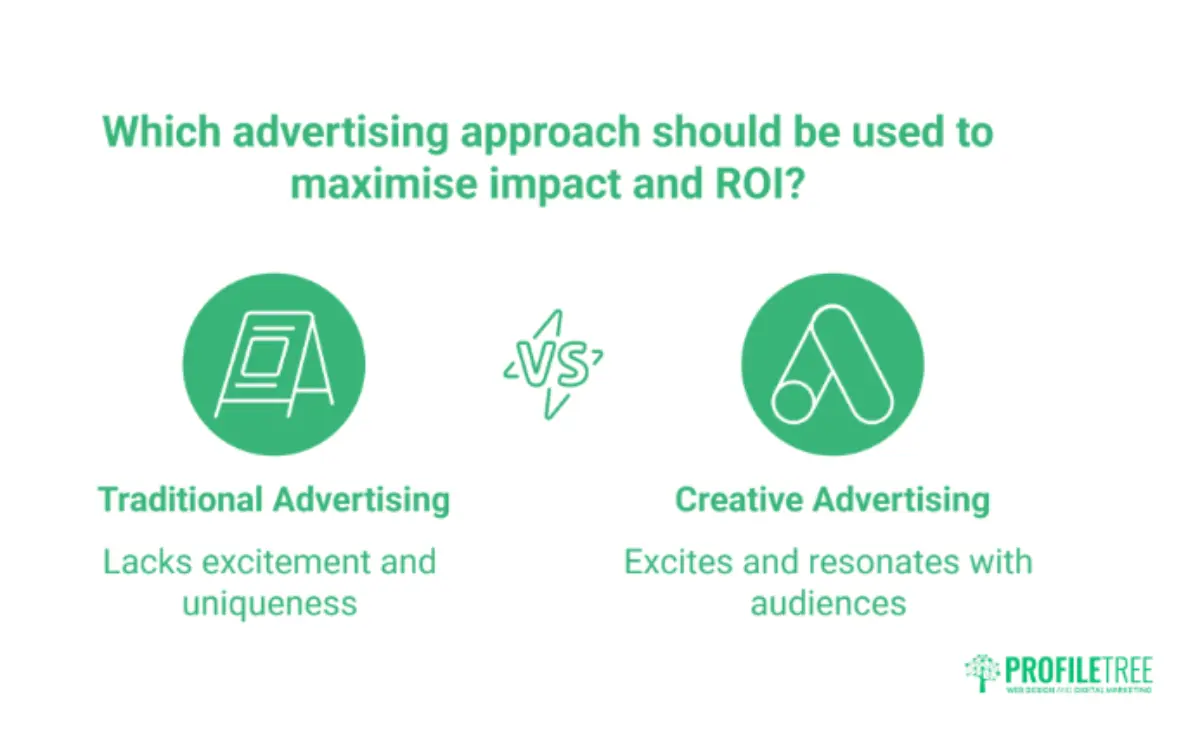
In advertising, creative strategy solves the most expensive problem in paid media: relevance. An ad that reaches the right person with the wrong message wastes the entire media spend. An ad that delivers the right message to the wrong audience is equally wasteful. Creative strategy narrows the gap between what you’re saying and what your target audience needs to hear.
The ROI of advertising is determined by creative strategy more than by media buying. Budget allocation, targeting precision, and bidding strategy all matter — but an ad with a weak creative concept will underperform regardless of how efficiently it’s placed.
Creative Tactics in Advertising: The Execution Layer
Creative tactics are the specific choices made within the framework set by the strategy. Which visual format? What headline structure? How long should the video be? What does the call to action say? These are all tactical decisions — important, but secondary to getting the strategy right first.
The most common creative advertising mistake is starting with tactics. A business decides it wants to run Facebook ads (tactical) without first establishing who the audience is, what message they need to hear, and what action should follow (strategic). The result is usually a competently produced ad that has no clear strategic purpose.
Creative Strategy Examples: What Good Looks Like
The most instructive creative strategy examples are not necessarily the biggest budgets or most viral campaigns. What makes an example worth studying is the clarity of the brief behind it: you can infer from the output what the strategic decisions were.
| Brand | Strategic Objective | Creative Approach | What Made It Work |
|---|---|---|---|
| McDonald’s ‘Raise Your Arches’ | Reconnect brand with emotional craving | Eyebrow gesture as universal signal — no product shown | Single clear insight: craving is a physical, involuntary response |
| Dove ‘Real Beauty Sketches’ | Shift brand from product to values | Forensic artist illustrates self-perception gap | Data-led insight made abstract into story |
| Melbourne Metro ‘Dumb Ways to Die’ | Reduce near-miss incidents on platforms | Humour and a catchy song for a safety message | Counter-intuitive format for serious objective; channel matched the young audience |
| Guinness ‘Made of More’ | Differentiate in a commoditised category | Long-form storytelling celebrating unconventional individuals | Brand message expressed through the content form itself |
The hallmark of all four is the same: a clear audience insight that produces a brief, and a brief that produces genuinely distinctive creative. The strategic layer is invisible in the finished work, but without it, none of these campaigns exist.
For SMEs, the principle scales down but the process is identical. A local solicitor running social media advertising needs the same four questions answered: who are we reaching, what do they need to hear, what should they do next, and how will we know if it worked.
Measuring Creative Strategy ROI
Creative strategy effectiveness must be measured against the specific objectives set at the brief stage. There is no universal creative performance metric, because performance depends entirely on what the strategy was designed to achieve.
Measurement by Objective
Brand awareness objectives: Track search volume growth for branded terms, social listening for unprompted brand mentions, and direct traffic as a proxy for top-of-mind awareness.
Engagement objectives: Monitor video completion rates, social engagement rates (the ratio of interactions to impressions), return visitor rates on your website, and email open rates by audience segment.
Conversion objectives: Track conversion rates by channel and creative variant, customer acquisition cost, and return on ad spend (ROAS). For service businesses, measure lead quality as well as lead volume.
SEO as a Creative Strategy Feedback Loop
Organic search performance provides one of the most valuable feedback signals for creative strategy. When your content ranks for the queries your target audience is asking, it confirms that your messaging, tone, and topic choices are aligned with real audience needs. When it doesn’t, the gap between what you’re saying and what they’re searching for is a strategic problem, not a technical one. ProfileTree’s approach to SEO and content strategy treats search performance as a continuous feedback mechanism, not a one-time optimisation task.
The Iteration Principle
Creative strategy improves through structured iteration, not through producing more creative. Every campaign should generate a documented set of learnings: what audience insight proved correct, which message resonated, which channel underperformed, what the data suggests about next steps. Without this discipline, you run the same creative mistakes repeatedly with different execution.
How ProfileTree Approaches Creative Strategy for SME Clients
The gap between businesses that grow through their digital presence and those that don’t is rarely technical. It’s strategic. A website built without a creative strategy is a brochure. A social media presence without a defined message is noise.
ProfileTree’s approach starts with the brief, not the deliverable. Before any web page is designed, any video is scripted, or any content is written, the strategic questions need answers: who is this for, what do they need to hear, and what should they do next?
“The businesses that get the best results from their digital investment are the ones who can tell you exactly who their best customer is and what that customer needs to believe before they’ll buy,” says Ciaran Connolly, founder of ProfileTree. “Most SMEs skip that conversation and go straight to asking what the website should look like. That’s working backwards.”
This strategic foundation feeds into every service ProfileTree provides — from the messaging hierarchy on a homepage to the hook on a 60-second video. Our content marketing service is built around this principle: content that isn’t anchored to a clear creative strategy produces traffic without conversion, presence without purpose.
Common Creative Strategy Mistakes
Understanding where creative strategy tends to break down is as useful as knowing how to build it well. The following mistakes appear consistently across businesses of all sizes — but they’re particularly costly for SMEs, where budgets are tighter and there’s less room to absorb wasted spend.
Evaluating Creative by Personal Preference
The most expensive mistake in creative strategy is approving work because it looks good to the person signing it off, rather than because it serves the target audience’s needs. The business owner’s aesthetic preferences are rarely a proxy for the target customer’s. Establish objective success criteria before creative is produced, then evaluate against those — not gut feel.
Building Platform-Agnostic Creative
A video optimised for YouTube fails on TikTok. Copy that works in an email underperforms on social media. Each platform has distinct audience expectations, technical constraints, and algorithm behaviours. Multi-platform campaigns require adapted creative for each channel, not a single asset stretched across every format.
Treating Campaign Launch as the End Point
Many businesses develop creative, launch it, then move on. This static approach ignores the continuous learning opportunities that active campaign management provides. The data generated by a live campaign is often more valuable than the creative itself — but only if it’s collected, reviewed, and applied to the next brief.
Skipping the Brief
The brief is not a bureaucratic step. It is the document that makes creative work defensible. Without it, every creative decision is subjective and every revision cycle is a negotiation between competing opinions. With it, creative teams can make faster, better decisions — and clients can evaluate the output against an agreed standard rather than changing their minds at the approval stage.
Frequently Asked Questions
What is the difference between creative strategy and marketing strategy?
Marketing strategy defines how a business reaches its goals through targeting, positioning, and channel selection. Creative strategy is a subset of this: it determines how messages are communicated — the tone, style, narrative, and format of every campaign and piece of content. Marketing strategy answers “what” and “where.” Creative strategy answers “how.”
What are the 4 elements of a creative strategy?
The four core elements are: Target Audience (the specific person you’re reaching and what matters to them), Key Message (the single most important idea you want them to take away), Objective (the measurable outcome that defines campaign success), and Distribution Channels (the platforms and formats through which the message reaches the audience).
What does a creative strategist actually do?
A creative strategist bridges the gap between business goals and creative execution. They analyse performance data, develop audience insights, write creative briefs, evaluate creative work against strategic criteria, and manage the feedback loop between what gets produced and what the data shows about what works. In many SMEs, this role is shared between the business owner and their agency.
How long does a creative strategy take to develop?
For an SME working without a dedicated strategy team, a functional one-page creative strategy can be developed in a focused half-day session. A more thorough strategy covering multiple audience segments, channel-specific messaging, and a quarterly content framework typically takes two to three working days, including audience research and internal review. The investment is significantly smaller than the cost of six months of unfocused content production.
Do SMEs really need a formal creative strategy?
Yes, and arguably more than large corporations. With limited budgets, every creative decision has a higher proportional cost if it misses. A formal strategy — even a simple one-page brief — means creative decisions are made for defensible reasons rather than by default. It also makes it possible to evaluate agency work objectively, which protects budget and speeds up the approval process.
Can I develop a creative strategy without an agency?
Yes. The core strategic work — defining your audience, agreeing a core message, setting a tone, and choosing your primary channels — requires structured thinking, not specialist tools. What an agency adds is external perspective (particularly useful if you’re too close to your own business to see it as a customer does), experience across different sectors and campaigns, and the ability to translate the strategy directly into execution. If budget is a constraint, develop the strategy yourself using the one-page framework above, then bring in specialist support for the execution layer.
How often should a creative strategy be updated?
Review and update your creative strategy at the start of each new campaign or financial year, and whenever a significant business change occurs — a new service, a new market, a shift in target audience. The core brand strategy rarely changes; the creative strategy should adapt to current market conditions, campaign goals, and what the performance data is telling you.