
Web Development Agency: Building Websites That Drive Business Growth
Table of Contents
A website development agency builds custom websites designed to achieve specific business objectives, whether that’s generating leads, selling products, or establishing credibility in your market. ProfileTree is a website development agency based in Belfast that creates bespoke websites for businesses across Northern Ireland, Ireland, and the UK, with a focus on sites that rank well in search engines and convert visitors into customers.
Your website is often the first interaction potential customers have with your business. A poorly built site with slow loading times, confusing navigation, or outdated design actively drives customers toward your competitors. A professionally developed website, built with a clear strategy and technical excellence, becomes your most effective sales tool.
What Does a Website Development Agency Do?
Website development encompasses everything involved in creating a functional, effective website. This goes far beyond visual design to include technical architecture, user experience, performance optimisation, and ongoing maintenance.
Discovery and Strategy
Before writing a single line of code, a professional website development agency invests time understanding your business:
- Who are your target customers?
- What actions do you want visitors to take?
- How does your website fit into your broader marketing strategy?
- What functionality do you need now, and what might you need in future?
- Who are your competitors, and what are they doing well or poorly?
This strategic foundation shapes every subsequent decision about design, technology, and content.
Information Architecture and UX Design
How information is organised determines whether visitors find what they need or leave frustrated. A website development agency creates:
- Site maps outlining the page structure and hierarchy
- User flows mapping how visitors navigate toward conversion points
- Wireframes showing layout and content placement before visual design begins
- Prototype testing to validate assumptions before full development
Visual Design
Design isn’t just about aesthetics. Effective website design:
- Reflects your brand identity consistently
- Guides visitors toward desired actions
- Establishes credibility and trust
- Works seamlessly across all devices
- Loads quickly without sacrificing visual impact
Front-End Development
Front-end development transforms designs into functional web pages. This includes:
| Technology | Purpose |
| HTML5 | Semantic page structure |
| CSS3 | Styling, layout, and responsive behaviour |
| JavaScript | Interactive elements and dynamic functionality |
| Accessibility Standards | Ensuring usability for all visitors |
Back-End Development
Back-end development handles everything users don’t see but rely on:
- Content management systems allowing non-technical users to update content
- Database design storing and retrieving information efficiently
- Server configuration ensuring reliable, fast performance
- Security implementation protecting against attacks and data breaches
- API integrations connecting your website to other business systems
Quality Assurance and Testing
Before launch, thorough testing catches issues that would frustrate users or damage your reputation:
- Cross-browser testing (Chrome, Safari, Firefox, Edge)
- Device testing (desktop, tablet, mobile)
- Performance testing (load times, server response)
- Security testing (vulnerability scanning)
- Accessibility testing (screen readers, keyboard navigation)
- Functional testing (forms, checkout, integrations)
Launch and Ongoing Support
Launching a website is the beginning, not the end. A website development agency provides:
- Managed launch with minimal downtime
- Post-launch monitoring for issues
- Regular security updates and backups
- Performance optimisation over time
- Ongoing development for new features
Types of Website Development
Different business needs require different development approaches. Understanding these options helps you choose the right solution.
WordPress Development
WordPress powers over 40% of all websites for good reason. It offers flexibility, extensive plugin ecosystems, and relatively straightforward content management.
ProfileTree specialises in WordPress website development that goes beyond basic theme installation:
- Custom theme development tailored to your brand
- Performance optimisation for fast loading
- Security hardening beyond default settings
- SEO-ready architecture from the ground up
- Integration with CRM, email marketing, and other business tools
WordPress suits most business websites, blogs, and content-heavy sites.
E-commerce Development
Selling products online requires specialised functionality:
- Product catalogues with filtering and search
- Shopping cart and checkout processes
- Payment gateway integration
- Inventory management
- Order processing and fulfilment
- Customer accounts and order history
Popular e-commerce platforms include:
| Platform | Best For |
| Shopify | Businesses wanting simplicity and reliability |
| WooCommerce | WordPress users needing e-commerce functionality |
| Magento | Large catalogues with complex requirements |
| BigCommerce | Scaling businesses with multi-channel needs |
ProfileTree develops e-commerce websites on Shopify and WooCommerce, helping retailers across the UK and Ireland sell more online.
Bespoke Web Application Development
Some businesses need functionality that off-the-shelf platforms can’t provide. Bespoke development creates custom solutions:
- Member portals with role-based access
- Booking and reservation systems
- Customer dashboards and self-service tools
- Internal business applications
- Complex data processing and visualisation
Custom development costs more initially but provides exactly what your business needs without compromise.
Headless and API-First Development
Modern web architecture increasingly separates the front-end presentation from back-end content management. This approach offers:
- Faster page loads through static generation
- Content reuse across websites, apps, and other channels
- Greater flexibility in front-end technology choices
- Improved security through reduced attack surfaces
Headless development suits businesses with complex content distribution needs or high-performance requirements.
Why Hire a Website Development Agency?
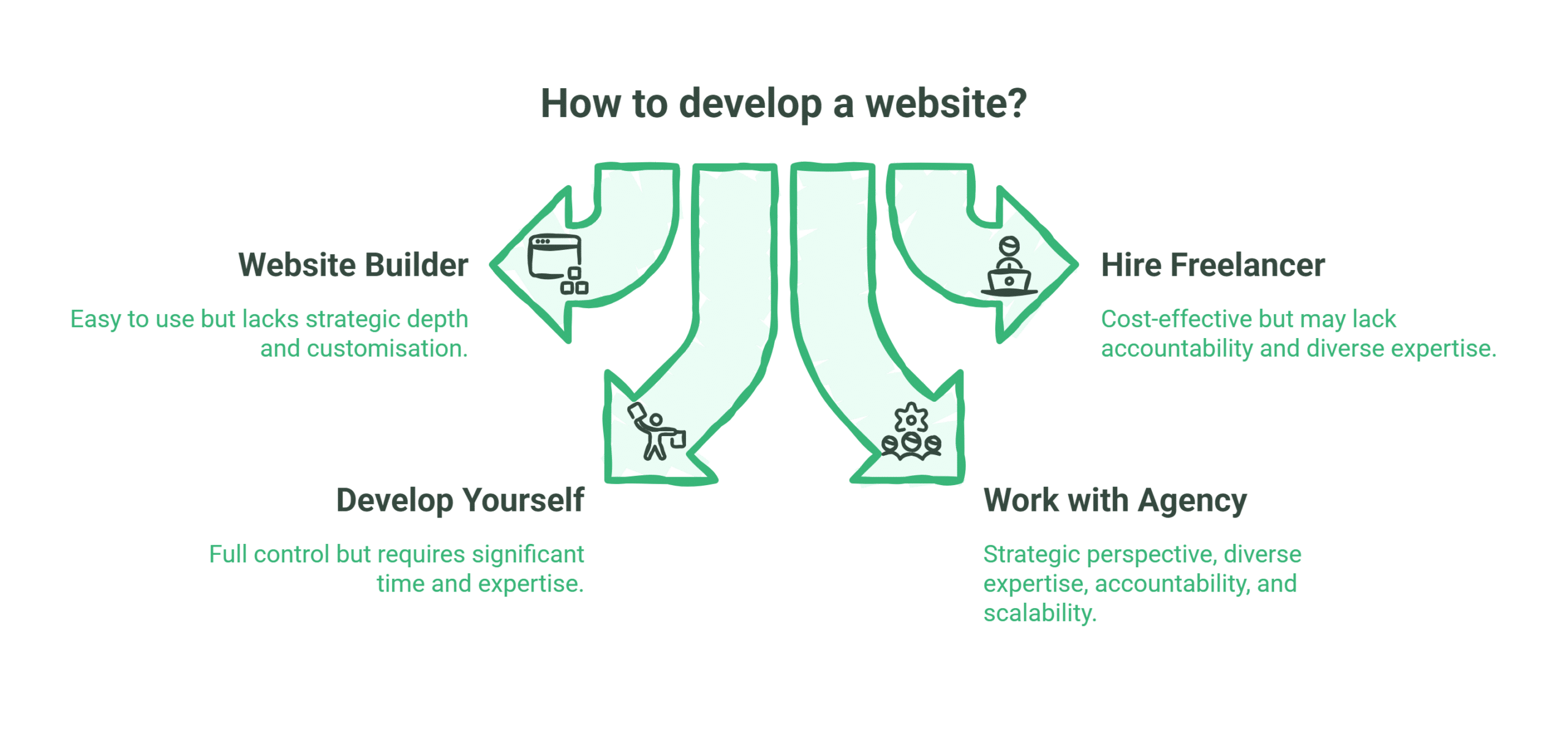
You could use a website builder, hire a freelancer, or attempt development yourself. Here’s why working with an agency often delivers better results.
Strategic Perspective
Website builders and many freelancers focus on building what you ask for. An agency questions whether what you’re asking for is actually what you need.
A good website development agency:
- Challenges assumptions that might lead to poor decisions
- Brings experience from hundreds of previous projects
- Considers your website within your broader business context
- Plans for future growth and changing requirements
Diverse Expertise Under One Roof
Effective websites require multiple skill sets:
- Strategists who understand business objectives
- UX designers who optimise user journeys
- Visual designers who create compelling aesthetics
- Front-end developers who build responsive interfaces
- Back-end developers who create robust functionality
- SEO specialists who ensure search visibility
- Content creators who communicate effectively
An agency provides access to all these skills without hiring multiple individuals.
ProfileTree combines web design, development, SEO, and content marketing expertise, ensuring your website works as a complete system rather than isolated components.
Accountability and Reliability
Freelancers get ill, take holidays, or simply disappear. Agencies provide continuity:
- Multiple team members who understand your project
- Documented processes and systems
- Formal contracts with clear deliverables
- Ongoing support beyond initial development
- Business stability and longevity
Scalability
As your business grows, your website needs to evolve. An agency relationship scales with you:
- Adding new functionality as requirements emerge
- Increasing capacity during busy periods
- Expanding to additional websites or platforms
- Integrating new business systems
How to Choose the Right Website Development Agency
The agency you choose significantly impacts your project’s success. Here’s how to evaluate potential partners.
Review Their Portfolio
Look beyond visual appeal to assess:
- Do they have experience with businesses similar to yours?
- Are the websites functional and user-friendly?
- Do they demonstrate strategic thinking or just aesthetic design?
- Are the sites still performing well (check speed, mobile responsiveness)?
Understand Their Process
A professional agency should clearly explain:
- How they gather requirements and define scope
- How they handle the design and development phases
- How they manage communication and feedback
- How they approach testing and quality assurance
- What happens after launch
Be wary of agencies that can’t or won’t explain their process.
Check Technical Capabilities
Ensure the agency has genuine expertise in relevant technologies:
- Which content management systems do they specialise in?
- Can they handle integrations with your existing business systems?
- How do they approach performance optimisation?
- What security measures do they implement?
Evaluate Communication
Pay attention to communication quality during the sales process:
- Do they listen to your requirements or push their preferred solution?
- Do they explain technical concepts clearly?
- Are they responsive and professional?
- Do they ask intelligent questions about your business?
How they treat you before signing indicates how they’ll treat you after.
Consider Ongoing Support
Your relationship shouldn’t end at launch:
- What support packages do they offer?
- How do they handle urgent issues?
- What’s included in ongoing maintenance?
- How do they approach future development work?
What to Expect: The Website Development Process
Understanding the typical process helps you prepare for a successful project.
Phase 1: Discovery and Planning (1-2 Weeks)
The agency gathers information about your business, objectives, and requirements:
- Stakeholder interviews to understand different perspectives
- Competitor analysis to identify opportunities
- Technical requirements gathering
- Content audit if redesigning existing site
- Project scope definition and timeline
Your involvement: High. This phase requires your input and decision-making.
Phase 2: Information Architecture and Wireframes (1-2 Weeks)
The agency defines site structure and page layouts:
- Site map showing all pages and their relationships
- Wireframes for key page templates
- User flow documentation
- Content requirements for each page
Your involvement: Medium. Review and feedback on the proposed structure.
Phase 3: Visual Design (2-3 Weeks)
Designers create the visual look and feel:
- Mood boards or style tiles for initial direction
- Homepage and key page designs
- Responsive designs showing mobile and tablet views
- Design system documentation for consistency
Your involvement: Medium to high. Design feedback is subjective and often requires multiple rounds.
Phase 4: Development (4-8 Weeks)
Developers build the functional website:
- Front-end development of designs
- Back-end functionality and CMS setup
- Integration with external systems
- Content population (or CMS training for self-population)
Your involvement: Low to medium. Periodic reviews and content provision.
Phase 5: Testing and Refinement (1-2 Weeks)
Quality assurance before launch:
- Bug identification and fixing
- Cross-browser and device testing
- Performance optimisation
- Security scanning
- User acceptance testing
Your involvement: Medium. Testing and final approval.
Phase 6: Launch and Post-Launch (1 Week+)
Going live and ensuring stability:
- DNS changes and domain configuration
- Performance monitoring
- Issue resolution
- Team training on CMS
Your involvement: Low. The agency handles technical aspects.
Website Development Costs: What Should You Budget?
Website development costs vary enormously based on complexity, functionality, and agency calibre. Here’s a realistic framework for UK and Irish businesses:
| Website Type | Typical Investment | Timeline |
| Brochure Website (5-10 pages) | £3,000-£8,000 | 4-8 weeks |
| Small Business Website (10-20 pages) | £8,000-£15,000 | 6-10 weeks |
| E-commerce Website (up to 100 products) | £10,000-£25,000 | 8-12 weeks |
| Large E-commerce (100+ products, custom features) | £25,000-£75,000 | 12-20 weeks |
| Bespoke Web Application | £30,000-£150,000+ | 16-40 weeks |
Factors That Increase Cost
Several factors push projects toward the higher end:
- Custom design versus template-based approaches
- Complex functionality like booking systems or member portals
- Multiple integrations with CRM, accounting, or other systems
- Large content volumes requiring migration or creation
- Multiple languages or regional variations
- Tight timelines requiring additional resources
The True Cost of Cheap Websites
Budget website builders and offshore development may seem attractive initially, but often cost more in the long run:
- Poor performance affects search rankings and conversion rates
- Security vulnerabilities lead to costly breaches
- Limited functionality requires expensive rebuilds
- Lack of support leaves you stranded when issues arise
A properly built website is an investment that pays dividends for years.
Why Choose ProfileTree as Your Website Development Agency?
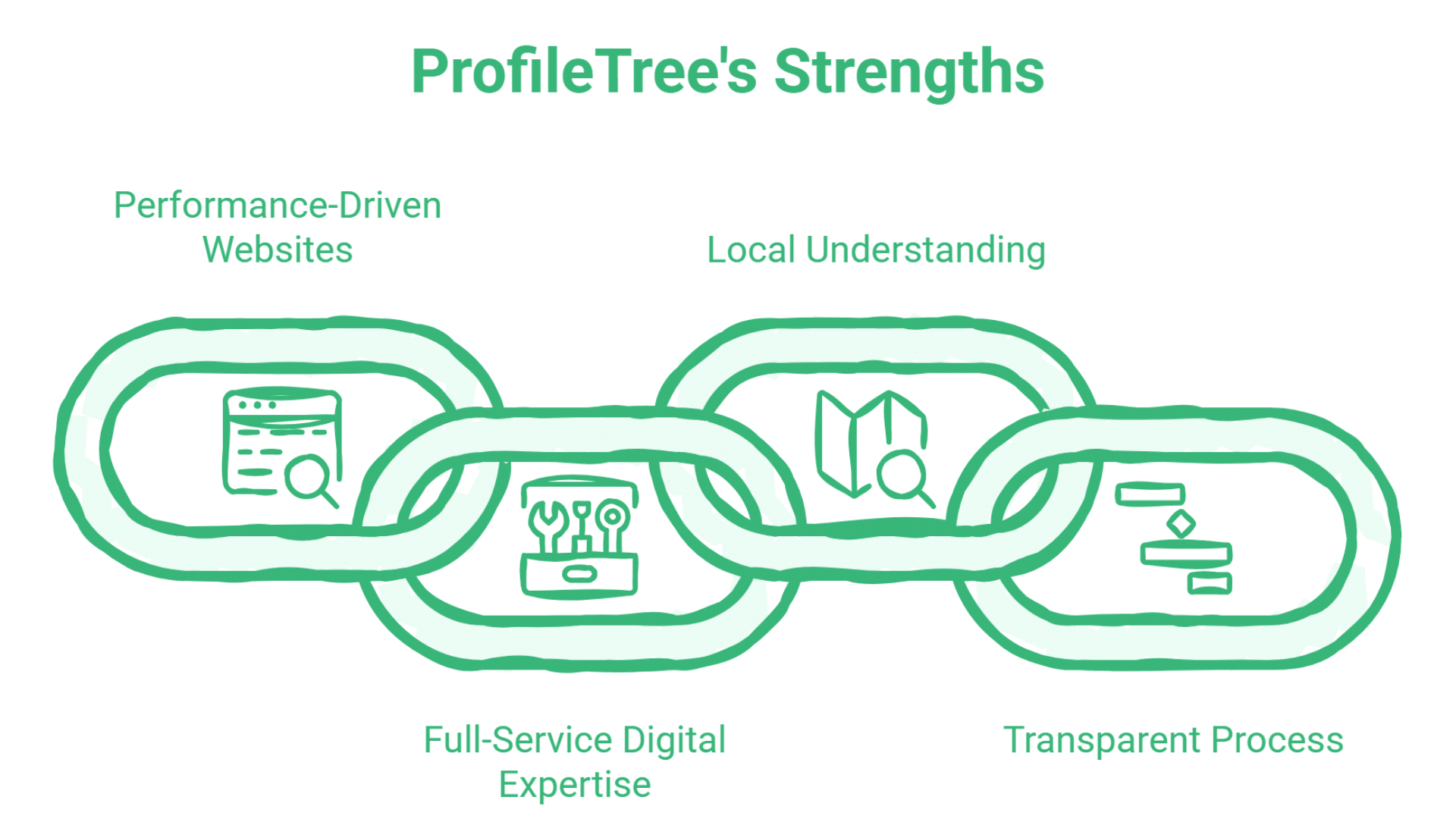
ProfileTree has been building websites that generate business results since 2011. Here’s what makes us different.
Websites Built for Performance
We don’t just build attractive websites. We build websites that:
- Rank well in Google through SEO-first development
- Convert visitors into leads and customers
- Load quickly on all devices and connections
- Scale with your business growth
Full-Service Digital Expertise
Your website doesn’t exist in isolation. ProfileTree provides integrated services, including:
- Content marketing to drive traffic
- Digital strategy to align online presence with business goals
- Video marketing to engage visitors
- AI training to improve operational efficiency
Local Understanding, Professional Standards
Based in Belfast, ProfileTree understands the UK and Irish business landscape. We combine local market knowledge with development standards that match any international agency.
Our 5-star rating from over 450 Google reviews reflects consistent delivery for businesses of all sizes across Northern Ireland, Ireland, and the UK.
Transparent Process
No surprises, no hidden costs, no jargon. We explain what we’re doing, why we’re doing it, and what you can expect. You’ll always know where your project stands and what comes next.
FAQs About Website Development Agency
How long does it take to build a website?
Timeline depends on complexity and scope. A straightforward brochure website might take 4-6 weeks, while a complex e-commerce site could take 12-16 weeks or more. The discovery and design phases often take longer than clients expect, but rushing these stages leads to problems during development. We’ll provide a realistic timeline during our initial discussions.
What’s the difference between web design and web development?
Web design focuses on visual appearance, user experience, and how people interact with your website. Web development involves the technical implementation, writing code, configuring servers, and building functionality. Most projects require both, and at ProfileTree, designers and developers collaborate throughout the process.
Do I need a custom website, or would a template work?
Templates suit businesses with straightforward needs, limited budgets, and generic requirements. Custom development makes sense when you need specific functionality, a unique design that reflects your brand, or performance that templates can’t deliver. We’ll recommend the approach that best fits your situation and budget.
Will I be able to update the website myself?
Yes. We build on content management systems like WordPress that allow non-technical users to update text, images, and basic content. We provide training so your team feels confident managing day-to-day updates. More complex changes might require developer involvement, but you won’t be dependent on us for routine content updates.
What happens if something breaks after launch?
We provide ongoing support packages that include bug fixes, security updates, and technical assistance. Issues that arise from our development work are fixed without additional charge. We also monitor websites proactively to catch problems before they affect your business.
Do you work with businesses outside Northern Ireland?
Absolutely. While we’re based in Belfast, we work with businesses across Ireland, the UK, and internationally. Modern collaboration tools mean location doesn’t limit who we can work with. Some clients prefer local agencies they can meet face-to-face, while others prioritise expertise over geography.
How do you handle website hosting?
We offer managed hosting services optimised for performance and security. Alternatively, we can build on your existing hosting or recommend third-party providers. We’ll advise on the best option based on your technical requirements and budget.
Conclusion
Your website is the foundation of your digital presence. A website development agency brings the strategic thinking, technical expertise, and diverse skills needed to create a site that genuinely drives business growth rather than simply existing online.
ProfileTree builds websites that rank in search engines, convert visitors into customers, and scale with your business. Our approach combines strategic planning, professional design, robust development, and ongoing support to deliver websites that work as hard as you do.
Ready to discuss your website project? Contact ProfileTree for an initial conversation about your requirements and how we can help.