
Video Marketing Ireland: A Practical Growth Guide for SMEs
Table of Contents
Video has become the format Irish business owners ask about most when planning their marketing, yet the gap between wanting video and knowing what to film is where most small firms stall. This guide closes that gap with practical steps rather than theory for SMEs across Ireland.
Across Ireland and Northern Ireland, owners and marketing managers face the same questions: what to produce, what it costs, and how to make it pay. The pressure is real, but the barriers are lower than most assume, and a clear plan beats a big budget almost every time.
Below you will find the reasons video earns its place in an SME plan, the funding routes worth knowing, the formats that build trust with Irish audiences, a practical view of tools and cost, and how to measure whether any of it worked.
Why Video Marketing Works for Irish SMEs
Video gives a small business a way to show, not just tell. For a service firm in Cork or a retailer in Belfast, a short clip can explain in ninety seconds what a page of text struggles to convey. The point is reach and trust, not production gloss. Before looking at formats and funding, it helps to understand where video fits in a smaller firm and why a strong digital strategy service treats it as one channel among several rather than a standalone project.
Regional SMEs Competing Nationally
Much advice assumes a Dublin tech firm with a marketing department. Most Irish SMEs are nothing like that. A craft producer in Donegal, a tourism operator in Mayo, or a family retailer in Derry has something a multinational cannot fake: genuine local identity. Video carries that identity well. A clip filmed in the actual workshop, featuring the people who run the business, reads as honest in a way a stock-image campaign never does.
That authenticity travels. A regional business that looks rooted in its place can still sell nationally, because trust built locally tends to read as credibility everywhere else. For firms outside the capital, this is a real advantage rather than a consolation.
It also lowers the bar to entry. A rural operator does not need a city studio to compete; a phone, a quiet room, and a clear message are enough to start. The businesses that win regionally tend to be the ones that began filming before they felt ready, then improved as they went.
The Effect on Organic Reach in Ireland
The video also supports how a business gets found. Pages with embedded video tend to hold visitors longer, and dwell time is a behavioural signal search engines weigh. That matters for organic reach in Ireland, where competition for local search terms keeps rising. A page that keeps people watching gives a clearer signal of usefulness than one they leave in seconds.
There is a second route worth noting. YouTube is the second-largest search engine by query volume, so a well-optimised video can rank on its own and bring traffic that a text article never could. Treating video as part of SEO services rather than a side project is what turns it into a compounding asset.
Making Video Affordable: Funding and Budget
Cost is the barrier most SMEs cite, and it is also the one most often misunderstood. Funding exists, and production no longer demands a broadcast budget. This section covers the main support routes and a realistic view of what video costs at different levels, so you can plan around evidence rather than guesswork. Where a project needs a fuller plan, our video marketing services can shape the spend around the commercial goal.
The Trading Online Voucher Explained
In the Republic of Ireland, the Local Enterprise Office runs the Trading Online Voucher, which co-funds work to develop or improve online trading. The scheme typically covers half the cost up to a set maximum, with eligibility tied to business size and trading history. Video work that supports online selling, such as product demonstrations or an explainer on a key service page, can fall within scope.
The application asks for quotes and a clear plan, so it pays to define the video project before applying rather than after. Check the current terms with your Local Enterprise Office, because thresholds and eligibility are reviewed periodically.
Support in Northern Ireland
Northern Ireland sits outside the Republic’s voucher scheme, so the routes differ. Invest NI runs supports aimed at innovation and growth that can extend to digital capability, and these are worth checking against your circumstances. A business trading on both sides of the border needs to handle each market on its own terms rather than assume one scheme covers both.
Funding aside, the cross-border position is itself a content opportunity. A video that acknowledges both the GB and Irish contexts, where regulation or reference points differ, signals a local expertise that an agency in London or Dublin cannot easily match.
A Realistic View of Cost
The honest answer to “what does it cost?” is that it depends on the goal. A series of sixty-second FAQ videos filmed on a good phone, with a clear script and decent audio, can serve customer education at close to no cost beyond time. A polished three-minute brand film involves planning, a shoot day, editing, and review rounds, and a realistic cycle that runs four to six weeks from brief to publication.
The principle is to match the production investment to the commercial value of the goal, not to a vague sense that better quality means more spending. All prices and figures in this guide are indicative UK and Ireland examples and correct at the time of writing; use them as a benchmark rather than fixed quotations.
Video Formats That Build Trust in Ireland
Different formats do different jobs, and matching the format to the goal is where many plans become vague. “We’ll do some social videos and maybe a testimonial” is not a content plan. This section sets out the formats that earn trust with Irish audiences and where each fits the buying journey. Tying them together with a wider content marketing service keeps every clip working toward the same commercial aim.
Testimonials and Local Case Studies
For a service business, a client speaking in their own words about a specific result is the highest-trust format available. It is more persuasive than any amount of polished brand copy because the credibility comes from the customer, not the company. Featuring a recognisable local setting adds relevance for an Irish audience and makes the story harder to dismiss as generic.
The practical step is to ask satisfied customers a few clear questions on camera: what problem they had, what changed, and what they would tell someone considering the same decision. Honest, specific answers outperform scripted praise every time.
Short-Form Social Video
Short clips under a minute suit social platforms, where Irish audiences spend a large share of their viewing time. The format rewards a strong opening: if the hook does not land in the first few seconds, the viewer scrolls past. Product highlights, quick tips, and behind-the-scenes glimpses all work here, and they are cheap enough to produce regularly.
Consistency beats perfection on social. A steady stream of timely, authentic clips usually outperforms one expensive hero piece, both for reach and for the algorithm signals that decide who sees your content. Connecting this output to a planned social media service helps each clip reach the right people at the right moment.
Video for Recruitment
Ireland’s labour market is tight, and most SMEs ignore video as a hiring tool. A short film showing what it is actually like to work somewhere, featuring real team members rather than staged smiles, does more to attract the right candidates than a job advert ever will. It also filters out poor fits, because people who watch and still apply tend to understand the role.
This kind of content has a long shelf life. A single well-made culture video can support recruitment across multiple campaigns, which makes the production effort easier to justify than a one-off advert.
Tools, Production and Distribution
Once the formats are clear, the practical questions are how to make the content and how to get it seen. Production costs have fallen far enough that the real differentiator is no longer equipment but a clear idea of what to say and who to say it to. This section covers the sensible use of newer tools, in-house production on a budget, and getting the distribution right. For teams that want to build the skills internally, our digital training service covers the practical ground.
Using AI Without Losing Your Voice
AI tools now help with scripting, editing, and repurposing, and they can save real time for a stretched team. The risk is that over-reliance flattens the local character that makes Irish SME content distinctive. A script generated wholesale tends to sound like everyone else’s; one shaped by AI but rewritten in your own register keeps the personality that earns trust.
Used well, these tools handle the repetitive work and free people to focus on the parts that need a human ear. The judgment call is knowing which tasks to hand over and which to keep: a rough first-draft script is fair game, but the lines that carry your tone are worth writing yourself. Our guidance on AI for marketing sets out where the tools help and where they get in the way.
In-House Production on a Budget
A modern smartphone, a small clip-on microphone, and a basic light are enough to produce content that performs well in many contexts. The common mistakes are weak audio and shaky framing, both of which are easy to fix. Batch filming several videos in one session keeps costs down, and a simple template for recurring content speeds up everything that follows.
The aim is not cinema quality. It is content that is clear, consistent, and recognisably yours, produced often enough to build an audience rather than perfectly enough to win an award.
Distribution and the Content Waterfall
Producing a video is half the work; getting it seen is the other half. One longer interview or brand film can be cut into several short social clips, a handful of LinkedIn posts, and a header video for a key page. That waterfall approach stretches a single shoot across weeks of output and is far more efficient than treating each platform as a separate project.
Native uploads usually outperform shared links, and timing posts to match when your audience is active lifts reach further. A reliable website matters here too, since slow pages undermine embedded video; our hosting and management keep that side steady so the content loads cleanly.
Measuring Whether Video Works
Video is an investment, so it deserves measurement rather than hope. The metrics worth tracking are the ones that connect to business outcomes, not vanity figures. This short section sets out what to watch and how to read it, so you can put more behind what works and stop what does not. A skilled video marketer treats every clip as part of a wider conversion funnel rather than a standalone post.
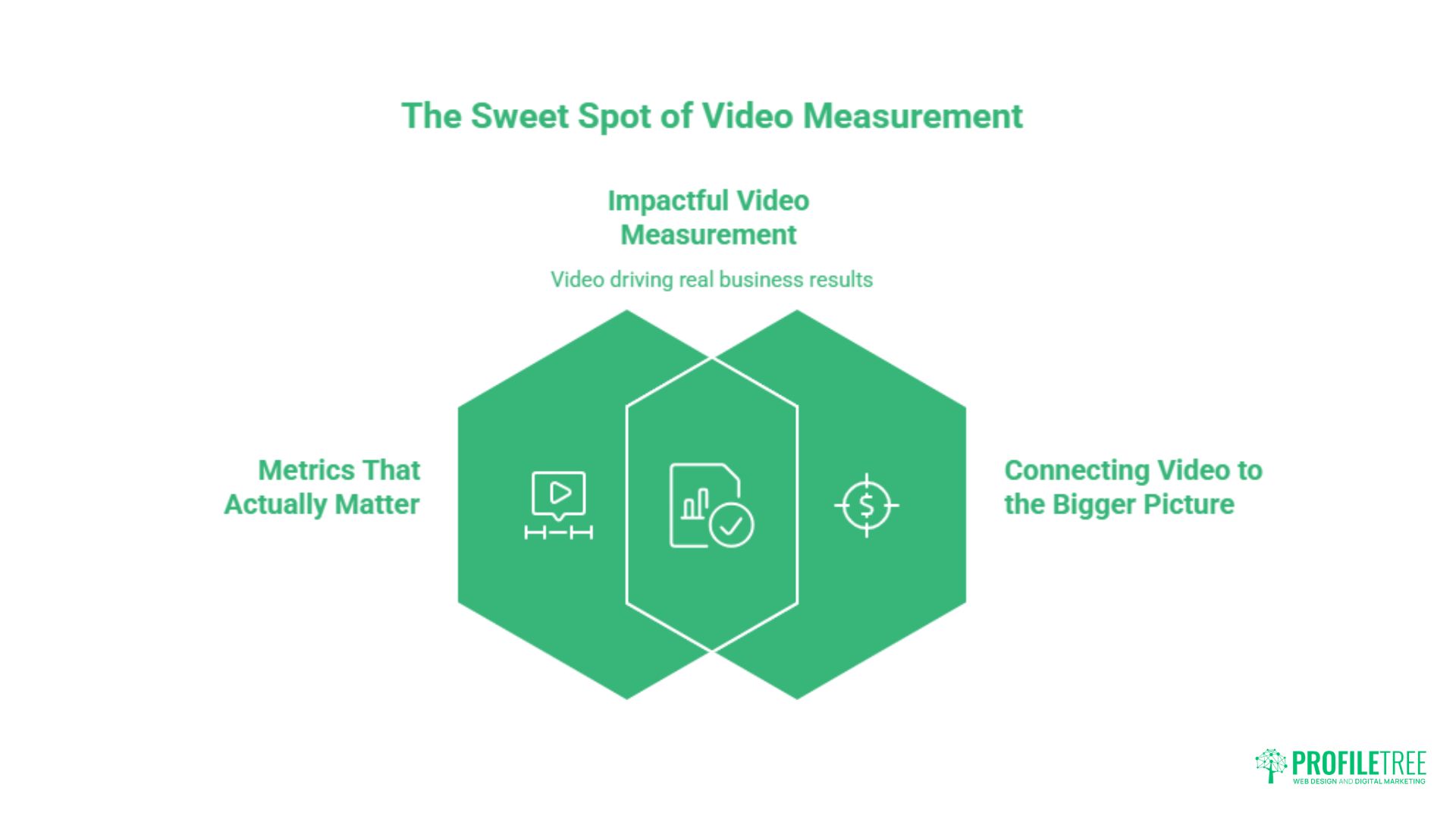
Metrics That Actually Matter
View counts tell you reach, but retention tells you whether the content held attention, and click-through and conversion tell you whether it moved anyone to act. For a small firm, the most useful question is simple: did this video contribute to an enquiry or a sale? Tracking that, even roughly, beats obsessing over likes.
Reviewing performance monthly is enough for most SMEs. Look at which formats and topics drew action, then reallocate effort toward them rather than spreading thin across every platform at once.
It also helps to set a baseline before you start, so later results have something to compare against. Even a rough note of current enquiries, page dwell time, and social engagement gives you a reference point. Without one, it is hard to tell whether a lift came from the video or from something else entirely.
Connecting Video to the Bigger Picture
Video rarely works in isolation. It supports email, social, and search, and its value often shows up as an assist rather than a direct conversion. A page that ranks partly because video kept visitors engaged, or an email that earned a click because it featured a clip, both reflect returns that a simple view count misses. Northern Ireland and the wider region offer plenty of scenic backdrops for this kind of content, as this guide to the top cities to visit in Northern Ireland illustrates.
As Ciaran Connolly, founder of ProfileTree, puts it: “The businesses that get the most from video are not the ones with the biggest budgets. They’re the ones who decided, before pressing record, exactly what they wanted the viewer to do next.”
Conclusion
Video marketing rewards Irish SMEs that start with a clear goal rather than a big budget. Decide what you want a viewer to do, pick the format and platform that fit, use funding where it applies, and measure what actually drives enquiries. The firms seeing steady returns are simply the ones that started with a plan and a phone. Ready to make video work for your business? Talk to our team about a plan built around your goals.
FAQs
How much does video marketing cost in Ireland?
It varies with the goal. Simple smartphone-filmed social clips can cost little beyond time, while a polished brand film involves planning, filming, and editing across several weeks. Match the spend to the commercial value of the video rather than to a general wish for higher quality. All figures here are indicative and correct at the time of writing.
Can I use the Trading Online Voucher for video production?
In the Republic of Ireland, yes, where the video supports online trading, such as product demonstrations or a service-page explainer. The Local Enterprise Office scheme typically co-funds half the cost up to a set maximum, with eligibility tied to business size and trading history. Confirm the current terms with your local office before applying.
What is the best length for a social media video for an Irish audience?
For social platforms, clips under sixty seconds tend to perform best, with the strongest results often coming from videos of around thirty seconds. The opening few seconds matter most, since that is where viewers decide whether to keep watching or scroll on.
Do I need a professional, or can I use a phone?
A hybrid approach suits most SMEs. Film social content in-house on a phone with decent audio and lighting, and bring in professional production for the pieces that carry more weight, such as a homepage brand film or a key testimonial. This keeps costs sensible while protecting quality where it counts.
How does video marketing improve my Google Maps ranking?
Adding a short video to your Google Business Profile and key pages can lift dwell time and engagement, both of which support local visibility. Video does not directly set the Maps position, but it strengthens the overall signals that help a local business appear for nearby searches.