
The Psychology of Learning: How We Retain Information
Table of Contents
Some lessons stick for life. Others slip away within an hour of the lecture ending. The difference is rarely about intelligence or effort, and almost always about how the brain encodes, stores and retrieves what it takes in.
The psychology of learning studies exactly that process: why memory forms, why it fades, and what reliably makes knowledge last. For teachers, trainers and anyone running staff development, these findings translate directly into better results.
This guide covers how the brain learns, the cognitive theories that explain retention, the emotional and social forces that shape it, and how UK practice, neurodiversity and AI tools are changing the picture. You can explore training services alongside it.
How the Brain Learns and Stores Information
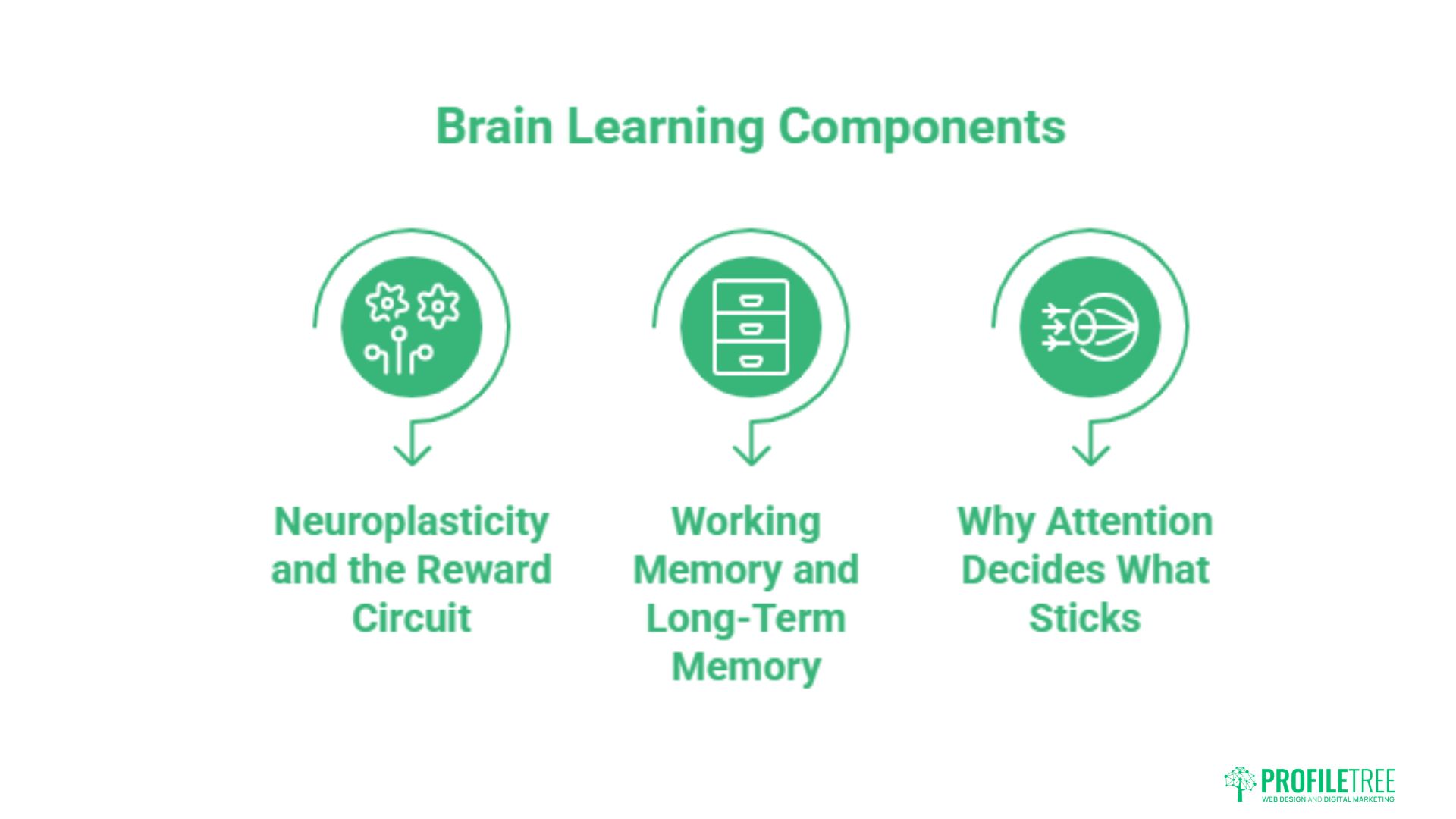
Every act of learning rewires physical structure in the brain. Understanding that biology explains why some study habits work and others waste time. This section looks at neuroplasticity, the two memory systems most relevant to learning, and the role attention plays in moving knowledge from one to the other. The same principles sit behind well-designed digital training programmes.
Neuroplasticity and the Reward Circuit
At the centre of learning sits neuroplasticity, the brain’s ability to reorganise itself and form new neural connections. It happens when we pick up a skill, build a memory or adapt to a new setting. Plasticity peaks in childhood, yet it never switches off.
Adults create fresh connections by challenging the brain: learning an instrument, solving unfamiliar problems, practising a craft. A new pianist strengthens the motor and auditory cortices. Demanding reasoning tasks engage the prefrontal cortex more efficiently for planning and decision-making.
Reward sharpens the whole process. When the brain registers progress or praise, it releases dopamine, a chemical tied to motivation. That release nudges us to repeat whatever earned it, so the material settles in more deeply. This is the basis of long-term potentiation, the strengthening of synapses through repeated use.
Working Memory and Long-Term Memory
The brain keeps information in different stores, and the two that matter most for study work very differently. Knowing the split helps you stop overloading the wrong one.
Working memory is a mental workspace. It holds and manipulates small amounts of information for a short time, such as a phone number you are about to dial or the figures in a sum. Its capacity is tight, and anything you stop attending to drops out fast.
Long-term memory is the opposite: vast, durable, capable of holding knowledge for a lifetime. Material that is rehearsed or judged important moves across from working memory through a process called consolidation, where it can be recalled later. The crossing depends on how the information is encoded, through association, imagery and emotional links rather than raw repetition.
Why Attention Decides What Sticks
Attention is the gatekeeper between the two stores. When focus is high, the brain encodes material properly for long-term storage. When it is split, the information rarely makes the journey.
This is why divided attention quietly wrecks study. Checking messages while reading means the brain never commits the page to memory. Focus also filters out noise, so only the parts that matter get kept. Techniques that raise concentration, such as mindfulness or single-tasking, measurably improve encoding. Emotional engagement helps, too, because material that feels meaningful earns more of the brain’s attention.
Cognitive Theories That Explain Retention
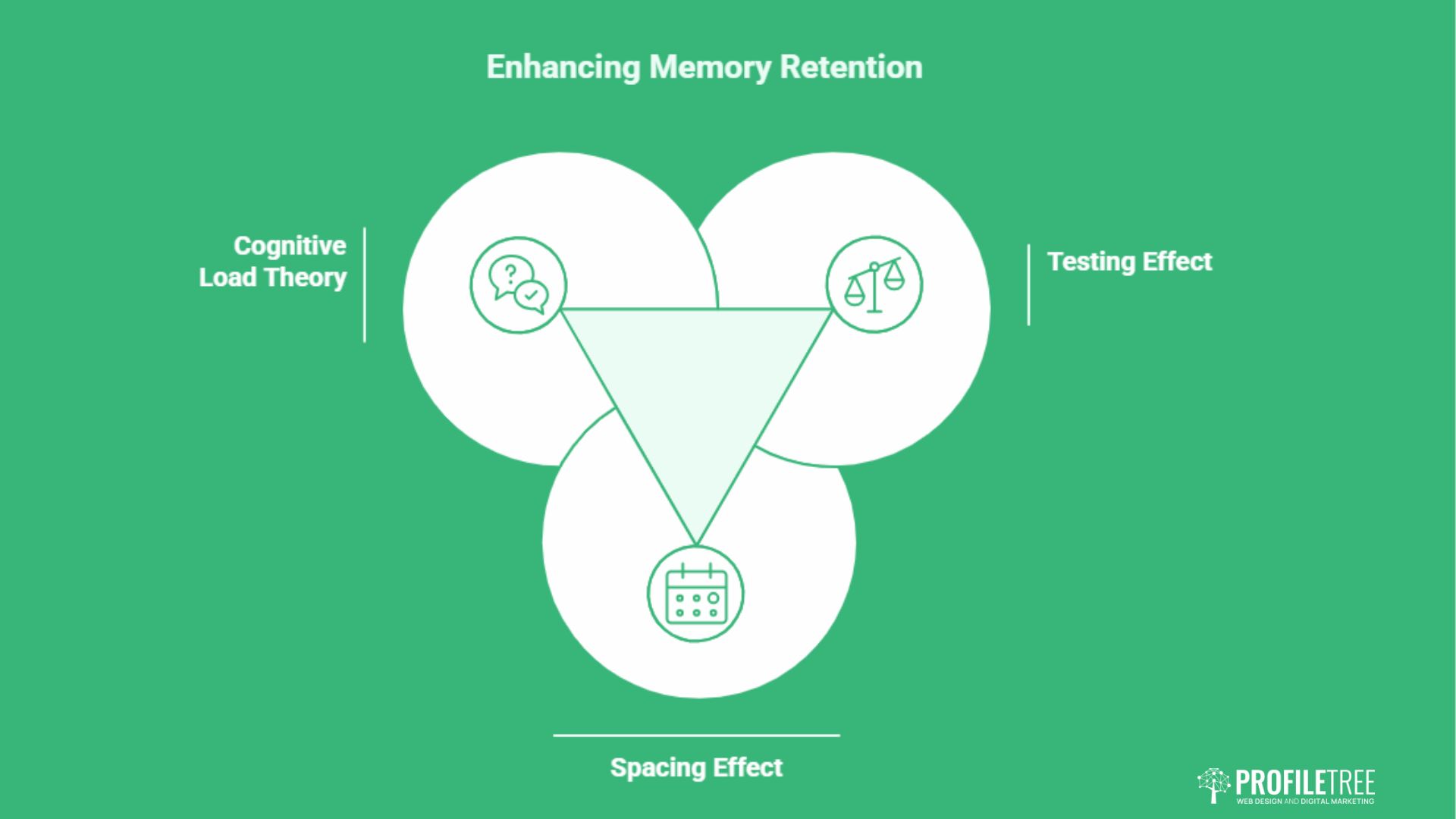
Three ideas dominate the modern science of learning, and each one carries a practical lesson for how to study or train. They explain why cramming fails, why spacing works and why testing yourself beats rereading. Trainers building staff learning courses lean on all three.
Cognitive Load Theory
Cognitive Load Theory holds that the brain can only process so much at once. Overload it, and comprehension collapses. The theory splits load into three parts: intrinsic (the inherent difficulty of the material), extraneous (load added by poor presentation or distraction) and germane (the useful effort of understanding and connecting ideas).
Cramming illustrates the problem. Pour too much in too quickly,y and the brain fatigues, encodes badly, and retains little past the exam. Complex tasks suffer most because they already demand heavy manipulation of information before any of it can be understood.
You can manage the load. Chunk material into smaller groups, strip out distractions, use diagrams to make abstract ideas concrete, master one concept before the next, and scaffold by offering support early and withdrawing it as confidence grows. Cognitive Load Theory now shapes a great deal of UK teaching practice, which the next major section returns to.
The Spacing Effect
Information lasts longer when learning is spread across time rather than packed into a single session. Spaced study gives the brain room to consolidate, strengthening the links between new material and what you already know.
Spacing also works against the forgetting curve, the steep drop-off in recall that follows any learning unless it is revisited. Each spaced session doubles as retrieval practice, pulling information back out at intervals and reinforcing the pathway every time.
Putting it into practice is simple. Review flashcards at widening intervals, using tools such as Anki or Quizlet that schedule reviews by performance. Set aside short daily review slots, starting with recent material and looping in older content. Break a topic across several days instead of one marathon sitting.
The Testing Effect
Retrieving information from memory, through quizzes or self-testing, strengthens it far more than passive review does. The act of recall reinforces the neural pathway and exposes the gaps that rereading hides.
The more often you retrieve, the firmer the memory becomes, and the better the brain organises related knowledge for future access. Self-quizzing, practice papers under realistic conditions, and interleaving (mixing topics within a session) all draw on this. Together, they make active recall one of the most reliable tools for lasting retention.
Comparing the Three Theories
Each theory targets a different weak point in how people study, which is why they work best in combination.
| Theory | Core idea | Practical move |
|---|---|---|
| Cognitive Load Theory | Working memory has a limited capacity | Chunk material, cut distraction, scaffold |
| Spacing Effect | Spread learning beats massed learning | Review at widening intervals |
| Testing Effect | Retrieval strengthens memory | Self-quiz instead of rereading |
Emotional and Social Forces in Learning
Memory is not a purely mechanical system. How you feel about material, how motivated you are, and who you learn alongside all shape what sticks. This section covers the link between emotion and memory, the difference motivation makes, and why learning with others outperforms going it alone. These factors matter as much in workplace AI training sessions as in classrooms.
How Emotion Strengthens Memory
Emotion is wired straight into memory. The amygdala processes emotional experience, the hippocampus encodes and consolidates it, and the two work together to flag emotionally charged events as worth keeping.
Strong feelings, positive or negative, trigger neurotransmitters such as dopamine and norepinephrine that tell the brain to pay closer attention and store the moment more efficiently. It explains why a first trip abroad or a heated argument stays vivid for years while ordinary days blur together. We remember the facts and the feelings as a single package.
Motivation, Curiosity and Goals
Motivation decides how much focus and effort you bring. It comes from inside (intrinsic) or outside (extrinsic), and the two behave differently.
Intrinsic motivation grows from genuine interest. A learner who finds a subject fascinating engages more deeply and retains more because they value the task itself. Extrinsic motivation, driven by grades, rewards or approval, can spark short-term effort but rarely sustains long-term engagement on its own. A blend of the two tends to work best in structured settings.
Curiosity pushes learners to explore beyond the lesson, which deepens understanding. Clear, achievable goals add direction, letting people track progress and stay engaged. When goals line up with real interest, motivation holds for the long haul.
Why Social Learning Works
Learning rarely happens in isolation, and bringing other people in tends to improve retention. Studying with peers forces you to clarify ideas, hear other angles and process material actively rather than skim it.
Teaching someone else is one of the strongest methods of all. Explaining a topic makes you organise and articulate it clearly, which cements your own understanding. Psychologists call this the protege effect: those who teach retain more than those who only revise. Peer feedback adds another layer, surfacing weak spots and prompting the kind of reflection that fixes them.
The UK Context, Neurodiversity and AI-Age Learning
Most general guides to learning psychology lean on US examples and stop at the theory. The picture looks different inside the UK education system, across neurodivergent learners, and now amid AI study tools. This section covers all three. It also connects to how organisations run modern digital transformation programmes.
Cognitive Load Theory in UK Schools
Cognitive Load Theory carries unusual weight in British education. Ofsted’s Education Inspection Framework draws heavily on it, judging curriculum design partly on how well it manages working memory and builds knowledge in sequence. The emphasis on memory retrieval and “cultural capital” flows from the same science-of-learning movement.
Rosenshine’s Principles of Instruction sit alongside it in many UK staffrooms, recommending small steps, frequent review and guided practice. The practical takeaway for any trainer is the same one cognitive load research points to: introduce less at a time, check understanding often, and revisit deliberately.
Learning Psychology and Neurodiversity
Standard models often assume one fairly uniform learner, which leaves out a large share of real people. Neurodivergent learners process information differently, and good practice adapts to that rather than treating it as a deficit.
Executive function differences, common with ADHD, affect how working memory holds and sequences information, so chunking and external structure help more than usual. Autistic learners may benefit from clear routines and reduced sensory load, which lowers extraneous cognitive demand. Dyslexic learners often gain from dual coding, pairing words with visuals, rather than text-heavy delivery. None of this is a separate science; it is the same principles applied with more flexibility.
How AI Tools Change Study
AI study tools are reshaping the oldest ideas in the field. Vygotsky’s scaffolding, the idea of supporting a learner just beyond their current ability, used to depend on a teacher. Large language models can now provide some of that support on demand, adjusting explanations until a concept lands.
The risk is the “Google effect”, or transactive memory, where people remember where to find information rather than the information itself. If an AI answers every question, retrieval practice never happens, and little is consolidated. The fix is to treat AI as a tutor that sets up active recall, not a shortcut that replaces it. Organisations weighing this up often start with structured AI chatbot solutions built around real learning goals.
“Most training fails for the same reason: it dumps everything into one session and never comes back to it. When you respect how working memory actually works, you space the material, you build in retrieval, and people retain far more without the burnout that comes from cramming a day’s worth of content into an afternoon.” — Ciaran Connolly, founder, ProfileTree
Putting Learning Psychology Into Practice
Theory only earns its keep when it changes what you actually do. This final section turns the research into a working environment, a practical method for teams, and the difference between the two terms that people often confuse. For a wider view of the region, these methods are used across, see this guide to cities in Northern Ireland. ProfileTree applies the same evidence base when building digital strategy plans for clients.
Designing a Space That Supports Memory
The physical setting shapes how well anyone learns. A distraction-free space lets the brain hold concentration and engage deeply; clutter and noise force it to split attention and waste capacity.
Light matters: natural daylight lifts alertness, mood, and even sleep quality, all of which aid consolidation, while dim rooms invite fatigue. Sound is personal, with some learners helped by low background noise and others needing quiet, though unpredictable interruptions hurt everyone. Temperature has an effect, too, with comfortable conditions supporting clearer thinking. An organised space reduces the small cognitive load that mess quietly adds.
A Simple Retrieval Routine for Teams
Workplace training fails when it front-loads everything into one session and never revisits it. A better pattern borrows directly from the spacing and testing effects.
Deliver material in small blocks rather than full-day downloads. Follow each block with a short, low-stakes quiz, so people retrieve rather than reread. Space follow-up reviews across the following weeks, mixing topics so the brain has to discriminate between them. Encourage staff to teach a peer what they learned, which locks it in through the protege effect. This is the backbone of effective corporate training delivery.
Learning Psychology Versus Educational Psychology
The two terms get used interchangeably, but they are not the same. Learning psychology studies the underlying process: how memory forms, how retention works, and what strengthens recall. It is the mechanism.
Educational psychology applies that knowledge inside real systems, focusing on curriculum design, classroom management, assessment and the social context of schools. One explains how the mind learns; the other decides how to organise teaching around it. Both feed the evidence-based methods that have pushed debunked ideas, such as fixed “learning styles”, out of serious practice.
Conclusion
Retention comes down to a handful of reliable principles: protect working memory, space your study, test yourself, engage emotion, and learn alongside others. Applied with attention to UK practice, neurodiverse learners, and the new role of AI, the same science makes classrooms and workplace training measurably more effective. Build your programme on how the brain actually learns, and the knowledge stays put.
Ready to build training that genuinely sticks?Talk to the ProfileTree team about evidence-based digital training for your organisation.
FAQs
What are the three main pillars of learning psychology?
The three pillars are behaviourism (learning through conditioning and reinforcement), cognitivism (the internal processing, encoding and storage of information) and constructivism (building knowledge through experience). Most modern theories of retention, including cognitive load and the testing effect, sit within the cognitivist tradition and explain how working memory and long-term memory interact.
How does the psychology of learning help teachers and trainers?
It gives them evidence-based methods rather than guesswork. Understanding cognitive load tells them to introduce less at once and provide scaffolded support. The spacing and testing effects tell them to revisit material over time and use retrieval practice instead of passive review. The result is clearer curriculum design, better-paced sessions and stronger long-term retention among learners.
What is the difference between learning psychology and educational psychology?
Learning psychology studies the process itself: how the brain encodes, stores and retrieves information. Educational psychology applies that understanding within real settings, covering curriculum design, assessment, classroom management and the social side of schooling. In short, one explains how the mind learns and the other decides how to organise teaching around it.
Why does spaced repetition work better than cramming?
Spaced repetition gives the brain time to consolidate, strengthening the neural links between new material and existing knowledge. It also works against the forgetting curve and turns each review into retrieval practice. Cramming overloads working memory, so material is encoded poorly and rarely survives past the immediate test.
Are learning styles a real thing?
The popular idea that people learn best in a fixed style, such as “visual” or “auditory”, has not held up under research and is now widely regarded as debunked. Evidence-based methods such as retrieval practice, spacing and dual coding benefit learners regardless of any supposed style, which is why current practice has moved away from the model.