
Online Surveys for SMEs: Tools, Strategy and Digital Growth
Table of Contents
Online surveys have become one of the most practical and cost-effective tools available to small and medium-sized enterprises (SMEs) in the UK. Whether you are a web design agency in Belfast, a retail business in Dublin, or a manufacturing firm in Manchester, online surveys give you direct access to the opinions, preferences, and frustrations of your customers without the budget of a large market research team.
At ProfileTree, we have seen firsthand how SMEs that build online surveys into their regular marketing and business strategy make faster, smarter decisions. They respond to customer needs more accurately, reduce guesswork in product development, and create stronger connections with the people they serve. Online surveys are not a passive data-collection exercise; they are an active business development tool when used correctly.
This guide covers everything from choosing the right online survey software to integrating surveys with your digital marketing strategy, automating feedback collection, and using the data to genuinely strengthen your position in the market. Whether you are new to online surveys or looking to get more value from the tools you already use, this is a practical resource built around what actually works for SMEs.
What Are Online Surveys for SMEs?
Online surveys are digital questionnaires distributed to customers, prospects, or team members to collect structured feedback, measure satisfaction, or gather market intelligence. For SMEs, they represent one of the few market research methods that are both affordable and scalable, delivering real data without the cost of focus groups or commissioned research.
Why Customer Feedback Drives Business Growth
Customer feedback sits at the centre of sustainable business growth. Online surveys give you a structured way to capture that feedback consistently, rather than relying on anecdotal conversations or occasional reviews. When you ask the right questions through a well-designed online survey, you learn what your customers value, where your service falls short, and what would make them recommend you to others.
Businesses that act on customer feedback through regular online surveys are far more likely to retain clients, improve repeat purchase rates, and develop products that the market actually wants. Pairing survey data with a clear customer experience strategy turns isolated feedback into a continuous improvement cycle that compounds over time.
The Fundamentals of Good Survey Design
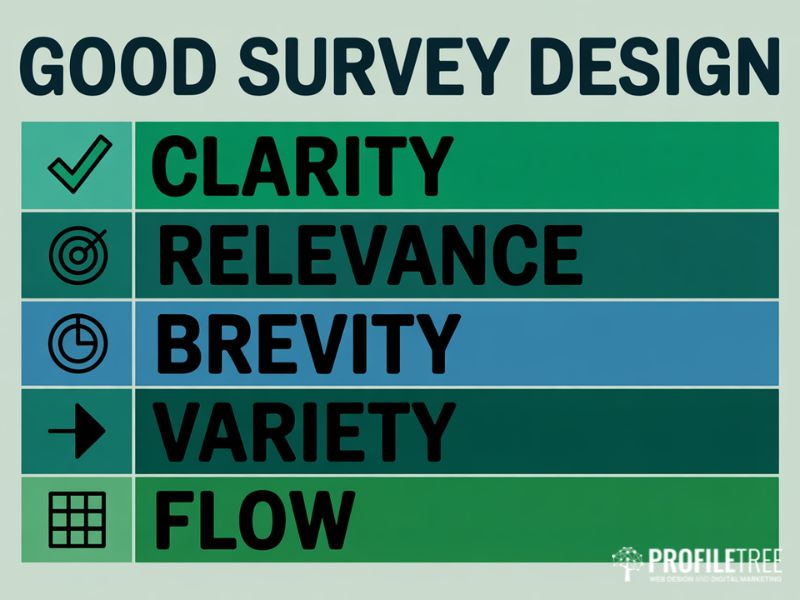
A poorly designed online survey produces low-quality data. Before you build your next questionnaire, apply these core principles to make every response count.
- Clarity: Write questions in plain language that cannot be misread or interpreted in more than one way.
- Relevance: Every question should connect directly to a business decision you are trying to make. Remove anything that is interesting but not actionable.
- Brevity: Shorter online surveys have higher completion rates. If your survey takes longer than five minutes, expect a significant drop-off before the final question.
- Question variety: Mix closed questions for easy quantification with open questions for context and depth.
- Logical flow: Order questions so they build naturally from easy and general to more specific, without creating leading questions that bias the responses.
Identifying the Right Audience for Your Survey
Who you send your online surveys to matters as much as what you ask. Sending a satisfaction survey to people who have never purchased from you produces meaningless data. Define your target respondent clearly before distributing any survey. This might be recent customers, long-term clients, lapsed buyers, or website visitors who did not convert. Each group will give you different insights, and separating those insights makes the data far more useful.
Choosing Online Survey Tools for Your SME
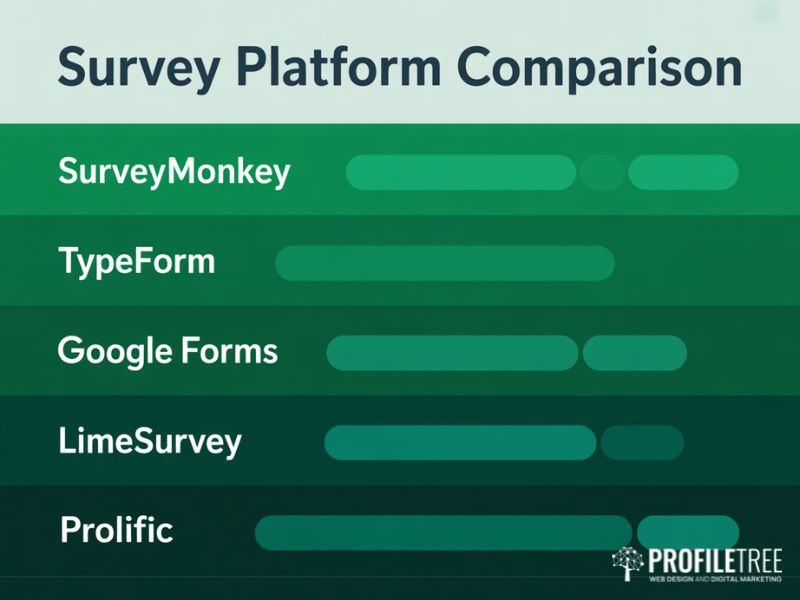
The online survey software market has grown substantially, and there are now options to suit every budget and technical requirement. The right tool for your business depends on your team size, how frequently you plan to run online surveys, what analytics you need, and how the platform integrates with your existing systems.
What to Look for in Online Survey Software
When evaluating online survey platforms, focus on the features that will actually affect your results rather than impressive-looking dashboards you will never use.
- Ease of use: You should be able to build and publish a well-structured online survey in under 30 minutes without technical support.
- Distribution options: The platform should let you share via email, embed on your website, post on social media, and generate shareable links.
- Analytics: Look for clear visualisations of results, the ability to filter responses by segment, and export options for deeper analysis.
- Integration: The best online survey tools connect directly with your CRM, email marketing platform, or content marketing systems so data flows automatically into the channels where it can drive decisions.
- Scalability: Choose a platform that can grow with your business rather than one you will outgrow within a year.
Popular Online Survey Platforms for UK SMEs
Several platforms have established themselves as reliable choices for SMEs running online surveys. Here is an honest comparison based on practical business use.
| Platform | Best For | Key Strength | Pricing |
|---|---|---|---|
| SurveyMonkey | General business surveys | Broad template library, strong analytics | Free tier; paid from approx. £32/month |
| Typeform | Customer-facing surveys | Conversational format, high completion rates | Free tier; paid from approx. £25/month |
| Google Forms | Basic internal feedback | Completely free, integrates with Google Sheets | Free |
| LimeSurvey | Complex or technical surveys | Advanced logic and customisation options | Free self-hosted; cloud from approx. £19/month |
| Prolific | Market research panels | Access to verified UK respondents | Pay per response |
According to the Office for National Statistics, SMEs account for over 99% of all UK businesses, which means the demand for affordable research tools that work at small scale is substantial. Most of the platforms above have been built with exactly that market in mind.
For most SMEs starting out with online surveys, Google Forms covers the basics at no cost. As your requirements grow, SurveyMonkey or Typeform offer the analytics and branding control that makes your online survey programme look professional and produce more reliable data.
Integrating Online Surveys With Your Digital Marketing Strategy
Online surveys become significantly more powerful when they are woven into your broader digital marketing strategy rather than run as isolated projects. When survey data informs your content planning, advertising targeting, and customer journey, every channel benefits from what you have learned.
Using Survey Data to Improve Content Marketing
One of the most direct applications of online survey data is content planning. When you ask your audience what questions they need answered, what topics confuse them, or what challenges they face in your industry, you get a content brief that comes directly from your customers rather than your own assumptions. This is particularly relevant for ProfileTree clients who need their blogs, guides, and service pages to perform well through SEO and content strategy and generate genuine enquiries.
Online surveys distributed to your email list or embedded on high-traffic pages can reveal the exact language your audience uses to describe their problems. That language belongs in your headings, meta descriptions, and opening paragraphs because it is the language they type into Google.
Social Media and Online Surveys
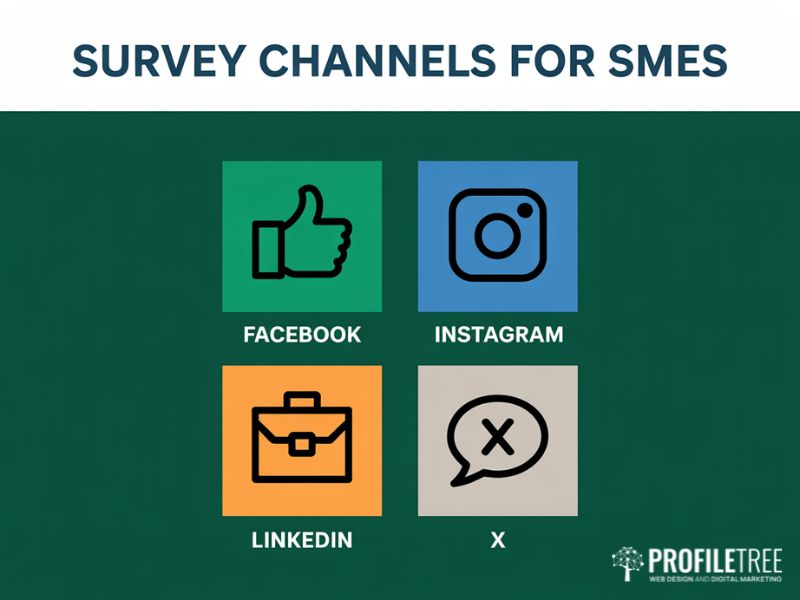
Social media platforms have built survey and polling tools directly into their interfaces, making it easier than ever to run quick online surveys without asking your audience to leave the platform. Combining this with a well-planned social media marketing approach means you can gather audience insight at the same time as building brand visibility. Each channel serves a slightly different purpose.
- Facebook polls: Good for gauging interest in a new product feature, asking which service your audience values most, or running light-hearted brand engagement questions.
- Instagram Stories polls: Effective for visual businesses. Quick yes/no or A/B questions with high response rates among younger audiences.
- LinkedIn polls: Suited to B2B SMEs. Use these for professional opinion questions that position your brand as a thought leader while gathering market data.
- X (formerly Twitter) polls: Best for real-time feedback on trending topics or fast-moving industry questions.
The advantage of embedded social media online surveys is immediacy. The disadvantage is that the data is shallow. Social polls tell you which option wins; they rarely tell you why. Use them to identify where to dig deeper with a full online survey.
Email Campaigns and Survey Integration
Email remains one of the highest-converting channels for online survey distribution. A short survey embedded in a post-purchase email, a quarterly client feedback request, or a service review prompt all achieve far higher response rates than standalone survey invitations sent without context. For a detailed look at structuring these sequences, see our guide to email marketing for small businesses.
Keep your email-based online surveys to three to five questions where possible. Include a clear statement of why you are asking and what you plan to do with the results. Customers who feel their feedback genuinely influences the business are more likely to respond next time.
Using Survey Results to Sharpen Paid Advertising
Online survey data can directly improve the performance of your Google Ads and social media advertising by revealing what your audience cares about most. If your online survey results show that price transparency is the primary concern for your customers, that insight should appear in your ad copy. If the data shows that speed of delivery matters more than cost, adjust your messaging accordingly. Advertising that reflects genuine customer priorities will always outperform generic creative.
Automation and AI in Online Survey Programmes
Manual survey management, sending individual emails, collating spreadsheets, and analysing results by hand, is one of the main reasons SMEs stop running online surveys after the first attempt. Automation removes the friction and makes a regular survey programme sustainable with minimal ongoing effort.
Automating Survey Distribution and Follow-Up
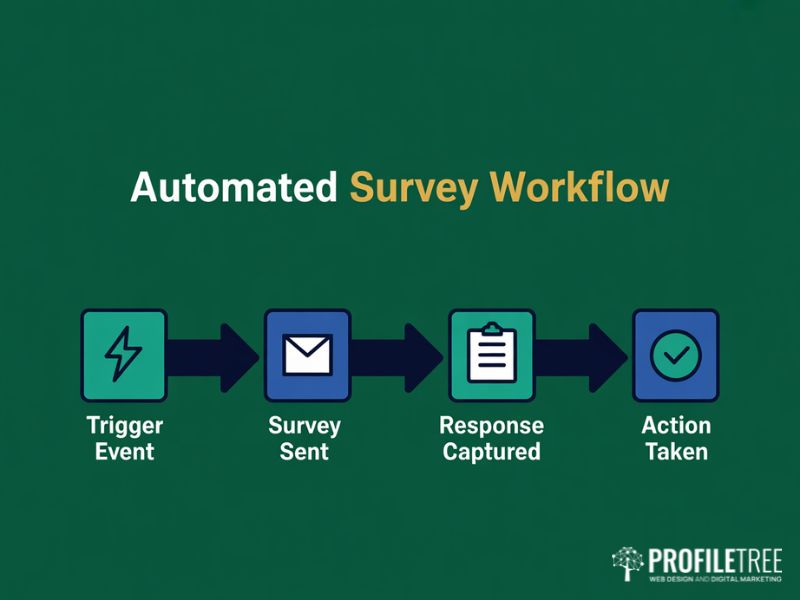
Most modern online survey tools integrate with email automation platforms, CRM systems, and e-commerce software. For a broader look at how automation fits into SME operations, our guide to marketing automation for small businesses covers the key platforms and workflows worth knowing. Once connected, you can set up triggers that automatically send an online survey when a customer completes a purchase, closes a support ticket, or has not engaged with your business in a defined period.
Automation also applies to follow-up. If a customer gives a low satisfaction score in an online survey, an automated workflow can flag that response to your customer service team, trigger a personal follow-up email, or add that customer to a recovery sequence. This closes the loop between feedback and action without requiring manual monitoring of every survey response.
As Ciaran Connolly, founder of ProfileTree, puts it: “Automation is not about replacing the human side of customer relationships. It is about making sure nothing falls through the cracks. An automated survey programme means every customer gets asked, every low score gets noticed, and every piece of useful feedback actually reaches the person who can act on it.”
How AI Enhances Online Survey Analysis
Artificial intelligence is changing how SMEs process online survey data, particularly for open-ended responses that previously required hours of manual reading and categorisation. ProfileTree’s AI marketing and automation services include exactly this kind of applied analysis, helping clients identify sentiment patterns, cluster similar responses, and surface key themes across hundreds of open-text answers in minutes.
For context on how AI tools are already being adopted across UK SMEs, our AI adoption rates in UK SMEs research provides a useful benchmark. Understanding where your sector sits relative to the wider market helps set realistic expectations for what an AI-assisted survey programme can achieve in your business.
- Sentiment analysis: Automated scoring of whether responses are positive, neutral, or negative.
- Theme clustering: Grouping similar open-ended responses to identify the most common topics without reading every entry.
- Predictive insight: Some advanced platforms can identify patterns in survey responses that correlate with customer churn or upsell readiness.
- Real-time dashboards: Live results views that update as responses come in, so you do not have to wait until a survey closes to start acting on findings.
Building a Richer Customer Profile With Survey Data
Every time a customer completes one of your online surveys, you learn something that makes your marketing more precise. Aggregating survey data over time builds detailed customer profiles that go beyond purchase history. When this data is embedded into a coherent digital strategy for your business, it improves targeting across every channel: email, paid media, organic search, and social.
These enriched profiles feed directly into your marketing activity. Email segmentation becomes more accurate. Ad targeting becomes sharper. Content becomes more relevant. The compounding effect of running consistent online surveys is a marketing strategy that improves steadily rather than staying static.
Strengthening Your SME’s Competitive Edge Through Online Surveys
The businesses that use online surveys most effectively are not necessarily the ones with the largest budgets or the most sophisticated technology. They are the ones that ask consistently, act on what they learn, and treat customer feedback as a continuous input into business strategy rather than an occasional project.
Identifying Market Trends Before Your Competitors Do

Online surveys give you early access to shifts in customer behaviour that might take months to appear in public data or industry reports. If you are regularly surveying your customers about their priorities, challenges, and buying habits, you will notice changes in sentiment before they become visible in your sales figures.
An SME that spots a change in customer priorities through its online survey programme six months before that shift becomes widely recognised has a genuine strategic advantage. It can adjust its service offering, update its messaging, and position itself ahead of demand rather than catching up to it.
Using Survey Insights to Drive Business Model Innovation
Some of the most significant business model changes at ProfileTree client businesses have come directly from online survey findings. A service that customers consistently asked for but which did not exist in the current offering. A pricing structure that created unnecessary friction. A communication process that left clients feeling uninformed.
Online surveys surface these gaps in a way that sales data cannot. Revenue figures show you what is happening; survey data tells you why. When you combine both, your decisions about what to change, what to invest in, and what to stop doing become much more grounded.
Adapting Strategy in Response to Market Challenges
The period since 2020 has shown every SME that the ability to respond quickly to changing conditions is more valuable than any fixed five-year plan. Online surveys played a significant role for businesses that navigated recent disruption successfully. Those that asked their customers directly what they needed, how their priorities had changed, and what would make them continue to do business were able to adapt their models faster than those working from assumptions.
That same responsiveness applies to every market challenge. Rising costs, supply chain disruption, shifts in consumer confidence, and changes in digital behaviour can all be monitored through well-timed online surveys that give you a direct line to the people your business serves.
Collaboration and Connectivity Through Survey Data
Online surveys are not just external tools for gathering customer feedback. Many SMEs use them internally to understand team satisfaction, identify operational bottlenecks, and gather input before making significant changes to processes or culture.
Internal online surveys, used well, support the kind of collaborative decision-making that makes teams feel involved rather than managed. Combining internal surveys with structured digital training for your team means the insights you gather can be acted on by people who have the skills and confidence to implement change effectively.
Financing Growth Through Better Business Intelligence
Access to reliable data from consistent online surveys strengthens your case when approaching investors, applying for funding, or making a case for growth to your own board or partners. A business that can show documented evidence of customer demand, satisfaction trends, and market validation is a significantly more credible proposition than one presenting assumptions without supporting data.
The UK market presents a substantial funding opportunity for SMEs with clear growth plans and evidence of market fit. Online surveys are one of the most cost-effective ways to generate the customer intelligence that supports those plans.
Taking the Next Step With Online Surveys
Online surveys are one of the most accessible and high-value research tools available to UK SMEs. When they are designed well, distributed to the right audience, and connected to genuine action, they improve every aspect of the business: product development, marketing, customer retention, and strategic planning.
The barrier to starting is lower than most business owners realise. A focused five-question online survey distributed to your existing customers this week could surface insights that change how you approach the next quarter. As your confidence and capability grows, integrating online surveys with automation, AI analysis, and your digital marketing channels will compound those returns.
If you would like to discuss how ProfileTree’s digital marketing strategy, content, and automation services can help you build a more effective customer intelligence programme, or if you are exploring tools such as AI chatbots for real-time customer feedback, get in touch with our Belfast team today.
FAQs
What are the primary advantages of online surveys for small businesses?
Online surveys give SMEs affordable, fast access to customer data. They scale easily, can be distributed across multiple channels, and produce results that feed directly into product, marketing, and service decisions.
How do online survey tools improve business decision-making?
They replace guesswork with evidence. When you know what your customers actually think, decisions about pricing, messaging, and service design become more accurate and easier to justify.
What challenges do businesses face when running online surveys?
Low response rates and survey fatigue are the most common issues. Both improve when surveys are short, well-timed, and tied to a clear stated purpose that the respondent can understand.
How do online surveys contribute to customer insight?
They tell you why customers behave the way they do. Analytics show you what happens on your site or in your sales funnel; online surveys explain the reasoning and motivation behind those actions.
What makes an online survey effective as a business tool?
A clear purpose, the right audience, concise questions, and a genuine plan for acting on the results. Without the last of these, even a well-designed survey produces data rather than insight.
How does SurveyMonkey compare to other online survey tools for UK SMEs?
It is one of the more reliable all-round options. The template library is broad, the analytics are solid, and it integrates with most CRM and email platforms. It costs more than Google Forms but less than enterprise research tools, making it a reasonable mid-market choice.