
Best Programming Languages to Learn for Beginners in 2026
Table of Contents
The programming landscape has transformed dramatically. What once required years of study can now be achieved in months with the right approach and focus. For business owners, marketing professionals, and aspiring developers, selecting the correct programming language has a direct impact on career prospects, business growth, and digital capabilities.
This guide cuts through the confusion surrounding programming languages to learn for beginners. Based on current market demand, learning curves, and real-world applications, we’ll examine which languages offer the best return on your time investment. Whether you’re building websites, automating marketing tasks, analysing data, or implementing AI solutions, understanding the programming fundamentals gives you a significant competitive advantage.
The advice has changed. HTML and CSS alone won’t suffice for modern digital professionals. Python, JavaScript, and SQL have become the new baseline, particularly for those working in digital marketing, web development, and business automation.
Why Learning Programming Matters for Business Growth
Programming knowledge has shifted from optional to essential across most business functions. Marketing managers who understand basic coding can implement tracking scripts without waiting for developers to do so. Business owners with programming skills can evaluate technical proposals more effectively and clearly communicate their requirements to development teams, ensuring a more seamless process.
The digital skills gap continues to widen, particularly in Northern Ireland and across the UK. Companies struggle to find professionals who combine marketing expertise with technical capabilities. Learning programming languages bridges this gap, making you significantly more valuable to employers or clients.
At ProfileTree, we’ve trained hundreds of SME owners and marketing professionals in coding fundamentals. The most successful participants share a common trait: they don’t aim to become full-time developers. Instead, they acquire sufficient programming knowledge to automate repetitive tasks, gain a deeper understanding of their technical teams, and make informed decisions about digital investments.
Programming also provides direct cost savings. Simple tasks that previously required hiring freelancers—such as updating website content, creating automated reports, or connecting marketing tools—become manageable with basic coding skills. For small businesses operating on tight budgets, this independence proves invaluable.
“The businesses that thrive aren’t necessarily those with the biggest development teams,” notes Ciaran Connolly, Director of ProfileTree. “They’re the ones where decision-makers understand enough about code to spot opportunities for automation and efficiency that others miss entirely.”
Understanding Different Types of Programming Languages
Programming languages fall into several categories, each suited to different tasks and thinking styles. Understanding these categories helps you select the right language for your specific goals, rather than following generic advice that may not align with your needs.
Procedural Programming Languages
Procedural languages execute instructions in a specific sequence, similar to following a recipe. Languages like C, Pascal, and BASIC fall into this category. They work by defining functions that operate on data, using loops and conditional statements to control program flow.
For beginners, procedural programming offers a straightforward mental model. You write commands, and the computer executes them in order. This directness makes debugging easier—when something goes wrong, you can trace through your code step by step to find the issue.
JavaScript and Python support procedural programming styles, making them accessible starting points. However, pure procedural languages like C require more attention to memory management and system-level details, which can be overwhelming for newcomers.
Functional Programming Languages
Functional programming treats computation as the evaluation of mathematical functions. Languages like Haskell, Erlang, and parts of JavaScript follow this paradigm. Functions are first-class citizens—you can pass them as arguments, return them from other functions, and store them in variables.
This approach reduces bugs by avoiding mutable state and side effects. When functions don’t change external data, your code becomes more predictable and easier to test. For data analysis and AI applications, functional programming concepts prove particularly useful.
Both Python and JavaScript support functional programming patterns alongside other programming styles. This flexibility enables beginners to begin with simpler approaches and gradually incorporate more advanced functional concepts as their understanding deepens.
Object-Oriented Programming Languages
Object-oriented programming (OOP) organises code around objects that combine data and behaviour. Java, Python, C++, and C# exemplify this approach. You define classes that serve as blueprints, then create instances of those classes to perform work.
For web development and application building, OOP provides a natural way to model real-world systems. A website’s user becomes a User object with properties such as username and email, along with methods like login() and logout(). This organisation helps manage complexity in larger projects.
Most modern programming languages support OOP, even if they don’t require it. Python allows you to write procedural code initially, then refactor to objects as your projects grow. This flexibility makes it particularly suitable for beginners who want to learn in a progressive manner.
Scripting Languages
Scripting languages automate tasks and integrate different systems. Python, JavaScript, Ruby, and PHP fit this category. They typically feature simpler syntax, dynamic typing, and interpreted execution rather than compilation.
For marketing automation, data processing, and website functionality, scripting languages dominate. Their rapid development cycles mean you can test ideas quickly without lengthy build processes. ProfileTree uses Python extensively for automating SEO audits, content analysis, and client reporting.
The line between scripting and general-purpose programming has blurred. Modern scripting languages handle everything from simple automation to complex web applications. JavaScript, initially designed for fundamental browser interactions, now powers entire server infrastructures through Node.js.
Logic Programming Languages
Logic programming languages, such as Prologue, work by defining facts and rules, and then querying those definitions. Rather than specifying how to solve a problem step by step, you describe what constitutes a solution.
While less common in mainstream web development, logic programming excels at specific tasks, such as natural language processing, expert systems, and specialised AI applications. Most beginners can safely skip this category initially, unless they are working in specialised fields.
Imperative vs Declarative Languages
Imperative languages specify exactly how to achieve results through explicit commands. You tell the computer each step to take. Most procedural and object-oriented languages are essential.
Declarative languages describe what you want without specifying how to get there. SQL, HTML, and CSS are declarative—you tell the data structure or appearance you want, and the system determines how to create it.
For beginners, imperative languages often feel more intuitive initially. The cause-and-effect relationship between code and output is direct and straightforward. Declarative languages require adjusting to a different mental model but offer powerful abstractions once mastered.
Factors to Consider in Choosing a Programming Language
Selecting your first programming language requires matching your goals with the language’s characteristics. The “best” language differs dramatically depending on whether you’re building websites, analysing data, or creating mobile applications.
Purpose and Goal of Learning
Define your programming objectives before selecting a language. If you want to add interactive features to websites, JavaScript becomes essential. For data analysis and machine learning, Python is the dominant language. Mobile app development points toward Swift for iOS or Kotlin for Android.
Business owners seeking general technical literacy might start with Python. Its readable syntax and broad applicability mean skills transfer across multiple domains—web development, automation, data science, and AI implementation. Marketing professionals often benefit most from Python and SQL, which directly support campaign analysis and automation.
At ProfileTree, we recommend clients identify three specific tasks they want to accomplish with code. “I want to automate our social media reporting,” “I want to build a custom CRM,” or “I want to analyse customer behaviour patterns” provide concrete direction. Vague goals, such as “learn to code,” often lead to frustration and abandoned studies.
Job Opportunities and Market Demand
Labour market data heavily favours specific languages—Python, JavaScript, and Java consistently top employer demand across the UK. SQL appears in the majority of data-related job postings, while TypeScript (JavaScript with added type safety) has seen explosive growth.
Regional factors matter. In Belfast and Northern Ireland, web development roles often require proficiency in JavaScript, React, and Node.js. Fintech positions prioritise Java and C#. Understanding your local market’s preferences helps focus your learning efforts.
Job listings provide valuable intelligence. Search positions you aspire to on Indeed, LinkedIn, or Glassdoor. Note which languages appear most frequently in requirements. This research ensures your learning aligns with actual opportunities rather than theoretical advice.
Ease of Learning and Developer Experience
Python consistently ranks as one of the most beginner-friendly languages. Its syntax resembles plain English—if user_age > 18: reads naturally even to non-programmers. The language enforces consistent formatting, which helps beginners develop good habits from the start.
JavaScript’s learning curve is slightly steeper due to its quirks and browser-specific behaviours. However, seeing your code produce immediate visual changes in a web page provides motivating feedback. This instant gratification helps maintain enthusiasm through the difficult early stages.
Java requires more boilerplate code for simple tasks, making it less ideal for absolute beginners. However, its strict typing catches many errors before the code runs, potentially preventing confusion. Some educators prefer teaching Java first, specifically because it requires precise thinking.
Consider learning styles alongside language difficulty. Visual learners often progress more quickly with JavaScript, as they can see results immediately in browsers. Analytical thinkers might prefer Python’s logical structure and comprehensive error messages.
Community Support and Learning Resources
Large communities mean abundant tutorials, forums, and troubleshooting resources. Python and JavaScript both boast massive communities when you encounter errors—which you will—thousands of others have likely faced identical issues and documented solutions.
Stack Overflow activity serves as a valuable proxy for community size. Python and JavaScript dominate the platform. Less popular languages may have limited resources, forcing beginners to struggle through problems that could be solved quickly with better documentation.
Free learning resources vary dramatically by language. Python offers excellent free courses through Real Python, Python.org, and countless YouTube tutorials. JavaScript has resources such as freeCodeCamp, MDN Web Docs, and The Odin Project. Java and C++ learning materials tend to focus on paid courses and textbooks.
ProfileTree’s digital training programmes focus heavily on Python and JavaScript precisely because of their excellent learning ecosystems. Trainees can supplement formal instruction with numerous free resources, significantly accelerating their progress.
Compatibility with Other Technologies
Modern software development rarely involves a single language. Websites are built using JavaScript, HTML, and CSS. Data pipelines might use Python for processing, SQL for storage, and JavaScript for visualisation. Consider how languages work together rather than in isolation.
JavaScript’s ubiquity makes it compatible with nearly everything. Python integrates smoothly with most databases, APIs, and web frameworks. Java’s JVM (Java Virtual Machine) allows interoperability with Scala, Kotlin, and other JVM languages.
For businesses implementing AI solutions, Python’s ecosystem proves decisive. Major AI platforms—OpenAI, Anthropic Claude, Hugging Face—provide Python libraries as their primary interface. While these services offer APIs accessible from any language, Python’s integration remains deepest and best-documented.
Top Programming Languages to Learn in 2026
The programming language landscape shifts constantly, but several languages have established dominant positions unlikely to change soon. These languages offer the best combination of accessibility for learning, job opportunities, and practical application across various business contexts.
JavaScript: The Language of the Web
JavaScript runs on virtually every website, making it the most widely deployed programming language. It powers interactive features—such as dropdown menus, form validation, and dynamic content loading—that users encounter frequently. For web development, JavaScript isn’t optional.
Beyond browsers, JavaScript has expanded into server-side development through Node.js. This allows developers to use a single language across entire web applications, from frontend interfaces to backend APIs and database interactions. Full-stack JavaScript development has become a highly sought-after skill set.
For beginners, JavaScript offers immediate visual feedback. Open your browser’s developer console, type in the command, and see the instant results. This immediate reinforcement helps maintain motivation through early learning challenges.
Modern JavaScript frameworks, such as React, Vue, and Angular, dominate professional web development. These tools handle complex applications efficiently, though they add learning overhead. Beginners should master the fundamentals of vanilla JavaScript before exploring frameworks.
ProfileTree builds most of its client websites using WordPress, complemented with custom JavaScript for interactive features. Understanding JavaScript enables our clients to make minor updates independently, rather than requiring developer assistance for simple changes. This independence reduces ongoing costs while maintaining website functionality.
JavaScript’s ecosystem includes npm (Node Package Manager), hosting over 2 million packages. Need to validate email addresses? Parse dates? Generate random user data for testing? A JavaScript package exists for virtually any everyday task.
TypeScript, a superset of JavaScript that adds static typing, has gained massive adoption. It catches errors during development, rather than in production, significantly reducing bugs. Once you understand JavaScript, TypeScript becomes a natural progression.
Python: The Swiss Army Knife of Programming
Python has emerged as the default language for an extensive range of applications. Web development, data science, machine learning, automation, and scientific computing—Python handles all of these competently. This versatility makes it an excellent choice as a first language.
The syntax prioritises readability. Python code often reads like pseudocode or plain English. Compare these two approaches to the same task:
Java:
public class HelloWorld {
    public static void main(String[] args) {
        System.out.println("Hello World");
    }
}
Python:
print("Hello World")The difference becomes more pronounced in complex programs. Python’s minimal boilerplate lets beginners focus on programming concepts rather than syntax peculiarities.
For business automation, Python excels. Need to scrape competitor pricing from websites? Process thousands of customer records? Generate automated reports? Python libraries exist for all these tasks, often requiring just a few lines of code.
ProfileTree uses Python extensively for SEO automation, content analysis, and client reporting. Scripts that once took hours of manual work now run automatically overnight, freeing our team to focus on strategy rather than data compilation.
Python’s dominance in AI and machine learning makes it a crucial tool for businesses exploring these technologies. TensorFlow, PyTorch, scikit-learn—virtually every major AI framework prioritises Python support. When clients inquire about AI implementation, Python is often an integral part of the solution.
The language’s “batteries included” philosophy means extensive functionality ships with the base installation. File handling, date manipulation, web requests, data structures—Python provides robust solutions without external dependencies.
Data analysis represents another Python strength. Libraries like Pandas, NumPy, and Matplotlib transform Python into a powerful analytics platform. Marketing teams can analyse campaign performance, identify trends, and generate visualisations without expensive specialised software.
Java: Enterprise Power and Stability
Java powers enormous systems, including banking platforms, Android applications, and enterprise resource planning software. Its “write once, run anywhere” capability means Java code runs identically across Windows, Mac, and Linux without modification.
For beginners, Java rigorously introduces programming concepts. Its static typing catches errors early, potentially preventing confusion about how variables and data types work. The strict structure enforces good practices from the beginning.
Android app development relies heavily on Java, though Kotlin has gained ground. If mobile applications interest you, Java remains highly relevant. Millions of Android applications testify to the language’s stability and capability.
Large organisations favour Java for its maturity and extensive enterprise tooling. Banking systems, insurance platforms, and government services often run on Java. This creates consistent demand for Java developers, particularly in established companies rather than startups.
The learning curve is steeper than Python or JavaScript. More boilerplate code, stricter syntax requirements, and compilation steps add friction. However, many developers credit Java with teaching them fundamental programming concepts thoroughly.
Java’s ecosystem encompasses the Spring Framework, Hibernate, and numerous other tools for building robust applications. While these tools add complexity, they provide battle-tested solutions to common development challenges.
For ProfileTree clients requiring complex business logic, integration with existing enterprise systems, or applications demanding high performance, Java often features in our technical recommendations. Its reliability and extensive tooling make it suitable for business-critical applications.
SQL: The Data Access Foundation
SQL (Structured Query Language) isn’t a general-purpose programming language—it’s specialised for database interaction. However, its importance cannot be overstated. Nearly every application stores data in databases, and SQL provides the standard interface for accessing and manipulating this data.
For marketing professionals and business analysts, SQL unlocks direct access to company data. Rather than requesting reports from IT departments, you can write queries yourself. “Show me all customers who purchased in the last 30 days but haven’t returned” can be expressed as a simple SQL query.
The syntax reads relatively naturally:
SELECT customer_name, email
FROM customers
WHERE last_purchase > '2025-11-15'
AND total_purchases > 1000
Most databases, including MySQL, PostgreSQL, SQL Server, and Oracle, use SQL with minor variations. Learn SQL once, and you can work with data across virtually any system.
SQL forms the backbone of data analysis capabilities. Client website analytics, SEO performance tracking, and content effectiveness all require SQL queries to extract meaningful insights from raw data.
Business intelligence tools like Tableau and Power BI generate SQL behind their visual interfaces. Understanding SQL helps you troubleshoot when these tools produce unexpected results or need customisation beyond their built-in capabilities.
Combined with Python, SQL creates a powerful data analysis workflow. Extract data with SQL, process it with Python’s Pandas library, and generate visualisations—this pattern efficiently handles most business analytics needs.
Go: Simplicity Meets Performance
Go (often called GoLang) emerged from Google to address specific problems: build speed, execution efficiency, and simplicity. It compiles to native machine code, similar to C, but with modern conveniences and strong concurrency support.
For beginners, Go offers clean syntax without the complexity of C or Java. The language intentionally limits features, forcing developers to opt for simple, readable solutions. Error handling is explicit rather than hidden in exception mechanisms.
Go excels at network services, APIs, and cloud infrastructure tools. Docker, Kubernetes, and many other cloud-native technologies are written in the Go programming language. If infrastructure or DevOps interests you, Go becomes increasingly relevant.
The learning curve sits between Python’s simplicity and Java’s complexity. Go requires thinking about types and memory more carefully than Python, but avoids Java’s verbose ceremony. For someone who has grasped basic programming concepts, Go provides a natural progression.
Go’s standard library includes robust networking, HTTP handling, and JSON processing. Building REST APIs requires minimal external dependencies, keeping projects manageable and maintainable.
For businesses building microservices or APIs to connect different systems, Go offers compelling advantages. Its performance rivals that of languages like C++, while maintaining readable code.
Kotlin: Modern Android Development
Kotlin runs on the Java Virtual Machine but with more concise, expressive syntax. Google officially supports Kotlin for Android development, and many developers find it more pleasant than Java for mobile applications.
The language addresses many of Java’s pain points—verbose syntax, null pointer exceptions, and boilerplate code. Kotlin code typically runs 30-40% shorter than equivalent Java while remaining fully interoperable with existing Java code.
For beginners interested in mobile development, Kotlin provides a gentle entry point. The syntax feels modern and clean, similar to Python in readability, while maintaining strong typing for error prevention.
Kotlin Multiplatform promises code sharing across Android, iOS, and web applications. While still maturing, this capability could significantly reduce development effort for businesses maintaining apps across multiple platforms.
Android Studio, Google’s official development environment, offers excellent support for Kotlin. Tutorials, documentation, and community resources have grown substantially, making Kotlin learning accessible.
ProfileTree recommends Kotlin for clients developing Android applications, particularly when the development team lacks extensive Java experience. The reduced verbosity accelerates development without sacrificing the robustness businesses require.
PHP: The Web Development Workhorse
PHP powers a substantial portion of the web, including WordPress, which runs over 40% of all websites. For businesses using WordPress or similar content management systems, PHP knowledge enables extensive customisation.
The language has evolved significantly. Modern PHP (versions 8 and later) includes strong typing, improved performance, and contemporary features. While PHP carries legacy baggage from earlier versions, current PHP bears little resemblance to the language’s reputation for messy code.
WordPress customisation requires PHP understanding. Creating custom plugins, modifying themes, or building specific functionality all require proficiency in PHP. For businesses heavily invested in WordPress, PHP becomes highly practical.
Learning PHP typically progresses quickly due to its straightforward syntax and immediate deployment—save a .php file to your web server, and it runs. This rapid feedback loop helps beginners see results quickly.
Laravel, a modern PHP framework, has revitalised PHP’s reputation. It provides elegant syntax, robust tools, and comprehensive documentation. Many contemporary web applications use Laravel for backend development.
ProfileTree regularly builds custom WordPress solutions for clients. PHP knowledge enables us to extend WordPress far beyond standard themes and plugins, creating bespoke solutions that perfectly match specific business requirements.
Choosing Programming Languages by Use Case
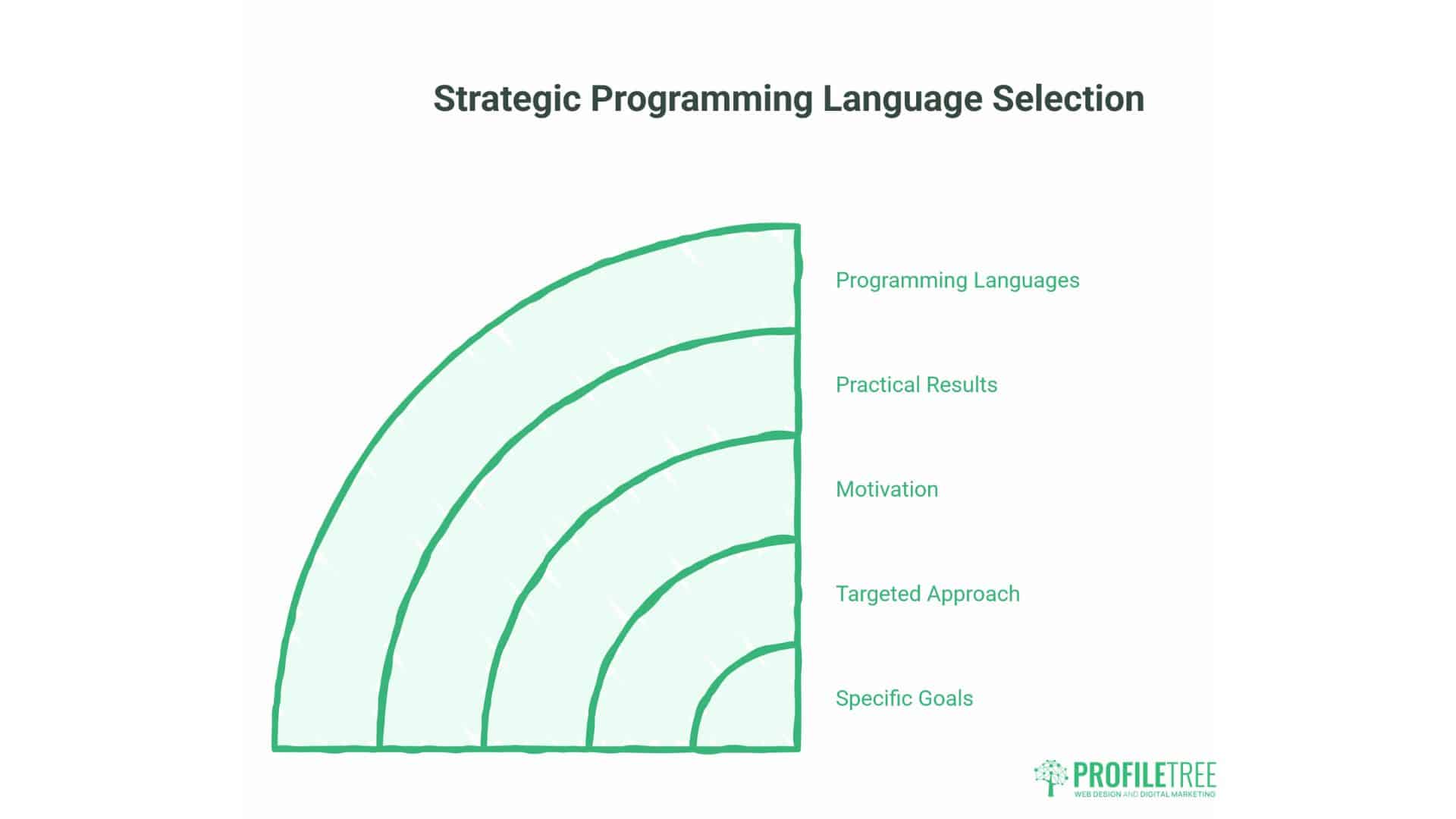
Your intended application dramatically influences which language to prioritise. Rather than learning languages abstractly, focus on those serving your specific goals. This targeted approach maintains motivation and produces practical results quickly.
Web Development and Digital Presence
Modern web development requires multiple programming languages to work together. HTML structures content, CSS handles presentation, and JavaScript provides interactivity. This “holy trinity” forms the foundation of every website.
For frontend development, master JavaScript alongside HTML and CSS. React has become the dominant framework for complex web applications, followed by Vue and Angular. These frameworks manage application state and efficiently update user interfaces to ensure seamless user experiences.
Backend web development offers a broader range of programming languages. Python, combined with Django or Flask, provides rapid development and clean code. JavaScript, combined with Node.js, enables full-stack development using JavaScript. PHP with Laravel remains a popular choice, particularly for content-heavy websites. Ruby on Rails offers another mature option, though its popularity has declined from peak levels.
ProfileTree’s web development primarily uses WordPress (PHP) with custom JavaScript for interactive features. This combination provides clients with familiar content management while enabling sophisticated functionality. For custom applications requiring more control, we implement Python with Django, offering flexibility and scalability.
The rise of JAMstack architecture (JavaScript, APIs, and Markup) has changed web development patterns. Static site generators, combined with API services, create fast and secure websites. This approach often uses JavaScript frameworks with markdown content and headless CMS solutions.
Progressive Web Applications (PWAs) blur boundaries between websites and native applications. They require advanced JavaScript skills but deliver app-like experiences through browsers, avoiding app store approval processes and platform-specific development.
For businesses, WordPress proficiency delivers immediate practical value. Understanding PHP and JavaScript enables extensive customisation without expensive developer hours. Small changes—adjusting form behaviour, modifying layouts, integrating third-party services—become manageable in-house tasks.
Mobile Application Development
Mobile development can be divided into two primary approaches: native and cross-platform. Native development utilises platform-specific languages—such as Swift for iOS and Kotlin or Java for Android—to produce optimal performance and user experience. Cross-platform tools utilise JavaScript or Dart to build applications that run on both iOS and Android, leveraging a shared codebase.
Swift, Apple’s modern language for iOS, offers clean syntax and strong safety features. Its playground feature allows for interactive coding—write code and see the results immediately without building entire applications. For anyone committed to iOS development, Swift is essential.
Kotlin dominates modern Android development. Google’s official recommendation offers improved syntax over Java while maintaining full compatibility with existing Android code and libraries. The Android development community has enthusiastically adopted Kotlin.
React Native enables JavaScript developers to build mobile applications without needing to learn Swift or Kotlin. Facebook maintains this framework, which powers applications from major companies such as Tesla, Shopify, and Discord. Performance approaches but does not fully match native applications.
Flutter, Google’s cross-platform framework, uses the Dart language. It provides excellent performance and visual consistency across platforms. Flutter’s hot reload feature displays code changes instantly, eliminating the need for rebuilding applications and dramatically accelerating development.
For businesses deciding between approaches, consider your specific requirements. Native development offers optimal performance and user experience, albeit at the cost of maintaining separate codebases. Cross-platform development reduces development time but may require compromises on performance or platform-specific features.
ProfileTree typically recommends cross-platform development for SMEs, prioritising market validation over perfect performance. React Native suits clients with existing JavaScript expertise, while Flutter offers advantages when starting fresh without platform preferences.
Data Analysis and Business Intelligence
Data analysis combines programming with statistical thinking. Python dominates this space through libraries like Pandas (data manipulation), NumPy (numerical computing), and Matplotlib or Seaborn (visualisation). The Jupyter Notebook environment enables the mixing of code, results, and explanatory text in interactive documents.
SQL remains essential for data extraction. Most business data resides in relational databases, and SQL provides the standard method of access. Combining SQL for data retrieval with Python for analysis creates a powerful workflow.
R offers an alternative to Python, particularly for statistical analysis and data science. Developed by statisticians, it excels at complex statistical procedures and academic research. However, Python’s broader applicability and easier learning curve make it preferable for most business contexts.
For marketing analytics, Python scripts can automate the entire reporting process. Connect to Google Analytics API, extract campaign data, calculate key metrics, generate charts, and email reports—all automatically. What once required hours of manual work becomes a scheduled script.
Business intelligence tools, such as Tableau, Power BI, and Looker, provide visual interfaces for data analysis. However, understanding underlying SQL and programming concepts helps troubleshoot issues, customise analyses beyond standard features, and extract maximum value.
ProfileTree’s SEO and content marketing services rely heavily on Python for data analysis. Competitor analysis, keyword research, and content performance tracking—these tasks generate enormous data volumes requiring programmatic processing. Python transforms raw data into actionable business intelligence.
Machine learning and predictive analytics rely on solid programming foundations. While no-code tools have emerged, serious machine learning demands an understanding of Python and libraries such as scikit-learn, TensorFlow, or PyTorch. These skills enable the creation of custom models tailored to specific business problems.
Marketing Automation and Digital Strategy
Marketing automation increasingly requires programming skills. Connecting systems through APIs, processing customer data, and personalising content at scale—these tasks benefit enormously from coding knowledge, even at basic levels.
Python excels for marketing automation. Scripts can monitor competitor websites, extract pricing data, trigger alerts when changes occur, or automatically compile competitor content. Social media automation, email campaign analysis, and lead scoring all become accessible with Python skills.
JavaScript enables sophisticated website personalisation. Display different content based on visitor behaviour, run A/B tests programmatically, or implement progressive disclosure revealing information based on engagement. These capabilities convert more visitors while improving user experience.
SQL skills allow direct access to marketing databases. Rather than requesting reports, you can query customer data directly. “Show me customers from Northern Ireland who visited in the last month but didn’t purchase” becomes a simple query.
Marketing platforms increasingly offer API access. Connecting these APIs—pulling data from Google Ads, pushing it to CRM systems, triggering automated emails—requires programming. Python’s Requests library and various SDK packages make these integrations manageable.
At ProfileTree, we’ve built custom marketing automation systems combining Python for data processing, SQL for storage, and JavaScript for user interfaces. These systems often outperform generic marketing automation platforms by precisely addressing specific client workflows.
Understanding programming helps evaluate marketing technology. When vendors promise features, technical knowledge lets you assess feasibility, identify limitations, and ask informed questions. This prevents costly investments in solutions that don’t deliver promised capabilities.
Artificial Intelligence and Machine Learning
AI implementation has become accessible to businesses of all sizes through APIs and pre-trained models. However, connecting these capabilities to your systems, processing data appropriately, and automating workflows requires programming skills.
Python dominates AI development. Major frameworks—TensorFlow, PyTorch, Keras—prioritise Python support. When OpenAI, Anthropic, or Google release new AI capabilities, Python libraries often appear first, accompanied by comprehensive documentation.
For businesses, AI programming typically involves training neural networks rather than training them from scratch. Instead, you’ll call APIs, process their responses, and integrate results into existing systems. This “AI orchestration” requires programming knowledge without demanding deep machine learning expertise.
Natural language processing (NLP) applications—such as sentiment analysis, content classification, and summarisation—have become remarkably accessible. Pre-trained models from Hugging Face or cloud providers handle the complex work. Your code simply calls these services with appropriate data.
Computer vision applications follow similar patterns—image recognition, object detection, and visual search all leverage pre-trained models through APIs. Python scripts manage data preparation, API calls, and result processing.
ProfileTree’s AI training programmes focus on practical implementation rather than theoretical computer science. We teach business owners and marketing professionals how to connect Claude API, OpenAI, and other services to automate content creation, customer service, and data analysis.
Understanding AI programming helps businesses avoid costly mistakes. Requirements for data preparation, API rate limits, cost per request, and result quality all affect project feasibility. Technical knowledge prevents unrealistic expectations and helps scope projects appropriately.
Game Development and Interactive Experiences
Game development requires different skills than those typically found in business applications. Real-time performance, graphics rendering, physics simulation, and complex state management create unique challenges.
C++ remains dominant in professional game development due to performance requirements. Major game engines—Unreal Engine, for example—use C++ for core systems. However, C++’s complexity makes it challenging for beginners.
C# with Unity provides a more accessible entry point. Unity powers numerous successful games across mobile, console, and PC platforms. C# offers cleaner syntax than C++ while maintaining solid performance for most game types.
JavaScript can create browser-based games. Libraries like Phaser and Three.js handle graphics and game logic. While less powerful than C++ or C#, JavaScript allows rapid prototyping and easy distribution through web browsers.
Python has limited use in game development, primarily for prototyping or creating simple games. The Pygame library provides basic game development capabilities but lacks the performance and tooling of Unity or Unreal.
For businesses creating interactive experiences, such as product configurators, training simulations, and virtual showrooms, game engines offer robust solutions. Unity and Unreal Engine both provide capabilities far beyond traditional web development.
ProfileTree has developed interactive product demonstrations and training modules. These experiences engage users more effectively than static content while providing memorable brand interactions.
Cybersecurity and System Administration
Cybersecurity professionals require programming to automate security testing, analyse system logs, and develop security tools. Python dominates this space due to its extensive libraries for network operations, data processing, and system interaction.
Bash scripting (Linux/Unix command line) forms another essential skill for system administration and security. Automating server configuration, log analysis, and security audits often requires the use of shell scripts. While technically not a programming language, Bash skills prove highly valuable.
PowerShell serves similar purposes in Windows environments. System administrators automate Windows server management, Active Directory operations, and configuration tasks through PowerShell scripts.
For penetration testing and security research, Python libraries such as Scapy (packet manipulation), Requests (web testing), and BeautifulSoup (web scraping) prove essential. Security professionals develop custom tools tailored to their specific testing requirements.
JavaScript knowledge helps understand web application vulnerabilities. Cross-site scripting (XSS), SQL injection, and other web attacks require understanding how web applications process user input and execute code.
Businesses that implement security measures benefit from having programming skills. Writing custom security rules, automating security audits, and analysing security logs all require coding capabilities. These skills help maintain security without entirely depending on external consultants.
Practical Learning Paths and Next Steps
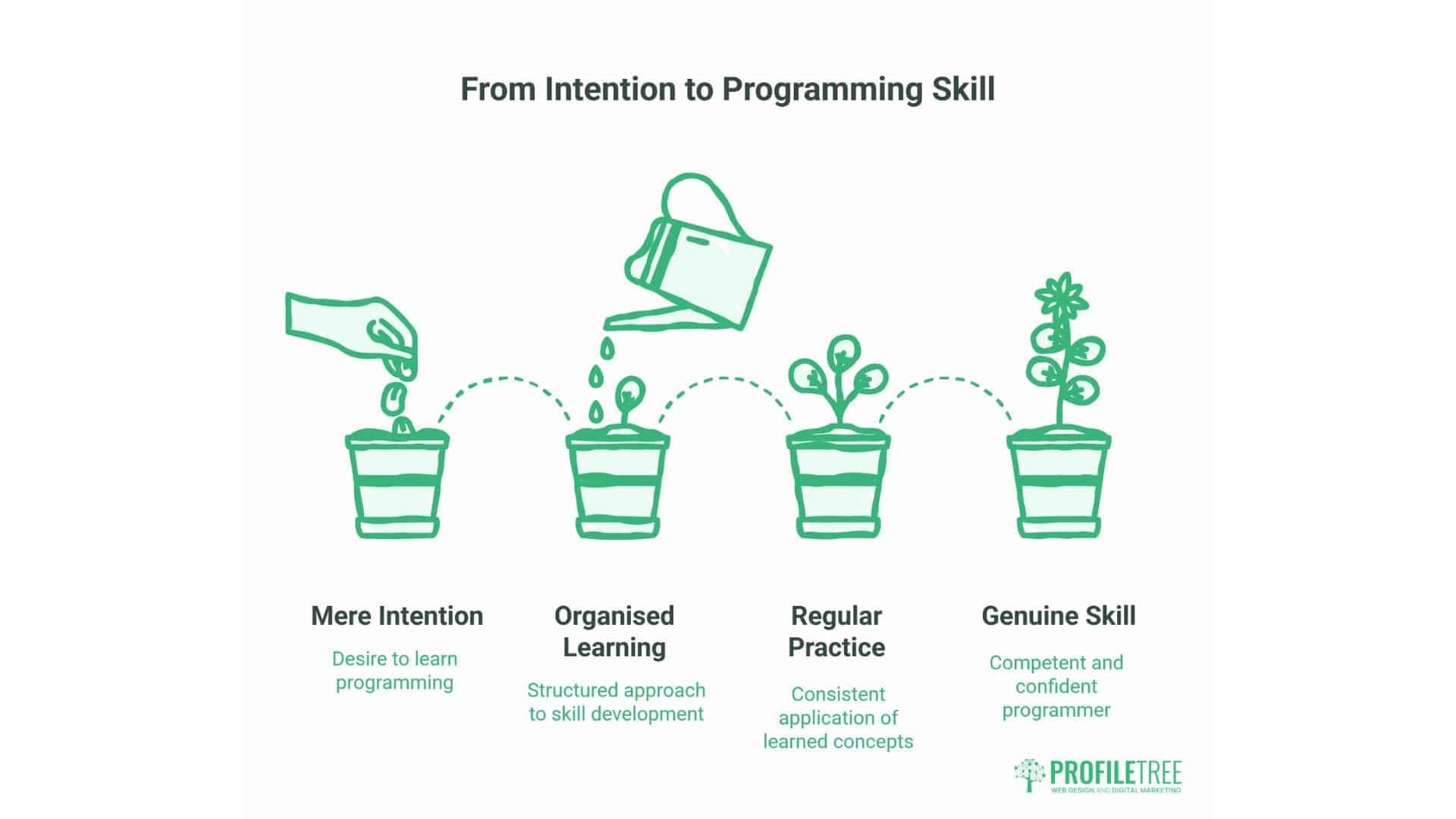
Moving from intention to actual programming skill requires structured learning and consistent practice. The following approaches help beginners build competence methodically while maintaining motivation.
The 100-Hour Foundation
Most programming languages reveal their core concepts within 100 hours of focused study. This represents roughly 12 weeks of studying, 8-10 hours weekly—a demanding but manageable commitment alongside full-time work.
Start with one language and resist the temptation to language-hop. Python or JavaScript provides the best first language for most business applications. Commit fully to one language until you can build complete, working projects independently.
Structure learning around projects rather than abstract tutorials. “Build a personal website,” “Create a price monitoring tool,” or “Develop an automated reporting system” provides concrete goals, maintaining motivation better than endless tutorial consumption.
Interactive platforms like Codecademy, freeCodeCamp, or DataCamp provide structured learning paths. Their immediate feedback and progressive difficulty help maintain engagement through early challenges.
Building Real Business Value
The transition from tutorials to real projects marks crucial progress. Select projects that directly serve business needs to maintain motivation and demonstrate value.
Marketing professionals might build tools automating competitor monitoring, social media posting schedules, or campaign performance dashboards. Business owners could create customer data analysis tools, inventory monitors, or automated reporting systems.
ProfileTree encourages training participants to identify three current manual tasks that consume a significant amount of time. These tasks become programming projects—automation targets demonstrating immediate value while building skills.
Imperfect projects offer a better learning experience than perfect tutorials. Building something worthwhile, even if inelegant, teaches problem-solving skills no tutorial covers. You’ll encounter factual errors, research solutions, and develop troubleshooting abilities.
Community and Continued Learning
Programming communities provide essential support, particularly when stuck on complex problems. Stack Overflow, Reddit programming forums, and language-specific communities offer help when official documentation proves inadequate.
Contributing to open-source projects accelerates learning dramatically. Reading others’ code, submitting bug fixes, or adding minor features exposes you to professional coding standards and practices. GitHub hosts millions of open-source projects welcoming contributors.
Regular coding practice helps maintain and develop skills. Brief daily practice outperforms sporadic intensive sessions. Even 30 minutes daily keeps concepts fresh and builds muscle memory for syntax and common patterns.
Regional Resources and Training
Within Northern Ireland and the UK, numerous resources support programming learning. Belfast hosts active developer meetups covering Python, JavaScript, and other programming languages and technologies. These gatherings offer opportunities for networking, education, and community support.
Universities across Northern Ireland, including Queen’s University Belfast and Ulster University, offer evening courses and continuing education in programming. These structured programmes provide accountability and expert instruction.
ProfileTree’s digital training workshops focus specifically on programming for business applications. We teach Python, JavaScript, and SQL in contexts directly relevant to marketing, content creation, and business automation—not abstract computer science theory.
Local businesses increasingly value programming skills in marketing and business roles. Job postings seeking “technical marketers,” “marketing technologists,” and “growth engineers” reflect this shift. These roles command salary premiums while offering diverse, engaging work.
FAQs
What is the easiest programming language to learn for complete beginners?
Python consistently ranks as the most beginner-friendly programming language due to its readable syntax, which resembles plain English. You can write meaningful programmes within hours of starting, and its extensive libraries mean you’re rarely starting from scratch. JavaScript runs a close second, particularly if you want immediate visual feedback in web browsers.
How long does it take to learn programming well enough for employment?
Reaching job-ready competence typically requires 6-12 months of consistent study and practice, assuming 10-20 hours of research and practice per week. This timeline applies to focused learning with specific goals, not passive tutorial consumption. Building a portfolio of real projects accelerates employment prospects significantly more than certifications alone.
Should I learn multiple programming languages at the same time?
No. Master one language thoroughly before adding others. Programming concepts transfer between languages, so your second language comes much faster than your first. Starting with multiple languages simultaneously typically results in confusion and slower progress overall.
Do I need a computer science degree to learn programming?
Absolutely not. Self-taught programmers successfully compete for positions across the industry. Focus on building demonstrable skills through projects and portfolios. Many employers value practical problem-solving ability over formal credentials, particularly in web development and data analysis roles.
Taking Action: Your Programming Journey Starts Now
Programming knowledge transforms from an optional enhancement to a business necessity. The languages explored here—Python, JavaScript, SQL, Java, and others—represent pathways to increased capability, career advancement, and business growth.
Select one language aligned with your goals. Web developers should prioritise JavaScript. Data analysts need Python and SQL. Mobile developers must choose between Swift, Kotlin, or cross-platform frameworks. System administrators benefit from Python and Bash.
Commit to 100 hours of focused learning—structure this time around real projects serving actual business needs rather than abstract tutorials. The satisfaction of building something useful maintains motivation through inevitable challenges.
ProfileTree supports businesses and professionals developing technical capabilities. Our web design services create platforms that enable you to implement new programming skills. Our AI training programmes teach practical implementation of AI through accessible programming. Our digital marketing training increasingly incorporates technical skills as marketing and technology converge.
The programming skills you build this year will compound in value throughout your career. Markets reward technical competence increasingly generously. Businesses with technically capable teams move faster, spend less on outsourcing, and identify opportunities competitors miss.
Start small. Write your first “Hello World” programme today. Tomorrow, make it slightly more complex. Within weeks, you’ll solve real problems. Within months, you’ll build substantial value. The journey from beginner to competent programmer is entirely achievable with consistent effort and clear direction.
Your competitive advantage in 2026 and beyond increasingly depends on technical fluency. The question isn’t whether to learn programming; it’s which language to learn first and when to begin. The answer to “when” is now.