
Dental SEO: Attracting New Patients Through Search
Table of Contents
Most new dental patients start their search for a dentist on Google, not in a phone book or a passing conversation. ProfileTree provides dental SEO services, sometimes searched as SEO for dentists, that help practices across Northern Ireland, Ireland, and the UK turn those searches into booked appointments. Whether someone has moved to a new area, has a toothache at 9 pm, or wants a straighter smile before a wedding, they search first and choose from what appears on the results page. Dental SEO is how your practice earns a place in that shortlist, consistently, and without paying for every click.
This guide covers the full picture of dental SEO: how patients actually search, what to prioritise in the Google Local Pack, how to build treatment pages that convert, and how to stay firmly within GDC and Irish Dental Council advertising rules while doing it. Local SEO sits at the centre of almost every recommendation here, because a dental practice competes first and foremost within its own town or postcode, not against every dentist in the country. Get the local SEO foundations right, and the rest of the strategy has somewhere solid to build from.
Understanding Dental SEO
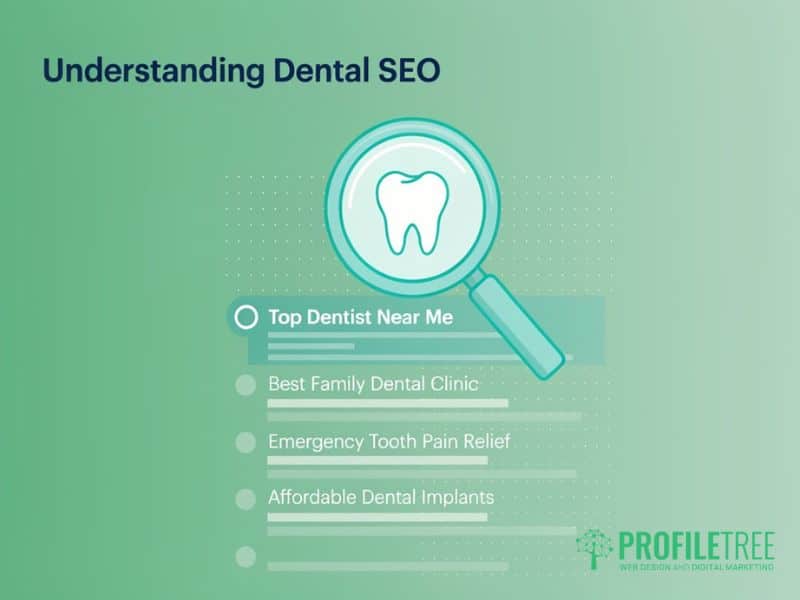
Dental SEO is the practice of optimising a dental website and Google Business Profile so that a practice appears when people search for dentists, treatments, or dental problems in their area. It differs from general SEO in three ways: the intent is almost always local, the content sits under Google’s “Your Money or Your Life” classification, and the buying decision often involves ongoing trust rather than a single transaction. ProfileTree’s search engine optimisation services apply the same principles across every regulated sector we work with, dental included.
How Dental Patients Search
Patients search dental practices in recognisable clusters. Some searches are broad (“dentist near me”), some are urgent (“emergency dentist Belfast”), and some are specific to a treatment (“Invisalign cost Belfast” or “dental implants Northern Ireland”). A practice that only optimises for “dentist [town]” misses the specific, high-value searches that bring in implant and orthodontic patients, who are usually worth considerably more per booking than a routine check-up.
Local Intent Dominance
Almost every dental search carries local intent, even when the word “near me” isn’t typed. Google assumes a location-based context for anything involving healthcare access, because patients need somewhere they can physically reach for an appointment, a filling, or an emergency extraction. This is why Google Business Profile and local citations carry more weight in dental SEO than they do for many other sectors, and why a strong local presence often does more for patient numbers than a generic content strategy.
The Dental Patient Search Journey
Dental SEO succeeds when it matches content to where a patient actually sits in their decision-making process. Three stages recur across almost every practice we work with, and mapping dental SEO content to each one is where the strategy earns its keep.
Top of Funnel: The “Educate Me” Search
Early searches sound like symptoms and worries rather than services: “why are my gums bleeding”, “do I need braces as an adult”, “is tooth sensitivity serious”. These searchers aren’t ready to book, but the practice that answers clearly and accurately builds trust with future dental patients well before the booking stage, and often earns the click when the same person later searches for a provider.
Middle of Funnel: The “Solution” Search
Once someone understands their problem, they start comparing options: “clear aligners vs braces”, “dental implants vs dentures”, “composite vs porcelain veneers”. Comparison content that’s honest about trade-offs, cost, and suitability performs well here, partly because so much of the existing content online is written by suppliers with an obvious commercial slant.
Bottom of Funnel: The Local Intent Search
This is where booking happens. “Emergency dentist Belfast”, “dentist accepting new NHS patients”, and “dental implants near me” are all searches from someone ready to choose a practice within days. Local SEO carries the most weight at this stage, and it’s the stage most practices under-invest in relative to its value.
Local SEO: Winning the Google Local Pack

For a dental practice, ranking in the Local Pack, the three-listing map result at the top of local searches, matters more than almost any other visibility metric. Most patients never scroll past it, which is why local dentist SEO deserves the largest share of a dental SEO budget in the early stages of any campaign.
Google Business Profile Optimisation
Your Google Business Profile, whether the business is styled as a practice or a dental clinic, should list every service the practice offers; it’s not enough to leave everything under “General Dentistry”. Separate entries for implants, Invisalign, teeth whitening, emergency care, and hygiene appointments all give Google more to match against specific searches. Attributes such as NHS acceptance, private-only status, wheelchair access, and parking availability should be kept current, and photos should show the practice, the team, and treatment rooms rather than stock imagery. Regular GBP posts covering new services, offers, or team updates keep the profile active, which Google treats as a freshness signal.
Local Citations and Directories
Consistent name, address, and phone number details across healthcare directories such as NHS Choices and Dentistry.co.uk, alongside general directories and the GDC register, reinforce the same signals Google Business Profile relies on for local dentist SEO. Inconsistent NAP details across even a handful of directories can quietly undermine the dental SEO gains that would otherwise be strong, and that’s an easy problem to fix once it’s spotted.
Reviews as a Ranking and Conversion Signal
Reviews influence both Local Pack rankings and whether a patient actually books, which is why they sit at the centre of most dental SEO work. Dental care involves a level of trust that most purchases don’t, so patients read reviews carefully before choosing a practice or dental clinic, and recency matters as much as volume; prospective patients tend to read the five or six most recent reviews rather than the average star rating alone.
Getting a steady flow of reviews works best as a routine, not an occasional push. The reception team asks at the desk after a positive appointment. A follow-up text or email goes out with a direct Google review link. A QR code in the waiting room removes the last bit of friction. The easier the process, the more reviews come in, and that’s what keeps the profile looking current to a patient comparing options.
Responding matters as much as collecting. Reply to reviews, positive or negative, within a day or two. Thank positive reviewers specifically, rather than with a templated line. For a negative review, stay calm, acknowledge the person’s experience, and move the detail offline while protecting patient confidentiality; how a practice handles a complaint in public tells a prospective patient more than any marketing claim could. Building this into the daily routine is often a training question as much as a marketing one, which is where ProfileTree’s digital training work with reception teams tends to pay off, turning review generation from an afterthought into a habit.
Google reviews should be the priority, with NHS Choices, Facebook, and treatment-specific platforms such as Invisalign’s own review pages supporting that primary channel.
Multi-Location Dental Practices
Groups with more than one site need a separate, fully verified Google Business Profile for each dental clinic or dental practice location, along with a unique location page; a template with the town name swapped won’t do the job on its own. Each location page should carry its own address, its own team, and genuinely local detail, such as nearby landmarks or parking notes, because thin, duplicated location pages tend to cannibalise each other in search results rather than reinforcing the dental SEO strength of the group as a whole.
Competing in a Crowded Local Market
Dental SEO rarely happens in isolation. Corporate dental groups with larger marketing budgets, established local practices with years of reviews, and newer practices marketing aggressively all compete for the same searches in most towns and cities, and every dental practice, or dental clinic, entering that competition needs a realistic view of where it can genuinely win.
Where Smaller Practices Can Win
A single-site practice competing against a corporate group with several locations usually can’t out-spend its way to the top of every search. It can out-focus a larger competitor with sharper local SEO, specialising in specific treatments, targeting individual neighbourhoods rather than an entire city, and building a genuinely stronger review base through consistent, simple follow-up after appointments. Long-tail searches, a specific treatment paired with a specific area, tend to be less contested and more directly tied to booking intent than a broad “dentist [city]” search.
Treatment-Specific SEO for High-Value Patients
Ranking for “dentist [location]” brings volume, but this is where dental SEO earns its keep: treatment-specific pages bring the enquiries that matter most to practice revenue. This applies as much to cosmetic dentistry SEO as it does to implants; dedicated pages for individual treatments consistently outperform a single generic services page, because a patient searching “dental implants Belfast” wants implant information immediately, not a list of everything the practice offers, and dental patients researching a specific procedure convert better when the page speaks directly to that procedure.
SEO for Dental Implants
Implant searches carry high commercial value and correspondingly high competition. A strong implant page covers the process, the difference between single implants and full-arch options, realistic cost ranges, and genuine before-and-after examples where consent allows. Content that’s honest about recovery time and suitability builds more trust than content that oversells the treatment, and trust converts better for a high-value treatment like this.
Cosmetic Dentistry: Invisalign and Composite Bonding
Cosmetic dentistry SEO searches are often comparison-driven. Pages built around “Invisalign vs traditional braces” or “composite bonding vs veneers” capture patients still deciding, while dedicated pages for each treatment capture those who already know what they want. Cosmetic dentistry SEO works best when both exist; relying on one at the expense of the other leaves value on the table.
General and Preventive Dentistry
Routine dentistry doesn’t carry the same commercial value as implants or cosmetic dentistry SEO work, but it stabilises the patient base and feeds referrals into higher-value treatments over time. Pages covering check-ups, fillings, and hygiene appointments, alongside clear “accepting new patients” messaging, capture the steady volume of searches that keep a practice’s diary full between larger cases.
Treatment-Specific SEO Priorities
| Treatment | Patient Intent | Commercial Value |
|---|---|---|
| Dental implants | High-value, considered purchase | High |
| Invisalign / clear aligners | Comparison-driven, cosmetic | High |
| Composite bonding/veneers | Comparison-driven, cosmetic | Medium-High |
| General & preventive dentistry | Routine, recurring | Medium |
| Emergency dentistry | Urgent, local-intent | Medium |
Content Marketing for Dental Practices
Treatment pages capture people ready to book, but ongoing content marketing is the side of dental SEO that drives searches months before a decision and keeps the practice visible in between. It works best as a companion to local SEO rather than a replacement for it.
Content That Matches Real Patient Questions
Cost content (“how much do veneers cost”), comparison content (“implants vs dentures”), and symptom content (“why do my gums bleed when I brush”) consistently draw the highest volume of genuine patient searches, because they mirror the exact questions people type rather than the language a practice uses internally. It’s not always obvious which questions matter most until reception and consultation notes are reviewed directly. FAQ-style content built directly from those real questions tends to outperform content written purely from a competitor’s article, because it answers what patients in that specific area are actually asking.
A Simple Seasonal Content Calendar
A light content calendar, built around new year treatment planning in January, wedding and summer smile preparation, back-to-school dental health in September, and Christmas party smile prep in the run-up to December, gives a practice a steady reason to publish without scrambling for topics every month. This works for cosmetic dentistry SEO just as well as it does for general dental SEO. The core treatment pages and FAQ content should still take priority; seasonal pieces work best alongside ProfileTree’s content marketing support as a supplement rather than the main strategy.
NHS and Private Search Intent, and Cross-Border Patients
A search like “dentist near me” carries different intent depending on who’s typing it, and getting this wrong is one of the most common dental SEO mistakes for a private practice. In the UK, this phrase often signals NHS intent: someone looking for an NHS place, sometimes from a waiting list. A private practice that ranks well for that broad phrase can end up with enquiries it can’t serve profitably, because the caller wants NHS access rather than a paying-patient relationship.
The more useful goal for a private practice is optimising for paying-patient intent specifically: treatment-led searches, cosmetic terms, and phrasing such as “private dentist” that signals someone ready to pay for a particular standard of care. High traffic on the wrong phrase is a worse outcome than moderate traffic on the right one; the practice still has to answer every enquiry that comes in, whether it’s profitable or not.
Patients near the Irish border move in both directions for dental treatment, driven by price, waiting times, or availability rather than a fixed side of the border. Currency movement between sterling and the euro shifts this over time. A practice within reach of the border benefits from dental SEO and location targeting that reflects this, rather than content that’s written as if every patient searches from a single jurisdiction.
SEO Within GDC and Irish Dental Council Guidelines
Dental marketing sits under specific professional regulation, and this is where many generic SEO guides, particularly those written for the US market, fall short. GDC standards and Irish Dental Council guidance both restrict certain claims a dental practice can make, particularly around guaranteed outcomes, comparative superiority, and the use of patient testimonials.
Navigating Advertising Standards in Search Content
Meta titles and headers written purely to maximise click-through can drift into territory the GDC’s guidance on advertising and the Advertising Standards Authority would flag: unqualified claims of being “the best”, guaranteed results, or pain-free promises that can’t be guaranteed for every patient. Dental SEO copy needs the same commercial instincts as any other sector, applied within a framework that keeps every claim defensible if a regulator or a competitor ever asks for evidence.
Why Ethical SEO Protects Professional Reputation
A ranking gained through overstated claims is a liability the moment a patient complaint or regulatory review looks at the practice’s marketing. The Dental Council of Ireland’s code of practice on professional behaviour and ethical conduct sets out much the same principle for practices south of the border: practices that treat dental SEO, or SEO for dentists, with the same care as clinical communication tend to keep both their rankings and their professional standing, because accurate, well-sourced content rarely needs revisiting after the fact.
Technical SEO for Dental Websites
The technical foundation determines whether dental SEO content ever gets the chance to rank at all.
Site Speed and Mobile-First Design
A large share of dental searches, especially emergency searches, happen on a phone in discomfort, and they’re not happening at a desk. A slow-loading site loses these dental patients before they ever see a phone number for the practice or dental clinic. Compressed images, a caching setup suited to the hosting environment, and a mobile layout that puts the phone number and booking link within reach of a thumb all matter more for dental SEO than for many other business types, given how many searches are made in genuine urgency. This is exactly the kind of foundation ProfileTree’s website design team builds in from the start, rather than retrofitting later.
Structured Data and Schema
Schema markup for the business type, medical procedures, and review ratings helps search engines understand a dental website’s content accurately. It shouldn’t sit in the visible article content; that belongs in the site’s structured data layer, best implemented and verified by a developer alongside the content, so both stay aligned as the site changes over time.
Content Strategy and Building Genuine E-E-A-T
Google treats dental content as “Your Money or Your Life” material, which means expertise and trustworthiness signals carry more weight in dental SEO than they would for a typical blog, and dental patients themselves tend to notice the difference too.
Demonstrating Real Experience and Expertise
Author bios with verifiable clinical or marketing credentials, references to the tools and standards behind treatment recommendations, and content that shows both the benefits and the realistic limitations of a treatment all build the kind of trust Google’s guidelines look for.
Ciaran Connolly, founder of ProfileTree, puts it simply: “Dental SEO only works long-term when the content earns trust as well as rankings, patients can tell the difference, and so can Google.”
Video content adds another layer of trust here, letting prospective patients see the practice and team before they ever book a consultation. ProfileTree’s video marketing work supports exactly this kind of trust-building content for healthcare clients.
Staying Visible in AI-Powered Search

Dental patients increasingly ask ChatGPT, Perplexity, or Google’s AI Overviews questions like “how much do dental implants cost near me” before they ever open a map. These tools tend to pull from pages that answer a question directly within the first few lines, cite real figures rather than vague claims, and come from a source that already carries some authority on the topic. That’s the pattern across most AI citations we see.
A dental practice with clear, well-sourced treatment pages, strong dental SEO, and a genuinely active Google Business Profile is better positioned to be cited in these AI-generated answers than one relying on thin, templated content, which means good dental SEO now serves both traditional rankings and this newer layer of search.
Measuring Dental SEO Success
Rankings alone don’t pay the bills, so measuring dental SEO, or SEO for dentists, needs to track the path from a search through to a booked appointment. Local Pack position and organic rankings for treatment keywords show local dentist SEO visibility.
Website traffic, treatment page views, and time on site show engagement. Phone calls, online bookings, and new patient registrations show whether any of it converts for the dental practice. Call tracking connected to a dental-specific CRM closes the loop between a search and a chair booked, which matters because dental sales cycles rarely finish inside a single visit or a single channel. This kind of measurement sits naturally within ProfileTree’s digital strategy work, rather than as a bolt-on report nobody reads.
Common Reasons Dental SEO Campaigns Fail
Most failed dental SEO comes down to a handful of avoidable mistakes.
Thin content is the most common one. It’s a single generic treatments page trying to rank for a dozen procedures, when each treatment needs its own depth to compete in local dentist SEO. Chasing high-volume, low-value terms is close behind; ranking for NHS-intent phrases when the practice or dental clinic is private fills the diary with enquiries it can’t convert. Ignoring reviews leaves one of the strongest local ranking and conversion signals to chance rather than building it into a routine. And treating the website as separate from the SEO work means a fast, well-structured build never happens, so even strong content sits on a foundation that struggles to rank.
Dental content carries a higher bar than most SEO work, because Google treats it as “Your Money or Your Life” material, and the General Dental Council has its own rules on what a practice can claim. Generic, one-size-fits-all SEO advice doesn’t just underperform here; for a regulated profession, thin or inaccurate content is a reputational risk as well as a ranking one.
Choosing an SEO Partner for Your Practice

If you’re hiring outside help rather than handling this in-house, a few signals separate a partner worth having from one to avoid. This applies whether you call it dental SEO or SEO for dentists; the vetting questions don’t change.
Be wary of guarantees. Nobody can honestly promise a page-one ranking; that’s not how Google works, and a guarantee usually means the person offering it doesn’t understand the market. Look instead for a partner who can speak to the dental specifics: the YMYL bar, GDC advertising rules, and the difference between NHS and private search intent covered above. Ask how they report results, too, and how the monthly retainer is structured against those results. Clarity on enquiries and new patient matters more than a monthly retainer that only ever reports a list of ranking positions, meaning little to the practice itself.
Breadth matters as well. Dental SEO rarely works as an isolated service, and a monthly retainer that only covers one part of it leaves gaps. It touches the website build, because a slow site won’t convert; content, because treatment pages need real depth; reviews, because they drive local rankings; and often video, because it eases the anxiety that blocks high-value bookings. A partner who can join these up under one dental SEO retainer tends to get further than one selling rankings on their own.
Why Choose ProfileTree for Dental SEO
There’s a reason healthcare-aware content standards and local dentist SEO expertise matter together. ProfileTree combines both, built across Northern Ireland, Ireland, and the UK, backed by a 5-star Google rating from more than 450 reviews.
That same approach, responsive, technically grounded, and geared to measurable results, carries across into dental SEO work, alongside web design, video production, and digital marketing services delivered under one roof rather than through a chain of separate suppliers. A dental SEO monthly retainer with ProfileTree covers all of it together, rather than splitting the work across separate suppliers who don’t talk to each other.
Conclusion
Dental patients searching for a dentist rarely look beyond the first few results, and that’s true whether they’re searching for a routine check-up or an emergency extraction at nine at night. Dental SEO is a practice that achieves visibility properly, through local optimisation, treatment-specific content, and a technical foundation that holds up under scrutiny from both Google and the GDC. Practices that treat it as an ongoing discipline rather than a one-off project tend to keep the patients they attract, because the same trust signals that win the search also reassure the patient once they’ve walked through the door.
Start with the fundamentals: claim and complete the Google Business Profile, build a review request into the everyday routine at reception, and give the highest-value treatments the dedicated pages they deserve. Whether you call this SEO for dentists or dental SEO, the same fundamentals apply. Extend into supporting content and video once those foundations are solid.
FAQs
1. How long does dental SEO take to show results?
Local SEO changes, such as Google Business Profile optimisation, can lift visibility within a few weeks. Competitive treatment keywords, particularly implants and cosmetic work, usually take four to eight months to show meaningful movement. New practices without an existing review base or backlink profile should expect the longer end of that range.
2. How much does dental SEO, or SEO for dentists, cost in the UK and Ireland?
Single-location practices typically invest somewhere between £800 and £2,000 a month, sometimes described as a monthly retainer, while multi-location practices or those in highly competitive areas often sit between £2,000 and £4,000 or more. The right figure depends on current visibility, competition, and how many treatments need dedicated content, so it’s worth measuring against new patient value rather than cost alone.
3. Can a dental practice rank for “dentist near me” everywhere?
No single practice ranks for “near me” everywhere, because Google shows results based on the searcher’s actual location. The realistic goal for local dentist SEO is strong visibility for your practice’s own area and the neighbourhoods you genuinely serve, built through consistent local SEO rather than chasing a search term no one can dominate universally.
4. How important are Google reviews for dental SEO?
Very important, on both the ranking and conversion side. Reviews feed directly into Local Pack visibility, and dental patients read them carefully, given how much trust a dental decision requires, so a steady, ongoing request process tends to outperform occasional bursts of review requests for any dental practice, regardless of size.
5. What’s the SEO difference between NHS and private dental patients?
NHS-focused pages should target phrases like “NHS dentist accepting patients [location]” clearly, so patients seeking NHS care aren’t misled into a private-only practice. Private-focused content can lean further into treatment depth and cosmetic outcomes, and a practice offering both should keep the two clearly separated rather than blending the messaging.