
SaaS SEO: Driving Organic Growth for Software Companies
Table of Contents
ProfileTree provides specialist SaaS SEO services helping software companies across Northern Ireland, Ireland, and the UK generate organic signups, trial starts, and demo requests through improved search visibility. SaaS SEO connects your software with the businesses and users actively searching for solutions like yours.
Software purchasing starts with a search. When business owners research solutions to their problems, when IT managers compare software options, or when users search for specific tools, they turn to Google. The SaaS companies appearing in those searches capture attention, trials, and ultimately customers. If your software isn’t visible when potential users search, competitors win the customers you should be acquiring.
Understanding SaaS SEO
What makes SEO different for software companies:
The SaaS Search Landscape
How potential customers search for software:
Search Categories:
| Category | Example Searches |
| Problem-aware | “how to manage projects better”, “automate invoicing” |
| Solution-aware | “project management software”, “invoicing tools” |
| Product-aware | “Asana vs Monday”, “[product name] alternatives” |
| Feature-specific | “software with Gantt charts”, “CRM with email integration” |
| Use case | “CRM for small business”, “accounting software for freelancers” |
| Comparison | “best project management tools 2025”, “[product] vs [product]” |
SaaS Buyer Journey:
| Stage | Search Behaviour |
| Problem recognition | “how to [solve problem]”, “[problem] solutions” |
| Solution research | “[category] software”, “tools for [task]” |
| Evaluation | “[product] review”, “[product] pricing”, “best [category]” |
| Comparison | “[product] vs [product]”, “[product] alternatives” |
| Decision | “[product] free trial”, “[product] demo” |
| Post-purchase | “[product] how to”, “[product] integrations” |
SaaS SEO Characteristics
Software SEO differs from other industries:
Key Differences:
| Factor | SaaS Reality |
| Customer lifetime value | High CLV justifies significant acquisition investment |
| Decision process | Often involves multiple stakeholders |
| Trial/freemium model | SEO drives trials, product converts |
| Recurring revenue | One ranking can drive ongoing signups |
| Global potential | Software often serves international markets |
What This Means for SEO:
| Reality | SEO Approach |
| High CLV | Justifies competitive keyword targeting |
| Multiple stakeholders | Content for different personas |
| Trial model | Optimise for trial/signup conversion |
| Recurring revenue | Long-term SEO investment pays continuously |
| Global reach | International SEO considerations |
Content-Led Growth Model
SaaS companies often succeed through content marketing:
Why Content Works for SaaS:
| Factor | Benefit |
| Educational need | Buyers research before purchasing |
| Problem-solution fit | Content demonstrates understanding |
| Trust building | Expertise shown through content |
| Long sales cycles | Content nurtures over time |
| Scalability | Content works while you sleep |
Content-Led Growth Framework:
| Stage | Content Role |
| Attract | SEO-driven content brings visitors |
| Educate | Content explains problems and solutions |
| Convert | Content drives trial signups |
| Retain | Content supports user success |
| Expand | Content drives upgrades and referrals |
Competitive Dynamics
SaaS markets are often highly competitive:
Competitive Challenges:
| Challenge | Reality |
| Well-funded competitors | VC-backed companies invest heavily |
| Established players | Category leaders dominate keywords |
| Review sites | G2, Capterra rank for comparison terms |
| Content saturation | Many topics heavily covered |
Competitive Opportunities:
| Opportunity | Approach |
| Long-tail keywords | Specific use cases, niches |
| Comparison content | Own your competitive positioning |
| Feature-specific | Target specific capability searches |
| Integration searches | “[Your product] + [other tool]” |
| Vertical focus | Industry-specific positioning |
Our SaaS SEO Services
Comprehensive optimisation for software companies:
Keyword Strategy for SaaS
Building the foundation for SaaS organic growth:
Keyword Research Framework:
| Keyword Type | Examples | Intent |
| Category | “project management software” | High intent, high competition |
| Problem | “how to track team tasks” | Earlier stage, educational |
| Feature | “software with time tracking” | Specific need |
| Use case | “project management for agencies” | Targeted segment |
| Comparison | “Asana vs Trello” | Evaluation stage |
| Alternative | “[competitor] alternatives” | High intent |
| Integration | “[product] Slack integration” | Existing user or evaluator |
Keyword Prioritisation:
| Factor | Consideration |
| Search volume | Traffic potential |
| Competition | Ranking difficulty |
| Intent | Likelihood of conversion |
| Relevance | Fit with your product |
| Current position | Quick win potential |
SaaS Keyword Mapping:
| Page Type | Target Keywords |
| Homepage | Brand, primary category |
| Product pages | Feature keywords |
| Use case pages | Segment-specific keywords |
| Comparison pages | vs and alternative keywords |
| Blog content | Problem and educational keywords |
| Integration pages | Integration-specific keywords |
Product and Feature Pages
Optimising core product pages:
Product Page Structure:
| Element | Content |
| H1 heading | Primary product/feature name |
| Value proposition | Clear benefit statement |
| Feature overview | Key capabilities |
| Use cases | Who it’s for, how it helps |
| Social proof | Testimonials, logos, reviews |
| Visually demonstrate | Screenshots, videos |
| CTA | Trial, demo, signup |
Feature Page Optimisation:
| Element | Optimisation |
| Unique pages | Dedicated page per major feature |
| Keyword targeting | Feature-specific keywords |
| Benefit focus | What the feature enables |
| Visual evidence | Screenshots, GIFs, videos |
| Use cases | Specific applications |
| Integration | Related features, products |
SaaS Schema Markup:
json
{
“@context”: “https://schema.org”,
“@type”: “SoftwareApplication”,
“name”: “Product Name”,
“applicationCategory”: “BusinessApplication”,
“operatingSystem”: “Web browser”,
“offers”: {
“@type”: “Offer”,
“price”: “0”,
“priceCurrency”: “GBP”,
“description”: “Free trial available”
},
“aggregateRating”: {
“@type”: “AggregateRating”,
“ratingValue”: “4.8”,
“ratingCount”: “500”
}
}
Use Case and Vertical Pages
Targeting specific segments:
Use Case Page Strategy:
| Element | Content |
| Segment identification | Who this page is for |
| Problem articulation | Challenges this segment faces |
| Solution positioning | How your product helps |
| Specific features | Most relevant capabilities |
| Segment proof | Testimonials from similar customers |
| Segment-specific CTA | Tailored call to action |
Vertical Pages:
| Industry | Page Approach |
| Industry overview | Understanding of sector challenges |
| Compliance/requirements | Industry-specific needs |
| Feature relevance | Which features matter most |
| Case studies | Industry customer examples |
| Integration | Industry tool integrations |
Use Case Keyword Examples:
| Pattern | Examples |
| [Product category] for [segment] | “CRM for real estate agents” |
| [Product category] for [company size] | “project management for startups” |
| [Product category] for [use case] | “invoicing software for contractors” |
| Best [category] for [segment] | “best accounting software for freelancers” |
Comparison and Alternative Content
Owning competitive conversations:
Comparison Page Types:
| Type | Example |
| Direct comparison | “[Your product] vs [Competitor]” |
| Alternative pages | “[Competitor] alternatives” |
| Category comparison | “Best [category] tools compared” |
| Migration guides | “Switching from [Competitor]” |
Comparison Page Structure:
| Section | Content |
| Introduction | Why this comparison matters |
| Quick comparison | Summary table |
| Feature comparison | Detailed capability comparison |
| Pricing comparison | Cost comparison |
| Best for | Who should choose each |
| Conclusion | Recommendation |
Alternative Page Approach:
| Element | Content |
| Competitor overview | Brief, fair description |
| Reasons to switch | Common pain points |
| Alternatives list | Your product + others |
| Comparison criteria | Objective evaluation |
| Your positioning | Why you’re a strong alternative |
Ethical Comparison Content:
| Do | Don’t |
| Be factually accurate | Misrepresent competitors |
| Acknowledge competitor strengths | Only highlight weaknesses |
| Focus on fit, not superiority | Claim you’re best for everyone |
| Update when things change | Leave outdated information |
SaaS Content Marketing
Educational content that drives organic growth:
Content Types for SaaS:
| Content Type | Purpose |
| How-to guides | Solve problems, demonstrate expertise |
| Ultimate guides | Comprehensive topic coverage |
| Templates | Practical resources, lead magnets |
| Case studies | Proof of results |
| Industry reports | Original research, linkable assets |
| Tool roundups | Helpful resources, comparison opportunity |
Content Funnel Strategy:
| Funnel Stage | Content Focus |
| Top of funnel | Problem-focused, educational |
| Middle of funnel | Solution-focused, comparison |
| Bottom of funnel | Product-focused, conversion |
Blog Content Strategy:
| Priority | Content Approach |
| High volume keywords | Comprehensive, competitive content |
| Long-tail keywords | Specific, targeted content |
| Question keywords | Direct answer content |
| Trending topics | Timely, newsworthy content |
Content Quality Requirements:
| Element | Standard |
| Depth | More comprehensive than competitors |
| Accuracy | Factually correct, current |
| Actionability | Practical, implementable |
| Visual | Screenshots, diagrams, examples |
| Unique value | Original insights, data, perspectives |
Technical SEO for SaaS
Platform and technical considerations:
SaaS Website Technical Priorities:
| Element | Importance |
| Site speed | Critical for user experience and rankings |
| Mobile experience | Many users research on mobile |
| Crawlability | Ensure all pages indexed |
| Security (HTTPS) | Essential for trust |
| International | hreflang for multi-language/region |
Common SaaS Technical Issues:
| Issue | Solution |
| JavaScript rendering | Ensure content is crawlable |
| Dynamic content | Server-side rendering where needed |
| Faceted navigation | Proper canonicalisation |
| Staging/dev exposure | Noindex non-production environments |
| App vs marketing site | Clear separation, proper linking |
SaaS Site Architecture:
| Structure | Approach |
| Homepage | Primary value proposition, main CTAs |
| Product section | Features, pricing, use cases |
| Solutions section | Vertical/segment pages |
| Resources section | Blog, guides, templates |
| Company section | About, careers, contact |
Link Building for SaaS
Building authority for software companies:
SaaS Link Building Strategies:
| Strategy | Application |
| Original research | Surveys, data studies |
| Free tools | Calculators, generators |
| Integration partnerships | Partner directories, co-marketing |
| Guest posting | Industry publications |
| Digital PR | Newsworthy announcements |
| Resource link building | Getting listed in roundups |
Linkable Asset Types:
| Asset Type | Example |
| Industry reports | “State of [Industry] 2025” |
| Free tools | Calculator, checker, generator |
| Templates | Spreadsheets, documents |
| Original data | Survey results, benchmarks |
| Comprehensive guides | Definitive resource on topic |
SaaS PR Opportunities:
| Opportunity | Approach |
| Funding announcements | Press release, media outreach |
| Product launches | Feature announcements |
| Milestone achievements | User numbers, revenue |
| Industry commentary | Expert quotes, thought leadership |
| Partnership announcements | Integration, collaboration news |
Integration Link Building:
| Approach | Benefit |
| Integration partner pages | Links from partner sites |
| App marketplace listings | Platform directory links |
| Integration content | Co-created content opportunities |
| Partner case studies | Mutual linking opportunities |
SaaS SEO by Business Model
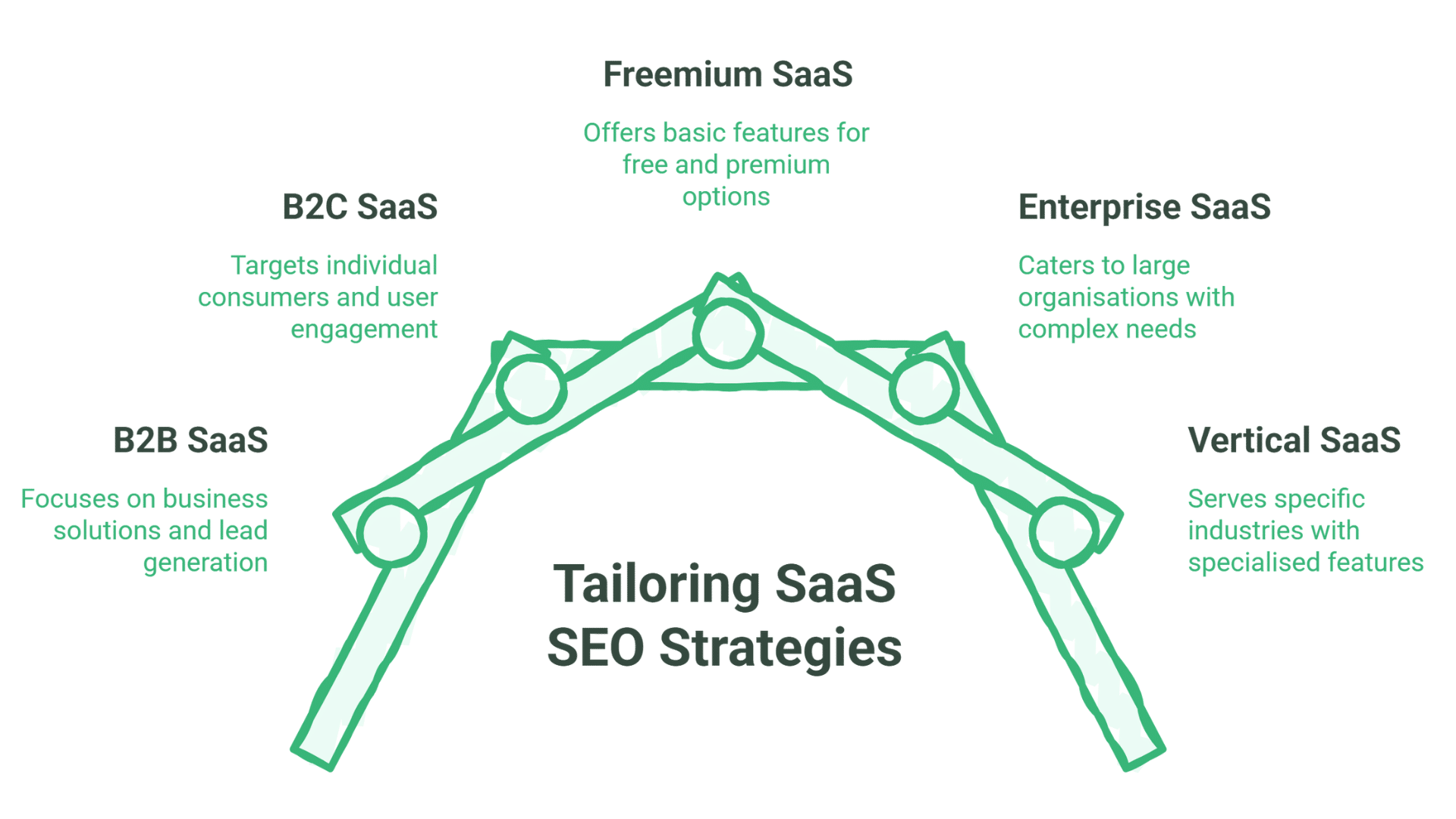
Strategies for different SaaS types:
B2B SaaS
Business-focused software:
Key Considerations:
| Factor | Approach |
| Multiple stakeholders | Content for different personas |
| Longer sales cycles | Nurture through content |
| Higher price points | Justify with comprehensive content |
| Demo focus | Optimise for demo requests |
B2B SEO Focus:
| Priority | Implementation |
| Industry content | Vertical-specific pages |
| Persona content | Role-specific content |
| Case studies | Business outcome focus |
| Integration | Enterprise tool connections |
B2C SaaS
Consumer-focused software:
Key Considerations:
| Factor | Approach |
| Higher volume | More keyword opportunities |
| Shorter decisions | Faster conversion paths |
| Price sensitivity | Pricing content important |
| Reviews matter | Review management critical |
B2C SEO Focus:
| Priority | Implementation |
| Feature keywords | Specific capability targeting |
| Comparison content | vs and alternative pages |
| Review presence | G2, Capterra, app stores |
| How-to content | User education |
Freemium SaaS
Free tier with paid upgrades:
Key Considerations:
| Factor | Approach |
| Volume focus | Drive free signups |
| Activation | Content supports activation |
| Upgrade paths | Content highlights premium features |
| Virality | SEO supports word of mouth |
Freemium SEO Focus:
| Priority | Implementation |
| Signup optimisation | Frictionless conversion |
| Feature comparison | Free vs paid clarity |
| User content | Support and education |
| Community | User-generated content |
Enterprise SaaS
Large organisation focus:
Key Considerations:
| Factor | Approach |
| Long sales cycles | Content for entire journey |
| Multiple stakeholders | IT, business, executive content |
| Security focus | Compliance, security content |
| Custom needs | Flexibility messaging |
Enterprise SEO Focus:
| Priority | Implementation |
| Trust content | Security, compliance, reliability |
| Industry depth | Vertical expertise |
| Case studies | Enterprise customer proof |
| Technical content | Integration, implementation |
Vertical SaaS
Industry-specific software:
Key Considerations:
| Factor | Approach |
| Niche focus | Deep industry content |
| Less competition | Dominate vertical keywords |
| Industry expertise | Demonstrate sector knowledge |
| Compliance | Industry-specific requirements |
Vertical SEO Focus:
| Priority | Implementation |
| Industry keywords | Sector-specific targeting |
| Compliance content | Regulatory requirements |
| Industry content | Sector news, trends |
| Community | Industry engagement |
Measuring SaaS SEO Success
Tracking performance for software companies:
Key Metrics
Visibility Metrics:
| Metric | What It Shows |
| Organic rankings | Positions for target keywords |
| Organic impressions | Search visibility |
| Keyword portfolio | Total ranking keywords |
| Share of voice | Visibility vs competitors |
Traffic Metrics:
| Metric | What It Shows |
| Organic sessions | Visitors from search |
| New vs returning | Acquisition vs retention |
| Pages per session | Engagement depth |
| Bounce rate | Content relevance |
Conversion Metrics:
| Metric | What It Shows |
| Trial signups | Free trial starts |
| Demo requests | Sales-qualified interest |
| Freemium signups | Free user acquisition |
| Email signups | Lead capture |
Attribution and Revenue
Connecting SEO to business outcomes:
| Metric | Tracking Approach |
| Organic signups | Source attribution |
| Signup to paid conversion | Cohort analysis |
| Customer lifetime value | Revenue attribution |
| Payback period | CAC recovery time |
SEO ROI Calculation:
| Element | Calculation |
| Organic signups | Monthly organic trial/signup volume |
| Conversion rate | Trials converting to paid |
| Average contract value | Revenue per customer |
| Lifetime value | Total customer revenue |
| SEO investment | Monthly SEO cost |
| ROI | (Revenue – Investment) / Investment |
Reporting
Monthly SaaS SEO Reporting:
| Element | Included |
| Ranking progress | Key keyword movements |
| Traffic analysis | Organic traffic trends |
| Content performance | Top performing content |
| Conversion tracking | Signups, demos, trials |
| Competitor comparison | Relative visibility |
| Technical health | Site performance |
| Link acquisition | New backlinks |
| Recommendations | Next period priorities |
Common SaaS SEO Challenges
Addressing typical software company SEO problems:
Competitive Category Keywords
The Challenge: Category keywords dominated by established players and review sites.
Solutions:
| Approach | Implementation |
| Long-tail focus | Specific use case keywords |
| Modifier targeting | “[Category] for [segment]” |
| Feature keywords | Specific capability searches |
| Question keywords | Problem-focused content |
Review Site Competition
The Challenge: G2, Capterra, Software Advice rank for comparison keywords.
Solutions:
| Approach | Implementation |
| Own your comparisons | Create your own comparison content |
| Optimise listings | Strong presence on review sites |
| Generate reviews | Build review volume |
| Different angle | Unique comparison perspectives |
Content Saturation
The Challenge: Topics heavily covered by competitors.
Solutions:
| Approach | Implementation |
| Content depth | More comprehensive than existing |
| Unique data | Original research, proprietary data |
| Fresh angles | New perspectives on topics |
| Content updates | Keep content current |
Technical Complexity
The Challenge: JavaScript-heavy sites, complex architectures.
Solutions:
| Approach | Implementation |
| Server-side rendering | Ensure crawlability |
| Technical audits | Regular technical review |
| Developer collaboration | SEO in development process |
| Performance focus | Site speed optimisation |
Why Choose ProfileTree for SaaS SEO
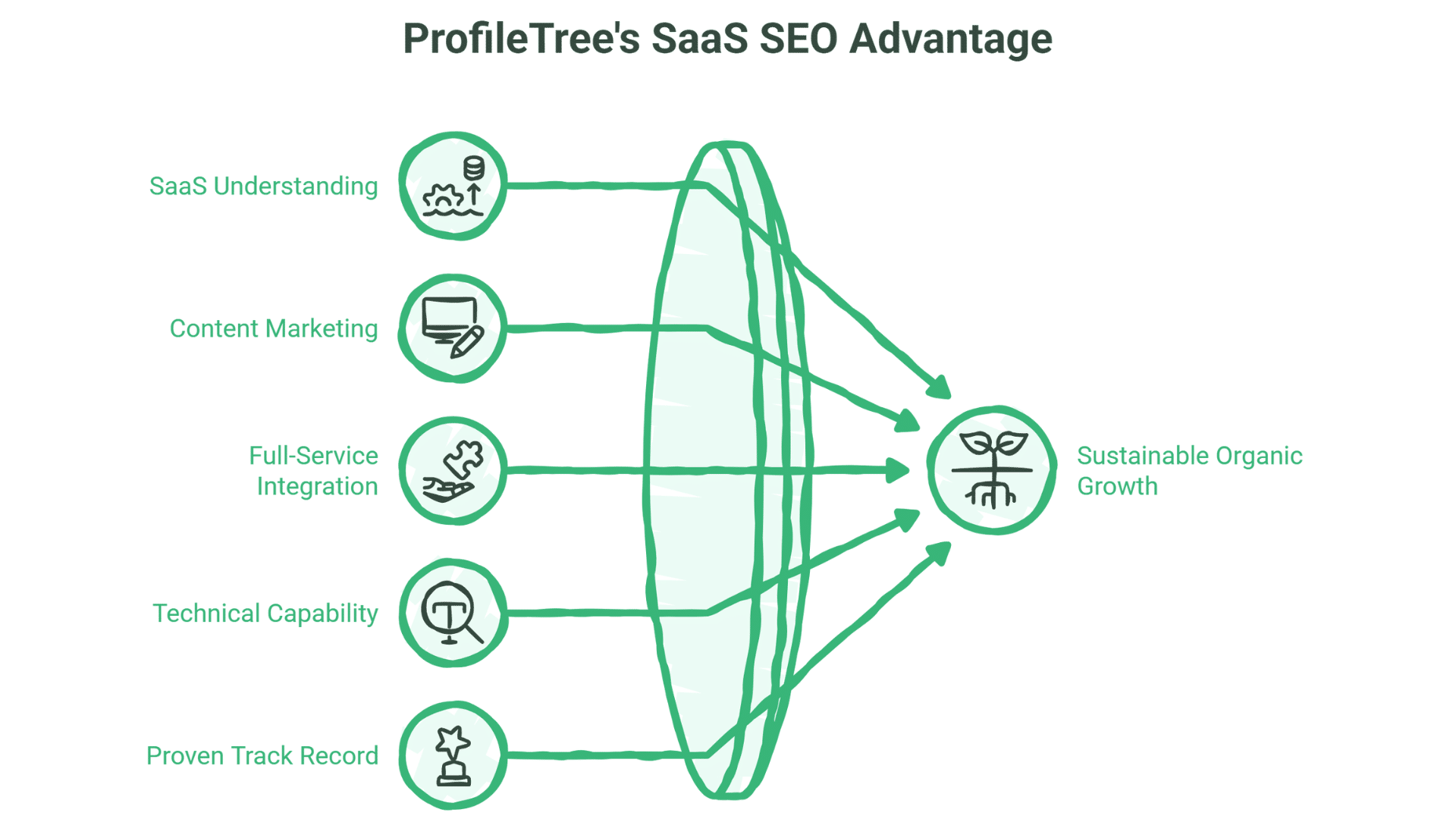
What differentiates our software SEO services:
SaaS Understanding
Knowledge of software business models:
- Subscription economics
- Freemium conversion
- Product-led growth
- B2B sales cycles
Content Marketing Expertise
Strong content creation capability:
- Technical writing
- Comprehensive guides
- Comparison content
- Thought leadership
Full-Service Integration
SEO integrated with broader services:
- Web design for conversion-optimised sites
- Video production for product demos
- Content marketing for content-led growth
- Digital strategy for go-to-market planning
Technical Capability
Technical SEO expertise for complex sites:
- JavaScript SEO
- International SEO
- Technical audits
- Performance optimisation
Proven Track Record
Our 5-star rating from over 450 Google reviews demonstrates consistent delivery. We work with software companies to build sustainable organic growth.
FAQs About SaaS SEO
How long does SaaS SEO take to show results?
SaaS SEO typically shows initial results within 3-6 months, with significant growth at 6-12 months. Competitive category keywords take longer than long-tail terms. The compounding nature of content marketing means results accelerate over time as the content library and domain authority grow.
How much should SaaS companies invest in SEO?
SaaS SEO investment typically ranges from £2,000-£10,000+/month depending on competition, content needs, and growth targets. Given high customer lifetime values in SaaS, a strong SEO ROI is achievable. Many SaaS companies invest 20-40% of their marketing budget in organic channels.
Should we target category keywords or long-tail?
Both, but prioritisation depends on your stage and resources. Early-stage companies often see faster results from long-tail, use case, and comparison keywords. As authority builds, category keywords become more achievable. A balanced strategy targets quick wins while building toward competitive terms.
How important is comparison content for SaaS SEO?
Very important. Comparison and alternative searches represent high-intent traffic. People searching “[competitor] alternatives” are actively considering switching. Owning these conversations lets you control the narrative rather than leaving it to review sites or competitors.
Should we create content for competitors’ keywords?
Yes, strategically. “[Competitor] alternatives” and “[Your product] vs [Competitor]” pages capture high-intent searchers actively evaluating options. Keep comparison content factual and fair—acknowledge competitor strengths while clearly articulating your differentiation.
How do we balance SEO with product-led growth?
They complement each other. SEO drives awareness and trials; product experience drives conversion and retention. Ensure SEO content accurately represents product capabilities. Optimise for keywords that attract users likely to succeed with your product. Content should set appropriate expectations.
What’s the role of review sites like G2 in SaaS SEO?
Review sites rank well for comparison keywords, making them important for visibility. Maintain strong profiles on G2, Capterra, and relevant platforms. Generate positive reviews. But also create your own comparison content to capture traffic directly. View review sites as both channels and competitors.
Conclusion
Software purchasing starts with a search. When businesses research solutions, compare options, or look for alternatives to current tools, they use Google. The SaaS companies visible in those searches capture consideration, trials, and customers.
SaaS SEO requires understanding both search optimisation and software business dynamics—content-led growth, comparison positioning, technical complexity, and the metrics that matter for subscription businesses.
ProfileTree provides specialist SaaS SEO services, helping software companies across Northern Ireland, Ireland, and the UK build sustainable organic growth that compounds over time.
Ready to grow your software company through organic search? Contact ProfileTree to discuss how SaaS SEO can drive more trials, demos, and customers for your software.