
SEO for Accountants: A UK Guide to Winning Client Enquiries
Table of Contents
When someone searches for “accountant near me,” “bookkeeper Belfast,” or “small business accountant Croydon,” the practice that appears in the results wins the new client. SEO for accountants matters because these searches happen every day, and accounting sits in a trust-critical space: clients hand over financial information and rely on a practice’s advice before they have experienced its service, so a firm’s online presence either builds that confidence or undermines it before a single conversation happens.
ProfileTree works with professional service businesses across Northern Ireland, Ireland, and the UK to build search visibility that generates client enquiries. For accountants, that means appearing when potential clients search, demonstrating expertise within the constraints of professional regulation, and making it straightforward to start a conversation.
What Accountant SEO Involves
Accountant SEO is not a single tactic. It is a combination of local search presence, on-site architecture, and content that satisfies both search engines and professional conduct rules simultaneously. Four areas tend to determine whether a practice appears where potential clients are looking.
Ranking in the Local Pack
Most accountant searches carry a location: “accountant Belfast,” “bookkeeper near me,” “tax advisor Derry,” “small business accountant Croydon.” Google answers these with the three-listing Local Pack above the organic results, pulled largely from Google Business Profile signals rather than the website itself.
A complete profile matters more than most practices assume. Category selection (Accountant as primary, with Tax Consultant, Bookkeeping Service, or Payroll Service as secondary categories depending on the practice’s mix), a business description that names the client types served, and consistent name, address, and phone details across every directory listing all feed into whether a practice appears in that three-listing block. Practices operating from more than one office need this consistency checked location by location; a single mismatched address on an old directory listing is enough to weaken the signal Google uses to confirm where a firm actually operates.
Photos matter more than most practices give them credit for. A profile showing the actual office, the actual team, and any visible professional certifications performs differently to one carrying a handful of generic stock images or none at all. Attributes worth completing in full include online appointment availability, accepted payment methods, and accessibility features, since incomplete attribute fields are one of the easiest gaps for a competing practice to close. None of this replaces a strong website, but a Google Business Profile is frequently the first thing a searcher sees, and an incomplete one undermines the credibility the rest of the site is trying to build.
Testimonials and Review Management
Reviews carry particular weight in accounting because the decision to hire an accountant is rarely made on price alone. A prospective client reading five reviews from other small business owners, each mentioning a specific outcome (a missed VAT registration caught early, a company formation handled without delay), gets reassurance that a page of service copy cannot provide on its own.
Review management for a regulated profession needs a lighter touch than in most other sectors. Requesting reviews after a positive outcome is standard practice. Offering an incentive for a review is not, and risks breaching the marketing rules that govern chartered and certified accountants (more on this below). Responding to every review, including any critical ones, in a measured and professional tone reinforces the same trust signals that Google and prospective clients are both looking for.
Professional Services Schema Markup
Structured data tells search engines and AI systems what a page represents in a machine-readable format. For an accounting practice, Organisation and LocalBusiness schema confirm the firm’s name, address, and services; Person schema on partner and staff bios connects named individuals to their professional qualifications; and the Review or AggregateRating schema (when genuinely earned reviews support it) can surface star ratings directly in search results.
Getting this right supports a wider point about how a site is structured: AI-powered search tools increasingly extract facts directly from a page’s schema, and self-contained sections rather than reading the whole thing top to bottom, so accurate markup on service and team pages has become part of how a firm gets cited, not just how it ranks.
Service Page Architecture for Different Specialisms
A single generic “services” page rarely covers accountancy well, because the client searching for “corporation tax planning” and the client searching for “payroll bureau services” are looking for different reassurances. Dedicated pages for each core specialism, tax return preparation, bookkeeping, payroll, VAT, audit and assurance, where relevant, and business advisory, each targeting its own search terms with its own client-type language, tend to outperform a single page trying to cover everything at once.
| Specialism page | Typical searcher | What the page needs to show |
|---|---|---|
| Tax returns | Sole trader, contractor | Self-assessment deadlines, what’s included, pricing basis |
| Bookkeeping | Small business owner | Software used (Xero, QuickBooks), turnaround times |
| Payroll | Employer with staff | Number of employees supported, RTI compliance, pricing tiers |
| Audit and assurance | Limited company, charity | Sector experience, statutory deadlines, named lead auditor |
| Business advisory | Growing SME | Case examples, forecasting approach, meeting cadence |
Client-type pages sit alongside these. A page built for contractors, one for landlords managing rental income, and one for startups navigating company formation each capture searchers looking for a specialist who understands their exact situation, rather than a generalist.
Two related ProfileTree resources cover adjacent ground worth nothing when planning this architecture: a general overview of accountant SEO fundamentals and a shorter, checklist-style companion piece. Both currently sit on the site alongside this page, and the editorial team should confirm whether to link all three, consolidate them, or differentiate their targeting further before this rewrite goes live, since three pages competing for the same core term could work against each other rather than for the practice.
“Accountants face a fundamental marketing challenge: clients need to trust you with sensitive financial information before they have experienced your service. Strong online presence with professional presentation and genuine client reviews builds that trust at the key research stage.” (Ciaran Connolly, founder of ProfileTree)
ICAEW, FCA and Companies House Considerations for Accountancy SEO
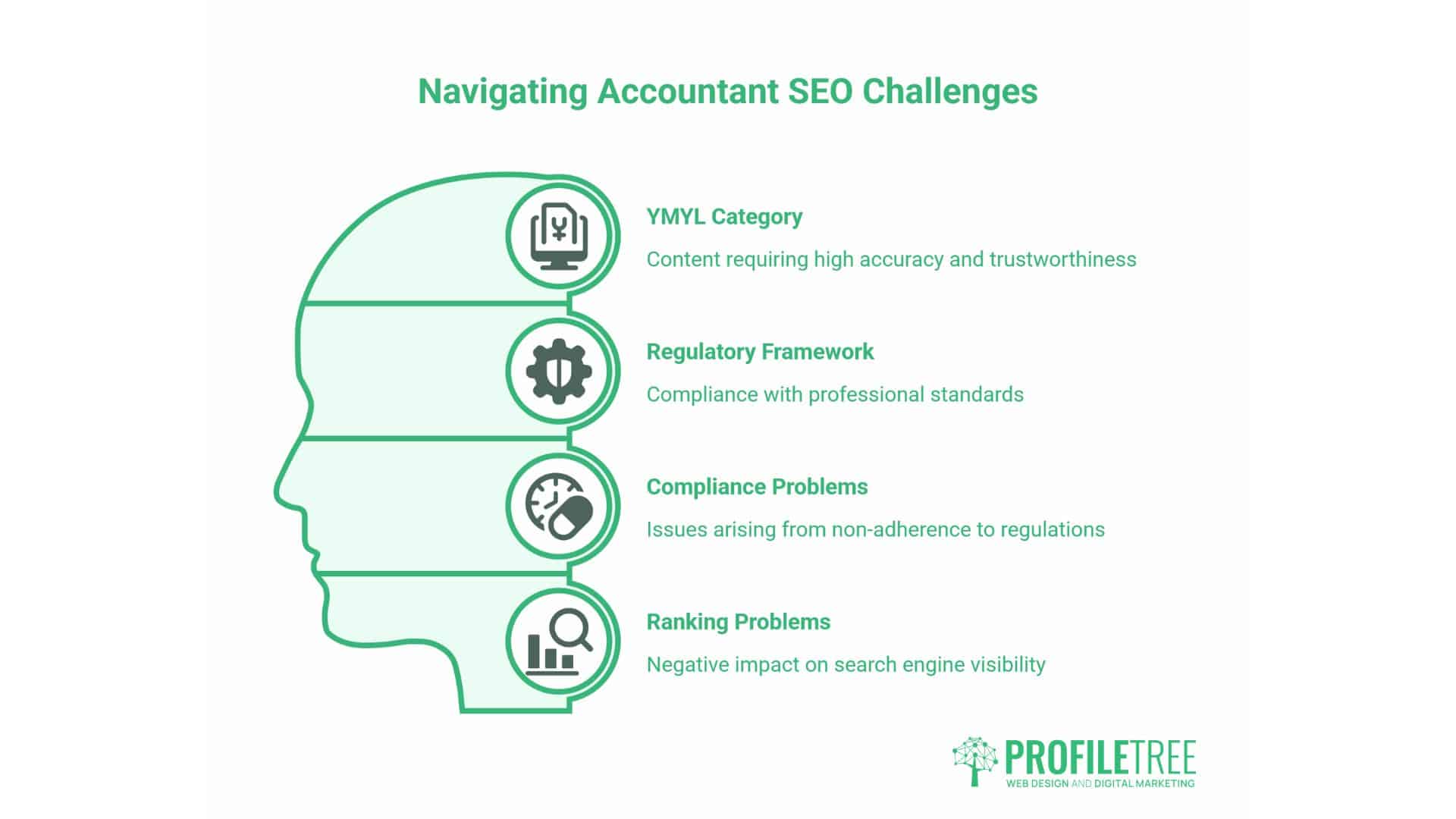
Accounting content sits within Google’s Your Money or Your Life category, meaning it faces closer scrutiny than most commercial content. It also sits within a professional regulatory framework that most SEO guidance ignores entirely, and getting this wrong creates a compliance problem long before it creates a ranking problem.
Members of the ICAEW are bound by the Code of Ethics marketing guidance, which states that promotional material must not bring the profession into disrepute, must not disparage other practices, and must not make claims that cannot be substantiated. This has direct implications for accountancy SEO: a “best accountant in Belfast” title tag or an unverifiable “we save clients thousands” claim is both a weak SEO choice (Google’s own guidance discourages self-promotional superlatives) and a potential conduct issue for ICAEW members, ACCA members, and other regulated practitioners. Content should lead with demonstrable facts (qualifications held, years in practice, services offered, genuine review counts) rather than comparative claims.
Firms that also hold FCA authorisation, typically those offering investment advice, pension guidance, or other regulated financial services alongside core accountancy, carry an additional layer. FCA rules on financial promotions require that marketing communications are clear, fair, and not misleading, and certain content may need sign-off from an approved person before publication. A dual-regulated firm’s website content needs a review step that a pure compliance-and-tax practice does not, particularly on pages discussing investment returns, pension transfers, or other regulated advice areas.
Companies House filing requirements offer a genuine content opportunity rather than just a compliance constraint. Guidance on annual accounts deadlines, confirmation statement requirements, and the practical detail of what happens if a filing is late answers exactly the kind of specific, dated question that self-assessment and year-end searchers are typing into Google. This content needs a clear “last reviewed” date and accurate current-year deadlines; outdated Companies House guidance from a previous filing year is one of the fastest ways to damage the trust a YMYL accounting page depends on.
This trust signal extends beyond tax content into pages that often get overlooked. ProfileTree’s guidance on About Us pages applies directly to accounting practices: partner biographies, qualification listings, and firm history do real E-E-A-T work when they are specific rather than generic. The same applies to consistent contact and location data across the site, covered in more general terms in ProfileTree’s piece on what a website is actually for, which uses a Belfast accountant as one of its own examples of why local specificity beats a templated approach.
What ProfileTree’s Accountant SEO Engagement Delivers
A typical engagement starts with a technical and content audit: current Google Business Profile completeness, existing rankings for the practice’s priority local and service terms, a review of the site’s schema coverage, and an honest look at whether the current service pages actually match how clients search.
From there, work is usually prioritised local signals first (Google Business Profile, citation consistency, review process), service page architecture second (building out the specialism and client-type pages that are missing), and content third (deadline-driven guidance, FAQ pages, and the E-E-A-T signals that YMYL content needs). Local fixes tend to show movement within the first few months and give the practice confidence that the wider content work is worth the investment.
Pricing for accountant SEO in the UK typically ranges from around £800 to £2,000 a month for a single-office local practice, rising to £2,000 to £4,000, or more, for larger, multi-office firms or those competing in high-density markets like London and the South East. Investment scales with the number of locations, the competitiveness of the target terms, and the extent of existing content that needs rebuilding rather than refreshing. Initial local ranking movement is often visible within three to four months; broader organic growth across service and content pages typically takes five to nine months, longer for genuinely competitive national terms.
“What makes accountancy SEO different from most local business SEO is the regulatory layer sitting underneath it. A plumber can say whatever they like about being the best in town. An ICAEW member cannot, and a firm with FCA permissions has an extra compliance check on top of that. Getting the marketing and the professional conduct rules aligned from the start saves practices from having to unpick promotional claims later.” (Ciaran Connolly, founder of ProfileTree)
Practices considering this kind of work can start with a free SEO audit covering Google Business Profile, current rankings, and a first look at service page gaps, before committing to a full engagement.
UK-Wide and Regional Coverage
Northern Ireland and the Republic of Ireland carry genuine jurisdictional differences worth addressing directly on a practice’s website: different tax authorities (HMRC versus Revenue), different company registration bodies, and, for firms near the border in towns like Newry or Derry, a real number of clients dealing with both systems at once. A single-page acknowledgement of this split, rather than defaulting entirely to one jurisdiction’s terminology, captures searches that competitors serving only one side of the border miss.
The same principle scales to England, Scotland, and Wales. A practice with clients or ambitions in London, Manchester, or other high-competition English markets is working against a denser field of established firms and marketing agencies who already understand HMRC’s Making Tax Digital rollout, current Corporation Tax rates, and self-assessment deadlines in detail. Location pages built for genuine regional presence, rather than a template with the city name swapped, need locally specific detail: which local enterprise partnerships or Chambers of Commerce a firm is active in, which local business networks it belongs to, and any client-facing office presence in that area. Thin, templated location pages are penalised rather than rewarded, so this only works where the local presence is real.
For firms weighing up how to prioritise this kind of expansion, ProfileTree’s guide to local SEO for UK and Irish businesses covers the underlying local search mechanics in more depth, and the Northern Ireland local SEO guide sets out the citation and NAP consistency work that underpins regional expansion.
Content Strategy for Accounting Practices
Content marketing for accountants needs to satisfy expertise requirements first and search intent second, because getting the order wrong on YMYL content is exactly what Google’s quality systems are built to catch.
Deadline and compliance content captures genuinely high-intent searches: self-assessment deadlines, Corporation Tax payment dates, and Making Tax Digital requirements all drive seasonal search spikes that a practice with the right page already live can capture without waiting for it to rank from scratch. This content needs a visible “last updated” date and accurate figures for the current tax year, since a page showing last year’s thresholds does more damage to trust than no page at all.
Educational content explaining business structures, VAT registration thresholds, and when a growing sole trader should incorporate builds the demonstrated expertise that E-E-A-T assessments look for. Industry-specific content (contractor and IR35 guidance, landlord and property tax content, startup formation advice) attracts the specialist enquiries that a generalist accountant page cannot.
Author credentials matter more here than almost anywhere else on a professional services website. Content should carry a named author with their qualification (ACA, ACCA, CIMA, AAT) and role, not an anonymous “the team at [practice]” byline. Google’s guidance on author credentials for YMYL content, and the wider shift toward first-hand, attributed expertise in AI-generated answers, both point in the same direction: a named, qualified author outperforms unattributed content on exactly the topics accountants write about most.
For practices building out this kind of content programme, the broader principles covered in ProfileTree’s guide to appearing in AI Overviews apply directly, since accounting content that clearly answers a specific question, with a named and credentialed author, is well placed to be cited rather than just ranked.
Common Mistakes Accounting Practices Make
A handful of errors recur across accounting websites:
- An incomplete Google Business Profile, missing services, few or no photos, and unanswered reviews, while a complete profile consistently outperforms a basic one in local search.
- Qualifications buried on an “About” page rather than surfaced on every relevant service page, despite being one of the strongest trust signals available.
- Generic content that could describe any accountant in the country, rather than content that shows what a specific practice actually does differently.
- No dedicated service or client-type pages, leaving a single generalist page to compete against specialists targeting the same searches.
- Outdated tax content left live after the relevant tax year has passed, which damages credibility with both readers and search engines.
- Marketing claims that stray into territory the ICAEW or ACCA Code of Ethics would flag, often without anyone at the practice realising it until a complaint is raised.
Firms unsure whether their current site falls into any of these patterns can review ProfileTree’s wider notes on common SEO myths affecting UK SMEs, several of which apply directly to professional services marketing.
Building Long-Term Visibility for Your Practice
Accountancy SEO rewards demonstrated expertise, genuine local presence, and professional credibility applied consistently, not as a one-off project. The advantage rarely comes from a single clever tactic; it comes from a complete Google Business Profile, verifiable qualifications, service pages built around how clients actually search, genuine reviews, and content that respects the regulatory framework a practice operates within, all applied consistently, whether it runs from a single Belfast office or several UK locations.
Practices ready to review their search visibility can get in touch with ProfileTree to discuss an audit tailored to the accountancy and professional services sector.
FAQs
How quickly can SEO generate accounting client enquiries?
Google Business Profile improvements often show movement within weeks, while broader website visibility typically takes three to six months, longer in dense markets like London.
Should an accounting practice display pricing on its website?
Some pricing guidance helps. Fixed fees, starting prices, or a clear explanation of how fees are calculated builds trust faster than complete opacity.
Does the ICAEW or ACCA Code of Ethics restrict what a practice can say in its marketing?
Yes. Members must avoid unsubstantiated claims and anything disparaging other practices, so superlatives like “best” or “leading” are best replaced with specific, verifiable facts.
How important are professional qualifications for an accountant SEO?
Very important. ACA, ACCA, CIMA, and AAT qualifications should appear on team and service pages, not just on an About page, with directory listings kept up to date.