
Predictive SEO for Small Businesses: A Practical Forecasting Guide
Table of Contents
Predictive SEO is the practice of using historical search data, trend signals, and demand forecasting to target keywords and create content before search volume peaks so your pages are already ranking when your audience arrives. For small and medium-sized businesses in Northern Ireland, Ireland, and the UK, it is one of the few areas where agility beats budget.
Most guides on this topic are written for enterprise teams with data scientists on staff. This one is not. It covers how to run a predictive SEO strategy using free tools, a spreadsheet, and a clear process and explains where professional support from an SEO or content marketing team makes the biggest difference.
What Is Predictive SEO?
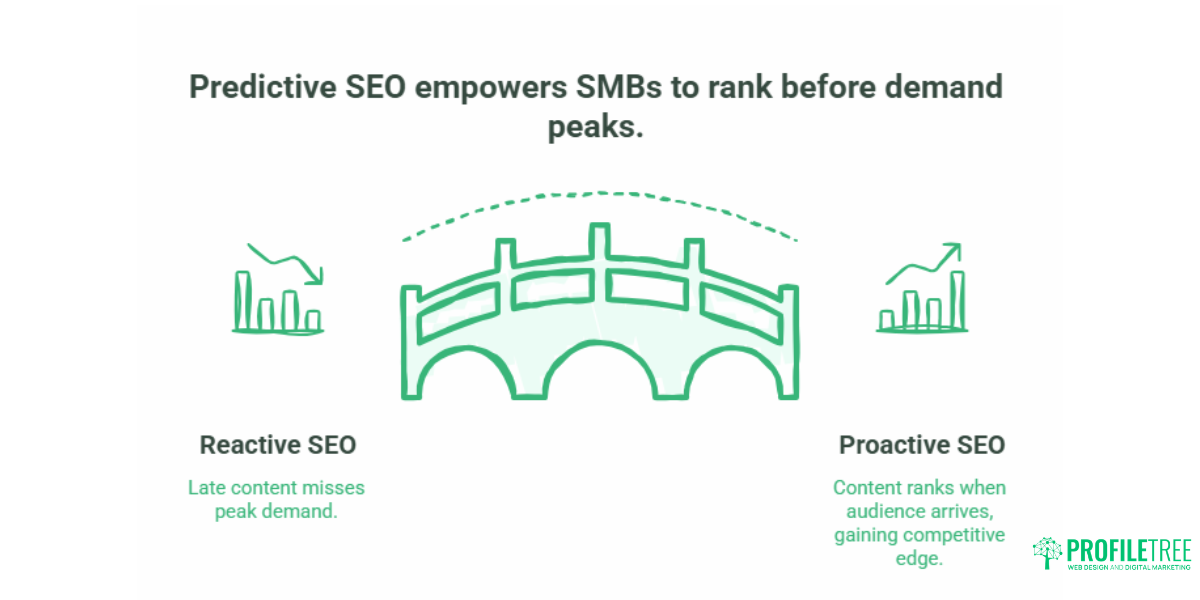
Predictive SEO is a proactive approach to search engine optimisation. Rather than optimising for keywords that are already at peak volume where competition is highest, and your content arrives late, predictive SEO identifies search demand while it is still rising. You publish before the wave crests, giving Google time to index and rank your content by the time searchers arrive in volume.
The core inputs are straightforward: your own historical performance data from Google Search Console, external trend signals from tools like Google Trends, and an understanding of the seasonal and cultural patterns that drive search behaviour in your specific market.
This differs from traditional, reactive SEO in one important respect. Reactive SEO responds to what is popular now. Predictive SEO targets what will be popular in three to four months, when your content will have had time to be crawled, assessed, and ranked.
Predictive SEO vs Reactive SEO
| Reactive SEO | Predictive SEO | |
|---|---|---|
| Targeting strategy | Optimise for existing high-volume keywords | Target keywords before they peak |
| Content lead time | Publish when the trend is already visible | Publish 3–4 months before peak |
| Ideal for | Established, competitive terms | Seasonal, emerging, and niche queries |
| Resource commitment | Ongoing reactive updates | Planned, calendar-driven production |
| Competitive advantage | Hard to gain on saturated terms | High most competitors arrive late |
Why Small Businesses Have an Advantage Here
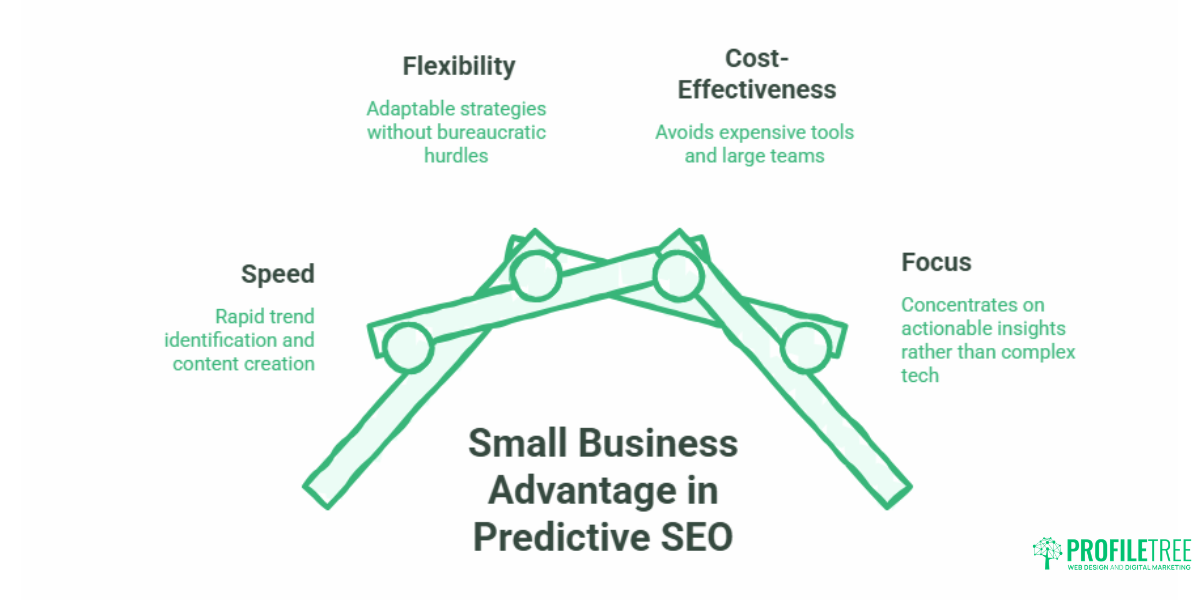
The prevailing assumption in most predictive SEO guides is that this approach requires a machine learning pipeline, expensive analytics software, or a dedicated data team. That assumption suits the platforms selling those tools, but it does not reflect how predictive SEO actually works for most UK and Irish SMEs.
Small businesses have one significant structural advantage: speed. A sole trader or small marketing team can identify a rising trend, brief a writer, produce an article, and have it live within two weeks. A large corporation with multiple approval layers, a content committee, and a quarterly planning cycle takes three to four months to do the same thing, by which point the window has closed.
The constraint for small businesses is not capability; it is knowing what to look for and when to act. That is where the process below becomes practical.
A Step-by-Step Predictive SEO Framework for Small Budgets
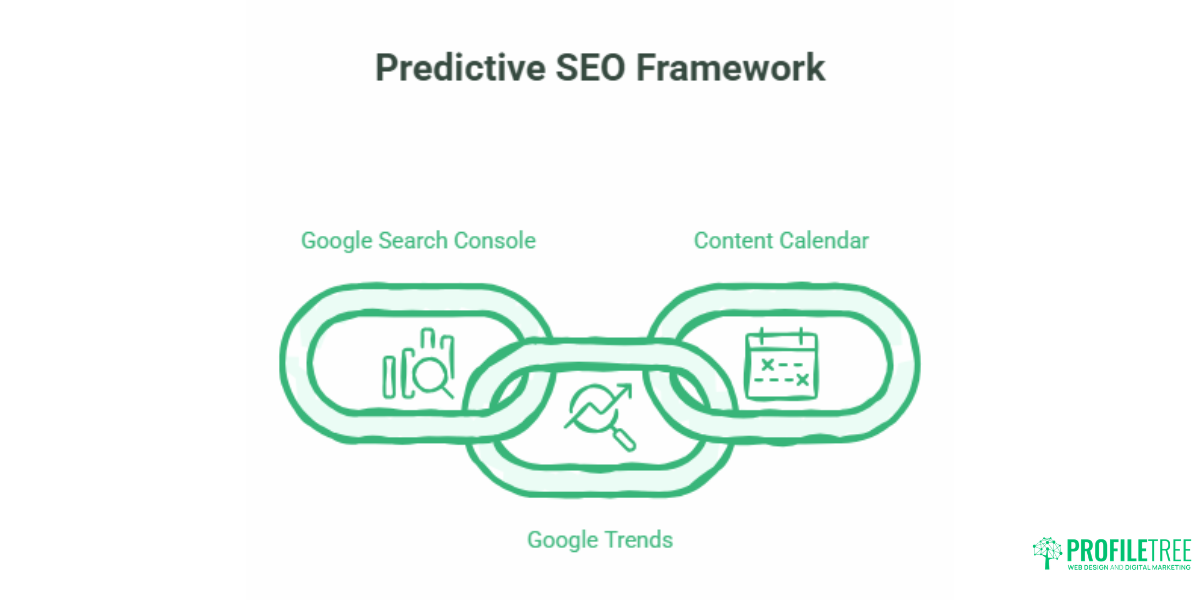
This three-step process uses only free tools. It does not require coding, machine learning, or paid software subscriptions.
Step 1: Mine Your Historical Data in Google Search Console
Google Search Console is the starting point for any predictive SEO process, because it shows you what happened on your site in the past and past patterns tend to repeat.
Log in to Google Search Console and navigate to Performance > Search Results. Set the date range to the past 16 months (the maximum available). Export the query data as a CSV. Sort by impressions descending, then look for queries that spiked during a specific window last year and then dropped off.
These forgotten spikes are predictive gold. A florist who sees “Mother’s Day flowers Belfast” climbing every January into March has identified a predictable demand cycle. If they published fresh content addressing that query in November, they would enter the search window with an established page rather than a new one.
Look particularly for queries where your page appeared in impressions but generated no clicks. These are pages that already have partial relevance in Google’s index but have lost the ranking battle. Refreshing and expanding those pages ahead of the next demand cycle is faster than building authority from scratch.
For SMEs that do not yet have enough of their own historical data to spot clear patterns, this is one area where ProfileTree’s SEO services add immediate value. Experienced analysis of GSC data, combined with competitor and market data, shortens the time it takes to identify actionable demand signals.
Step 2: Validate Early Demand via Google Trends
Once you have a list of candidate queries from your GSC data, validate them against Google Trends. This tool shows you the relative search interest for any term over time, broken down by geography and, in many cases, by week.
Search for your candidate keyword. Switch the region to the United Kingdom or Ireland (whichever is your primary market). Set the time range to the past five years. This gives you a clear picture of whether the pattern is consistent year on year, whether it is growing, flat, or declining, and precisely when search interest begins to rise.
The key number to extract is when interest starts climbing not when it peaks. That start date, minus four months, is your publishing deadline. If interest in “accountant Belfast tax return” reliably starts rising in August and peaks in January, your content needs to be live by April to have sufficient indexing time.
Google Trends also shows related queries, split into “top” and “rising” categories. The rising category especially queries tagged “breakout” identifies terms that are growing faster than the baseline. For an SME in a niche sector, these rising queries often represent the earliest opportunity to rank before larger competitors notice the trend.
Step 3: Build a Proactive 12-Month Content Calendar
The output of steps one and two is a list of queries, each with a predicted peak month and a confirmed publishing deadline. The next step is converting that list into a structured content calendar.
Map each query to a month on a simple spreadsheet. For each entry, record the query, the predicted peak window, the publishing deadline, the page type (new article, refresh of existing page, or expanded pillar content), and the internal link target the service or category page that this content should support.
“The most consistent mistake we see from SMEs on their content planning is treating SEO content as something to publish when there’s time,” says Ciaran Connolly, founder of ProfileTree. “Predictive SEO flips that. The calendar comes first, and the content follows a schedule tied to actual demand cycles not a gap in the diary.”
For businesses that produce content at volume, this is where ProfileTree’s content marketing service becomes a practical resource. Briefing writers against a demand-led calendar, with clear keyword targets and internal link requirements, produces measurably better SEO outcomes than producing content in response to topical moments.
Localised Trends: A UK and Ireland Perspective
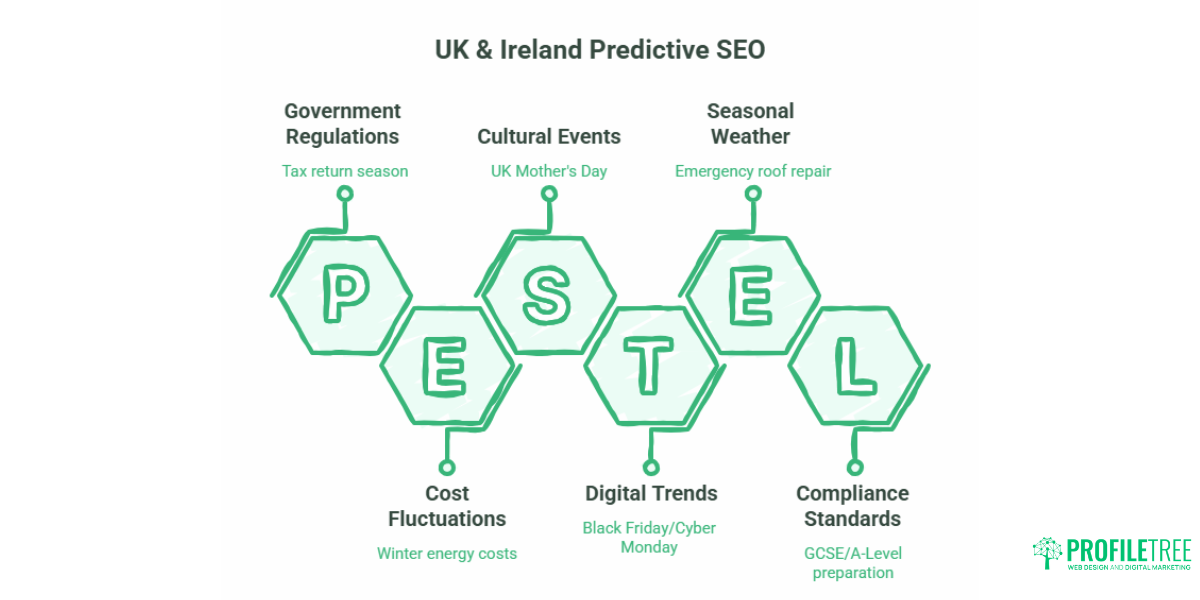
Every predictive SEO guide published by a US platform uses American seasonal examples: Thanksgiving, Spring Break, and the Super Bowl. These are of limited use to a business in Belfast, Dublin, or Edinburgh. The UK and Irish demand calendar is different, and that difference is an opportunity, because localised seasonal forecasting is almost entirely absent from the current competitive landscape for this topic.
Here are some of the demand cycles that matter to UK and Irish SMEs, and the timing implications for content production:
| Key Event | Interest Starts | Peak Window | Content Deadline | Target Sectors |
|---|---|---|---|---|
| GCSE/A-Level preparation | January | April–May | October (prior year) | Education, tutoring, stationery |
| UK Mother’s Day (March) | Mid-January | Late February–March | October (prior year) | Summer tourism in Northern Ireland/Ireland |
| Tax return season (31 Jan) | September | November–January | May | Accountancy, financial services |
| Winter energy costs | August | October–November | June | Trade services, eco-home, HVAC |
| Summer tourism NI/Ireland | February | May–August | October (prior year) | Hospitality, tourism, transport |
| Black Friday/Cyber Monday | September | October–November | June | E-commerce, retail |
A roofing company in Northern Ireland that publishes content around “emergency roof repair after storm” in September, ahead of the Atlantic storm season, will rank for those queries during peak demand in October and November. The same principle applies to any business with identifiable seasonal demand patterns.
This localised approach also applies to Google Trends searches themselves. When validating a query, always filter by the United Kingdom rather than using worldwide data. Search behaviour in the UK and Ireland diverges from global patterns in ways that materially affect which queries are worth targeting and when.
How AI Supports SEO Forecasting
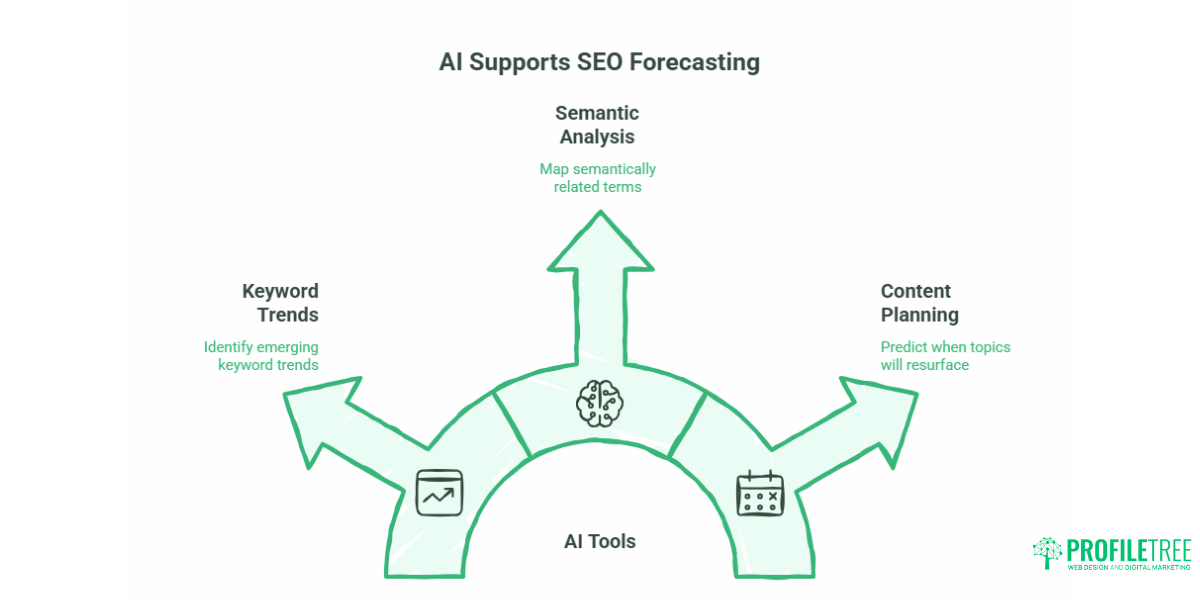
AI does not replace SEO judgment. It processes data at a scale and speed that no analyst can match manually, then surfaces patterns worth investigating.
Identifying Emerging Keyword Trends
Search behaviour shifts gradually before it shifts dramatically. A topic that generates modest query volume in January often spikes in March. AI-assisted tools can detect these early movement signals in search data by analysing long-tail query clusters, related entity growth, and seasonal repetition across multiple years.
Google Search Console is the starting point. Export your queries report and look at impressions for terms where clicks have not yet followed. A query generating 50 to 200 impressions per month at position six to ten with zero clicks is not a failed keyword; it is an opportunity that has not yet been claimed. The page is visible but not compelling enough to click. That is a title and meta description problem, not a ranking problem.
Semantic Keyword Analysis
Search engines have moved well beyond matching exact phrases. Google’s understanding of query intent means that pages ranking for one keyword will often be surfacing for dozens of semantically related terms. AI keyword research tools map these semantic clusters, identifying the surrounding vocabulary that top-ranking pages use, which in turn tells you what your content needs to cover to be considered authoritative on a topic.
For a Belfast accountancy firm, this might mean that a page targeting “VAT returns for small businesses” also needs to address related questions around Making Tax Digital, quarterly submissions, and HMRC deadlines to rank well. AI analysis of the SERP identifies those requirements without manual competitor auditing.
Predictive Content Planning with GSC and Google Trends
Combining Google Search Console’s year-on-year data with Google Trends gives a surprisingly reliable picture of when topics will resurface. If a keyword cluster generated a 40% impression spike in October last year, the reasonable prediction is that the same spike will occur this October. Publishing content in August gives you two months of indexation and link acquisition before the peak.
This is the core of practical AI-assisted SEO forecasting for SMEs: not exotic machine learning models, but structured interpretation of data you already have access to.
Free and Low-Cost Tools for Predictive Keyword Research
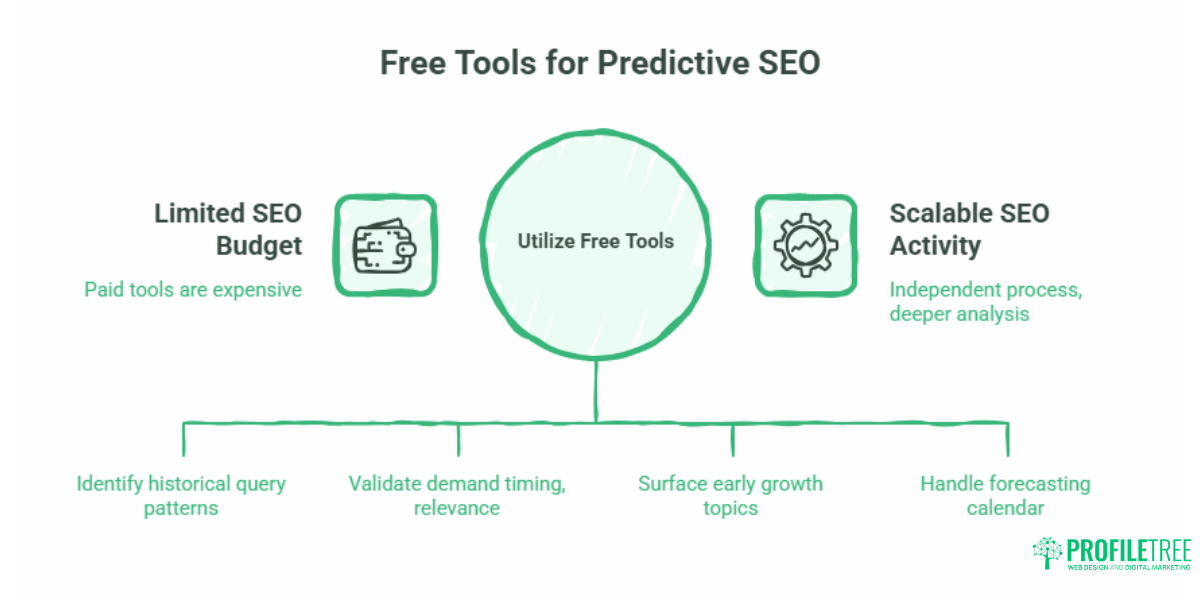
Running a predictive SEO process does not require paid tools at the outset. The following free resources cover the core workflow:
Google Search Console identifies historical query patterns and surfaces pages with untapped ranking potential. It is the essential starting point.
Google Trends validates demand timing, confirms geographic relevance, and surfaces rising queries before they appear in keyword research tools. The “related queries rising” section is particularly useful for identifying early signals.
Exploding Topics (free tier) surfaces topics showing early growth before they enter mainstream keyword databases. The free version provides enough visibility to spot emerging subjects worth investigating.
Google Sheets handles the forecasting calendar. A simple spreadsheet with columns for query, current position, predicted peak month, publishing deadline, and content owner is sufficient. The process does not require a dedicated SEO platform to produce results.
For businesses at the point of scaling their SEO activity or those that want a deeper analysis of competitor content gaps and search demand modelling, digital training from ProfileTree equips in-house teams to run this process independently, with hands-on instruction in GSC analysis, keyword research, and content planning.
The Four-Month Indexing Rule
One of the most commonly missed elements in predictive SEO guides is the indexing lag, the time Google requires to crawl, index, and build enough ranking history for a page to compete for a searched query.
For a new page on a well-crawled site, this typically runs four to six weeks for initial indexing. But ranking at a competitive position, not simply appearing in results on page six, requires Google to have evaluated the page across multiple crawl cycles, assessed click behaviour, and compared it to competing pages. For moderately competitive queries, that process takes three to four months from the date of publication.
This means the publishing deadline for seasonal content is not the week before the trend peaks. It is four months ago. A business that publishes a Christmas gift guide in November is three months late. The same guide, published in August, with internal links from existing high-authority pages and a clear topical structure, has a realistic chance of ranking before December traffic arrives.
The practical implication: identify your most important seasonal demand windows first, count back four months, and set that as your non-negotiable publishing date. Treat it the same way you would treat a tender deadline or a product launch, something the content calendar is built around, not fitted around.
Embedding Video into Your Predictive SEO Strategy
YouTube operates as a standalone search engine, and predictive SEO principles apply there just as they do to Google web search. Seasonal video content published ahead of demand cycles can generate significant views during peak windows, and video pages that embed YouTube content perform better in organic search than text-only equivalents.
For SMEs producing video content, the same process applies: identify seasonal queries using YouTube’s search suggest and Google Trends, publish ahead of the demand peak, and ensure the video title, description, and tags reflect the exact phrasing people use when searching.
The following ProfileTree video covers how a proactive digital strategy supports long-term search visibility:
For businesses considering video as part of their content production plan, ProfileTree’s video production service covers the full process from scripting through to post-production.
Measuring Predictive SEO Results
Predictive SEO performance should not be measured week-on-week. The correct comparison is year-on-year traffic during a specific demand window. If a page targeting “tax return help Belfast” generated 40 organic sessions in January last year and generates 180 this January after a predictive content effort, that is the relevant metric.
Set up date-comparison segments in Google Analytics 4 and Google Search Console, aligned to your demand windows. For a business targeting UK Mother’s Day, compare the six weeks ending on Mother’s Day this year against the same window the previous year. Filter by organic traffic and by the specific queries your predictive content was targeting.
Secondary metrics to track include position improvement for target queries over the four months following publication, click-through rate on pages that were refreshed versus newly created, and the proportion of impressions converting to clicks as ranking position improves. Consistent position improvement combined with growing impressions confirms that Google is assessing the page positively, a leading indicator of traffic gains before peak demand arrives.
Frequently Asked Questions
What is the difference between traditional and predictive SEO?
Traditional, reactive SEO optimises for keywords that already have established search volume, where competition is highest and late-arriving content struggles to rank. Predictive SEO targets those same queries three to four months before they peak, giving new or refreshed content time to be indexed and ranked before demand arrives. The strategic difference is timing: one follows trends, the other gets ahead of them.
Can I run a predictive SEO process using only free tools?
Yes. The core workflow requires only Google Search Console, Google Trends, and a basic spreadsheet. Search Console surfaces historical query patterns and identifies seasonal spikes in your own data. Google Trends validates timing and geographic relevance. A Google Sheet tracks the publishing calendar against demand windows. Paid tools add speed and additional data sources, but they are not required to start.
How far in advance should I publish predictive content?
As a general rule, four months before the expected search peak. Google needs time to crawl and index a new page, assess click-through behaviour, and compare it to competing content before it ranks at a competitive position. Publishing a Christmas gift guide in November means you are targeting a window that has already peaked for most retailers. Publishing the same guide in August gives your content a realistic chance of ranking before December.
Do I need machine learning or coding skills for predictive SEO?
No. The enterprise-oriented guides on this topic make predictive SEO sound technically complex because they are selling tools that are. For most UK and Irish SMEs, a spreadsheet-based forecasting process using freely available data is sufficient to produce measurable results.
Is predictive SEO useful for local service businesses?
It is particularly well-suited to them. A roofing company, an accountancy practice, or a garden services business all face predictable seasonal demand cycles. Identifying when search interest in their core services begins to rise and publishing content ahead of that window is more achievable for a local service business than trying to outrank national competitors on perennially high-volume terms.
How do I measure whether predictive SEO is working?
Compare organic traffic and query impressions during your target demand window year-on-year. Week-on-week metrics do not reflect the seasonal nature of predictive SEO performance. Set up date-comparison views in Google Search Console and Google Analytics 4, aligned to the specific windows your content was designed to capture.