
What is Kotlin? A Developer’s Guide to the Language
Table of Contents
Kotlin is a statically typed, cross-platform programming language developed by JetBrains. It runs on the Java Virtual Machine (JVM), compiles to JavaScript, and targets native platforms — meaning you can use a single codebase to build Android apps, iOS apps, backend services, and web applications.
Google made it its officially preferred language for Android development in 2019. Since then, it has become the standard choice for new Android projects, and its role is expanding well beyond mobile.
If you are a developer evaluating your options, a technical lead considering a migration from Java, or a business owner trying to understand what your development partner means when they recommend it, this guide covers what you need to know.
What is Kotlin? A High-Level Overview
JetBrains, the company behind IntelliJ IDEA, began developing the language in 2010. The goal was a more practical alternative to Java: shorter, safer, and fully interoperable with the existing Java ecosystem. Version 1.0 launched in 2016, the same year Google announced first-class Android support.
The language is free to use under the Apache 2.0 licence and is maintained as an open-source project. It is now part of Google’s official Android documentation and tooling.
What distinguishes it from many alternatives is that it did not ask developers to abandon their existing Java codebases. You can call code from either language within the same project. That interoperability removed the primary adoption barrier, and uptake followed quickly.
Today, the language is used across Android development, server-side applications, multiplatform projects, and — increasingly — AI-adjacent tooling through JetBrains’ own frameworks.
Key Features and Advantages
The language was designed to solve real problems that Java developers face every day. The features below are not theoretical — they are the practical reasons development teams choose it for new projects and migrate existing codebases toward it.
Null safety
Null pointer exceptions (NPEs) are among the most common causes of runtime crashes in Java applications. The type system here separates nullable types from non-nullable types at the language level. A variable declared as String cannot hold null. A variable that might be null must be declared as such, and the compiler forces you to handle that case before the code runs. This moves an entire class of bugs from production to compile time.
Concise syntax
A significant amount of boilerplate that Java requires is simply gone. Data classes, for example, generate constructors, getters, equals, hashCode, and toString methods automatically from a single line of code. What takes 50 lines in Java takes 5 here. For development teams working to timelines and budgets, this matters.
Coroutines for asynchronous programming
The coroutine system provides a lightweight model for concurrent and asynchronous code. Rather than creating new threads for each task — expensive in terms of memory — coroutines are suspended and resumed within existing threads. This makes it practical to run thousands of concurrent operations without the overhead of an equivalent thread-per-task approach.
Interoperability with Java
Every Java library works in Kotlin. If your project depends on Spring, Retrofit, Hibernate, or any other Java framework, you can use it directly without wrappers or adapters. This is what made adoption realistic for teams with existing Java codebases: you introduce the new language file by file rather than rewriting everything.
Multiplatform capability
Kotlin Multiplatform (KMP) allows teams to write shared business logic once and deploy it across Android, iOS, desktop, and web targets. Platform-specific UI layers remain native, but everything underneath — API calls, data models, business rules, validation logic — can be shared from a single codebase.
Kotlin vs Java: Should You Make the Switch?
The case for the language on new JVM projects is clear. The question for existing teams is whether migration is worth the effort.
| Feature | Kotlin | Java |
|---|---|---|
| Null safety | Built into the type system | Manual null checks required |
| Syntax verbosity | Concise; data classes, type inference | More verbose; significant boilerplate |
| Coroutines | Native support | Requires external frameworks |
| Interoperability | Full Java interop | Full Java interop |
| Android support | First-class (Google-preferred) | Fully supported but secondary |
| Multiplatform | Yes (KMP) | No native equivalent |
| Learning curve | Moderate for Java devs | Established; large body of documentation |
| Open source | Yes (Apache 2.0) | Yes (OpenJDK, Apache 2.0) |
For greenfield Android projects, Kotlin is the sensible default. Google’s tooling, documentation, and new APIs are written with it in mind first, and Java examples are often secondary or omitted entirely.
For existing Java codebases, migration does not need to be immediate or complete. The interoperability means you can introduce the new language gradually — new features written fresh, legacy modules remaining in Java — and migrate at whatever pace suits your team and budget.
For backend and server-side work, both languages are viable. The conciseness and coroutine support make Kotlin practical for high-throughput services, but Java remains dominant in enterprise environments with established engineering teams and long-running systems.
The realistic summary: use Kotlin for anything new on the JVM, especially Android. Java migration is worthwhile when the team has capacity and the codebase is actively maintained. Legacy Java systems that work and are not actively developed are not candidates for migration.
What is Kotlin Used For?
It started as an Android language. That is still its strongest use case, but the picture has changed significantly. Here is where it is doing real work in 2026.
Android app development
This is where adoption is most complete. Google declared Android development “Kotlin-first” in 2019, meaning that new Android APIs, Jetpack libraries, and official samples are all written in Kotlin. For any business commissioning an Android application today, this is the expected language choice.
Android projects span consumer-facing apps to enterprise tools, including logistics apps, customer portals, field service applications, and retail apps. As Ciaran Connolly, founder of Belfast digital agency ProfileTree, has observed when guiding clients through development decisions: “Technical decisions should serve business objectives, not constrain them. We translate business goals into technical specifications that deliver measurable results.” The language fits this principle because it reduces development time and maintenance overhead, which directly translates into lower costs for businesses commissioning the work.
Kotlin Multiplatform for cross-platform development
KMP is one of the more significant developments in mobile development over the past few years. It allows teams to write shared business logic once and deploy it to Android, iOS, desktop, and web, while keeping platform-specific UI layers native.
The practical implication for businesses is cost and consistency. A traditional dual-platform approach requires two separate development tracks in two separate languages. KMP lets a team share code for data fetching, business rules, authentication logic, and local storage, while keeping each platform’s UI in its native framework. For SMEs with limited development budgets, this can make a dual-platform app viable where it would otherwise not be.
KMP reached Stable status for Android and iOS sharing in late 2023. Adoption by major companies, including Netflix and McDonald’s, has accelerated confidence in it as a production-ready approach.
Server-side and backend development
The language is well-suited to backend development, particularly for microservices and API-driven architectures. The Ktor framework, built by JetBrains, is designed specifically for server-side use. Spring, the dominant Java backend framework, has supported it since Spring 5 and provides language-specific extensions.
In the UK, backend adoption is concentrated in fintech and SaaS companies. London’s fintech sector, in particular, has been migrating legacy Java services, attracted by conciseness and the coroutine model for handling high-concurrency workloads.
AI and data science
This is the area of fastest current movement. JetBrains has released Koog, an open-source framework for building AI agents, and has introduced support for the Model Context Protocol (MCP) SDK. For development teams building AI-integrated applications — chatbots, recommendation systems, intelligent automation — these tools make it a viable option alongside Python for AI-adjacent work.
ProfileTree’s AI implementation services work with businesses across Northern Ireland and the UK to put AI tools into practical use. For teams already working in this ecosystem, the ability to build AI features without switching stacks reduces complexity considerably.
Getting Started: Your First Code
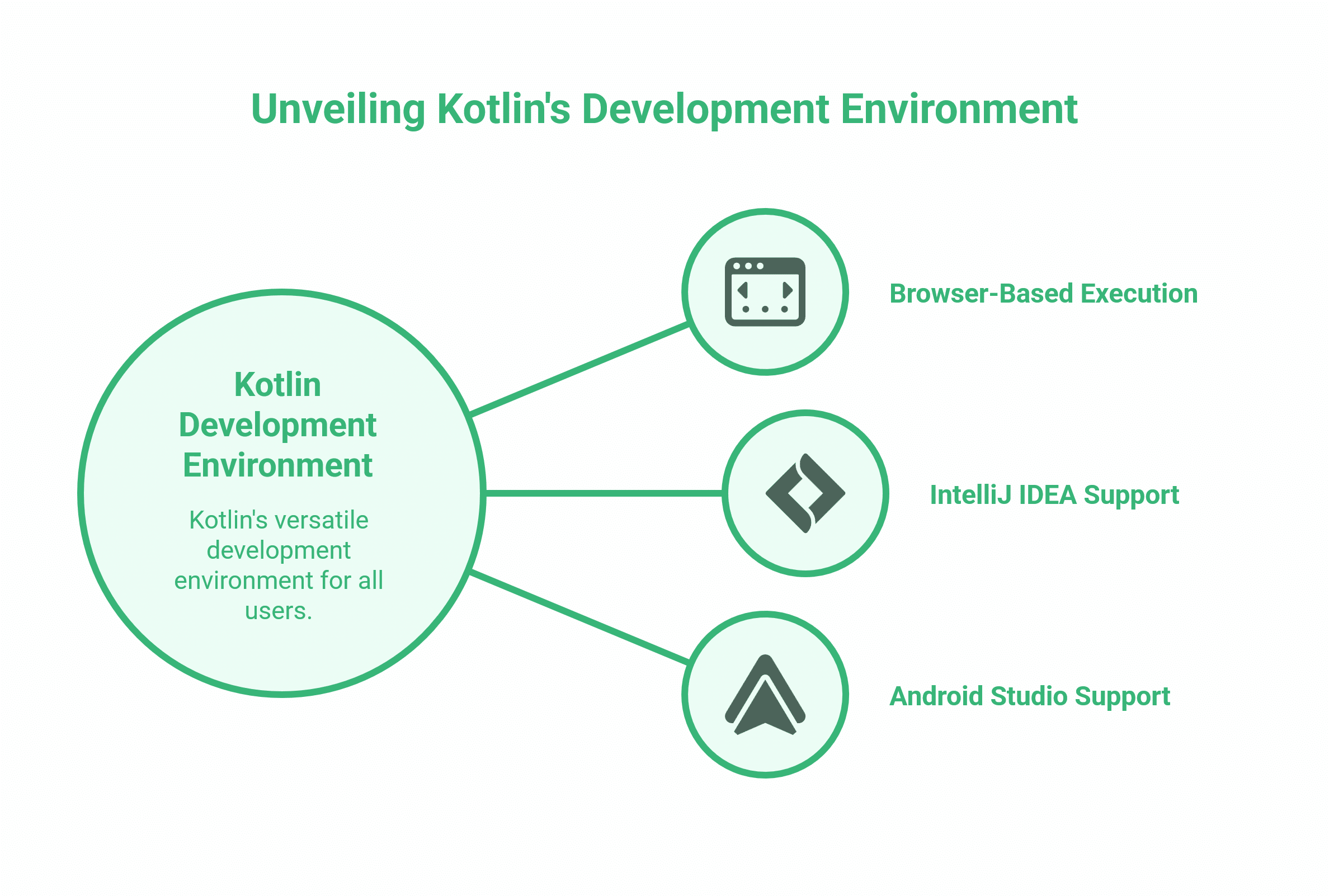
The language can be run immediately in the browser at play.kotlinlang.org without any installation. For local development, IntelliJ IDEA (the free Community Edition is available) and Android Studio both provide full support out of the box.
A basic programme:
kotlin
fun main() {
    println("Hello, World!")
}
A data class — one of the most practical features:
kotlin
data class Client(val name: String, val email: String, val company: String)

fun main() {
    val client = Client("Aoife Murphy", "aoife@example.com", "Murphy & Co")
    println(client)
    // Output: Client(name=Aoife Murphy, email=aoife@example.com, company=Murphy & Co)
}
That single data class line generates a constructor, toString, equals, hashCode, and a copy function. The equivalent in Java requires around 40 lines.
Null safety in practice:
kotlin
var name: String = "ProfileTree"    // Cannot be null
var city: String? = null             // Can be null; compiler requires handling

val length = city?.length ?: 0      // Returns 0 if city is null
For developers coming from Java, the learning curve is manageable. The syntax is different, but the underlying concepts — objects, inheritance, interfaces, generics — are familiar. Most experienced Java developers are productive within a few weeks.
Careers and Demand in the UK and Ireland
Developer skills in this area are in demand across the UK, as reflected in salary data.
According to Glassdoor (August 2025 data), the average salary for a Kotlin developer in the UK is £44,592 per year, with a typical range of £30,807 to £67,464. ITJobsWatch data for the six months to March 2026 shows a median figure of approximately £77,500 for roles where the language is a primary skill requirement — reflecting the more senior positions that specifically cite it alongside broader backend experience.
The discrepancy between these two figures reflects the difference in sample composition. Glassdoor captures a wider range of roles at all seniority levels; ITJobsWatch tracks quoted salaries in permanent job postings, which skew toward senior and specialist positions.
Geographically, London accounts for the highest volume of roles, driven by fintech and SaaS companies migrating their Java backends. Manchester, Bristol, and Edinburgh all show growing demand in mobile and backend work. Belfast has a smaller but active developer community, with companies including Citi and global technology firms advertising relevant roles locally.
For developers in Northern Ireland and Ireland considering where to invest their skills, the case is straightforward. It is the expected language for Android projects, and its backend presence is growing. For those already working in Java, the transition is lower-effort than moving to an entirely different paradigm.
Conclusion
The language is no longer just a mobile tool. Its role in server-side development, cross-platform mobile via KMP, and AI tooling makes it worth understanding whether you are a developer evaluating your next investment or a business owner trying to follow the technical conversations your development partner is having.
For SMEs considering custom app development, the combination of Android-first support, multiplatform capability, and reduced development overhead makes it a practical choice. ProfileTree’s web development team works with businesses across Northern Ireland, Ireland, and the UK to translate those technical realities into applications that serve clear business objectives. If you are weighing up a web or app development project and want to understand your options before briefing a developer, our team is happy to talk it through.
FAQs
What is Kotlin used for?
It is primarily used for Android app development, server-side backend work (with Ktor and Spring), and Kotlin Multiplatform projects that share code across Android and iOS. It runs on the JVM, so it can handle anything Java can, with less code and built-in null safety.
Is Kotlin better than Java?
For new JVM and Android projects, it is the better choice for most teams. Its null safety removes an entire class of runtime errors, and Google’s Android tooling is now Kotlin-first. For stable legacy Java systems, migration has a real cost and may not be justified.
Is Kotlin a good language to learn first?
If your goal is Android development, yes. If you are starting from scratch with no clear direction, Python has a gentler syntax and broader applicability. Kotlin is a better first language than Java if you’re targeting JVM or Android development, because its syntax is cleaner and its null-safety catches errors that would otherwise confuse beginners.
Can I learn Kotlin without knowing Java?
Yes. It is a standalone language with its own documentation and learning path. Some knowledge of the JVM ecosystem is useful eventually, but Android Studio’s tutorials and kotlinlang.org both assume no prior Java experience.