
Social Media and Insecurity: The Stats and Psychology
Table of Contents
Do social media and insecurity actually go together, or is that just a talking point? The research says yes. Platforms built around comparison measurably lower self-esteem and body satisfaction, and the effect shows up in controlled trials, not just in complaints on forums.
Social media and insecurity turn up together in almost every conversation about mental health and marketing now, and it’s not hard to see why. Spend five minutes scrolling, and the pattern shows itself: filtered faces, curated wins, and a running feed of lives that look better than your own.
This guide covers what the research says about that link, how large the effect is, why it matters for anyone planning social media marketing for businesses, and why a brand’s own posting habits either add to the problem or help its audience feel steadier. Most marketing advice skips that last part, which is a mistake.
Why Social Media Breeds Insecurity
Social media breeds insecurity by design, not by accident. Most major platforms are built around comparison, which keeps people scrolling.
Psychologist Leon Festinger set out social comparison theory back in 1954: people determine their own worth by comparing themselves with others. Social media did not invent that habit. It industrialised it. The feed serves a steady run of people at their most photogenic and most successful, so you end up judging your ordinary Tuesday against everyone else’s edited highlight reel. That’s an unfair contest from the first swipe, and it feeds directly into the link between beauty standards and how people see themselves.
Then there’s the reward loop. Every like, comment, and share triggers a small hit of dopamine, and platforms make that reward unpredictable, which is exactly what makes it hard to put down. When a post lands flat, the same system that handed you approval now hands you anxiety instead. Over time, people start to read engagement figures as a score of their own value.
A three-year study published in JAMA Paediatrics in 2023, led by researchers at the University of North Carolina at Chapel Hill, tracked 169 sixth and seventh-grade pupils using brain scans. It found that habitual checkers became more neurally sensitive to social rewards and punishments over time than pupils who checked less often. That mechanism is the clearest starting point for understanding why social media and insecurity show up together so consistently across the research. The full JAMA Paediatrics study sets out the method.
Key Statistics at a Glance
| Finding | Source |
|---|---|
| Habitual teen social media checkers showed growing neural sensitivity to peer feedback over three years | JAMA Paediatrics, 2023 (UNC Chapel Hill) |
| Cutting social media use by roughly 50% for a few weeks improved appearance and body esteem in 17- to 25-year-olds | Psychology of Popular Media, 2023 (RCT, 220 participants) |
| Body satisfaction dropped after viewing AI-generated influencer images, whether or not participants knew the images were artificial | International Journal of Eating Disorders, 2026 (Clemson University) |
| Social comparison is a documented driver of self-evaluation, first described in 1954 | Festinger, social comparison theory |
FOMO: The Fear of Missing Out
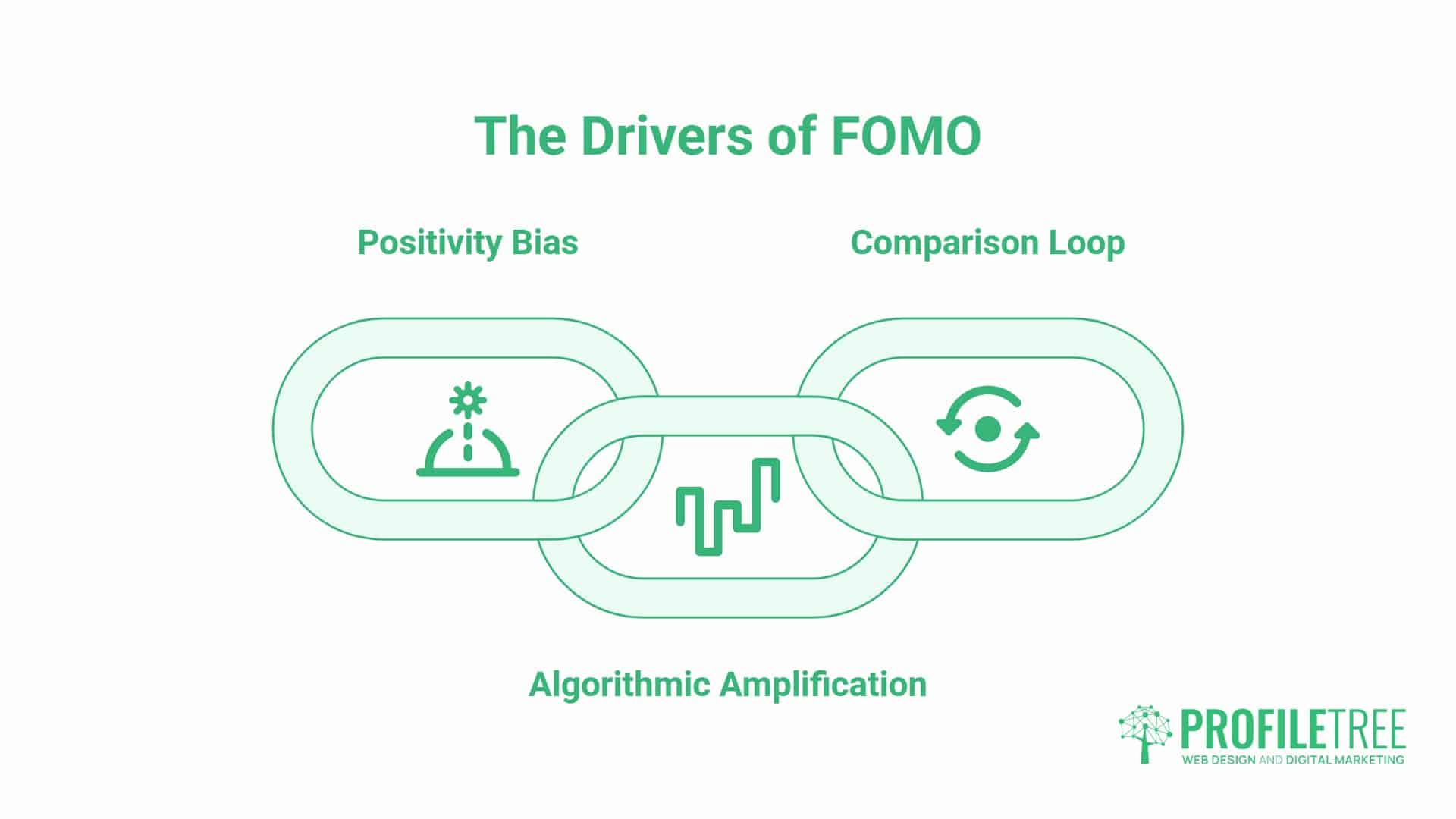
FOMO is one of the clearest bridges between social media and insecurity, because it turns ordinary comparison into urgency: the nagging sense that other people are having a better time, making smarter choices, or generally living more than you are. Platforms lean into it through a strong positivity bias. People post the holiday and the promotion, not the argument in the car park or the quiet Sunday doing nothing.
The result is a warped sample of how everyone else lives. Set your own baseline against that feed and chronic dissatisfaction is almost the default. Two things make it worse. Algorithms push emotionally charged content, so the aspirational and the dramatic travel furthest while ordinary life barely registers. And once FOMO pulls someone into posting more to keep up, they join the same loop, where a flat post breeds fresh worry. Heavier use can deepen loneliness rather than ease it, a pattern covered in the research on social media isolation.
Social Media and Insecurity: Body Image and Self-Esteem
Body image is the most heavily studied part of this whole subject, and the findings barely wobble across studies or age groups. Of every angle researchers have tested, the tie between social media and insecurity is strongest here: more exposure to idealised bodies tracks with lower body satisfaction, more disordered eating, and more cosmetic surgery enquiries.
Editing tools and in-app filters are the norm now, not the exception, and that’s the real problem. It isn’t only that edited images exist. It’s that constant exposure that quietly resets what people count as normal. When flawless skin and specific proportions fill most of the images you see in a day, your own unedited face starts to feel like the odd one out.
A 2023 randomised controlled trial published in Psychology of Popular Media, led by Gary Goldfield and colleagues at the Children’s Hospital of Eastern Ontario, put this to the test. Across 220 participants aged 17 to 25, those who cut their social media use by about half for a few weeks reported real gains in how they felt about their appearance and weight, while a control group saw no change. The APA write-up has the detail, and the wider picture sits in the data on beauty standards.
Fitness and lifestyle influencers add their own twist. The content usually pins a physique on effort and discipline alone, which quietly implies that any body not looking similar just hasn’t tried hard enough. The bits that actually explain the look, so genetics, lighting, editing, undisclosed sponsorships and sometimes surgery, tend to be missing from the caption. For brands, that matters: sponsor content built on standards nobody can reach, and you’ve made a choice about what your name stands for.
AI-Generated Imagery: A New Layer of Comparison
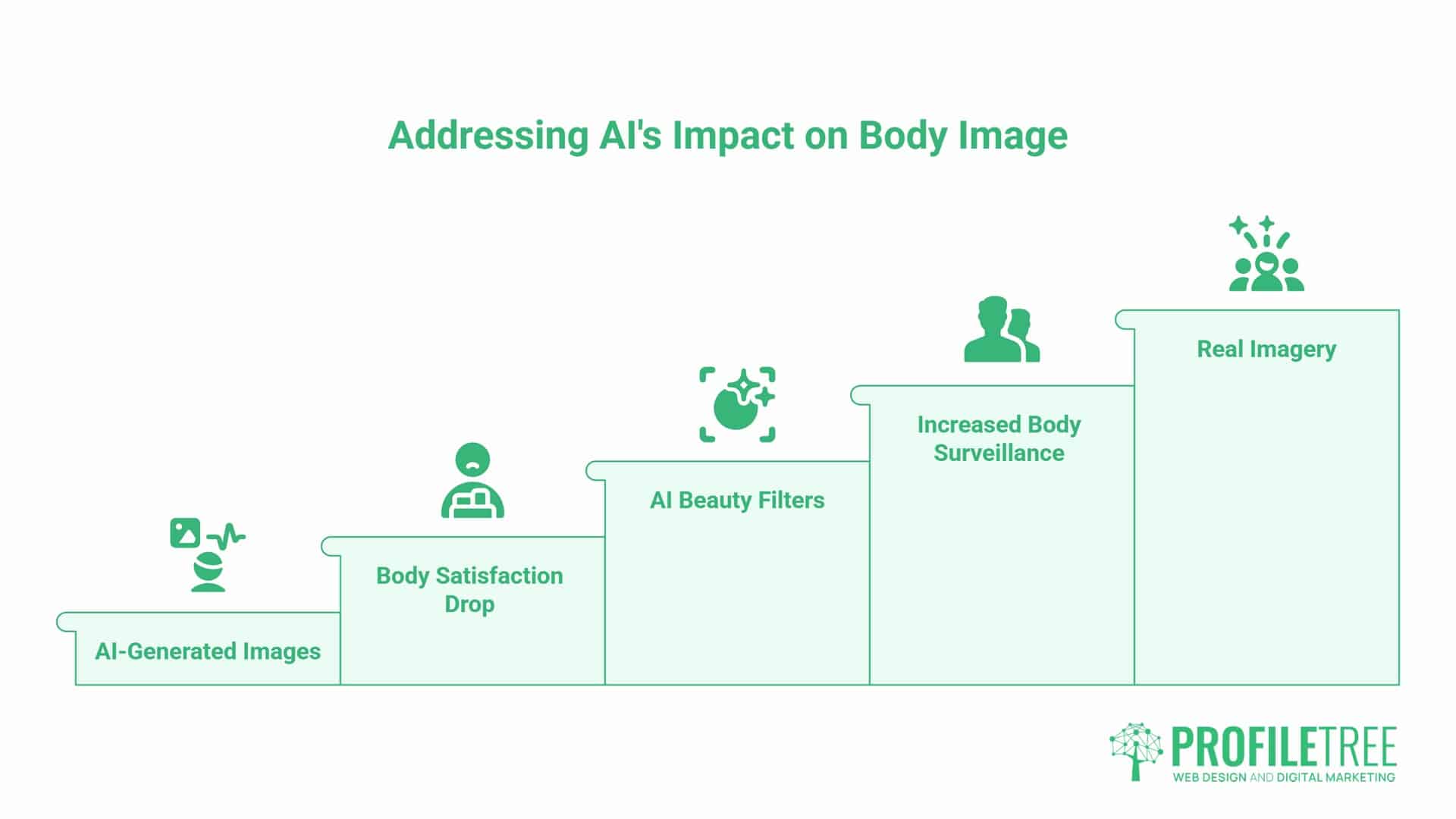
Editing tools and filters were already the norm, but newer research points to a further problem. AI-generated and AI-assisted images do their own damage, and disclosing that an image is AI-generated does not undo it. This is where social media and insecurity meet the newest layer of technology: generative tools that create comparison targets which never existed in reality.
A study published in the International Journal of Eating Disorders in February 2026, led by researchers at Clemson University, tested this directly. Regular social media users viewed AI-generated images of influencers, and body satisfaction dropped afterwards, regardless of whether participants knew the images were artificial. Telling people a picture was AI-generated did not protect their body image. It mainly made them trust the technology less.
Separate research on AI beauty filter apps, published in the Journal of Consumer Behaviour in 2026, found a related pattern. Heavier use of tools such as automated skin-smoothing and feature-reshaping filters was tracked with lower appearance self-esteem and more body surveillance, the habit of constantly monitoring and judging one’s own appearance. Filters have not plateaued as an issue. Generative tools are adding a new, harder-to-spot layer on top of the comparison problem, not replacing it.
For brands, the practical takeaway is narrow but useful. If a product image or influencer partnership has been digitally retouched or AI-generated, disclosure is good practice for trust, but it will not neutralise the psychological effect on the viewer. The safer route is to lean on real, unedited imagery where the category allows it.
The Business Cost of User Insecurity
Here’s the part most guides on social media and insecurity skip. There’s a well-worn link in consumer psychology between how people feel and what they buy. Anxiety and low self-esteem do drive some purchases, especially in beauty, fashion and fitness, where aspirational marketing is built to trade on the gap between how customers feel and how they wish they felt. It works, up to a point.
The catch is that insecurity-driven purchases rarely build loyalty. The buy soothes a passing feeling rather than meeting a real need, and when the feeling returns, there’s no reason it sends the customer back to you. That model gives you short purchase cycles and weak retention. Brands that instead make their audience feel capable and informed build something sturdier that converts better over time, as set out in ProfileTree’s data on social media and sales conversion.
“The brands we see achieving real longevity online are not the ones manufacturing insecurity in their audience,” says Ciaran Connolly, founder of Belfast digital agency ProfileTree. “They’re the ones that make their audience feel more capable after engaging with their content. That shift from attention-grabbing to trust-building is the most significant strategic change we’re helping businesses make right now.”
The Regulatory Picture Is Changing
The UK Online Safety Act has moved from framework to active enforcement. Ofcom’s monitoring and impact programme now reviews child safety practices on the six platforms UK children use most: Facebook, Instagram, TikTok, Snapchat, YouTube and Roblox. In its first year enforcing the Act, Ofcom opened investigations into 30 companies covering 96 sites and apps, and issued 16 fines against six providers totalling close to £4 million, according to Ofcom’s own industry bulletins.
The regulator has also begun issuing legally binding information requests about recommender systems, the algorithms that decide what a feed actually shows someone. That is a direct line back to the comparison mechanics covered above. If the feed itself is now open to formal scrutiny, brands relying on emotionally charged, comparison-heavy content are operating in a regulatory environment that did not exist two years ago.
For any business running organic or paid social content, that changes the planning calculus. The regulatory response to social media and insecurity has shifted fast in the UK, and a digital strategy that treats platform and content risk as an input from the start, rather than an afterthought once something goes wrong, is now the safer commercial choice as well as the more ethical one.
How Brands Can Build Trust Instead of Insecurity
The question for a brand manager isn’t whether social media and insecurity are connected. They plainly are. The question is what part your brand wants to play in it.
The disruptive model interrupts people with content they never asked for and engineers a reaction strong enough to earn a click. Short-term it works; over time it wears down trust. The value-add model treats every post as something the audience should be better off for having seen: practical information, honest talk about what you sell, and creative work that entertains without trading on comparison. For most small firms, that just means treating the audience as people you want a long relationship with. ProfileTree’s social media marketing work starts from one question: what does this audience actually need to know, and how do we become the most useful source of it?
Authenticity gets overused as a word, but it points at something real: audiences can now tell genuine communication from the performed kind, and they respond differently. Smaller businesses actually hold an edge here. A firm in Belfast can show its real team, real workspace and real process in a way a multinational can’t, and that’s a proper differentiator, not just a nicer tone. Getting a team comfortable doing that is part of what ProfileTree covers in its digital training.
The Responsible Brand Audit
Before your next social review, ask five honest questions. Running through them regularly keeps the link between social media and insecurity in view, rather than something reviewed once and forgotten. Does your content use heavily altered images? Does your copy rely on FOMO or scarcity that isn’t genuinely true? Are the lifestyles you attach to your brand realistically within reach? Do you treat engagement as your main measure of success, regardless of whether it reflects real interest? And does your content leave the audience feeling better or worse about themselves? A yes to any of the first four, or a “worse” on the last, is a signal worth taking seriously.
The Mental Health Dimension
The mental health case for treating social media and insecurity as connected, not coincidental, keeps growing, even while the precise causal mechanics stay under debate. Likes, shares and comments create a live scoreboard for self-worth. Strong performance reads as approval; a quiet post reads as rejection. That isn’t imagined meaning in a neutral system, since platforms are built to make those numbers feel like they matter. The NHS Every Mind Matters campaign has flagged the link between usage patterns and anxiety, particularly among teenagers.
Algorithms add an echo chamber on top. Feeds fill with content that matches your existing mood, so someone already anxious gets served more of what confirms it. Heavy use also appears to be reshaping how people take in information generally, which is the thread running through the research on attention span. And it’s worth staying sceptical about scary round numbers online; the piece on misleading statistics is a good check on how figures get stretched.
Building a Healthier Relationship With Social Media
Deleting everything is rarely realistic for most people or most businesses, so the useful question is how to manage social media and insecurity at a personal level, one habit at a time, without letting the platforms quietly chip away at how you see yourself.
For individuals, three things carry most of the weight. Curate the feed on purpose, since who you follow is an active choice about your daily reference group. Take scheduled breaks, because even short ones improve mood and body image by more than the time spent suggests. And separate the metrics from your worth, since a like count reflects timing and format as much as quality. For brand teams, build one question into content reviews: Is this likely to leave the audience feeling capable or inadequate? That doesn’t mean dropping aspiration, just being honest about whether the gap you show motivates people or deflates them. The scale of the habit shows in the data on time spent online.
FAQs
Does social media cause insecurity?
The evidence points to cause, not just correlation, because trials that cut people’s usage consistently improve mood and body image. The mechanism is social comparison built into how feeds work.
How does social media cause insecurity?
Mainly through three routes: comparing your inner life to other people’s edited highlights, reading engagement figures as a measure of worth, and algorithms pushing the most emotive content hardest.
How many people feel insecure because of social media?
There’s no reliable headline figure, so treat round numbers with caution. What’s clearer is that reducing use measurably improves how people feel, which tells you the effect is widespread.
Does social media lower self-esteem?
For many users, yes, particularly around appearance. A 2023 trial found that cutting use by about half for a few weeks improved appearance and body esteem in young adults.
What is responsible social media marketing?
It means serving the audience’s real interests rather than exploiting comparison to chase engagement, using honest imagery and claims and avoiding manufactured scarcity.