
Go Programming Language: Built for Modern Development
Table of Contents
The Go programming language occupies an unusual position in software development. It is neither the oldest language in the room nor the newest, yet it has quietly become the backbone of some of the most demanding infrastructure on the internet. ProfileTree, a Belfast-based web design and digital marketing agency, works with development teams across the UK and Ireland who are increasingly choosing Go—or Golang, as it is widely searched—as their language of choice for backend systems, cloud services, and API development.
Go language was built at Google to solve practical engineering problems: build times that stretched to hours, concurrency handling that was error-prone, and codebases that became unreadable at scale. Its concurrency model, based on goroutines and channels, remains one of the most approachable and effective approaches to parallel processing in any language available today.
This guide covers what Go language is, how it works, where it genuinely excels, and how to decide whether it belongs in your next project.
What Is the Go Programming Language and Where Did It Come From?
Go is an open-source, statically typed, compiled programming language originally developed at Google in 2007 and released publicly in 2009. Its origins lie in a specific frustration: at Google’s scale, C++ and Java builds were taking minutes or hours, codebases were difficult to read across large teams, and concurrency was genuinely painful to implement safely. Robert Griesemer, Rob Pike, and Ken Thompson set out to build something that borrowed C’s performance and efficiency while adopting the readability that higher-level languages like Python had demonstrated was possible.
The language compiles to native machine code, produces fast executables without a virtual machine layer, and was designed from day one to be readable by engineers who had never seen a particular codebase before. The name “Golang” came from the original domain, golang.org, and the term stuck because “Go” alone is effectively unsearchable. Both names refer to exactly the same language.
Go’s version history is short but consequential. Go 1.0 arrived in March 2012 with a stability guarantee that still holds: code written for Go 1.0 should compile and run correctly on any later Go 1.x release, a commitment that has been central to enterprise adoption. Go 1.11 (2018) introduced modules, replacing the criticised GOPATH-based dependency system with a versioned approach tracked through a go.mod file. Go 1.18 (March 2022) added generics; the single most-requested feature in the language’s history, deliberately held back until the core team were satisfied with the implementation. By 2024, Go had become the primary language for the cloud-native tooling that underpins modern infrastructure; Docker, Kubernetes, Terraform, and Prometheus are all written in Go.
Core Features of the Go Language
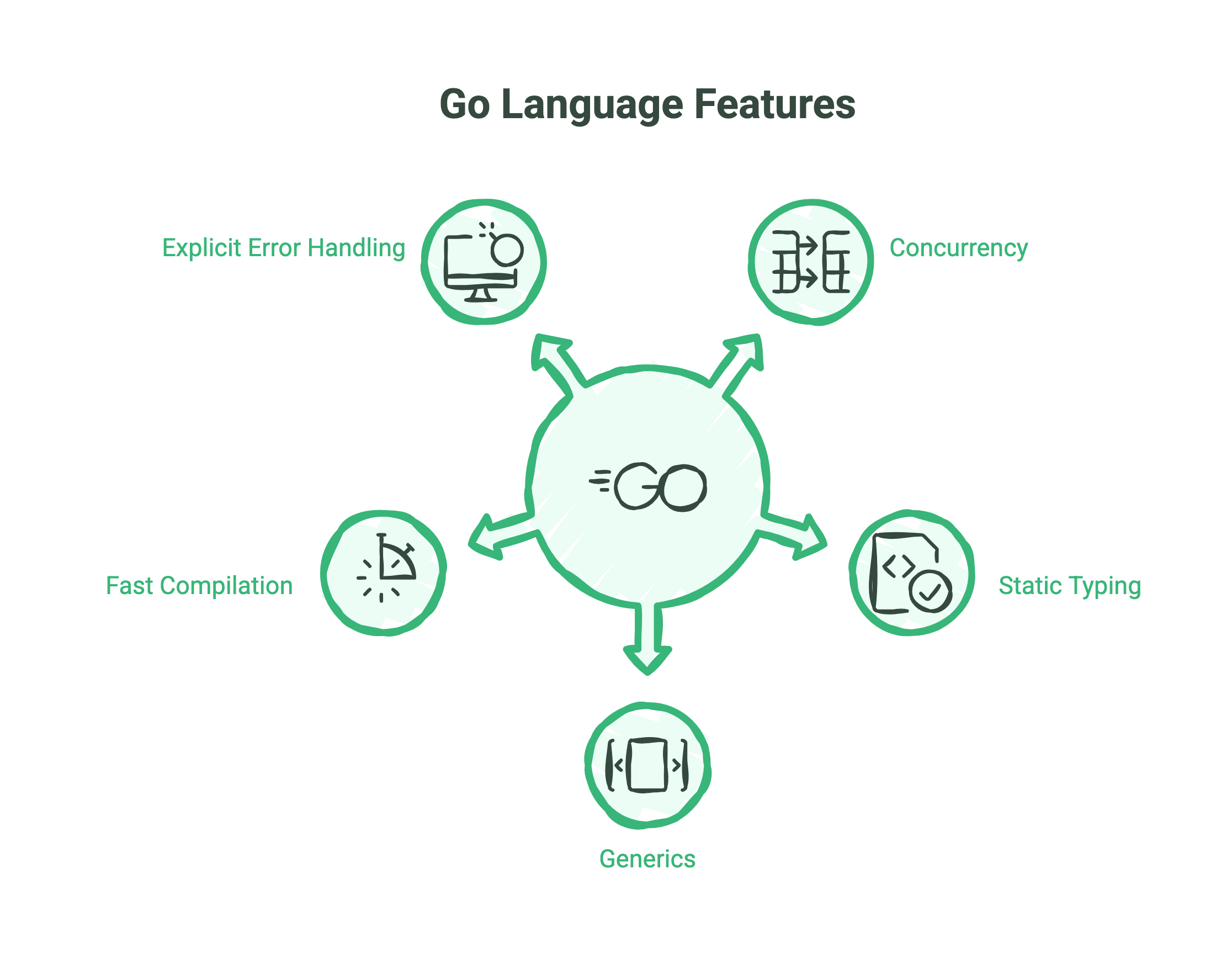
Golang’s design philosophy is built around deliberate simplicity. Features were added only when they solved real problems; features were left out when they added complexity without sufficient benefit. Five of those features define how Go actually behaves in production.
Concurrency Through Goroutines and Channels
Concurrency is where Golang has its clearest technical advantage over most competing languages. Traditional concurrency approaches use OS threads, which are expensive to create and consume significant memory; typically around 1MB per thread.
Go uses goroutines instead. A goroutine is a lightweight execution unit managed by the Go runtime rather than the operating system. A single Go programme can run tens of thousands of goroutines simultaneously using only a few megabytes of memory, because the runtime maps goroutines to OS threads using an M:N scheduler. Goroutines communicate through channels, which are typed conduits for passing data between concurrent processes. Channels enforce a model where concurrent tasks communicate explicitly rather than sharing mutable state, which eliminates a whole category of bugs around race conditions and deadlocks.
A question that comes up regularly for developers moving into Go from Java or Python is when to reach for a channel versus a mutex. They solve different problems, and conflating them is one of the most common sources of subtle bugs in concurrent Go code.
Channels are the right choice when goroutines need to pass ownership of data from one to another; a pipeline stage handing processed results downstream, a worker pool distributing tasks, or a done signal telling goroutines to shut down cleanly. The mental model is: use a channel when the point is communication. If one goroutine produces something and another needs to consume it, a channel makes the handoff explicit and safe.
Mutexes (from the sync package) are the right choice when multiple goroutines need to read or write a shared resource and you are not transferring ownership; you simply need to prevent simultaneous access. A cache that several goroutines read from and occasionally update is the textbook case. A sync.RWMutex is worth knowing here specifically: it allows multiple concurrent readers but blocks when a write is in progress, which suits read-heavy shared state far better than a plain mutex.
The Go proverb “do not communicate by sharing memory; share memory by communicating” is a useful starting heuristic, but it is not a hard rule. Channels introduce overhead and can obscure the flow of data when the problem is genuinely about shared state rather than message passing. If you are protecting a single counter or a shared map, a mutex is simpler and faster. If you are coordinating the lifecycle and data flow of concurrent workers, channels will produce cleaner code.
Static Typing and Memory Safety
Golang is statically typed, meaning every variable must have a declared type and the compiler rejects code where types do not match. This catches errors at compile time rather than at runtime, which matters in production systems where runtime failures are costly.
Memory is managed automatically through Go’s built-in garbage collector, relieving developers from the manual allocation and deallocation required in C and C++. The garbage collector runs concurrently with the programme and has been tuned progressively across versions; Go 1.14 brought sub-millisecond pause times in typical applications.
Generics: The Language After 1.18
Before Go 1.18, writing a function that sorted a slice required either duplicating code for each type or bypassing the type system with interface{}, which lost compile-time safety. Generics eliminated both problems. Developers can now write a single function with a type parameter, and the compiler enforces correctness across every type it is used with.
Go’s generics are intentionally constrained compared to those in C++ or Java. The implementation uses square bracket syntax and constraint-based type bounds, keeping the language readable while covering the practical use cases that previously required workarounds.
Fast Compilation
Golang compiles entire programmes in seconds, even for large codebases. The import system was designed to prevent cyclic dependencies and allow each package to compile independently. The result is a single native binary with no runtime dependency; a Go web service can be deployed as one executable file, which simplifies containerisation and reduces deployment surface area considerably.
Explicit Error Handling: A Feature, Not a Flaw
Golang handles errors by returning them as values rather than throwing exceptions. The pattern that critics point to most often looks like this:
result, err := doSomething()
if err != nil {
return err
}
Repeated across a codebase, this looks verbose. The criticism is fair on its face. But the argument for it becomes clearer when you are maintaining a large service across a team of ten engineers over three years, rather than writing a script alone on an afternoon.
In languages that use exceptions—Java, Python, C#—errors travel invisibly up the call stack until something catches them, or until they surface as an unhandled panic at runtime. The caller has no idea, from reading the function signature, whether a call can fail or what failure looks like. Go’s approach makes failure an explicit part of every function’s contract. The caller is forced to decide what to do with an error at the point it occurs, not six layers up the stack when the context has been lost.
The maintenance consequence is significant. When a new engineer reads a Go function, every decision about error handling is visible in the code itself. There are no hidden exception hierarchies to learn, no undocumented failure modes to discover through production incidents. For teams building financial services, healthcare applications, or any system where silent failures are expensive, this explicitness has real operational value.
Go 1.13 added error wrapping with fmt.Errorf and the %w verb, which allows errors to carry context as they propagate without losing the original error for programmatic inspection. The errors.Is and errors.As functions allow callers to unwrap and check specific error types. This addressed the most practical criticism of Go’s error handling — that it was difficult to add context to errors as they moved up the call stack — while keeping the explicit, value-based model intact.
Go Language Performance: How It Compares
Performance comparisons between languages depend heavily on the workload, so claims about which is universally fastest are rarely useful. The more practical question is what Golang offers for the types of task where it is most commonly deployed.
The table below covers the languages most frequently evaluated alongside Go for backend and infrastructure work.
| Go | Python | Java | Rust | |
| Execution Speed | Very fast (compiled) | Slow (interpreted) | Fast (JIT) | Very fast (compiled) |
| Memory Usage | Low | High | Medium–High | Very low |
| Concurrency Model | Goroutines (excellent) | GIL limits threads | Thread pools | Async / ownership model |
| Learning Curve | Moderate | Low | High | Very high |
| Cold Start Time | Near-instant | Fast | Slow (JVM) | Near-instant |
| Garbage Collection | Yes (low pause) | Yes | Yes | No (manual) |
| Generics Support | Yes (since 1.18) | Yes (dynamic) | Yes (mature) | Yes (mature) |
For backend API services and cloud infrastructure, Go language consistently outperforms Python on throughput and Java on startup time and memory consumption. It does not match Rust for raw performance or memory control, but the productivity trade-off strongly favours Go for most web and infrastructure applications.
Where Go Programming Language Excels: Real-World Use Cases
Go’s strengths align with a specific category of work: high-throughput services, infrastructure tooling, and anything where deployment simplicity and operational reliability matter. The following areas represent where the Golang language has genuine, demonstrated production advantage.
Cloud-Native Infrastructure and Microservices
Go has become the default language for cloud-native tooling. Docker, Kubernetes, Terraform, Consul, etcd, and Prometheus are all written in Go; largely because Go produces small, self-contained binaries with fast startup times, which aligns directly with container-based deployments. A Go service packaged into a Docker container can start in milliseconds, compared to several seconds for a Java application waiting on JVM initialisation.
For microservices architectures specifically, Go’s light memory footprint and high throughput mean you can run more service instances on the same infrastructure, which has a direct effect on hosting costs.
Go Programming Language for AI Infrastructure
The relationship between Go language and artificial intelligence is worth understanding carefully, because it is easy to overstate. Python dominates AI model training and experimentation; the major frameworks are Python-first and that will not change in the near term.
Go’s role in AI is on the infrastructure side. When a large language model or recommendation engine is ready to serve predictions, the serving layer—the API that receives requests, passes inputs to the model, and returns outputs—benefits from Go’s concurrency model and low latency. Several cloud providers and AI product teams use Go for inference-serving layers while keeping Python for the training pipeline. If your development team is building AI-powered products, this division of responsibility is a practical pattern worth knowing.
UK and Irish Fintech: Go Programming Language in Production
Go programming language has significant adoption in the UK and Irish fintech sector, largely because its concurrency model fits high-frequency transaction processing. Monzo moved substantial parts of its backend to Go early in its development and has written publicly about the performance and operational benefits. Starling Bank and Revolut also use Go extensively in their backend services.
The reasons are practical: banking services need to handle large numbers of simultaneous requests, the cost of runtime errors is very high, and deployment simplicity matters when features are released frequently. Go’s fast compilation, single-binary deployment, and low production error rate suit all three requirements. For development teams in Belfast, Dublin, London, and across the UK building financial or transaction-heavy applications, this track record is worth factoring into any language decision.
ProfileTree’s web development services include architecture consultancy for businesses at exactly this decision point; choosing the right backend technology before build work begins is considerably cheaper than re-platforming after the fact.
Sustainability and Energy Efficiency
As UK and EU businesses face increasing pressure around ESG commitments and cloud infrastructure costs, the energy efficiency of programming languages has become a practical concern rather than an academic one.
A 2017 study by researchers at the University of Minho, widely cited in language energy consumption discussions, found that compiled C-family languages used significantly less energy than Python or Ruby for equivalent tasks. Go, as a compiled language with low memory overhead, sits in the efficient tier. For businesses running services at scale, the practical effect shows up in hosting costs: a Go service handling the same throughput as an equivalent Python service will typically require fewer CPU cores and less memory. For teams modelling infrastructure costs before choosing a language for a new service, this is a factor worth including in the analysis.
Getting Started with Go Programming Language
The installation and project setup process for the Go programming language is designed to be straightforward, reflecting the same emphasis on simplicity that runs through the language itself. The official toolchain is available at go.dev and includes the compiler, the formatter (gofmt), and a built-in testing suite.
Installation and the Toolchain
Download the appropriate installer for your operating system from go.dev/doc/install. On macOS and Linux, the installer places Go binaries at /usr/local/go; on Windows, the default is C:\Program Files\Go. After installation, verify the setup by running go version in your terminal.
Go 1.21 introduced toolchain management, allowing individual projects to specify which Go version they require. This removes a historical source of friction where developers with different Go versions installed locally produced inconsistent build behaviour.
Understanding go.mod
Every Go project has a go.mod file at its root. This file declares the module name (typically a domain-based path such as github.com/yourorg/yourproject), the minimum required Go version, and all external packages the project depends on with their specific versions.
Running go get adds a dependency and updates the file automatically; go mod tidy removes any packages that are no longer needed. The accompanying go.sum file records cryptographic hashes for each dependency, providing a tamper-evident record of exactly what was downloaded.
Your First Go Programme
The quickest way to verify your installation and understand Go’s structure is the canonical “Hello World” example.
package main
import “fmt”
func main() {
fmt.Println(“Hello from Go”)
}
Save this as main.go and run go run main.go. The programme compiles and executes in under a second. Run go build main.go to produce a standalone binary. This simplicity scales: the same command compiles projects with thousands of files in seconds. For a more structured introduction, the official Tour of Go at go.dev/tour covers the language’s features interactively in the browser without requiring a local installation first.
Is Go Programming Language Right for Your Next Project?
No language is the right choice for every situation, and Go is no exception. The clearest signals that Golang is worth adopting are: high concurrency requirements, where goroutines outperform most alternatives; deployment simplicity, since Go’s single-binary output reduces container overhead and removes runtime dependencies; large or long-lived codebases, where Go’s enforced formatting and deliberate simplicity keep code consistent across teams and years; and performance demands that exceed what Python provides without the operational complexity of a JVM-based stack.
Go programming language is probably not the right choice when you need deep data science library support (Python’s ecosystem here is unmatched), when your team’s expertise is heavily Java-based and the migration cost would outweigh the gains, or when the backend language choice has minimal impact on a straightforward content-driven site.
The most common mistake is treating language choice as a purely technical decision. Team experience, ecosystem maturity for your specific domain, and the long-term operational cost of the choice all matter as much as benchmark results. ProfileTree’s digital training programmes help technical leads and business owners in Northern Ireland and the UK build the framework to evaluate decisions like this confidently; covering technology assessment, digital strategy, and how to brief development teams on architecture requirements without needing a computer science background.
Conclusion
The Go programming language has earned its position in modern software development by solving real problems—slow builds, unwieldy concurrency, and operational complexity—with deliberate, practical design. Its adoption in cloud-native infrastructure, UK fintech, and AI serving layers reflects genuine technical fit rather than trend-following.
For development teams and technical decision-makers evaluating Go programming language, the picture is clearer now than it was even three years ago. Generics have matured. The toolchain is stable. The ecosystem is broad enough for production use across web APIs, cloud services, CLI tools, and infrastructure automation. Whether you are starting a new service from scratch or evaluating a migration from a legacy stack, the Go language’s combination of simplicity, performance, and deployment ease makes it a serious candidate worth assessing on its own merits.
If your business is evaluating technology choices for a new backend service or cloud-native application, ProfileTree’s web development team works with businesses across Northern Ireland, Ireland, and the UK on architecture decisions, software projects, and digital transformation programmes. Contact our team to discuss how the right technology choices can shape your project outcomes.
Frequently Asked Questions
Why is the language called Go but people search for Golang?
The official name is Go. Golang became the common search term because the original website lived at golang.org, and because “Go” alone returns too many unrelated results. Both names refer to the same language.
What is the Go programming language used for?
Go is primarily used for backend web services and APIs, cloud infrastructure tooling, command-line applications, and microservices. Docker, Kubernetes, and Terraform are all written in Go. It is also used for network programming, DevOps automation, and AI deployment pipelines.
Is Go easy to learn?
Go’s syntax is compact and its standard library is well-documented. The main adjustment for developers coming from Python or JavaScript is Go’s static typing, explicit error handling, and concurrency model. Most developers can write functional Go within a few weeks; idiomatic Go takes longer.
Does Go have generics?
Yes. Generics were added in Go 1.18 (March 2022) and are now stable and in widespread production use. Go’s implementation uses type parameters with constraint-based bounds and is intentionally simpler than Java’s or C++’s generics.
Is Go better than Python for backend development?
For throughput and concurrency, Go outperforms Python significantly. Python’s strength is in development speed and data science library depth. For high-volume APIs and infrastructure work, Go is the stronger choice; for data-heavy or ML workloads, Python’s ecosystem is unmatched.
Who created the Go programming language?
Go was created by Robert Griesemer, Rob Pike, and Ken Thompson at Google. Development began in 2007 and the first public release was in 2009.
Is Go still relevant?
Yes. Go is the dominant language for cloud-native infrastructure and remains in active development. The 2024 Stack Overflow Developer Survey ranked it among the most-used and most-admired languages for backend and systems work, with strong adoption continuing across fintech, DevOps tooling, and AI infrastructure.