
Education SEO: Attracting Students Through Search Visibility
Table of Contents
ProfileTree provides specialist education SEO services helping schools, universities, colleges, and training providers across Northern Ireland, Ireland, and the UK attract more students through improved search visibility. Education SEO connects your courses and programmes with students actively searching for learning opportunities.
Education decisions start with a search. When prospective students research courses, parents investigate schools, or professionals seek training, they turn to Google. The educational institutions appearing in those searches get considered, visited, and ultimately enrolled. If your institution isn’t visible when potential students search, competitors capture the enrolments you should be winning.
Understanding Education SEO
What makes SEO different for educational institutions:
The Education Search Landscape
How students and parents search for education:
Search Categories:
| Category | Example Searches |
| Course/subject | “computer science degree”, “plumbing course” |
| Institution type | “universities near me”, “grammar schools Belfast” |
| Location-based | “schools in Belfast”, “colleges Northern Ireland” |
| Career-focused | “how to become a nurse”, “marketing qualifications |
| Comparison | “best universities for law UK”, “[university] vs [university]” |
| Practical | “UCAS deadlines”, “student finance NI” |
Student Search Journey:
| Stage | Search Behaviour |
| Exploration | “what can I study”, “careers in [field]” |
| Research | “[subject] courses”, “best universities for [subject]” |
| Comparison | “[institution] ranking”, “[course] entry requirements” |
| Evaluation | “[institution] reviews”, “student life at [university]” |
| Application | “[institution] how to apply”, “application deadlines” |
| Decision | “[institution] open days”, “accommodation [institution]” |
Education SEO Characteristics
Education sector SEO has unique dynamics:
Key Differences:
| Factor | Education Reality |
| Decision cycle | Months to years of consideration |
| Multiple stakeholders | Students, parents, employers |
| Seasonal patterns | Application cycles, intake periods |
| Trust importance | Reputation, accreditation critical |
| High stakes | Life-changing decisions |
What This Means for SEO:
| Reality | SEO Approach |
| Long decision cycle | Content for every stage |
| Multiple audiences | Parent, student, employer content |
| Seasonality | Align with application cycles |
| Trust focus | Authority, accreditation emphasis |
| High consideration | Comprehensive, helpful content |
Competitive Landscape
Education markets have varied competition:
Competitive Dynamics:
| Sector | Competition Level |
| Higher education | High—established universities dominate |
| Private schools | Moderate to high—reputation driven |
| Vocational training | Moderate—fragmented market |
| Professional courses | Moderate—specialist providers compete |
| Online learning | High—global competition |
Competitive Opportunities:
| Opportunity | Approach |
| Local focus | Serve specific geographic areas |
| Niche subjects | Specialist courses, unique programmes |
| Career pathways | Career-focused content |
| Student experience | Authentic student content |
| Employer connections | Industry partnership content |
Audience Complexity
Education serves multiple audiences:
Primary Audiences:
| Audience | Search Behaviour |
| Prospective students | Course research, comparison |
| Parents | School research, quality indicators |
| Career changers | Professional development, retraining |
| Employers | Corporate training, apprenticeships |
| International students | Study abroad, visa information |
Content for Each Audience:
| Audience | Content Needs |
| Students | Course details, student life, outcomes |
| Parents | Quality, safety, outcomes, costs |
| Career changers | Flexibility, career outcomes, funding |
| Employers | Training solutions, partnerships |
| International | Entry requirements, visa, support |
Our Education SEO Services
Comprehensive optimisation for educational institutions:
Course and Programme Pages
Creating pages that attract and convert prospective students:
Course Page Structure:
| Element | Content |
| H1 heading | Course/programme name |
| Introduction | What the course offers, who it’s for |
| Course content | Modules, curriculum, learning outcomes |
| Entry requirements | Qualifications, experience needed |
| Career outcomes | Where graduates go, employment rates |
| How to apply | Application process, deadlines |
| Fees and funding | Costs, financial support |
| Student testimonials | Graduate voices |
| FAQs | Common questions |
| CTA | Apply, enquire, visit |
Course Page Optimisation:
| Element | Optimisation |
| Title tag | [Course name] |
| Meta description | Key benefits, outcomes, call to action |
| URL | /courses/[course-name]/ |
| Headers | Logical H2/H3 structure |
| Internal links | Related courses, support pages |
Course Schema Markup:
{
“@context”: “https://schema.org”,
“@type”: “Course”,
“name”: “BSc Computer Science”,
“description”: “Three-year undergraduate degree…”,
“provider”: {
“@type”: “Organization”,
“name”: “University Name”,
“sameAs”: “https://university.ac.uk”
},
“educationalCredentialAwarded”: “BSc (Hons)”,
“timeRequired”: “P3Y”,
“occupationalCredentialAwarded”: {
“@type”: “EducationalOccupationalCredential”,
“credentialCategory”: “degree”
}
}
Subject and Department Pages
Optimising broader subject areas:
Subject Page Strategy:
| Element | Content |
| Subject overview | What studying this subject involves |
| Course options | All courses in this subject |
| Why study here | Institution’s strengths |
| Facilities | Labs, studios, resources |
| Staff | Academic expertise |
| Research | Research strengths |
| Career paths | Where graduates work |
Subject Keywords:
| Pattern | Examples |
| [Subject] degree | “computer science degree” |
| Study [subject] | “study business” |
| [Subject] courses | “engineering courses” |
| [Subject] at [institution] | “law at Queen’s Belfast” |
| Best [subject] university | “best nursing university UK” |
Career and Outcomes Content
Content connecting education to careers:
Career Content Types:
| Content Type | Examples |
| Career guides | “How to become a [profession]” |
| Graduate outcomes | Employment statistics, destinations |
| Alumni stories | Graduate career journeys |
| Industry connections | Employer partnerships |
| Work placements | Placement opportunities |
Career-Focused Keywords:
| Pattern | Examples |
| How to become [profession] | “how to become a teacher” |
| Qualifications for [career] | “qualifications for nursing” |
| [Profession] training | “accountancy training” |
| What can I do with [degree] | “what can I do with psychology degree” |
Graduate Outcomes Content:
| Element | Content |
| Employment rates | Percentage employed/studying |
| Salary data | Graduate salary information |
| Employer names | Where graduates work |
| Career progression | Long-term outcomes |
| Alumni testimonials | Real graduate stories |
Content Marketing for Education
Creating content that attracts prospective students:
Content Types:
| Content Type | Purpose |
| Subject guides | “Guide to studying [subject]” |
| Career guides | “Careers in [field]” |
| Student life content | Campus, accommodation, activities |
| Application guides | How to apply, personal statements |
| Study tips | Academic success content |
| Open day content | Event information, virtual tours |
Blog Content Strategy:
| Topic Category | Examples |
| Subject exploration | “Is [subject] right for me?” |
| Career guidance | “Jobs you can do with [degree]” |
| Application help | “Writing your personal statement” |
| Student life | “What to expect in first year” |
| Practical advice | Student budgeting tips” |
| News and events | Open days, achievements |
Content Calendar:
| Period | Content Focus |
| September-November | Application support, open days |
| December-January | UCAS deadline content |
| February-March | Offer holder content |
| April-June | Results, clearing preparation |
| July-August | Clearing, welcome content |
| Year-round | Evergreen subject/career content |
Local SEO for Education
Local visibility for educational institutions:
| Element | Education Focus |
| Primary category | School, university, college, etc. |
| Photos | Campus, facilities, student life |
| Posts | Open days, events, achievements |
| Reviews | Student and parent reviews |
| Q&A | Common prospective student questions |
Education GBP Categories:
| Category | Institution Type |
| University | Higher education |
| School | Primary, secondary |
| College | Further education |
| Training centre | Vocational |
| Language school | Language learning |
Local Citation Strategy:
| Directory Type | Examples |
| Education directories | The Complete University Guide, UCAS |
| School directories | Good Schools Guide, ISC |
| Training directories | FindCourses, HotCourses |
| Local directories | Regional education listings |
| Review platforms | StudentCrowd, WhatUni |
Technical SEO for Education
Platform and technical considerations:
Education Website Requirements:
| Element | Importance |
| Site architecture | Clear navigation to courses |
| Mobile experience | Many students research on mobile |
| Site speed | Large sites need optimisation |
| Search functionality | Help users find courses |
| Accessibility | Essential for inclusive access |
Common Education Technical Issues:
| Issue | Solution |
| Complex site structure | Clear information architecture |
| Duplicate course content | Canonicalisation, unique content |
| PDF prospectuses | HTML alternatives, PDF optimisation |
| Dynamic course databases | Ensure crawlable course pages |
| Multiple campuses | Proper location structure |
Education Site Architecture:
| Structure | Pages |
| Homepage | Primary proposition, key pathways |
| Courses | Course finder, subject areas, individual courses |
| About | Institution information, history, values |
| Student life | Accommodation, facilities, support |
| Research | Research areas, projects, impact |
| Apply | Application information, deadlines |
| Contact | Enquiry options, campus locations |
Link Building for Education
Building authority for educational institutions:
Education Link Building Strategies:
| Strategy | Application |
| Research citations | Academic research links |
| News coverage | Educational achievements, stories |
| Industry partnerships | Employer, professional body links |
| Alumni networks | Graduate business links |
| Educational resources | Linkable educational content |
Education PR Opportunities:
| Opportunity | Approach |
| Research publications | Research news, discoveries |
| Student achievements | Awards, competitions, success |
| New programmes | Course launches |
| Industry partnerships | Employer collaborations |
| Community involvement | Local engagement, outreach |
Academic Authority:
| Source | Link Opportunity |
| Research databases | Citation links |
| Academic partners | Collaborative links |
| Professional bodies | Accreditation links |
| Industry partners | Partnership pages |
| Media coverage | News features |
Education SEO by Institution Type
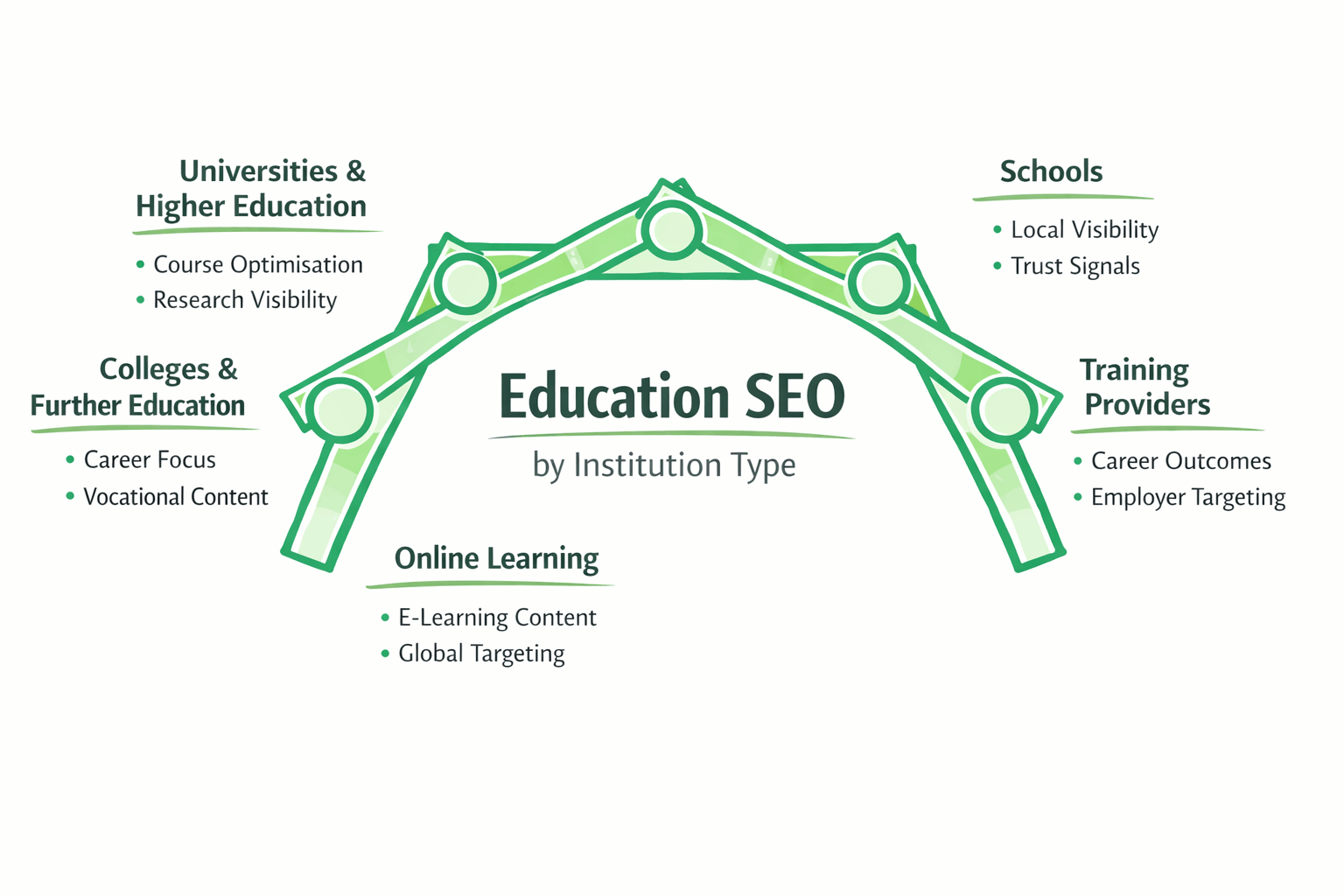
Strategies for different educational providers:
Universities and Higher Education
Degree-level education:
Key Considerations:
| Factor | Approach |
| Course breadth | Many courses to optimise |
| Research profile | Research content and links |
| International students | Global audience targeting |
| Brand competition | Competing with established names |
SEO Focus:
| Priority | Implementation |
| Course pages | Individual optimised course pages |
| Subject authority | Comprehensive subject content |
| Research visibility | Research output SEO |
| International targeting | Multi-language, country content |
Schools (Primary and Secondary)
Pre-university education:
Key Considerations:
| Factor | Approach |
| Parent audience | Parents as primary searchers |
| Local focus | Serving geographic catchment |
| Trust emphasis | Ofsted, safety, values |
| Limited courses | Focus on school experience |
SEO Focus:
| Priority | Implementation |
| Local SEO | Google Business Profile, local rankings |
| Trust content | Ofsted, values, safeguarding |
| Parent information | Admissions, policies, uniform |
| School life | Activities, facilities, achievements |
Colleges and Further Education
Post-16 and vocational education:
Key Considerations:
| Factor | Approach |
| Course variety | A-levels, vocational, apprenticeships |
| Multiple audiences | School leavers, adults, employers |
| Career focus | Employment outcomes |
| Local service | Serving local community |
SEO Focus:
| Priority | Implementation |
| Course pages | All courses individually optimised |
| Career content | Employment-focused content |
| Multiple pathways | A-level, vocational, apprenticeship content |
| Local visibility | Local SEO for catchment |
Training Providers
Professional and vocational training:
Key Considerations:
| Factor | Approach |
| Specific qualifications | Targeted course content |
| Career outcomes | Direct employment links |
| Employer clients | B2B and B2C audiences |
| Certification | Accreditation importance |
SEO Focus:
| Priority | Implementation |
| Course pages | Qualification-specific pages |
| Career targeting | “How to become” content |
| Employer content | Corporate training pages |
| Accreditation | Certification body relationships |
Online Learning Providers
E-learning and distance education:
Key Considerations:
| Factor | Approach |
| Global competition | Competing internationally |
| Platform features | Technology differentiation |
| Flexibility | USP of online learning |
| Credibility | Establishing trust online |
SEO Focus:
| Priority | Implementation |
| Course content | Detailed course pages |
| Learning experience | Platform, support content |
| Flexibility content | Study around work/life content |
| Trust building | Reviews, accreditation, outcomes |
Measuring Education SEO Success
Tracking performance for educational institutions:
Key Metrics
Visibility Metrics:
| Metric | What It Shows |
| Organic rankings | Positions for course/subject keywords |
| Organic impressions | Search visibility |
| Featured snippets | Answer box appearances |
| Local Pack | Local visibility for schools |
Traffic Metrics:
| Metric | What It Shows |
| Organic sessions | Visitors from search |
| Course page views | Interest by course |
| Application page visits | Application intent |
| Prospectus downloads | Deep engagement |
Conversion Metrics:
| Metric | What It Shows |
| Enquiries | Contact form submissions |
| Open day registrations | Event interest |
| Application starts | Application intent |
| Prospectus requests | Information requests |
Attribution Challenges
Education has long consideration periods:
| Challenge | Solution |
| Long decision cycles | Multi-touch attribution |
| Multiple visits | User journey tracking |
| Offline conversion | CRM integration, ask at enrolment |
| Multiple stakeholders | Household tracking where possible |
Seasonal Analysis
Education metrics need seasonal context:
| Analysis | Approach |
| Application cycles | Track against intake periods |
| Year-over-year | Compare same periods |
| Clearing period | Specific tracking for clearing |
| Event correlation | Open day traffic analysis |
Reporting
Monthly Education SEO Reporting:
| Element | Included |
| Ranking progress | Key course/subject movements |
| Traffic analysis | Organic traffic by page type |
| Seasonal comparison | Year-over-year performance |
| Conversion tracking | Enquiries, applications, events |
| Content performance | Top performing pages |
| Competitor comparison | Relative visibility |
| Application cycle | Progress against intake targets |
| Recommendations | Next period priorities |
Common Education SEO Challenges
Addressing typical education sector problems:
Large, Complex Websites
The Challenge: Universities and colleges have thousands of pages.
Solutions:
| Approach | Implementation |
| Clear architecture | Logical site structure |
| Priority focus | Key courses and pages first |
| Technical foundation | Crawlability, indexation |
| Content governance | Quality control processes |
Competing with Aggregators
The Challenge: UCAS, Complete University Guide, and course aggregators rank highly.
Solutions:
| Approach | Implementation |
| Direct course content | Better course information than aggregators |
| Unique content | Student experience, outcomes |
| Brand searches | Build direct brand awareness |
| Long-tail focus | Specific course combinations |
Multiple Campuses/Locations
The Challenge: Institutions with multiple sites need a location strategy.
Solutions:
| Approach | Implementation |
| Location pages | Individual campus pages |
| GBP per location | Separate profiles per campus |
| Clear structure | Location-specific content |
| Consistent NAP | Accurate location information |
Seasonal Demand
The Challenge: Search demand follows application cycles.
Solutions:
| Approach | Implementation |
| Year-round content | Evergreen subject content |
| Cycle preparation | Rankings ready before peaks |
| Clearing content | Prepared for results period |
| International timing | Different intake cycles |
Why Choose ProfileTree for Education SEO
What differentiates our education SEO services:
Education Sector Understanding
Knowledge of education market dynamics:
- Application cycles and timing
- Multiple stakeholder audiences
- Trust and reputation importance
- Career outcomes focus
Content Expertise
Strong educational content capability:
- Course page optimisation
- Career guidance content
- Student-focused writing
- Technical accuracy
Full-Service Integration
SEO integrated with broader services:
- Web design for educational websites
- Video production for virtual tours and course videos
- Content marketing for student recruitment content
- Digital strategy for education marketing
Local Knowledge
Understanding of Northern Ireland, Ireland, and the UK education:
- Regional education landscape
- Local competition
- Geographic targeting
- Cross-border considerations
Proven Track Record
Our 5-star rating from over 450 Google reviews demonstrates consistent delivery. We work with educational institutions to build sustainable organic growth.
FAQs
How long does education SEO take to work?
Education SEO typically shows results within 3-6 months, with significant improvements at 6-12 months. Given application cycles, SEO investment should begin well before key intake periods. Rankings need to be in place before prospective students start their research.
How much does education SEO cost?
Education SEO typically ranges from £1,500-£5,000+/month depending on institution size, course breadth, and competition. Large universities with thousands of courses require more investment than single-site training providers. ROI should be measured against student lifetime value.
Should we optimise every course page?
Prioritise strategically. Start with high-demand courses, courses with capacity, and strategically important programmes. Ensure all course pages meet minimum SEO standards, but invest most heavily in priority courses. A phased approach works well for large institutions.
How important are rankings vs aggregator sites?
Both matter. Rankings establish brand visibility and can drive direct traffic and applications. Presence on aggregator sites (UCAS, course finders) provides additional visibility. Strong SEO on your own site provides content control and direct relationship building.
How do we compete with more established institutions?
Focus on differentiation: unique programmes, specialist strengths, student experience, local advantages, career outcomes. Target specific subject areas where you excel. Build content demonstrating genuine expertise. Established institutions can’t be best at everything.
Should we create content for subjects we don’t offer?
Generally, no—focus resources on subjects where you can enrol students. Exception: career guidance content can attract early-stage researchers who may then consider your related programmes. But prioritise content directly connected to your course offerings.
How do we handle the clearing and results period SEO?
Prepare in advance. Create clearing pages before results day. Optimise for clearing keywords. Ensure your site can handle traffic spikes. Update course availability in real-time during clearing. This is a short window but high-intent traffic.
Conclusion
Education decisions start with a search. When prospective students research courses, parents investigate schools, or professionals seek training, they turn to Google. The educational institutions appearing in those searches capture consideration and enrolments.
Education SEO requires understanding both search optimisation and education sector dynamics—application cycles, multiple audiences, trust importance, and the career-focused nature of modern education choices.
ProfileTree provides specialist education SEO services helping schools, universities, colleges, and training providers across Northern Ireland, Ireland, and the UK attract more students through improved search visibility.
Ready to attract more students through search? Contact ProfileTree to discuss how education SEO can support your student recruitment.