
Digital Transformation for SMEs: A Practical Guide
Table of Contents
Digital transformation for SMEs gets talked about as though it’s one single project with a start date and an end date. It isn’t. It’s a series of deliberate decisions about how your business uses technology to serve customers better, operate more efficiently, and stay competitive as the market shifts around you. Some of those decisions are small. Some require genuine commitment. But none of them requires an enterprise-level budget or an in-house IT team.
This guide is written for business owners and managers in the UK and Ireland working through small business digital transformation: somewhere between “we’ve barely started” and “we’ve done the basics but aren’t sure what comes next.” It covers the practical steps, the real barriers, the available funding, and the digital transformation tools that actually move the needle at the SME scale.
What Digital Transformation Means for Small Businesses
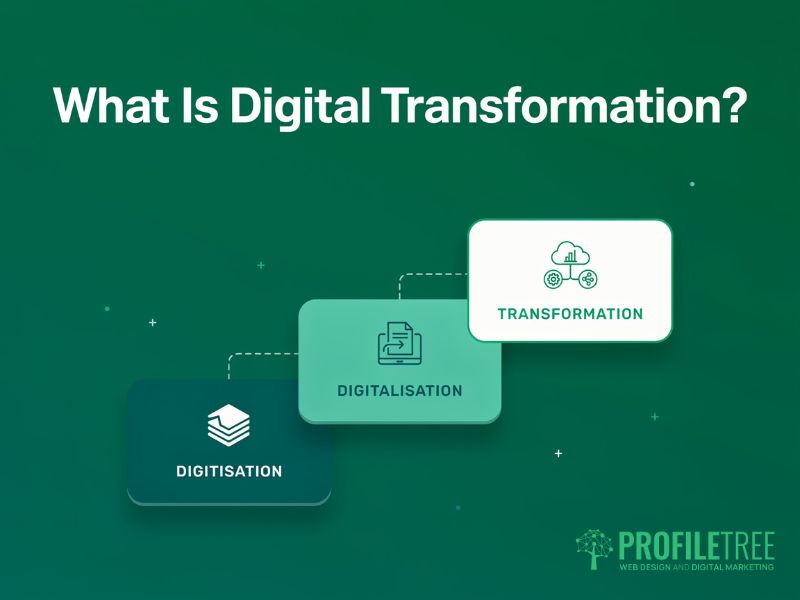
Digital transformation for SMEs is not simply about buying new software. Before investing in any tools, it helps to be precise about what SME digital transformation actually involves, because three distinct concepts are routinely collapsed into one, and confusing them leads to wasted investment.
Digitisation, Digitalisation, and Transformation
These three stages define the progression from paper-based working to a fully digital operation.
Digitisation is the simplest: converting something analogue into a digital format. Scanning paper invoices and saving them as PDFs is digitisation. It is necessary, but it does not change how your business works.
Digitalisation goes further. It means using technology to change a business process itself. Moving from paper invoices to cloud-based accounting software like Xero is a form of digitalisation. You’re not just storing the same information differently; you’re automating reconciliation, improving cash flow visibility, and reducing manual errors.
Digital transformation for small businesses is the broader shift: rethinking how your business creates value, serves customers, and makes decisions in a world where digital is the default. It involves changes to processes, roles, and culture, not just software. For most SMEs, the realistic goal is a programme of progressive digitalisation that fundamentally changes how the business operates.
Why SMEs Have a Structural Advantage
Larger organisations often struggle with SME digital transformation because they carry the weight of legacy systems, established hierarchies, and change-resistant cultures built up over decades. SMEs rarely have those constraints. You can make a decision this week and implement it next week. That agility is a genuine competitive asset, and it is one reason why smaller businesses can move faster than their larger competitors when they choose to.
Why Digital Transformation is No Longer Optional
The question business owners asked five years ago was, “Should we go digital?” That question is settled. For SMEs, digital transformation for small businesses is now a baseline requirement, not a differentiator. The gap between digitally capable businesses and those that aren’t is widening, and it is widening quickly.
Customer Expectations Have Changed Permanently
Your customers compare their experience with your business against the best digital experience they have had anywhere, not just in your sector. If your booking process is clunky, your invoicing is slow, or your communication is patchy, they notice. Poor digital experience drives customer attrition even in industries that do not consider themselves digital businesses: service trades, professional services, retail, and hospitality.
The Productivity Gap is Real
UK government productivity data has consistently shown that SMEs which adopt digital solutions for SMEs outperform those that do not on revenue per employee, profit margin, and growth rate. The difference is not explained by company size or sector alone. It is explained by whether businesses have made the structural changes that technology enables: better data, faster decisions, and less time spent on manual administration.
“The biggest misconception I see from SME owners is that digital transformation requires expensive enterprise software. Cloud-based tools, no-code platforms, and AI applications have fundamentally changed what’s accessible at SME scale. The businesses we work with in Northern Ireland are achieving outcomes that would have cost five times as much a decade ago.”Ciaran Connolly, Founder, ProfileTree
Overcoming the Three Biggest Barriers for SMEs
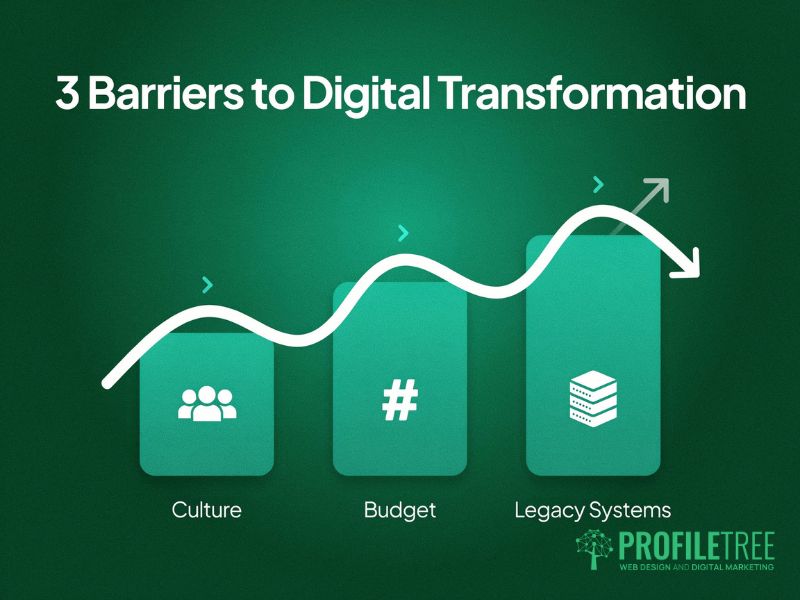
Most SME digital transformation initiatives stall for predictable reasons. Understanding them in advance gives you a better chance of working through them. The three barriers below account for the majority of failed small business digital transformation programmes, regardless of sector or business size.
Cultural Resistance and the Skills Gap
This is the most common reason digital transformation for SMEs fails, and it’s almost never mentioned in technology vendor marketing. Staff who’ve done their jobs a certain way for years will resist change, not because they’re difficult, but because they’re busy, the new system is unfamiliar, and no one has clearly explained what’s in it for them.
The solution isn’t a mandatory training day. It’s involving key staff in the selection process so they feel ownership of the decision, introducing digital transformation tools one system at a time rather than all at once, identifying internal champions who adapt quickly and can support colleagues, and communicating the business reason for the change clearly and repeatedly.
Skills gaps are a related but separate issue. In many SMEs, there is a meaningful gap between the digital capabilities the business needs and what the current team can comfortably do. Addressing this through structured training, particularly the funded programmes covered below, is faster and cheaper than most owners expect.
Budgetary Constraints and ROI Concerns
Budget is a genuine constraint for most SMEs, but it’s often cited as a barrier when the real issue is uncertainty about return. Business owners who can’t see a clear line between a technology investment and a financial outcome are right to be cautious. The most effective approach is a pilot project in one business function: track results against a baseline and use that data to justify further investment before committing to longer-term contracts.
A useful framework for thinking about costs across different business sizes:
| Business Size | Realistic Annual Tech Budget | Priority Focus |
|---|---|---|
| Micro (1 to 9 employees) | £2,000 to £8,000 | Cloud accounting, CRM, and scheduling |
| Small (10 to 49 employees) | £8,000 to £30,000 | Process automation, digital marketing, data analytics |
| Medium (50 to 249 employees) | £30,000 to £100,000+ | ERP integration, custom development, AI tooling |
Legacy System Integration
Many SMEs have accumulated systems over time that don’t talk to each other. Accounting software in one place, customer records in a spreadsheet, project management in email threads. The prospect of migrating all of that data and integrating new digital solutions for SMEs can feel overwhelming, which leads to inaction.
The practical answer is to prioritise integration rather than replacement where possible. Most modern cloud platforms have built-in connectors to the tools businesses already use. Before assuming you need to replace a system, check whether it integrates with the new tool you are considering. If migration is genuinely necessary, many providers offer migration support as part of the onboarding process.
For businesses considering moving legacy data to cloud-based systems, getting professional support for the transition is usually worthwhile. The cost of a poorly executed migration, in terms of lost data, staff time, and disruption, typically exceeds the cost of expert help.
Funding and Support: UK and Ireland Context
One of the clearest advantages available to UK and Irish businesses pursuing digital transformation for SMEs is access to public funding for digital adoption. Most business owners either don’t know these programmes exist or underestimate how accessible they are. Tapping into this funding can meaningfully reduce the financial barrier to SME digital transformation.
UK-Wide Support
The Help to Grow: Digital scheme provides eligible SMEs with subsidised access to approved software platforms, including accounting, CRM, and e-commerce digital transformation tools. The scheme covers 50% of the software cost up to a defined limit and is open to businesses with five or more employees that have been trading for at least 12 months.
Innovate UK, the government’s innovation agency, runs multiple grant competitions relevant to SMEs investing in digital capabilities. While some are focused on R&D, others specifically target digital adoption and process improvement. Their Innovate UK Edge service also offers direct mentoring for businesses working through technology decisions.
Local Growth Hubs, operating in each area of England, offer funded diagnostic services that help businesses assess their digital readiness and identify appropriate support. Northern Ireland businesses should also explore Invest NI’s digital capability programmes.
Ireland and Northern Ireland
In the Republic of Ireland, Local Enterprise Offices (LEOs) provide a range of supports for small businesses pursuing digital transformation for small business, including trading online vouchers worth up to €2,500, which cover website development, e-commerce platforms, and digital marketing tools. Enterprise Ireland offers more substantial support for scaling businesses, including Technology Gateway programmes and digital innovation vouchers.
In Northern Ireland, Invest NI’s Digital Transformation programme and the Business Support NI network both offer funded advisory services. The GO Succeed programme, delivered in partnership with local councils, provides funded mentoring specifically covering digital marketing, website development, and online trading.
Practical step: Before spending your own money on any digital transformation tools, check whether a funded programme covers it. A 30-minute call with your Local Enterprise Office or Local Growth Hub can save thousands of pounds and point you towards expert support you wouldn’t otherwise know about.
ProfileTree has worked with businesses across Northern Ireland, Ireland, and the UK to map out funding options and implement practical digital transformation plans. Our team can help you identify the right starting point for digital strategy support for SMEs.
Essential Digital Transformation Tools for SMEs
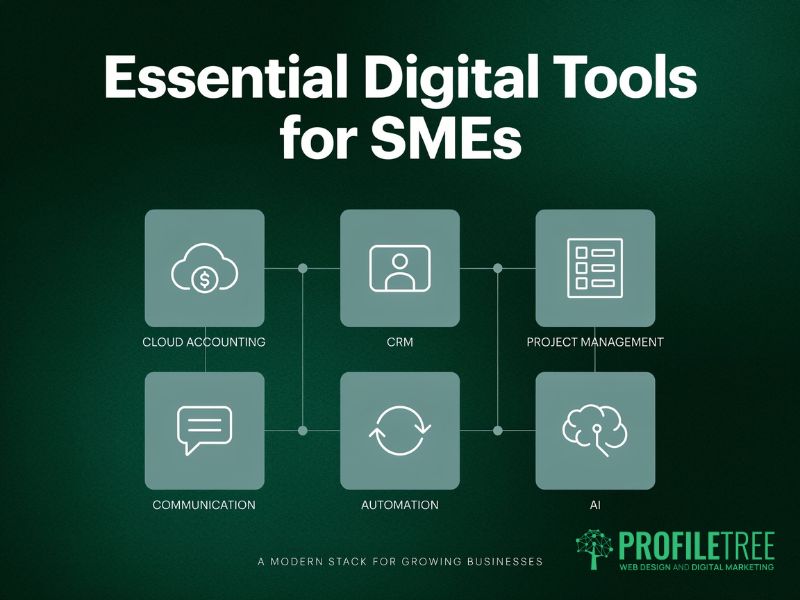
Choosing the right digital transformation tools matters less than choosing tools your team will actually use. The best software in the world delivers nothing if staff work around it. That said, there are categories of digital solutions for SMEs that consistently deliver measurable returns at most stages of maturity.
Cloud-Based Business Foundations
These are the non-negotiables for small business digital transformation: the systems that handle the core functions of running a business. If you’re still managing any of the following in spreadsheets or paper, this is where to start.
- Accounting and invoicing: Xero, QuickBooks Online, or FreeAgent. These replace manual bookkeeping with automated reconciliation, real-time cash flow visibility, and integrated payroll.
- Customer management: HubSpot’s free tier is a reasonable starting point for businesses with straightforward sales processes. For service businesses with repeat customers, a simple CRM dramatically reduces the admin involved in managing relationships.
- Project and task management: Trello, Asana, or ClickUp. Moving internal coordination out of email threads and into a shared system reduces missed tasks and improves accountability.
- Communication: Microsoft Teams or Google Workspace. These are not just messaging tools; they integrate document storage, video calls, and calendar management in a single platform.
No-Code and Low-Code Solutions
One of the most important shifts in SME digital transformation over the past three years is the accessibility of tools that let non-technical users build sophisticated digital processes without writing code. This category has matured considerably and is now genuinely usable by SME teams without technical expertise.
Process automation platforms like Make (formerly Integromat) or Zapier allow you to connect your existing software and automate data transfer between systems. A customer fills in a contact form; that data automatically creates a CRM contact, sends a confirmation email, and logs a follow-up task. What previously required developer time now takes an hour to set up.
For businesses that need custom internal tools, platforms like Airtable provide a more flexible alternative to spreadsheets, with views, automations, and integrations that can be configured without coding. These are particularly useful for inventory management, project tracking, and internal request workflows.
AI Tools as Part of Your Digital Transformation
AI has moved from a technology curiosity to a practical component of digital transformation for small businesses in the past two years. SMEs do not need large budgets or technical teams to use it effectively.
The most immediate applications are in content production and communication. AI writing tools reduce the time spent on routine communications, marketing copy, and documentation. The output needs editing and quality review, but the time saving is real for businesses that currently struggle to keep up with their content requirements.
For customer-facing applications, AI-powered chatbots can handle common enquiries outside business hours, reducing the volume of routine calls and emails your team needs to handle. Platforms like Tidio offer entry-level implementations that integrate with most website platforms.
More advanced applications, including predictive analytics, automated reporting, and personalised marketing, are increasingly accessible through mainstream platforms like Mailchimp and HubSpot without requiring separate AI infrastructure.
Before and After: Common SME Workflow Comparisons
| Business Function | Traditional Approach | Digitally Transformed Approach |
|---|---|---|
| Invoicing | Manual creation in Word/Excel, chased by phone | Automated via Xero; payment reminders sent automatically |
| Customer enquiries | Phone calls during business hours; messages on paper | CRM captures all contacts; chatbot handles out-of-hours queries |
| Marketing | Ad hoc social posts; no performance tracking | Scheduled campaigns, analytics dashboard, and email automation |
| Internal communication | Email chains; missed information | Teams/Slack channels; shared docs; task management system |
| Sales pipeline | Spreadsheet or memory | CRM with stages, follow-up reminders, and revenue forecasting |
For businesses exploring AI implementation for SMEs, ProfileTree’s AI transformation team can advise on which digital transformation tools are worth adopting at your current scale.
Measuring What Matters: KPIs for SME Digital Transformation
Tracking the impact of digital transformation for SMEs is the step most businesses skip, which makes it impossible to know whether a digital investment is working or to justify further spending. You don’t need a complex analytics setup; you need a small number of indicators that reflect the outcomes you care about. These metrics apply to small business digital transformation at the earliest stage and to businesses three years in.
Operational Metrics
Time saved on administrative tasks is the most direct measure of small business digital transformation success. Before implementing a new system, record how long a particular process takes. After implementation, measure again. A cloud accounting platform that saves your finance function four hours a week is delivering roughly £3,000 to £6,000 in value annually.
Error rates and process completion rates are also useful. If your order processing had a 5% error rate that dropped to below 1% after digitisation, that is a measurable outcome with a calculable financial value.
Customer Metrics
Customer satisfaction scores, repeat purchase rates, and average response times all indicate whether your digital solutions for SMEs are reaching the people they’re intended to serve. Track whether customers are using new portals or booking systems, and whether it’s reducing friction.
Commercial Metrics
Revenue per employee and customer acquisition cost are the commercial metrics most directly linked to digital capability. Businesses that have digitised their sales and marketing processes typically see acquisition costs reduce over time as automated approaches outperform manual ones.
Don’t wait for perfect data. Start tracking from the point of implementation, accept that early data will be noisy, and look for trends over three to six months.
Supporting digital transformation for small businesses, ProfileTree delivers practical digital training for teams across Northern Ireland and the wider UK, covering foundational digital skills through to advanced AI and data applications.
Starting Your Digital Transformation
Digital transformation for SMEs isn’t about chasing the latest technology trend or investing in expensive systems you don’t yet need. Digital transformation for small businesses is about making deliberate, sequenced decisions that change how your business operates and serves customers, using digital transformation tools that are now genuinely accessible at the SME scale.
The businesses that get small business digital transformation right share a few characteristics: they start with a clear problem rather than a technology solution, they involve their team early and communicate the reasons for change, they measure results against a baseline, and they use what they learn to decide what comes next.
If you’re at the beginning of that journey, the most useful first step is an honest assessment of where your business currently sits. What are the three processes that consume the most time relative to the value they deliver? Start there.
ProfileTree works with SMEs across Northern Ireland, Ireland, and the UK to develop digital transformation plans, identify relevant funding, and implement digital solutions for SMEs and training that create lasting change. Our team combines technical expertise with business understanding, because the technology is the easy part.
FAQs
1. How do SMEs start digital transformation?
The most reliable starting point for digital transformation for SMEs is a single business function where the pain is obvious and the case for improvement is clear. Don’t try to transform everything at once. Pick one area, whether that’s accounting, customer management, or marketing, and run it as a pilot project. Set a baseline before you start, track results after implementation, and use what you learn to decide where to invest next. The businesses that successfully complete small business digital transformation are the ones that prove the value of each step before taking the next.
2. What are the four main areas of digital transformation?
The four areas most commonly referenced in SME digital transformation are process transformation (changing how work gets done internally), business model transformation (changing how value is created and delivered), domain transformation (using digital capabilities to enter adjacent markets or service areas), and cultural transformation (changing how people in the business think about technology and data). For most SMEs, process and cultural transformation are the most immediately relevant, and progress in one area tends to enable progress in the others.
3. What grants are available for UK SMEs for digital technology?
In England, the Help to Grow: Digital scheme offers eligible businesses subsidised access to approved digital transformation tools. Innovate UK runs grant competitions relevant to SMEs adopting digital capabilities. Local Growth Hubs offer funded diagnostic and advisory services. In Northern Ireland, Invest NI and the GO Succeed programme both provide digital-focused support. In the Republic of Ireland, LEO trading online vouchers (up to €2,500) and Enterprise Ireland digital innovation vouchers are the primary mechanisms. The most efficient route is to contact your Local Enterprise Office or Local Growth Hub directly.
4. How long does digital transformation take for a small business?
Initial results from a well-chosen pilot project in digital transformation for small businesses are typically visible within three to six months. A meaningful shift in how the business operates is more realistically a one to two-year programme. Wholesale small business digital transformation is genuinely ongoing; there is no point at which you have finished and can stop. Design your approach to be sustainable at current resource levels, not dependent on a burst of effort that cannot be maintained.
5. Can SMEs do digital transformation without an internal IT team?
Yes, and most do. The majority of modern digital solutions for SMEs are designed to be managed by non-technical users. Where specialist support is needed, particularly for systems integration, website development, or AI implementation, most businesses use external partners rather than employing technical staff permanently. This is often more cost-effective and gives access to a broader range of expertise than a single in-house hire would provide. The key is to work with a partner who understands your business context, not just the technology, so that the digital transformation tools they recommend are genuinely useful rather than technically impressive but impractical.