
AI and Privacy: Protecting User Rights While Running Your Business
Table of Contents
AI and privacy have become inseparable concerns for any business that uses artificial intelligence tools. Whether you are using AI for customer service, marketing automation, recruitment, or content creation, the moment that an AI system touches personal data, privacy obligations follow.
This guide explains the key principles every business owner needs to understand: what the law requires, where the practical risks sit, and how to build AI use into your operations in a way that respects both user rights and your legal obligations.
Why AI and Privacy Matter for Small Businesses
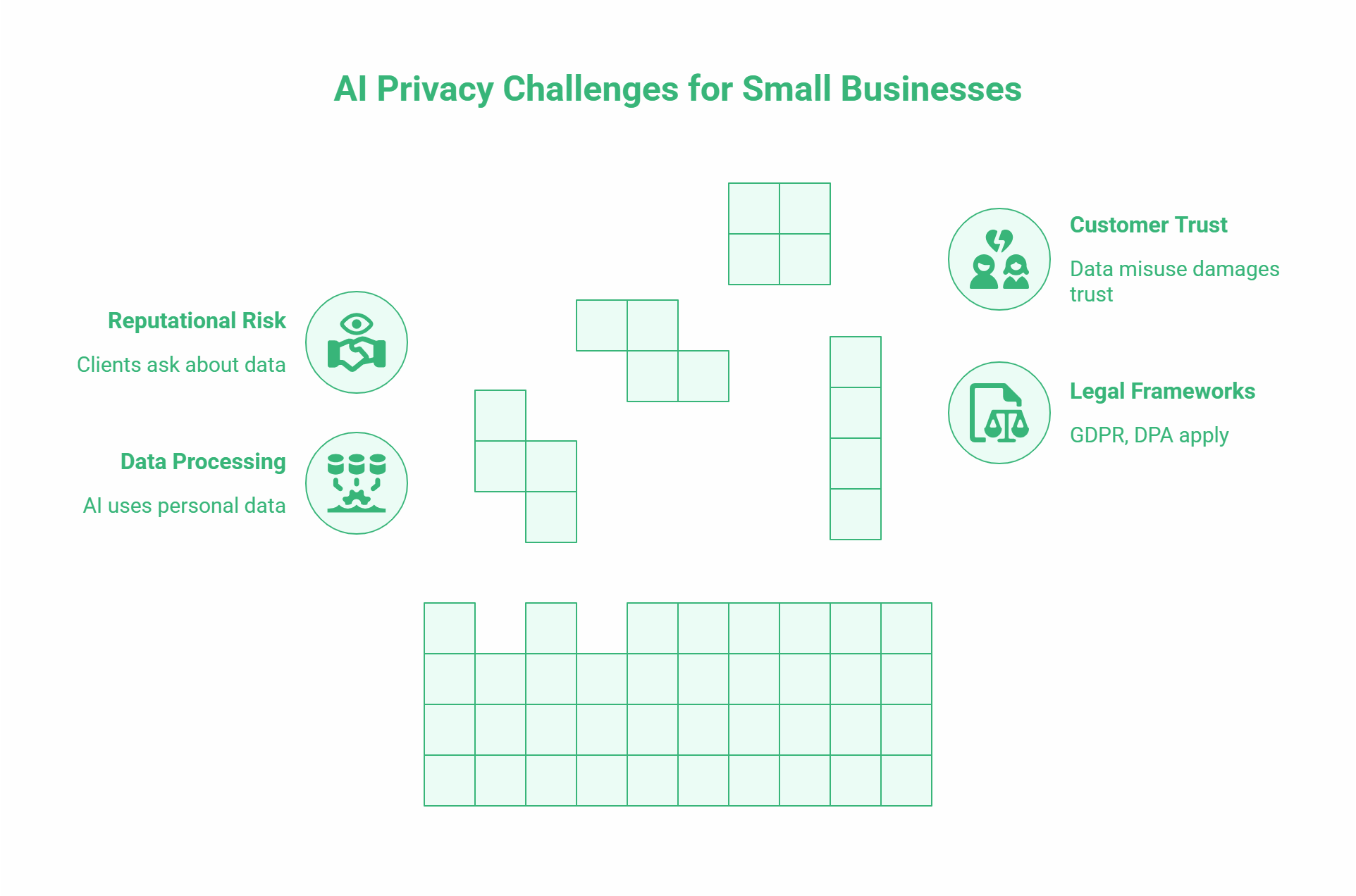
The assumption that AI privacy concerns only affect large technology companies is common and wrong. Any business using AI systems that process personal data has privacy obligations, regardless of size.
Personal data includes names, email addresses, IP addresses, purchase histories, behavioural data collected by your website, employee records, and any other information that can identify an individual, directly or indirectly. Most AI tools used in business today process at least some of this data.
What triggers a privacy obligation
The trigger is not the use of AI itself but what the AI does with data. An AI tool that helps you draft internal documents without processing customer data sits in a different position to a chatbot that handles customer queries, an AI recruitment tool that screens job applications, or a personalised email platform that profiles customer behaviour to determine what content to send.
For the latter group, UK GDPR (in Great Britain and Northern Ireland), GDPR (in Ireland and the EU), and the Data Protection Act 2018 all apply. These are the frameworks that set out what you can and cannot do with personal data, and they contain specific provisions that bear directly on automated processing and AI-driven decision-making.
The reputational dimension
Beyond the legal requirement, there is a practical business dimension. Enterprise clients and public sector organisations now routinely ask suppliers about their data handling practices as part of procurement assessments. A business that cannot answer basic questions about how its AI tools process personal data, or what safeguards are in place, is at a disadvantage in those conversations.
Customer trust follows the same pattern. When people discover their data has been used in ways they did not expect or consent to, the commercial damage can significantly outweigh any short-term benefit gained from the AI application.
Understanding the Legal Framework: GDPR and AI
GDPR and its UK equivalent are the primary legal frameworks governing AI use involving personal data. They were not designed specifically for AI, but several of their provisions apply directly to how AI systems handle personal information.
Lawful basis for processing
Before using any AI system that processes personal data, you need a lawful basis for doing so. The most common bases for business use are legitimate interests (processing is necessary for your business purposes and does not override individuals’ rights) and consent (the individual has explicitly agreed to the processing).
Consent is often harder to rely on in practice because it must be freely given, specific, informed, and unambiguous, and individuals must be able to withdraw it easily. Legitimate interests is more commonly used, but it requires a documented balancing test demonstrating that your interests do not override the individual’s privacy rights.
Transparency obligations
Individuals must be told when their data is being processed by AI systems, what the AI does with it, and what the consequences are. This information should appear in your privacy notice in plain language. If you use a customer-facing chatbot, for example, users should know they are interacting with an AI system and that the conversation may be used to improve the system or inform future marketing.
The ICO has specifically flagged inadequate transparency in AI processing as an enforcement priority. A privacy notice that says nothing about AI use while your business deploys AI throughout its customer-facing operations is a compliance gap.
Automated decision-making: Article 22
Article 22 of GDPR gives individuals the right not to be subject to solely automated decisions that have legal or similarly significant effects on them. Credit decisions, insurance pricing, recruitment screening, and loan assessments all fall into this category.
If your business uses AI to make any of these decisions without meaningful human review, Article 22 applies. You need a lawful basis for the automated processing, must be able to explain the decision logic to the individual on request, and must offer a route for human review.
“AI offers incredible opportunities for innovation, but it also poses significant risks to privacy that cannot be ignored,” says Ciaran Connolly, founder of ProfileTree. “Transparency and adherence to privacy laws are non-negotiable for any business serious about responsible AI use.”
Data Security and Practical Risk Management
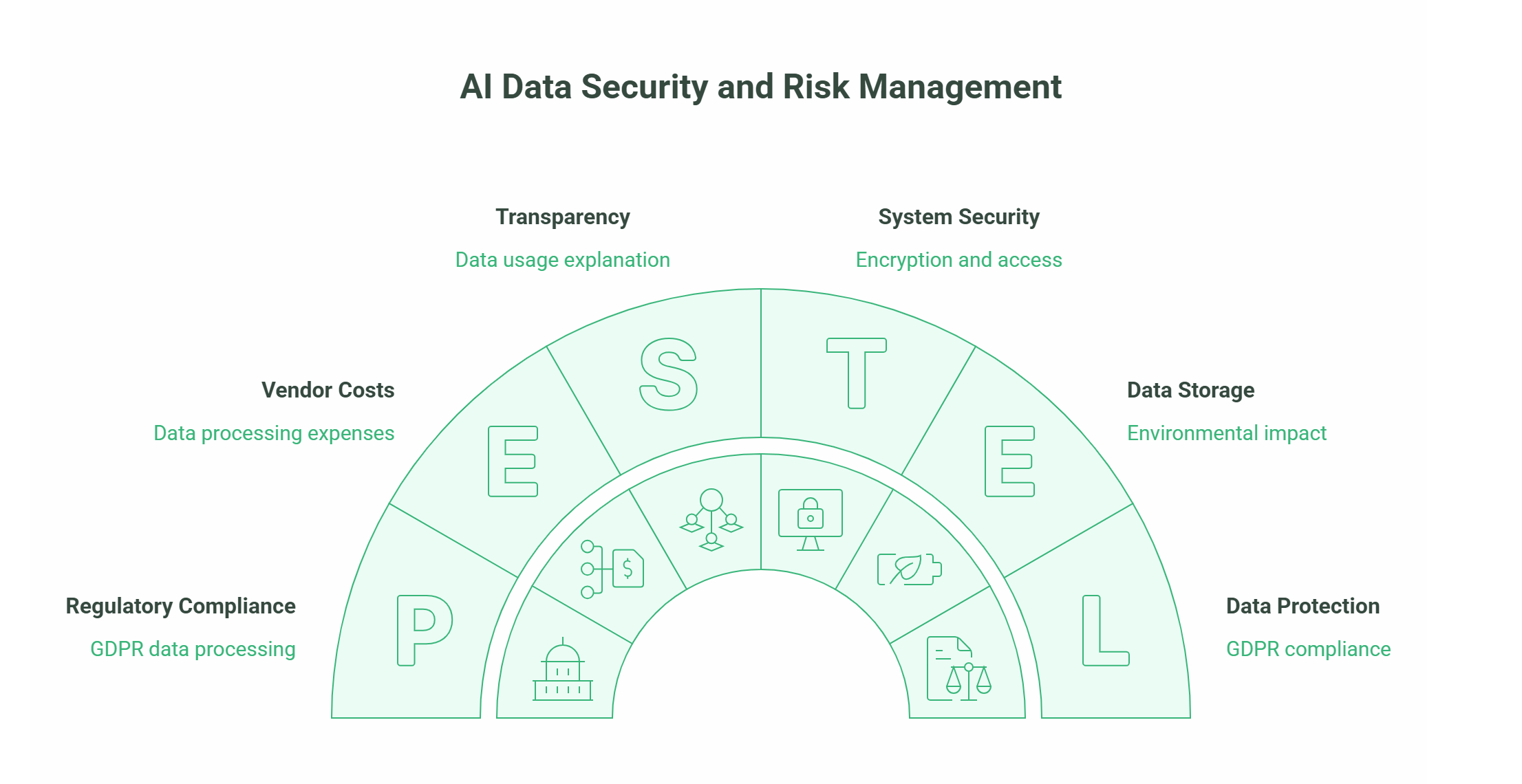
Privacy and security are distinct but closely related obligations. GDPR requires that personal data be processed securely, using appropriate technical and organisational measures. For businesses using AI, this obligation extends to the AI tools themselves and the vendors supplying them.
Assessing vendor security
When you use a third-party AI tool that processes personal data, your business is the data controller and the vendor is typically a data processor. This means you are responsible for ensuring the vendor handles the data appropriately. Practically, this requires:
A Data Processing Agreement (DPA) with every AI vendor that processes personal data on your behalf. Many vendors provide standard DPAs; if yours does not, request one before deploying the tool.
Understanding what data the vendor accesses, where it is stored, how long it is retained, and whether it is used to train the vendor’s models. This last point is particularly relevant for AI tools: some vendors use customer data to improve their AI systems, which may not be consistent with the purposes for which you collected that data.
Encryption and access controls
AI systems that store or transmit personal data should use encryption for data at rest and in transit. Access to systems containing personal data should be controlled on a need-to-know basis, with appropriate authentication requirements.
Data minimisation in AI systems
AI systems often work better with more data. This creates a direct tension with GDPR’s data minimisation principle, which requires that you only process personal data that is necessary for the specified purpose. When configuring AI tools, review what data inputs the system requires and limit access to what is genuinely needed. Feeding an AI system with extensive personal data because it might improve performance, without a clear necessity, is a compliance risk.
Bias, Fairness, and Accountability in AI
Legal compliance addresses what you must do. Ethical AI practice addresses what you should do. For businesses using AI in any process that affects people, the two increasingly overlap.
The practical risk of bias
AI systems can produce biased outputs when their training data reflects historical inequalities or when their design does not account for variation across demographic groups. A recruitment tool trained on historical hiring data from a non-diverse workforce will tend to replicate that lack of diversity in its outputs. A credit scoring model trained on data that historically correlated certain postcodes with default risk may disadvantage applicants from those areas regardless of their individual creditworthiness.
This is not a hypothetical concern. Several large companies have abandoned or significantly reworked AI recruitment tools after internal audits identified bias problems. For businesses using commercially available AI tools, the practical implication is that you cannot assume a tool is fair simply because a reputable vendor built it.
Human oversight as the key safeguard
The most effective practical safeguard against AI bias and errors is meaningful human oversight. For consequential decisions, this means a person with the authority and information to review and override the AI’s output if it appears incorrect or unfair.
This is a regulatory expectation under Article 22 of GDPR for automated decisions. It is also sound operational practice independent of the regulatory requirement. AI systems make mistakes. Removing human review entirely from decisions that affect individuals removes the capacity to catch those mistakes.
Explainability
If an individual asks why an AI system reached a particular conclusion about them, your business needs to be able to provide a meaningful explanation. “The algorithm decided” is not a sufficient answer under GDPR. You need to understand the decision logic at least well enough to explain it in plain terms.
This is a practical argument for choosing AI tools that are explainable over those that are accurate but opaque. A slightly less accurate model that you can explain and audit is often a better business choice than a more accurate one that operates as a black box.
Privacy-Enhancing Practices for Business AI Use
Beyond minimum compliance, there are practical approaches that reduce privacy risk while maintaining the business benefits of AI.
Privacy by design
Privacy by design means building privacy considerations into how you deploy AI from the start, rather than addressing them after the fact. In practice, this means asking privacy questions before deploying a new AI tool: what personal data does it access, does it need all of that data, how is it stored, who can access it, and what happens to it when you stop using the tool.
This approach is explicitly encouraged by data protection regulators and reduces the likelihood of discovering a compliance problem after significant business processes have been built around a tool.
Data Protection Impact Assessments
A Data Protection Impact Assessment (DPIA) is required under GDPR before deploying AI systems that are likely to present high risks to individuals. High-risk indicators include systematic profiling, processing sensitive data, and automated decision-making at scale.
For many standard business AI applications, a formal DPIA may not be mandatory. But going through the exercise informally, asking the questions a DPIA would require, is useful even when it is not legally compelled. It surfaces risks and forces clear thinking about data flows that might otherwise remain unexamined.
Anonymisation where feasible
Where AI systems can operate on anonymised or pseudonymised data without losing necessary functionality, this approach reduces privacy risk. Truly anonymised data sits outside GDPR’s scope. Pseudonymised data remains within scope but carries a lower risk.
Not all AI applications can function effectively on anonymised data, particularly those that personalise outputs to individual users. But for analytics, model training, and testing purposes, anonymisation is often feasible and worth implementing.
What This Means Practically: Steps for SMEs
For a small or medium-sized business without a dedicated data protection officer or legal team, the following steps represent a practical approach to AI and privacy compliance.
Step 1: Map your AI tools and their data use
List every AI tool your business currently uses. For each one, identify: what personal data does it access, where does that data come from, who is the vendor, and does a Data Processing Agreement exist. Many businesses find they have AI tools they are not fully aware of, embedded in existing platforms like CRMs, HR systems, and marketing automation tools.
Step 2: Review your privacy notice
Your privacy notice should accurately describe how your business uses AI to process personal data. If it does not mention AI at all, or if your AI use has expanded since it was last updated, it needs revision. Plain language descriptions of what AI does with personal data are both a legal requirement and a trust signal to customers.
Step 3: Audit consequential automated decisions
Identify any decisions your business makes that are materially influenced by AI outputs and that affect individuals, such as marketing personalisation, recruitment screening, customer segmentation, or pricing. For each, assess whether meaningful human review is in place and whether you could explain the decision logic to an affected individual.
Step 4: Build vendor accountability into procurement
Before adopting any new AI tool that processes personal data, make it standard practice to request and review the vendor’s DPA, understand their data retention and training data policies, and confirm their security certifications. This takes time upfront but significantly reduces risk.
ProfileTree’s AI training programmes through Future Business Academy help SME teams develop practical AI skills alongside the governance and compliance awareness that responsible deployment requires. Our guide to overcoming AI adoption challenges for SMEs covers implementation considerations, including data and privacy.
Frequently Asked Questions
Does GDPR apply to AI tools my business uses?
Yes, if those AI tools process personal data about individuals. Most customer-facing AI tools, HR AI systems, and marketing AI platforms process personal data and therefore fall within GDPR’s scope. Your business is typically the data controller, making you responsible for ensuring the processing is lawful, transparent, and secure.
What is a Data Processing Agreement and do I need one?
A Data Processing Agreement (DPA) is a contract between a data controller (your business) and a data processor (the AI vendor) that sets out the terms under which the vendor handles personal data on your behalf. GDPR requires a DPA to be in place for any third-party processing of personal data. If you use AI tools that process customer or employee data and do not have DPAs with those vendors, you have a compliance gap.
Can I use customer data to train an AI model?
Only if you have a lawful basis for doing so and have been transparent with customers that their data may be used for this purpose. Using data collected for one purpose (providing a service) to train an AI model for a different purpose (improving the vendor’s product) without disclosure is likely to breach GDPR’s purpose limitation principle.
What does meaningful human oversight mean in practice?
It means that a person with relevant information and genuine authority to change or override the decision reviews AI outputs before they produce consequences for individuals. A human who rubber-stamps AI outputs without the information or authority to override them does not constitute meaningful oversight. For recruitment screening, for example, a recruiter who reviews AI-ranked applications and can independently assess candidates provides meaningful oversight. An automated system that sends rejection emails without any human in the loop does not.
How do I know if my AI tool is biased?
You start by asking the vendor. A reputable AI vendor should be able to tell you what data the model was trained on, how it has been validated for fairness across demographic groups, and what monitoring is in place. If a vendor cannot answer these questions, that is a risk signal. For tools used in consequential decisions, periodic auditing of outputs for patterns that suggest differential treatment of protected groups is also advisable.
What is Privacy by Design in the context of AI?
Privacy by Design means considering privacy implications before deploying an AI system rather than addressing them after the fact. For AI specifically, it involves asking before deployment: what personal data does this system need, is all of that data necessary, how is it secured, how long is it retained, and how can individuals access or delete their data. It is the difference between building privacy in and bolting it on.