
Backlink Audit Tools: A Practical Guide for UK and Irish Businesses
Table of Contents
Most UK small business owners hear “your backlinks might be hurting you” and have no idea where to start. Backlink auditing used to mean exporting a spreadsheet, manually scoring hundreds of links, and submitting a disavowal file to Google, hoping for the best. In 2025, that process looks quite different.
AI-assisted tools now do the heavy analytical work, and Google’s own spam-filtering systems have changed, which links actually require action. The result is that a modern backlink audit is less about fear and more about efficiency: understanding what your link profile says about your site’s authority, identifying genuine gaps versus competitor domains, and making targeted decisions rather than mass disavow submissions.
This guide covers what a backlink audit involves, which tools work best for UK and Irish websites, and how the shift towards AI-driven link analysis affects the decisions SMEs need to make.
What Is a Backlink Audit?
A backlink audit is a structured review of all the external websites linking to your domain. The goal is to assess whether those links are helping your search rankings, doing nothing, or — in a smaller number of cases — flagging your site to Google as part of a spammy link network.
Search engines treat backlinks as signals of credibility. A link from a relevant, well-regarded website in your sector tells Google your content is worth referencing. A cluster of links from unrelated, low-quality directories tells a different story.
What Does an Audit Actually Examine?
A standard backlink audit looks at referring domains (how many distinct websites link to you), anchor text distribution (the words used in those links), domain authority scores, link relevance to your niche, and the ratio of followed versus no-followed links. Most professional tools also flag links that match patterns associated with manual penalty risk: paid link networks, hidden links, and links from sites flagged in previous Google spam actions.
Why Audits Matter for SMEs in the UK and Ireland
For a small business website, a single cluster of low-quality links acquired years ago by a previous SEO provider can suppress rankings without the owner ever knowing why. An audit surfaces those patterns. It also reveals opportunities: if a competitor has acquired links from a relevant trade body or regional publication that you haven’t, that’s an actionable gap.
Businesses managing .co.uk, .ie, or regional domains also face a specific consideration: local citation quality varies considerably across directories, and some link sources that were widely recommended five years ago now carry negative signals.
The Best Backlink Audit Tools for UK Marketers
The market is dominated by a handful of major platforms, each with different strengths. For UK and Irish businesses, two practical considerations often get overlooked in global guides: pricing in GBP and how well each tool’s database covers regional link sources.
Comparison table — Backlink Audit Tools for UK Businesses
| Tool | GBP Pricing (approx.) | Database Size | Best For |
|---|---|---|---|
| Semrush | From £99/month | 43 trillion links | All-round auditing and reporting |
| Ahrefs | From £99/month | 35+ trillion links | Competitor gap analysis |
| Majestic | From £42/month | 15+ trillion links | UK agencies; Trust Flow metric |
| Moz Pro | From £69/month | Smaller database | SMEs starting out |
| Google Search Console | Free | Google index only | Baseline check, no competitor data |
Pricing is approximate and subject to change. VAT applies to UK business subscriptions.
Semrush
Semrush is the most widely used all-around SEO platform, and its backlink audit module is among the most developed. It scores links using an internal toxicity metric, allows bulk disavow file exports, and generates white-label reports — useful for agencies handling multiple client accounts. For UK users, its interface is in GBP on UK-registered accounts, though pricing is set in EUR/USD at source with conversion applied.
Ahrefs
Ahrefs has one of the largest and most frequently updated link indexes available. Its strength is competitive intelligence: the “Link Intersect” feature shows which domains link to your competitors but not to you, which is a direct input for any link acquisition strategy. For a Belfast or Dublin-based business trying to identify which local media or trade publications they’re missing, this is typically the most useful feature available.
Majestic
Majestic is the only major backlink tool founded in the UK, with its database historically strong on British and Irish link sources. Its proprietary Trust Flow and Citation Flow metrics provide a different lens to domain authority scores, and the tool is generally more affordable for agencies running multiple projects. For SMEs managing their own SEO, the interface is less intuitive than Semrush or Ahrefs, but the data is reliable.
Free and Lower-Cost Options
Google Search Console shows the links Google has indexed for your site, free of charge. It doesn’t score link quality or show competitor data, but it’s a valid starting point for any business not yet using a paid tool. Moz Pro and Ubersuggest offer backlink data at lower price points, though with smaller databases — adequate for initial audits on newer or smaller sites.
How AI Is Changing Backlink Analysis
The conversation around AI and backlink strategies has often been vague, full of claims about “intelligent automation” and “machine learning insights” that don’t tell practitioners anything useful. What AI actually does in modern SEO tools is worth being specific about.
Pattern Recognition at Scale
The core value of AI in backlink analysis is speed of pattern detection. What previously required a human analyst to manually review hundreds of referring domains — looking for footprints of link networks, unnatural anchor text distributions, or clusters of links appearing simultaneously — can now be flagged automatically. Tools like Semrush’s Toxicity Score and Ahrefs’ spam score use machine learning trained on link profiles that have received Google manual actions, then surface links from your profile that share similar characteristics.
This doesn’t replace human judgment. A link flagged as potentially toxic still requires a review of context: a sudden cluster of links from Irish news sites isn’t a spam signal, it’s PR working.
Google’s SpamBrain and What It Means for Disavow Files
Google’s SpamBrain system — its own AI-powered spam classifier — now filters a significant proportion of low-quality links before they affect rankings. In practice, this means many of the links that would previously have required disavowal are already being ignored by Google’s systems.
“The disavow tool is now genuinely a last resort for most businesses, not a routine maintenance task,” says Ciaran Connolly, founder of Belfast digital agency ProfileTree. “We’re more focused on whether a client’s link profile reflects genuine authority in their sector than on chasing down every spammy directory link.”
The disavow file retains value in specific situations: if your site has received a Google manual action (visible in Search Console under Security and Manual Actions), if you can identify a clear link network pointing at your domain, or if a previous SEO provider built links you can document as paid or manipulative.
AI-Assisted Competitor Analysis
Where AI tools have genuinely changed the competitive intelligence process is in the speed of backlink gap analysis. Identifying which authoritative domains link to three or four of your competitors but not to you — and understanding why — used to take hours. Most modern platforms surface this in minutes, allowing an SEO strategy to be built around specific link acquisition targets rather than broad outreach.
For an SME in Northern Ireland or the Republic, this might mean identifying which regional business publications, sector trade bodies, or local authority websites are linking to competitor domains but not yours. Those are specific, actionable targets with a realistic path to acquisition through PR, content, or directory listings.
How to Perform a Backlink Audit — Step by Step
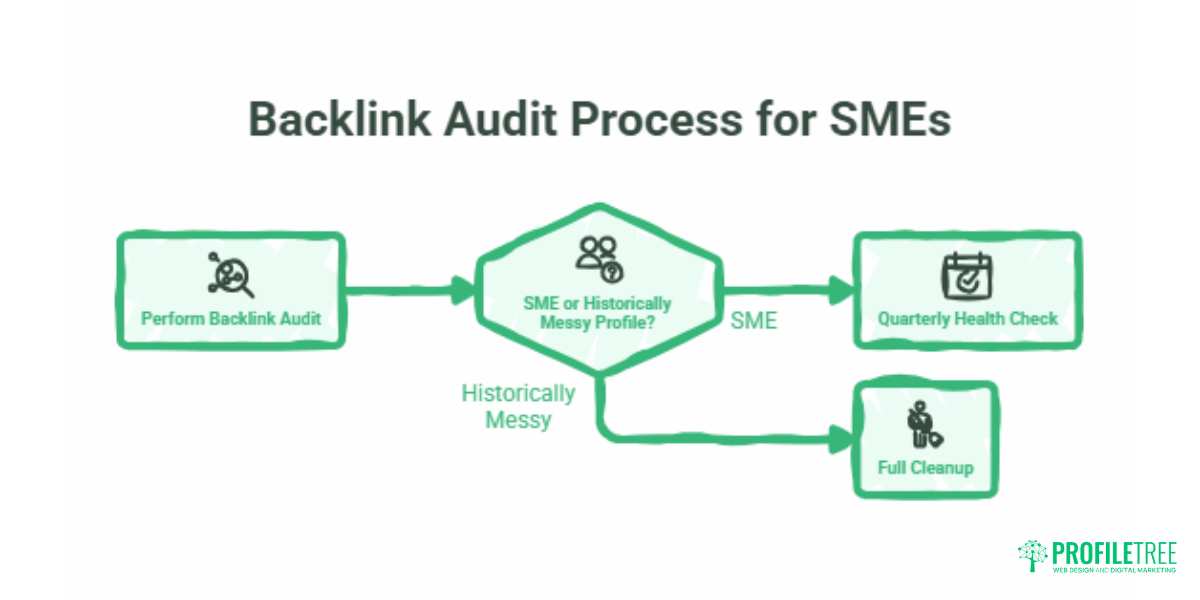
A backlink audit doesn’t need to take a full working day. For most SMEs, a quarterly health check takes around 30 to 45 minutes using any of the major tools. A full cleanup of a historically messy profile takes longer.
Step 1 — Benchmark Your Current Profile
Export your full referring domain list from whichever tool you’re using. Note your total referring domains, your domain authority or domain rating score, and your Trust Flow if using Majestic. These become your baseline metrics. If you repeat this quarterly, you’ll see whether your profile is growing, stable, or shrinking, and whether quality is improving alongside quantity.
Step 2 — Identify Genuine Toxicity vs Google-Ignored Spam
Not every low-scoring link warrants action. Sort your flagged links by the platform’s toxicity or spam score and focus on the top 10 to 15% — the highest-risk links. For each, ask: Does this site exist as a genuine web property? Is it part of an obvious network (identical templates, same IP ranges, same publishing patterns)? Has Google indexed any of its content?
Links from thin, clearly artificial sites with no real content or traffic are candidates for disavowal only if you have a meaningful volume of them or if you can connect them to a specific manual action. One or two low-quality links among a healthy broader profile don’t require action.
Step 3 — Competitive Gap Analysis
Use the link intersect or gap analysis feature in your chosen tool. Enter three to five competitor domains and filter for referring domains that link to two or more of them but not to you. This is your link acquisition priority list. Prioritise by relevance to your sector and by the realism of acquiring a link from that domain.
For a regional business, local newspapers, council business directories, sector trade associations, and Chamber of Commerce listings are realistic targets. National press links require a PR strategy or a genuinely newsworthy angle.
Step 4 — Link Reclamation Before New Acquisition
Before building new links, check whether you have links pointing to pages that no longer exist. A referring domain linking to a 404 page is wasted equity. Identify these with a crawl of your broken inbound links, then either reinstate the page or redirect the URL to a relevant live page.
This is often the quickest win in a backlink audit: recovering equity that’s already been earned without any new outreach required.
Backlink Auditing in the Context of a Wider SEO Strategy
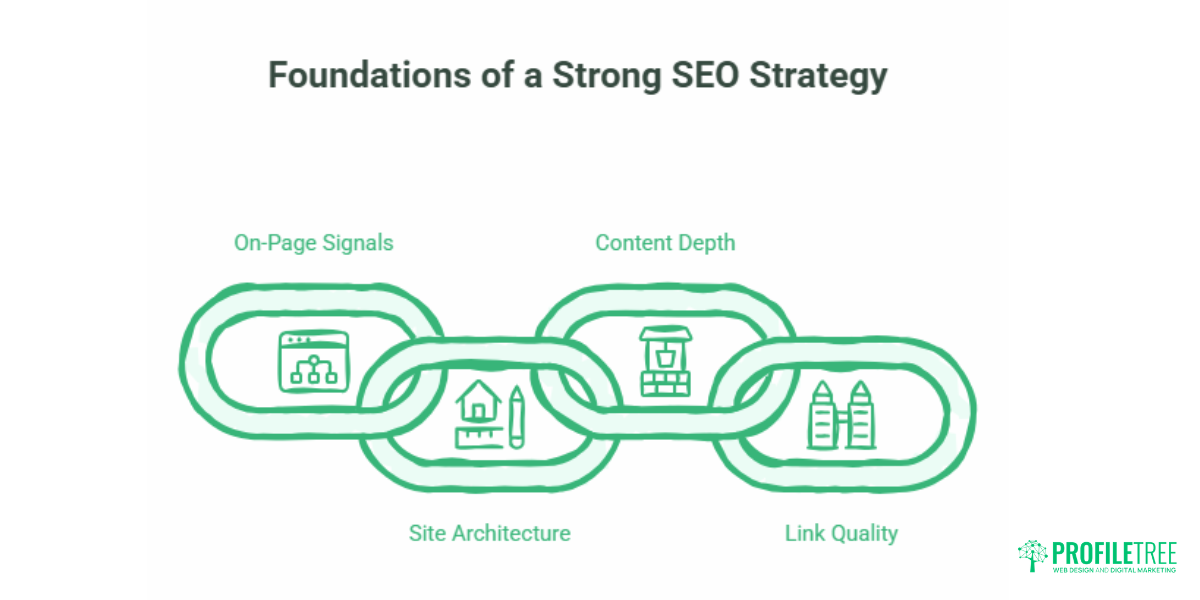
A backlink audit in isolation is only part of the picture. Link quality interacts directly with on-page signals, site architecture, and content depth. An authoritative link pointing to a thin page with no clear topical focus passes less value than the same link pointing to a well-structured, substantive piece of content.
For SMEs working with an SEO provider, understanding what a healthy backlink profile looks like means you can hold your provider accountable. If an agency is building dozens of links per month through low-quality directories, you should be able to see that pattern in a tool like Ahrefs or Semrush. Conversely, if a content marketing strategy is generating editorial links from sector publications, that should be visible too.
ProfileTree’s SEO services approach link building as an output of content and PR strategy, not a separate mechanical process. The links a business earns through well-researched guides, sector commentary, and local business coverage carry more weight than any volume of directory submissions, and they don’t create the audit problems that bought or spammed links generate down the line.
For in-house marketing teams who want to manage their own SEO audits without relying on an external agency, ProfileTree’s digital training programmes cover backlink analysis, Search Console interpretation, and competitive research as practical skills, not just theory.
Conclusion
Backlink auditing has become more manageable for SMEs than it was five years ago, largely because AI-powered tools now handle the pattern recognition that previously required specialist time. The principles haven’t changed: links from relevant, credible sources help rankings; large volumes of low-quality links pose a risk; and competitive gap analysis is one of the most direct ways to identify where your link profile needs to grow. If you’d like a review of your current link profile, ProfileTree’s SEO team works with businesses across Northern Ireland, Ireland, and the UK.
FAQ
What is a backlink audit?
A backlink audit is a review of all the external websites linking to your domain. It assesses whether those links support your search rankings, are being ignored by Google, or carry a risk of triggering a manual penalty. Most audits also include a competitive analysis to show where your link profile falls short compared to competitors in your sector.
Is there a free backlink audit tool?
Google Search Console shows which sites Google has indexed as linking to you, at no cost. It doesn’t score link quality or provide competitor data, so its usefulness is limited to a basic inventory. Most paid tools offer a free trial with restricted data access, which is usually enough to run a first-pass audit on a smaller site. Ahrefs and Semrush both offer limited free versions with daily query caps.
How long does a backlink audit take?
A quarterly health check on a site with a normal link profile takes 30 to 45 minutes using a platform like Ahrefs or Semrush. A full cleanup of a profile that has accumulated low-quality links from previous SEO work can take four or more hours, depending on the volume of links requiring individual review and any disavow file preparation needed.
Are toxic backlinks still a concern in 2025?
For most websites, less so than they were. Google’s SpamBrain system now filters many low-quality links before they affect rankings, meaning a handful of directory or spam links in an otherwise healthy profile are unlikely to cause harm. Manual penalty risk applies where a site has a systematic pattern of manipulative links, typically visible in Search Console. Routine disavowal of every flagged link is no longer standard practice.
Which backlink tool works best for UK-based websites?
Majestic, founded in the UK, has historically strong coverage of British and Irish link sources. Ahrefs has the largest and most frequently updated database overall, making it the better choice for competitive gap analysis. For agencies managing multiple client reports, Semrush’s white-label reporting features are worth the higher cost. Google Search Console is the correct starting point for any business not yet on a paid plan.
Does a backlink audit improve SEO rankings?
Not directly. Cleaning up low-quality links removes potential suppression signals but doesn’t generate positive ranking uplift on its own. The more significant benefit comes from the competitive gap analysis: identifying which credible domains link to your competitors but not to you gives a direct input into link acquisition strategy, which does have a measurable effect on rankings when paired with strong on-page content.