
How Technology Impacts SEO: A Guide for SME Decision-Makers
Table of Contents
Search engines are no longer matching keywords to web pages. They are matching intent to answers. That shift, driven by artificial intelligence, machine learning, voice search, and a series of structural changes in how Google processes queries, means the way technology impacts SEO is one of the most commercially important things a business owner can understand right now.
This guide explains what is actually changing, why it matters for businesses in Northern Ireland, Ireland, and the UK, and what you should do about it before your competitors do.
How AI Is Reshaping the Way Search Works
The biggest shift in how technology impacts SEO is happening at the level of the search engine itself. Google no longer simply retrieves pages that contain your target keywords. It uses machine learning systems, including neural matching and, more recently, Gemini-based systems, to understand what a query actually means and serve content that answers it, regardless of whether the exact phrase appears on the page.
From Ranking Pages to Answering Questions
Google’s AI Overviews launched in the UK in August 2024 and expanded to Ireland in March 2025 as part of a wider EU rollout. They now appear above organic results for a growing proportion of informational queries. When someone searches “how does emerging technology affect SEO,” they may receive a synthesised answer drawn from multiple sources before they ever see a traditional blue link.
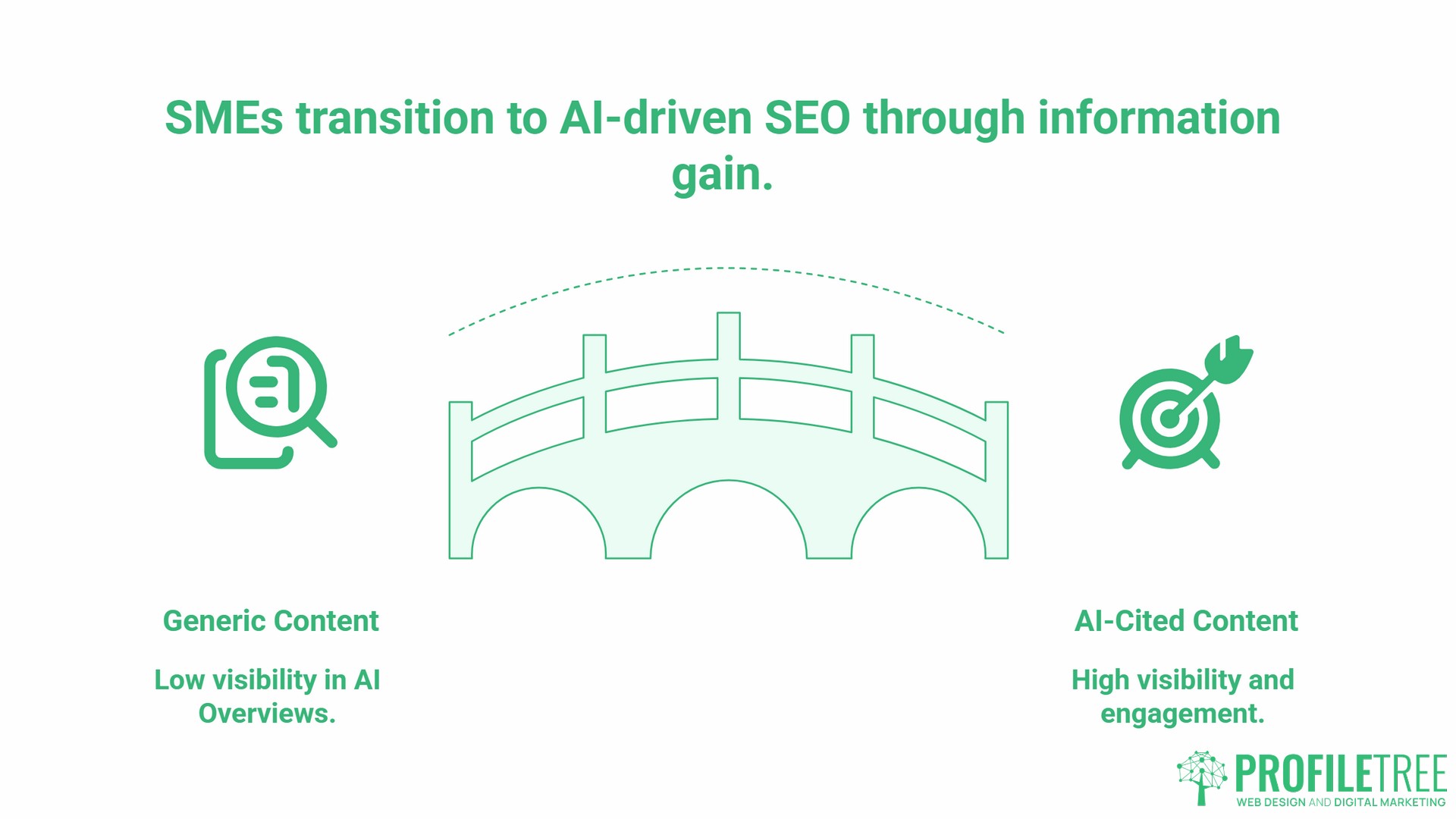
For SMEs, this creates a specific challenge. If your content is generic, it will not be cited in AI Overviews. If it covers ground that dozens of other articles already cover in the same way, it adds nothing new. The quality that matters most now is what a Google patent describes as “information gain”: the degree to which a page adds something the other results do not. It is not a confirmed ranking factor, but it lines up closely with what actually gets cited.
Research by Ahrefs, analysing nearly 17 million citations, found that AI-cited content is on average 25.7% fresher than content appearing in traditional organic search results. Separately, Ahrefs also found that pages ranking across multiple related sub-queries are 161% more likely to be cited in an AI Overview than pages ranking only for the primary term, with a Spearman correlation of 0.77.
For a business in Belfast or Dublin serving local clients, information gain often comes from specificity: real processes, actual results from real projects, and honest assessments of what works in the UK and Irish market rather than in a generic global context.
Why “SEO Technologies” Are Changing Content Strategy
The new SEO technologies powering Google’s systems, including Gemini-based AI processing, can understand relationships between concepts, not just individual words. A page about “local SEO for service businesses in Northern Ireland” is now considered topically related to pages on Google Business Profile, mobile search behaviour, and review management, even if those exact phrases do not appear in the text.
This is why content written around tightly connected topic clusters, rather than individual keyword targets, performs better under the latest SEO technology. It is also why thin, isolated articles that target a single keyword phrase without depth are losing ground across the board.
“The businesses getting cited in AI answers are those that have built genuine authority on a topic over time,” says Ciaran Connolly, founder of ProfileTree. “A single article is not enough. What matters is whether your site consistently covers a subject with real depth and real expertise.”
Voice Search and the Shift Towards Conversational Queries
Voice search is not a fringe behaviour. Spoken queries look fundamentally different from typed ones, and that difference matters more than the raw volume. Anyone who has dictated a search to a phone knows they phrase it as a full question rather than a clipped keyword string.
The volume figures move around a lot depending on who is counting and what they count, and ProfileTree’s breakdown of voice search statistics covers what the current data does and does not support.
Where a typed search might be “local SEO Belfast,” a voice query is more likely to be “who does SEO for small businesses in Belfast” or “how do I get my business to appear in Google Maps.”
What Voice Search Means for Keyword Strategy
The implications of this for new SEO technology are practical. Voice queries are longer, more conversational, and much more frequently local in intent. They tend to ask direct questions and expect direct answers. Content that is structured around answering specific questions, with a clear answer in the first sentence followed by supporting detail, is far better positioned to capture voice search traffic than content built around keyword density alone.
For a service business in Northern Ireland or the west of Ireland, voice search optimisation is not optional. Voice queries skew heavily local, which puts the searcher closer to a commercial decision than most other query types. Someone asking for a plumber out loud is usually about to ring one.
Smart Devices and the IoT Effect
The Internet of Things has expanded the surfaces on which search happens. Queries now originate from smartphones, smart speakers, car dashboards, wearables, and connected home devices. Each of these has different display constraints and different user expectations. A voice result from a smart speaker delivers one answer. There is no page two.
This does not mean SMEs need complex IoT strategies. It means they need content that is structured to provide a single, authoritative answer to a specific question. The businesses that appear in those single-answer results are typically those with strong local SEO signals, well-maintained Google Business Profiles, and content that answers questions directly.
ProfileTree’s SEO services cover voice search optimisation as part of a broader local SEO strategy, because for most SMEs in the UK and Ireland, local visibility and voice visibility are the same problem.
Visual Search: The Opportunity Most UK Businesses Are Missing
Visual search is among the least-discussed areas of how technology impacts SEO, and that gap is an opportunity. Google disclosed in October 2024 that Lens was handling close to 20 billion visual searches a month, up from 12 billion when it was last reported at I/O in 2023. Roughly a fifth of those are shopping-related. A user can photograph a product, building, plant, or logo and receive search results based on what the image contains.
What This Means for E-Commerce and Local Businesses
For e-commerce businesses, visual search is already a commercial channel. A user photographing a product they saw in a shop window can land directly on a product page if that page is properly optimised with high-quality images, descriptive filenames, and structured data markup (specifically, Product schema and ImageObject schema).
For professional services businesses, visual search matters less directly, but the underlying principle carries over: image metadata, alt text, and structured data are now part of how Google understands and indexes your content. Pages with poorly named images, missing alt text, or no schema markup are leaving indexing signals on the table.
For UK retailers and manufacturers looking to compete on this, the practical first step is an image audit: checking that every product image has a descriptive filename, complete alt text, and is supported by appropriate schema. This is a technical task that sits at the intersection of web development and SEO strategy.
5G, Page Speed, and the Technical Infrastructure Behind Modern Search
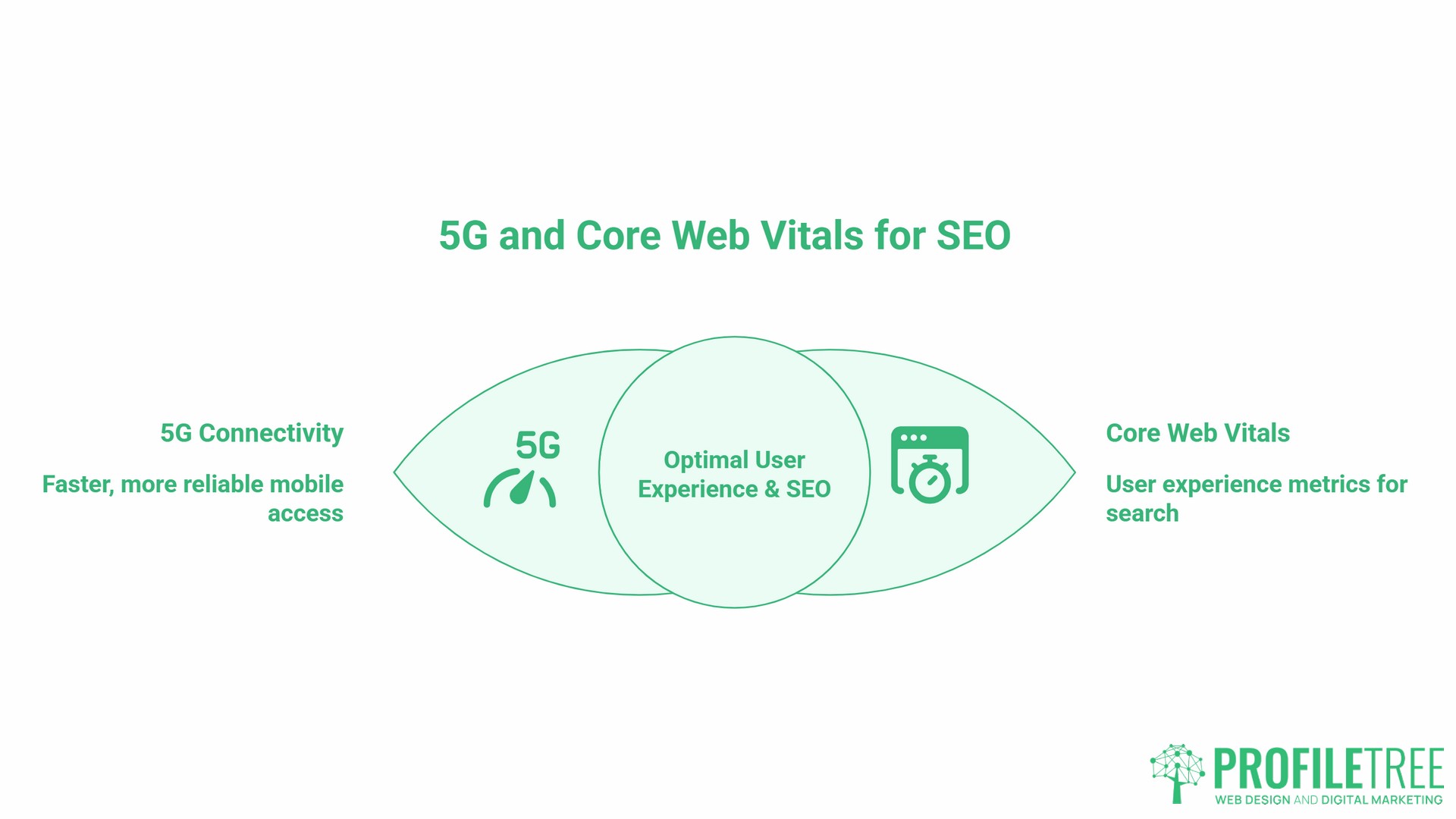
One of the least visible ways that technology impacts SEO is through infrastructure. Page speed has been a Google ranking factor for several years, but the arrival of widespread 5G connectivity has changed the baseline against which sites are measured.
Core Web Vitals in a 5G World
Ofcom’s Connected Nations 2025 report put outdoor 5G coverage from at least one operator at 97 per cent of UK premises, but rural indoor coverage remains far patchier, and 4G still carries the bulk of mobile data. This creates a specific challenge for businesses serving mixed urban and rural audiences: your site needs to perform well across both, and a site that performs well on 5G may still load slowly on a rural 4G connection.
Google’s Core Web Vitals measurement framework, which covers Largest Contentful Paint (loading performance), Interaction to Next Paint (responsiveness), and Cumulative Layout Shift (visual stability), applies equally regardless of the connection type your visitors use.
For SMEs, this translates into concrete decisions. Image compression, lazy loading, server response times, and caching configuration are not abstract technical concerns. They directly affect whether your site passes or fails the Core Web Vitals thresholds that influence search rankings. These are decisions that belong in any conversation about web design and development, not just SEO.
The SEO Evolution: Traditional Practice vs Current Practice
The table below contrasts how search worked five years ago with what the latest SEO technology demands now.
| Dimension | Traditional SEO | Current Practice |
|---|---|---|
| Primary focus | Keyword matching | Intent and entity recognition |
| Content goal | Rank for target phrase | Be cited as an authoritative source |
| Key metric | Ranking position | AI Overview citations, click-through rate |
| Technical priority | Meta tags and backlinks | Core Web Vitals and structured data |
| Voice search | Secondary consideration | Primary for local businesses |
| Visual search | Not applicable for most | Growing commercial channel |
| Human role | Content production | Expertise, judgement, and E-E-A-T signals |
Future-Proofing Your SME Digital Strategy
Understanding how technology impacts SEO is the first step. Knowing what to do with that understanding is where most SME owners get stuck. The priorities below are ordered by commercial impact for a business with a typical UK or Irish SME digital budget.
Audit Your Content for AI Visibility
The first practical task is to assess whether your existing content is the kind AI systems would cite. Ask these questions of each major page on your site:
Does it directly answer a specific question, with the answer in the first two sentences? Does it include information that is specific to your business, your market, or your experience, rather than general industry knowledge? Is it supported by structured data that helps Google understand what the page is about? Is it part of a connected topic cluster, or is it an isolated article with no internal linking context?
Pages that fail on most of these points are unlikely to benefit from new SEO technologies, regardless of how frequently you update them. The solution is not more content; it is better-structured, more specific content.
Prioritise the Right Technologies for Your Budget
Not every SME needs to address every area of new SEO technology simultaneously. The table below is a priority guide based on implementation cost and commercial impact.
| Technology | Implementation Cost | Commercial Impact for SMEs |
|---|---|---|
| AI-optimised content structure | Low | High |
| Voice search and local SEO | Low to medium | High (for local businesses) |
| Core Web Vitals and page speed | Medium | High |
| Structured data and schema | Medium | High |
| Visual search optimisation | Low to medium | Medium (high for e-commerce) |
| AR and immersive search | High | Low to medium currently |
The Human Expertise Advantage
As AI content floods search results, the scarcest and most valuable SEO resource is genuine human expertise. Google’s E-E-A-T framework, Experience, Expertise, Authoritativeness, and Trustworthiness, was designed specifically to reward content produced by people with real, demonstrable knowledge.
For a Belfast solicitor, an Irish accountant, or a Northern Ireland manufacturer, this is a competitive advantage that no automated content tool can replicate. The question is whether you are using your genuine expertise to build content that clearly signals your authority to both search engines and prospective clients.
ProfileTree’s digital training programmes are built around helping SME teams understand these shifts and apply them without needing to become technical SEO specialists. The goal is to equip business owners and their marketing managers to make informed decisions, not to turn them into developers.
How These Changes Connect to Your Website and Content Decisions
The way technology impacts SEO does not exist in a separate conversation from web design, content marketing, or digital strategy. They are the same conversation. A website built without consideration for Core Web Vitals will underperform in search, regardless of how strong its content is. Content built without structured data will be harder for AI systems to extract and cite. A digital strategy that treats SEO as a bolt-on rather than a foundational element will consistently underinvest in the areas that now drive the most commercial value.
For SMEs in Northern Ireland, Ireland, and the UK, the practical implication is that the agencies and consultants you work with need to be connected across these disciplines. An SEO specialist who cannot speak to your web developer, or a web designer who has no understanding of how their decisions affect search performance, will cost you visibility that is increasingly difficult to recover.
ProfileTree’s content marketing and SEO work operate as part of an integrated service precisely because the separation between these disciplines no longer makes practical sense under current search technology.
ProfileTree is a Belfast-based web design and digital marketing agency working with SMEs across Northern Ireland, Ireland, and the UK. If you want to understand how the latest SEO technology changes apply to your business specifically, get in touch with the ProfileTree team.
Frequently Asked Questions
Will AI replace traditional SEO?
No. AI is changing the tasks involved in SEO a great deal, but it is not replacing the need for strategic thinking, genuine expertise, or the human judgement required to build real authority in a niche. What AI is replacing is low-effort, high-volume content production as a viable ranking strategy. The tasks that remain most valuable, understanding your audience, building genuine subject matter authority, and making strategic decisions about content and technical infrastructure, still require human expertise.
Does my UK business need to care about 5G for SEO?
Yes, though not in isolation. The arrival of 5G raises user expectations for page speed across the board. Even if your customers are not yet on 5G connections, Google’s performance benchmarks are calibrated to reflect improving network conditions. Sites that perform poorly on Core Web Vitals assessments are already being measured against those that are improving.
How much should an SME invest in AI tools for marketing?
The most practical approach is to invest in tools that assist human creativity and decision-making rather than replace it entirely. AI tools for keyword research, content gap analysis, and performance reporting can noticeably cut the time spent on low-value tasks. AI tools that generate publishable content without expert review carry real risk under current Google quality assessments.
Is voice search actually resulting in sales?
Yes, particularly for local services and repeat e-commerce purchases. A user asking their phone, “find a web design agency in Belfast”, is much closer to a buying decision than a user typing the same phrase. Voice search traffic tends to be lower in volume but higher in commercial intent than broad informational search traffic.
How do I optimise for Google Lens and visual search?
Start with the basics: high-resolution images with descriptive filenames (not IMG001.jpg), complete alt text that accurately describes the image, and the Product or ImageObject schema where appropriate. For e-commerce, make sure product images are indexed and that your product pages include structured data. For local businesses, make sure your Google Business Profile images are up to date and accurately reflect your premises or services.
Does machine learning change how I should choose keywords?
Yes. Exact-match keyword targeting has become less important than topic cluster coverage. Google’s machine learning systems understand semantic relationships between concepts, which means a page that covers a topic thoroughly, addressing related questions, sub-topics, and user concerns, will typically outperform a page that targets a single keyword phrase with high density. The shift is from “what phrase do I want to rank for” to “what topic do I want to own.”