
Podcast SEO: How to Get Your Episodes Found in Search
Table of Contents
Most podcasters publish great content and then wonder why nobody finds it. The answer is almost always podcast SEO. Applying the right podcast SEO strategies from the start changes that entirely. Without it, even a well-produced show can sit at position 70 on Google, collecting a handful of impressions and no clicks.
Podcast SEO is the practice of optimising your show so it ranks on Google and inside podcast directories such as Apple Podcasts and Spotify. It is a two-channel discipline: you need to satisfy both a traditional search engine and the in-app algorithms that surface shows to listeners. Get both right, and you create a compounding discovery loop where each new episode builds on the authority of the last.
This guide draws on what we have learned at ProfileTree working with businesses across Northern Ireland, Ireland, and the UK. It covers everything from keyword research and metadata to transcripts, technical SEO, and the localisation strategies that most generic guides skip entirely.
Understanding Podcast SEO Algorithms
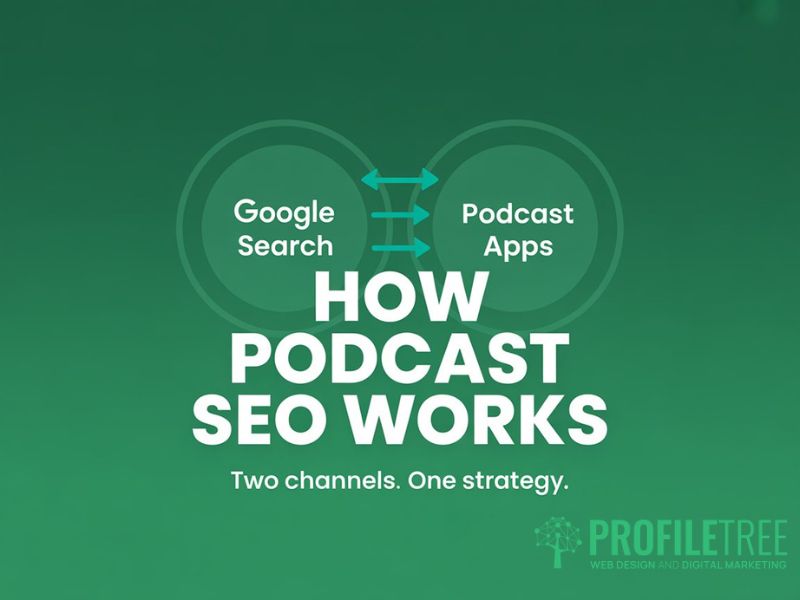
Before you optimise anything, you need to know which algorithm you are optimising for. These podcast SEO tips start with the fundamentals: podcast SEO operates across two distinct channels, and treating them as the same thing is one of the most common mistakes podcasters make.
How Google Indexes Podcast SEO Content
Google does not listen to your podcast. It reads the text around it: your episode title, show description, show notes, and any transcript you publish. This means your podcast is only as searchable as the text you attach to each episode.
Google has been indexing podcast content more aggressively since 2019, and episodes now appear in standard search results alongside articles and videos. Pages that include a transcript, a well-structured set of show notes, and proper metadata give Google far more to work with than a bare audio player and a two-line description. Ahrefs research indicates that pages covering multiple sub-questions within a topic are 161% more likely to appear in AI Overviews, and the same logic applies to podcast episode pages: the more useful text you publish around the audio, the better your chances of ranking.
The practical implication is that your podcast website matters as much as your audio file. Each episode should have its own dedicated page with a unique title, a keyword-rich description, and full show notes at a minimum.
Apple Podcasts vs Spotify: Core Differences
In-app podcast SEO works differently from Google, and the two major platforms have their own ranking signals.
Apple Podcasts weighs the podcast name and episode title most heavily. Its algorithm also looks at subscriber velocity (how quickly people subscribe after discovering your show), ratings, and review frequency. An episode titled ‘Episode 47’ tells Apple’s algorithm nothing useful. An episode titled ‘Podcast SEO: How to Rank Your Show on Google and Spotify’ gives the platform exactly what it needs to surface your content to the right listeners.
Spotify places significant weight on the metadata you enter in its creator tools: podcast title, description, and the ‘About’ section. Spotify’s algorithm also factors in completion rates and saves, which means episode quality and listener engagement feed back into your discoverability. Encouraging listeners to save episodes and follow your show is not just good community practice; it is a direct ranking signal.
| Platform | Primary Ranking Signal | Character Limit: Title | Character Limit: Description |
|---|---|---|---|
| Apple Podcasts | Podcast name, episode title, ratings/reviews | 255 characters | 4,000 characters |
| Spotify | Title, About section, listener engagement | 50 characters (recommended) | 500 characters |
| Google (Search) | Episode page text, transcript, show notes | 60 characters (title tag) | 160 characters (meta description) |
BBC Sounds: Podcast SEO for UK Creators
For UK and Northern Irish podcasters aiming for mainstream discoverability, BBC Sounds represents a significant opportunity that almost no SEO guide addresses. BBC Sounds operates its own editorial curation and search function, and content submitted through BBC Sounds Open is indexed both within the platform and in Google.
Optimising for BBC Sounds requires particular attention to programme descriptions: the platform surfaces content through category browsing and keyword search, so your programme description must include the terms your target audience would genuinely type. Unlike Spotify or Apple, BBC Sounds also carries strong topical authority in UK search results. A listing on BBC Sounds that links back to your podcast website passes meaningful credibility to your domain.
If you produce content relevant to a UK or Irish audience, submitting to BBC Sounds should be part of your distribution strategy. The editorial bar is higher than open podcast directories, but the authority signal is commensurately stronger.
Podcast SEO Keyword Research for Podcasters
Keyword research is one of the core podcast SEO best practices, and the principle is straightforward: find the phrases your target audience types into a search bar, then build your content around those phrases. What differs from standard content research is where you apply the findings.
Podcast SEO Tips: Identifying the Right Search Intent
Podcast listeners use two distinct types of search queries, and you need to serve both.
Educational queries are specific and problem-focused: ‘how to start a podcast‘, ‘best microphone for podcasting on a budget’, or ‘podcast SEO strategies. These are the queries that land someone on your episode page from a Google search. Optimising episode titles and show notes for educational queries is how you build organic discovery from outside the podcast platforms.
Entertainment and interest queries are broader: ‘business podcasts UK’, ‘marketing podcast Northern Ireland’, or ‘small business advice podcast’. These are the queries people use when browsing directories. Your show name, category selection, and full description need to serve this intent.
The most effective podcast SEO strategies address both. An episode might rank on Google for a specific educational query while your show listing surfaces in-app for a broader interest query. These two traffic streams compound over time.
Using YouTube Search Data to Find Podcast Topics
YouTube’s autocomplete is one of the most underused podcast SEO tools available. Because YouTube audiences overlap closely with podcast audiences, the topics that perform well on YouTube are reliable indicators of audio demand.
Search your topic on YouTube and note what autocomplete suggests. Look at the titles of the top-performing videos in your niche. The language people use to find video content tends to mirror the language they use to find podcast content on the same subject. You can then cross-reference these against tools like Google Keyword Planner or AnswerThePublic to confirm search volumes before committing to an episode topic.
Our guide to YouTube SEO strategies covers this research process in detail, and many of the principles translate directly to podcast discovery.
Keyword Research Tools for Podcasters
The right podcast SEO tools make keyword research faster and more reliable. No single tool covers every platform, but the following combination gives you reliable data for both Google and in-app optimisation:
- Google Keyword Planner: Free, integrates with Google Ads data, and shows search volume trends over time. Good starting point for episode topic validation.
- AnswerThePublic: Surfaces the questions people ask around a topic. Particularly useful for identifying FAQ content and episode angle ideas.
- Podcast-platform autocomplete: Type your topic into the Apple Podcasts and Spotify search bars and note what they suggest. This reflects actual listener search behaviour on those platforms.
- Ahrefs or SEMrush: Paid tools that show keyword difficulty, competitor content gaps, and backlink data. Valuable if you are treating your podcast as a serious SEO asset.
- YouTube autocomplete: Free and highly effective for identifying what your audience wants to hear before they know it exists as a podcast.
Podcast SEO: Metadata and On-Page Optimisation
Metadata is the single most controllable variable in podcast SEO. You cannot force Google to rank you, but you can give both Google and in-app algorithms exactly what they need to understand your content. That process starts with the text fields you fill in before you hit publish.
Writing Episode Titles That Rank
Episode titles are one of the highest-impact elements of podcast SEO. Your title needs to serve two audiences simultaneously: the search engine that will index it and the human who will decide whether to click. These goals are usually compatible, but they require deliberate phrasing.
Include your primary keyword naturally within the first half of the title. ‘Podcast SEO Strategies: How to Get Your Show Found on Google’ puts the target phrase up front and adds a clear benefit. Avoid the opposite pattern: ‘Episode 47: Getting Found Online’ tells both Google and potential listeners almost nothing.
Titles on Spotify should ideally be under 50 characters so they display without truncation on mobile. Apple Podcasts allows up to 255 characters, but clarity matters more than length. A focused, specific title consistently outperforms a vague, long one.
The SEO Show Notes Blueprint
Show notes are one of the most impactful elements of podcast SEO. They are your primary tool for injecting indexable text into an episode page, and most podcasters treat them as an afterthought. Treated seriously, they are the difference between an episode page that ranks and one that does not.
A well-structured set of show notes follows a predictable format: a brief summary paragraph (100 to 150 words) that covers the episode’s main theme and includes your target keyword naturally; a list of the three to five key points covered in the episode; timestamps for major topic changes if your episodes run long; links to any resources, tools, or external sources mentioned; and a brief call to action at the end.
The summary paragraph is the most important SEO element. Write it as you would write any optimised body paragraph: keyword in the first sentence, factual and specific, no filler. The timestamp list adds additional indexable text and improves user experience by letting people skip to the section they care about most.
Where show notes differ from a standard article is in the relationship between them and the transcript. Show notes are written for the listener experience; they are structured, edited, and concise. A raw transcript is written for Google: it captures every word of your episode in a crawlable format, including long-tail phrases, questions, and topic variations that would be tedious to replicate manually.
Use both. Keep them separate: your show notes should appear prominently on the page, and your transcript can be collapsed behind a ‘View full transcript’ toggle so it does not visually clutter the page for human visitors.
Using AI to Build Keyword Clusters from a Single Episode
AI tools are changing how podcasters approach podcast SEO content production. One of the most practical applications is turning a single episode into a cluster of SEO-optimised content. A 40-minute episode can be processed by a tool like Claude or ChatGPT to produce a structured transcript, a set of SEO show notes, three to five short-form social clips, and a 600-word article targeting a secondary keyword.
The key is treating the AI output as a draft, not a final product. Raw AI transcripts need editing for accuracy and brand voice. The SEO article needs human review to remove generic phrasing and add specific examples. But the workflow dramatically reduces the time cost of content repurposing, and each piece of derivative content creates an additional path for new listeners to find your show.
ProfileTree’s content marketing services include this kind of content repurposing workflow for SMEs who want to extract maximum value from a single recording session.
Technical Podcast SEO: What You Need to Know
Technical SEO is an area many podcasters skip, but for SEO for podcasts to work properly, the technical foundations have to be in place. A few specific technical elements determine whether search engines can properly index your episodes and whether your hosting platform is sending the right signals to directories.
Transcripts vs Show Notes: When to Use Each
The debate about whether transcripts or show notes are better for podcast SEO misses the point: they serve different purposes, and you need both.
Transcripts are primarily for search engines. A full episode transcript gives Google thousands of words of relevant text to index, including natural long-tail phrases, topic variations, and question-and-answer patterns that would be impossible to replicate in a human-written article. Google can read transcripts, and a well-formatted transcript on an episode page meaningfully increases the range of queries that page can rank for.
Show notes are primarily for users. They create a structured, readable summary that improves time-on-page and reduces bounce rate, both of which feed back into search performance indirectly. They are also the format that podcast directories display to potential listeners browsing by topic.
Ciaran Connolly, founder of ProfileTree, puts it plainly: [FLAGGED FOR SIGN-OFF] ‘The biggest mistake we see is podcasters choosing between transcripts and show notes as if they are alternatives. They are not. One earns you the right to rank; the other earns you the click.’
RSS Feed and Hosting Optimisation
Your RSS feed is a core part of technical podcast SEO and the backbone of your show’s distribution. Every directory pulls your episodes through it, which means errors in your feed cause problems across every platform simultaneously.
At a minimum, your RSS feed should include a complete podcast title (with your primary keyword), a full show description, episode-level titles and descriptions for every episode, correct category tags, and an explicit content rating. Most major hosting platforms handle RSS generation automatically, but it is worth auditing your feed in a tool like Podbase or CastFeedValidator to confirm there are no errors.
Episode-level metadata within your RSS feed carries significant weight for in-app discovery. Every episode description you write for your hosting platform is the same description that appears in Apple Podcasts, Spotify, and other directories. Write it for the listener who has never heard of your show, not for someone who already follows you.
Website Technical Requirements for Podcast SEO
Your podcast website should meet the same technical standards as any SEO-optimised site: fast loading speeds, mobile responsiveness, clean URL structure, and HTTPS. Each episode should have a dedicated URL that includes the episode topic rather than a generic episode number.
For podcasters running on WordPress, a structure like /podcast/podcast-seo-strategies/ is preferable to /podcast/episode-47/. Descriptive URLs earn more clicks from search results and send clearer signals to Google about page content. Our SEO analysis tools guide covers how to audit these elements on your existing site.
Podcast SEO for UK and Ireland: Localisation Strategy
Most podcast SEO guides are written for a US audience, which creates a genuine gap for UK and Irish creators. Search behaviour in Britain and Ireland differs from North American patterns in ways that directly affect how you should phrase titles, descriptions, and show notes.
Why Regional Context Matters for Podcast SEO in the UK
The most obvious difference is spelling. ‘Programme’ rather than ‘program’, ‘licence’ rather than ‘license’, ‘organisation’ rather than ‘organisation’. AI tools and transcription software default to American English, so if you are relying on auto-generated transcripts without editing them, you may be inadvertently targeting the wrong market.
Beyond spelling, UK audiences use different terminology for the same concepts. A podcast targeting Northern Irish business owners should reference the Invest NI network, InterTradeIreland, and Go Succeed rather than US-centric business frameworks. These are not just cultural considerations; they are keyword opportunities. Digital marketing for Northern Ireland businesses’ is a lower-competition phrase than ‘digital marketing for small businesses’, and it targets the exact audience most likely to convert.
Local authority signals also matter differently in the UK. Mentions by BBC, The Guardian, or sector-specific publications like Business First Northern Ireland carry more weight for UK-based audiences than equivalent US publications. Building your podcast’s presence across those channels, through guest appearances, press mentions, or content links, creates entity associations that AI systems and search engines pick up.
Optimising for British vs American English Search Terms
Regional language is a practical podcast SEO consideration that most guides overlook. Running both UK and US spellings in your keyword research is worth doing even if you exclusively target a UK audience. Search volumes for individual terms vary by region, and the dominant variant in your specific market may not be the one you assume.
For example, in the UK, ‘maths podcast’ outperforms ‘math podcast’, and ‘solicitor podcast’ has meaningful search volume, whereas ‘attorney podcast’ has almost none. These differences compound across every episode if you are consistently using the wrong variant.
Our local SEO guide for UK businesses covers the broader principles of region-specific keyword targeting that apply equally to podcast content.
Podcast SEO: Distribution and Off-Page Signals
On-page optimisation determines whether search engines can rank your podcast. Off-page signals determine whether they choose to. Building external authority for your podcast website is not optional if you want to compete with established shows that have been accumulating backlinks for years.
Building Backlinks: Podcast SEO Best Practices
Guest appearances on other podcasts are the most natural way to earn backlinks in the podcast space. When you appear as a guest, ask your host to link to your show website and to the specific episode where you discussed a particular topic. A link from a relevant, established podcast is worth more than a directory listing.
Press coverage, particularly from regional and industry publications, creates high-authority backlinks that are difficult to replicate through other means. Pitching a data-driven insight from your podcast to a journalist covering your niche is a legitimate route to editorial coverage. ProfileTree has worked with businesses across Northern Ireland to translate podcast content into press coverage, and the backlink value alone often justifies the effort.
Our content marketing services include outreach and PR support for businesses looking to build external authority alongside their content production.
Using YouTube to Drive Search Intent
YouTube is an often-overlooked part of podcast SEO strategy. Publishing video versions of your podcast episodes creates a second discovery channel and a second set of indexable metadata. YouTube is the world’s second-largest search engine, and a well-optimised episode clip can drive listeners to your full audio show from an entirely different search query.
The most effective approach is not uploading a full episode as a talking-head video. Instead, edit your strongest two to three-minute segment into a standalone clip, optimise the YouTube title and description for a specific query, and include a clear call to action directing viewers to your podcast for the full conversation.
ProfileTree’s YouTube SEO guide covers title optimisation, thumbnail strategy, and chapter markers, all of which apply when you are repurposing podcast content for video search.
Taking Your Podcast SEO Further
Podcast SEO is not a one-time task. It is a discipline that pays back the effort you put into each episode through compounding organic discovery. Applying proven podcast SEO strategies and podcast SEO best practices consistently is what separates shows that grow from those that plateau. The podcasters who gain listeners month after month are not always the ones with the best audio quality or the most engaging guests. They are the ones who treat every episode as a search asset: keyword-researched, properly titled, supported by structured show notes, and distributed across multiple platforms.
Start with the fundamentals: get your episode titles right, build a consistent show notes workflow, and publish transcripts. From there, layer in the technical elements, the UK-specific keyword strategy, and the distribution tactics that build backlinks over time. Each improvement adds to a foundation that keeps working long after the episode stops trending on social media.
If you would like support building a podcast SEO strategy for your business, contact the ProfileTree team to discuss your content goals.
FAQs
1. Does podcast SEO really affect how many listeners I get?
Yes, directly. Podcast SEO determines whether your show appears in search results on Google and inside platforms like Apple Podcasts and Spotify when someone searches for your topic. Without it, your show relies entirely on word-of-mouth and social sharing for discovery. With it, each episode has the potential to rank for specific queries and bring in new listeners who were not aware of your show at all. The compounding effect is significant: an episode that ranks on page one for a relevant phrase will attract listeners consistently for months or years after publication.
2. What is the most important part of podcast SEO?
Episode metadata, specifically the title and description you write for each episode, is the single most controllable and highest-impact element. Your episode title needs to include your target keyword in a natural, specific way that also gives a potential listener a clear reason to click. Your episode description should expand on that with additional keywords, a summary of the content, and any relevant links. These two elements feed directly into both Google’s indexing and in-app search on Apple Podcasts and Spotify.
3. Does Spotify have its own SEO algorithm?
Spotify does have its own podcast SEO algorithm. It ranks content based on metadata: keywords in the podcast title, the About section, and episode descriptions are its primary signals. Listener engagement also factors in: completion rates, episode saves, and show follows all feed into Spotify’s recommendation engine. This means podcast SEO on Spotify is a combination of text optimisation and delivering episodes that people actually finish and save. Spotify does not index external Google search results, so Spotify-specific optimisation and Google SEO are separate workstreams.
4. Are transcripts worth the effort for podcast SEO?
Yes, but only if they are published on your episode page in a format that search engines can read. A transcript stored in a Google Doc does nothing for your SEO. Published on your episode page as indexable HTML text, a full transcript adds thousands of words of relevant content to the page, widening the range of search queries it can rank for. Raw transcripts need some editing for readability, particularly to remove filler words and correct transcription errors, but the SEO value of a clean published transcript consistently outweighs the time investment.
5. What podcast SEO tools are most useful for UK podcasters?
For Google-facing keyword research, Google Keyword Planner and AnswerThePublic are the most accessible starting points. For in-app research, Spotify and Apple Podcasts autocomplete give you genuine platform-specific data at no cost. Paid tools like Ahrefs or SEMrush are worthwhile if you are treating your podcast as a primary content marketing channel, particularly for competitive analysis and backlink research. For UK-specific search behaviour, Google Trends with the region filter set to the United Kingdom is a useful supplement to standard keyword tools, as search volumes for the same topic can vary considerably between UK and US markets.