
SEO and Accessibility: The Definitive Guide for UK Businesses
Table of Contents
Search engine optimisation and web accessibility are often treated as separate disciplines, handled by different teams with different goals. One chases rankings; the other focuses on inclusion. The reality is that both disciplines share far more common ground than most digital teams realise, and ignoring that overlap costs businesses traffic, users, and legal standing.
Google’s algorithms now weigh user experience more heavily than at any previous point, and many of the technical signals that influence rankings: heading structure, descriptive link text, semantic HTML, and page speed are also the foundations of accessible design. For UK businesses, there is an added layer: domestic legislation creates genuine legal obligations around digital accessibility that go well beyond a best-practice checklist.
This guide covers the technical overlaps between SEO and accessibility, the UK legal landscape, the risks of quick-fix solutions, and a practical audit framework that lets you improve both at once. Whether you are managing a commercial website, a public sector platform, or an SME blog, the principles here apply.
Is Accessibility a Direct Google Ranking Factor?
This is one of the most searched questions on the topic, and the honest answer is more nuanced than a simple yes or no. Accessibility is not a named binary signal in the way that HTTPS or page speed are. Google has never published a document stating that WCAG compliance directly lifts rankings. What it has done, repeatedly, is confirm that the signals shaped by accessibility: user experience, Core Web Vitals, semantic structure, and content quality are ranking factors.
How User Experience Signals Feed Rankings
Google’s ranking systems are designed to surface pages that genuinely serve users. When a site is poorly structured, difficult to work through, or slow to respond, users leave quickly. High bounce rates and low dwell time send negative signals to Google’s quality systems, even if the technical content of a page is strong.
Accessible websites tend to perform better on exactly the metrics that matter. Clear heading hierarchies, logical page structure, and descriptive link text all reduce cognitive friction for every user, not just those using assistive technology. That reduced friction keeps users on the page longer and encourages deeper engagement, which reflects positively in ranking signals.
Improving your awareness of SEO risks includes understanding that poor accessibility does not just exclude users; it actively signals low quality to search engines that are increasingly good at reading a page the way a person does.
Core Web Vitals and the Accessibility Connection
Google’s Core Web Vitals measure loading performance (Largest Contentful Paint), visual stability (Cumulative Layout Shift), and responsiveness (Interaction to Next Paint, which replaced First Input Delay in 2024). All three are measurable, all three are ranking inputs, and all three are directly shaped by accessible design decisions.
A page bloated with inaccessible third-party widgets will score poorly on LCP. Accessible image sizing and proper aspect-ratio declarations prevent unexpected layout shifts, improving CLS. Clean, semantic HTML without unnecessary JavaScript overhead responds faster to user input, improving INP scores. Accessibility work, done properly, is Core Web Vitals work by another name.
Semantic HTML and Search Engine Indexing
When search engine crawlers visit a page, they read the HTML structure to understand what the content is about and which parts matter most. Semantic HTML tags such as <header>, <nav>, <main>, <article>, and <footer> give crawlers a map of the page. Without them, a crawler sees a flat wall of <div> elements with no structural signal.
Screen readers work in exactly the same way. A visually impaired user navigating by keyboard or screen reader depends on that same semantic structure to understand where they are on the page. Writing code that is readable by a screen reader is, structurally, the same task as writing code that is readable by a crawler.
| Element | What a Search Crawler Reads | What a Screen Reader Reads |
|---|---|---|
<h1> to <h6> | Navigation landmarks allow users to jump between sections | Navigation landmarks; allows users to jump between sections |
<nav> | Signals site structure and crawlable links | Announces a navigation region; skippable by keyboard users |
<article> | Identifies standalone indexable content | Denotes self-contained content for reading or sharing |
Alt text on <img> | Provides keyword-relevant context for image indexing | Replaces the image with a meaningful description |
| Descriptive anchor text | Signals the topic of the linked page | Tells the user where a link will take them |
Technical Overlaps: Where WCAG Meets SEO
The Web Content Accessibility Guidelines (WCAG) are the international standard for accessible web content, currently at version 2.2. Many of their success criteria map almost exactly onto SEO best practices. Understanding these overlaps means you can audit and improve both areas simultaneously, rather than treating them as separate workstreams.
Heading Hierarchy and Keyword Signalling
Every page should have a single H1 that contains the primary keyword and describes the page’s main topic. H2 headings break the content into major sections; H3 headings provide subsections within those. Skipping levels (for example, jumping from H1 to H3 without an H2) breaks the logical outline of the page.
For screen reader users, headings are the primary navigation tool. A well-structured heading hierarchy lets them skip directly to the section they need. For search engines, headings signal topic relevance and content organisation. A page where headings are used purely for visual styling, rather than semantic meaning, fails both audiences at once.
An effective SEO content strategy depends on a heading structure that reflects genuine content hierarchy, not visual preference.
Alt Text in the Age of AI Vision
Alt text has always served two purposes: describing images to visually impaired users and providing keyword context to search engines. In 2026, a third consideration has emerged. Google’s image-understanding systems, powered by Gemini-based vision models, now interpret visual content directly. This changes the calculus for alt text, but not in the direction many assume.
Some teams have moved to AI-generated alt text, relying on automated tools to describe images at scale. The risk here is keyword stuffing. AI-generated descriptions optimised for SEO often pack multiple keyword phrases into a short alt attribute, producing descriptions that read unnaturally and that trigger spam filters.
The better approach is manual, contextual alt text written for the user first. A description that genuinely communicates what the image shows, and why it matters in context, serves both the screen reader user and the search engine without gaming either.
Keep alt text under 125 characters. That limit exists because many screen readers truncate longer descriptions, meaning anything beyond it goes unread. It also prevents the verbose keyword stuffing that damages SEO.
Descriptive Link Text and Navigation
The phrase “click here” is one of the most damaging patterns in both SEO and accessibility. For search engines, anchor text is a ranking signal for the linked page. “Click here” communicates nothing about the destination; descriptive anchor text like “technical SEO audit guide” tells the crawler exactly what it will find. For screen reader users, links are often navigated independently of their surrounding context. A list of “click here” links gives a visually impaired user no way to distinguish between them.
WCAG 2.2 success criterion 2.4.4 requires that the link purpose can be determined from the link text alone, or from the link text together with its surrounding context. Meeting this criterion is simultaneously good SEO practice. Writing anchor text that describes the destination is a habit that serves both audiences without requiring any additional effort.
Video Transcripts and Captions for Crawlability
Search engines cannot watch videos. A page that communicates its core content through a video without supporting text is, from a crawler’s perspective, close to empty. Transcripts and captions solve this problem by converting spoken content into indexable text, giving the page additional keyword density and topical depth without requiring any additional content creation.
For deaf or hard-of-hearing users, captions are not a convenience feature; they are the primary means of accessing video content. Under WCAG 1.2.2, captions are required for all pre-recorded audio content in video. Meeting that requirement also gives your video content a significant SEO advantage.
Understanding how to improve user experience through inclusive content design is one of the more consistent ways to generate measurable search performance gains over time.
The UK and Ireland Perspective: Beyond the ADA
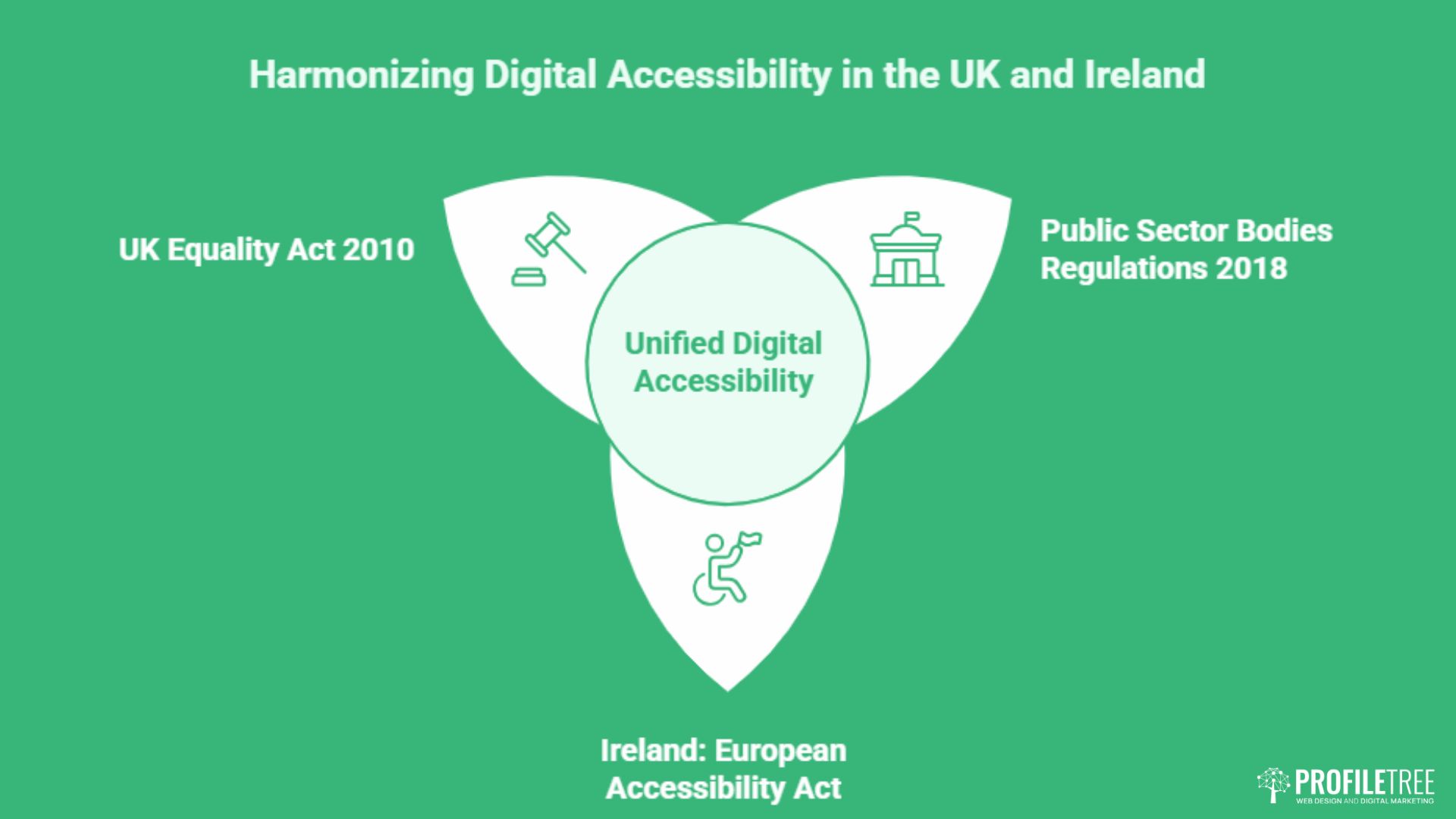
Most content covering the legal dimension of web accessibility focuses on the United States Americans with Disabilities Act (ADA). For businesses operating in the UK and Ireland, the relevant legislation is different, and the obligations it creates are often misunderstood. This is the section that most competitor content ignores, and it is the most practically important for ProfileTree’s clients.
Northern Ireland, like the rest of the UK, has a distinct and well-established legal framework for accessibility, one that applies to private businesses as well as public bodies. Businesses in Northern Ireland’s major cities and across the island of Ireland should understand these obligations clearly.
The UK Equality Act 2010 and Digital Compliance
The Equality Act 2010 places a duty on all service providers (including those providing services through websites) to make “reasonable adjustments” to avoid putting disabled people at a substantial disadvantage. The Act explicitly covers digital services. A website that is technically inaccessible to screen reader users, or that cannot be navigated by keyboard alone, may be in breach of the Act’s reasonable adjustment duty.
The phrase “reasonable adjustments” gives businesses some flexibility, but it is not a free pass. Courts and tribunals assess what is reasonable based on the size of the business, the cost of the adjustment, and the benefit to the disabled person. For most adjustments covered by WCAG 2.1 Level AA, such as adding alt text, improving colour contrast, and ensuring keyboard navigation, the cost is low relative to the benefit, making it difficult to argue that compliance is unreasonable.
Private companies should not assume the Equality Act only applies to public-facing, large-scale services. A small business website that fails to serve disabled customers is potentially exposed to a claim under Section 29 of the Act, which prohibits discrimination in the provision of services.
Public Sector Bodies Regulations 2018
For public sector organisations, the obligations are more specific and more stringent. The Public Sector Bodies (Websites and Mobile Applications) (No. 2) Accessibility Regulations 2018 require all public sector websites and apps to meet WCAG 2.1 Level AA and to publish an accessibility statement. The regulations are enforced by the Government Digital Service (GDS) in Great Britain and by the Cabinet Office in Northern Ireland.
Non-compliance carries reputational risk and the possibility of enforcement action. Public sector bodies that have not yet published an accessibility statement or conducted a WCAG audit should treat this as a matter of priority, not a future consideration.
Ireland: The European Accessibility Act
The European Accessibility Act (EAA) came into force across EU member states in June 2025. In the Republic of Ireland, it applies to a broad range of digital products and services, including e-commerce sites, banking, transport, and public communications. The EAA sets a higher bar than previous Irish accessibility legislation and expands coverage to private sector businesses in ways that the 2018 public sector regulations did not.
For businesses serving customers across both Northern Ireland and the Republic, compliance now means understanding both the UK Equality Act framework and the EAA simultaneously. Getting that right is not a one-time exercise; it requires an ongoing audit and remediation process.
| WCAG Success Criterion | Accessibility Requirement | SEO Benefit |
|---|---|---|
| 1.1.1 Non-text Content | All images have descriptive alt text | Images become indexable with keyword-relevant context |
| 1.2.2 Captions (Pre-recorded) | Videos include synchronised captions | Video content becomes indexable text |
| 1.3.1 Info and Relationships | Semantic HTML reflects content structure | Crawlers understand page hierarchy accurately |
| 2.4.4 Link Purpose | Link text is descriptive | Anchor text passes topical signals to linked pages |
| 2.4.6 Headings and Labels | Headings describe section content | Keyword-rich headings improve topical relevance signals |
| 1.4.3 Contrast (Minimum) | Text meets 4.5:1 contrast ratio | Lower bounce rates from improved readability |
The Risks of Accessibility Overlays and AI Quick Fixes
The accessibility industry has a problem: a category of products that promise WCAG compliance through a single script tag. Accessibility overlay tools (sometimes called “widgets” or “accessibility toolbars”) are third-party JavaScript plugins that claim to automatically fix accessibility issues on any website. Their marketing targets business owners who want compliance without the cost of a full audit. The reality is more complicated, and from an SEO perspective, the risks are real.
Why Overlays Often Fail Users
Overlays work by injecting JavaScript that attempts to modify the DOM in real time, adding ARIA labels, adjusting contrast, and changing heading structures on the fly. The problem is that these modifications are made after the page has loaded, based on assumptions about what might be wrong. They frequently break the pages they are trying to fix, interfere with screen readers that are already handling the DOM correctly, and create conflicts with keyboard navigation.
Multiple independent accessibility audits, including research published by the overlay review site Overlay Fact Sheet, signed by hundreds of accessibility specialists, have found that overlays do not reliably achieve WCAG compliance and, in many cases, make the experience worse for the users they claim to serve. In several documented cases, overlays have actively prevented screen readers from functioning on pages that were otherwise partially accessible.
The SEO Cost of Overlay Scripts
From a purely technical SEO standpoint, overlay scripts introduce measurable costs. A third-party script loading on every page adds to Total Blocking Time, a sub-metric of INP that measures how long the browser’s main thread is blocked by JavaScript. Scripts that intercept and modify the DOM also increase Cumulative Layout Shift scores if they rearrange visible elements after initial render.
Both of these effects work against Core Web Vitals performance, meaning a business that deploys an overlay to solve an accessibility problem may simultaneously damage its search rankings. The only long-term solution is fixing accessibility issues in the underlying code, not layering a script on top.
Understanding your website’s true performance requires looking at the full spectrum of performance metrics before drawing conclusions about where improvements are needed.
AI-Generated Alt Text: Useful Tool or SEO Risk?
Automated alt text generation, now built into several CMS platforms, has made it easier for teams to add basic image descriptions at scale. Used carefully, this is a genuine efficiency gain. Used carelessly, it creates a different problem.
AI-generated descriptions optimised for keyword density often produce alt attributes that repeat page keywords multiple times, creating patterns that trigger spam filters. They also frequently describe images inaccurately, generating a generic description based on image categories rather than what is actually shown. For an e-commerce site with hundreds of product images, inaccurate alt text creates both an accessibility failure and a keyword relevance problem simultaneously.
The better approach is to use AI-generated alt text as a starting point, then review and edit descriptions for accuracy and natural language before publishing. This workflow captures the efficiency gain without the quality cost.
The SEO and Accessibility Audit Framework
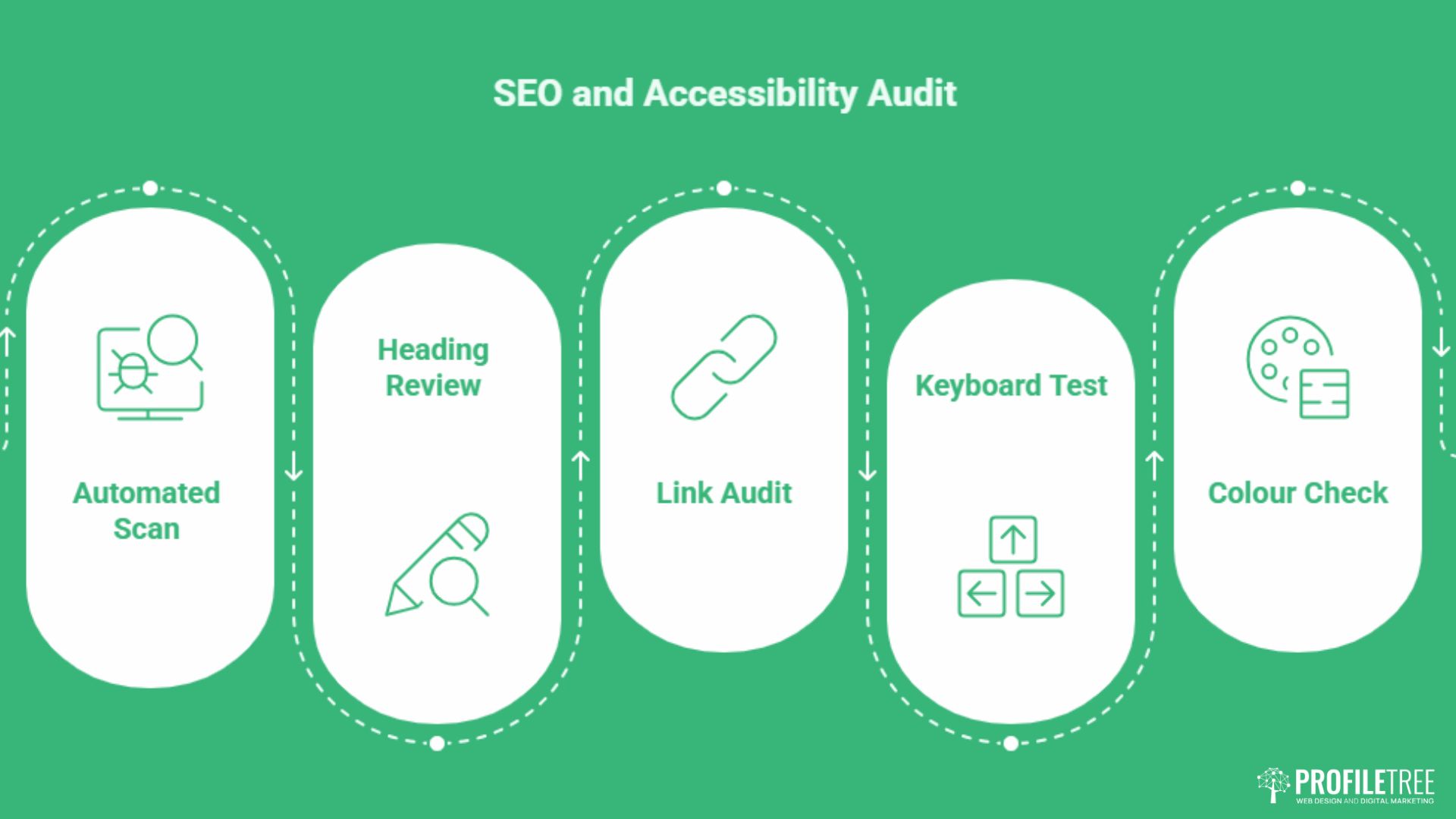
Running an accessibility and SEO audit as a single process is more efficient than running them separately, and the combined output is more actionable. The following framework reflects how ProfileTree approaches these audits for SME clients across Northern Ireland, Ireland, and the UK.
As Ciaran Connolly, founder of ProfileTree, notes: “The businesses that treat accessibility as a compliance burden tend to do the minimum and move on. The ones that treat it as a quality signal end up with faster sites, better content structure, and rankings that hold up through algorithm updates. The work overlaps more than most people expect.”
Step 1: Automated Baseline Scan
Start with automated tools to capture the most common, measurable issues. Google Lighthouse, run from Chrome DevTools or PageSpeed Insights, produces scores for Performance, Accessibility, Best Practices, and SEO simultaneously. This gives you a single baseline across all four dimensions without requiring specialist tools.
Axe DevTools (available as a browser extension) provides a more detailed accessibility-specific scan with issue descriptions mapped to WCAG success criteria. Screaming Frog, run in crawl mode, identifies missing alt text, broken links, missing meta descriptions, and heading structure issues at scale. These three tools together cover the majority of technical issues that automated scanning can detect.
Note that automated tools reliably identify only around 30 to 40 per cent of WCAG issues. The remainder requires manual testing.
Step 2: Heading Structure Review
Export the heading structure of every key page and review it as an outline. Does the H1 contain the primary keyword? Do H2 headings map to the major sections you would expect a user to move between? Are H3 headings genuine subsections, or are they styled headings that skip levels?
A heading structure that fails this review is both an SEO problem and an accessibility failure. Fix the hierarchy first; the keyword optimisation follows naturally once the structure is sound.
Step 3: Link Text Audit
Screaming Frog can export a full list of anchor texts across a site. Filter for generic phrases: “click here,” “read more,” “learn more,” “here,” “this,” and similar non-descriptive patterns. Every instance needs to be rewritten with descriptive text that communicates the destination’s topic.
Pay particular attention to navigation menus and calls to action. These are the links most likely to be navigated in isolation by screen reader users, and they carry significant internal linking value for SEO.
Step 4: Keyboard Navigation Test
Put the mouse aside and work through the site using only the Tab, Shift+Tab, Enter, and arrow keys. Can you reach every interactive element? Is there a visible focus indicator showing which element is currently selected? Can you skip over repetitive navigation to get to the main content?
Keyboard navigation failures are some of the most common and most serious accessibility issues on commercial websites. They are also invisible to automated scanners, which is why manual testing is non-negotiable for a thorough audit.
Businesses that want a thorough assessment of their digital presence often benefit from structured digital training that covers both SEO fundamentals and accessibility principles together, rather than treating them as separate disciplines requiring separate expertise.
Step 5: Colour Contrast and Readability Check
WCAG 2.1 Level AA requires a minimum contrast ratio of 4.5:1 for body text and 3:1 for large text (18pt or 14pt bold). The WebAIM Contrast Checker allows you to test any colour combination against these thresholds. Failing contrast ratios affect both visually impaired users and anyone viewing the site in bright conditions, such as on a mobile screen outdoors.
From an SEO standpoint, low contrast contributes to higher bounce rates and lower time on page, as users struggle to read content and abandon the page. This is one of the accessibility improvements most likely to produce a measurable improvement in engagement metrics within weeks of implementation.
An independent review of your site’s SEO health will often surface many of the same technical issues that a basic accessibility scan would find, confirming that the two disciplines share more common ground than most teams expect.
Conclusion
SEO and accessibility reinforce each other at every technical layer, from heading structure and semantic HTML to link text and page speed. For UK businesses, accessible design is also a legal obligation, not a discretionary improvement. The most practical approach is to audit both simultaneously, fix the foundations once, and benefit from the ranking and compliance gains together.
ProfileTree works with SMEs across Northern Ireland, Ireland, and the UK to build websites that perform in search and serve every user. Get in touch with ProfileTree to find out how ProfileTree can help.
FAQs
Is accessibility a direct Google ranking factor?
Accessibility is not a named binary ranking signal, but it shapes the signals that directly affect rankings. Semantic HTML improves crawlability. Descriptive link text strengthens internal linking. Page speed, which accessibility work often improves, is a confirmed Core Web Vitals input. The indirect relationship between WCAG compliance and search performance is strong enough that treating them as unrelated is a strategic mistake.
Do accessibility overlays help or hurt SEO?
Overlays typically hurt SEO by adding third-party JavaScript that increases Total Blocking Time and can trigger Cumulative Layout Shift. They also frequently fail to achieve genuine WCAG compliance, creating legal exposure without delivering the performance or accessibility benefits that proper code-level fixes would provide. The only reliable solution is remediating issues in the underlying HTML and CSS.
What is the best tool for checking both SEO and accessibility at once?
Google Lighthouse covers Performance, SEO, and Accessibility in a single report and is the logical starting point for any audit. For deeper accessibility testing, Axe DevTools provides WCAG-mapped issue detail. For site-wide SEO and link auditing, Screaming Frog covers heading structures, missing alt text, and broken links at scale. Using all three together takes around an hour for a site of typical SME size and produces a thorough picture of both disciplines.
Does the UK Equality Act 2010 apply to private company websites?
Yes. The Equality Act 2010 requires all service providers, including private businesses, to make reasonable adjustments for disabled users. This covers digital services. A website that prevents a visually impaired user from accessing a service available to other customers may constitute a breach of Section 29 of the Act.
Do screen readers read meta descriptions?
Screen readers do not read meta descriptions when a user browses a website, because they are not rendered in the visible HTML. However, meta descriptions appear in search engine results pages, and the journey of a screen reader user often begins there. A clear, descriptive meta description helps any user decide whether to click, including those using screen readers to move through search results.