
Using Big Data to Drive Marketing Decisions
Table of Contents
Big data gives marketers something that gut instinct cannot: a clear, evidence-based view of what customers actually do, not just what they say they want. For SMEs across Northern Ireland, Ireland, and the UK, that shift from assumption to analysis is where better campaign decisions begin.
Big data in marketing refers to the analysis of large volumes of customer, behavioural, and campaign data to inform smarter decisions. SMEs can apply big data through analytics platforms, customer data tools, and AI-assisted reporting to improve targeting, reduce wasted spend, and identify which channels actually drive results. ProfileTree works with businesses across the UK and Ireland to put data-driven digital marketing strategies in place.
What Is Big Data in a Marketing Context?
Big data is not just about scale. It refers to information that is too varied, too fast-moving, or too large to process through standard spreadsheet tools. In marketing, the relevant data comes from website behaviour, CRM records, social media engagement, email interactions, ad platform reporting, and point-of-sale systems.
The Three Characteristics That Define It
The academic framing of big data uses three dimensions: variety, volume, and velocity.
Variety covers the range of formats: numerical sales data, unstructured social media comments, video watch times, and GPS location data all count. Volume refers to the sheer quantity generated across channels, often in real time. Velocity means how quickly data arrives and needs to be acted on.
For most SMEs, the practical concern is not the raw scale but the ability to bring different data sources together into a single, usable view. A business running Google Ads, an email list, and a WooCommerce store may have three separate data systems that have never been connected.
Why Marketing Specifically Benefits
Marketing decisions have historically been based on limited feedback: sales figures, call volume, and occasional surveys. Big data changes the feedback loop. Instead of waiting until the end of a quarter to assess a campaign, teams can see what is working at the keyword, audience, and creative level within days. The speed of feedback changes how budgets get allocated and how quickly poor-performing work gets cut.
How Data-Driven Marketing Actually Works
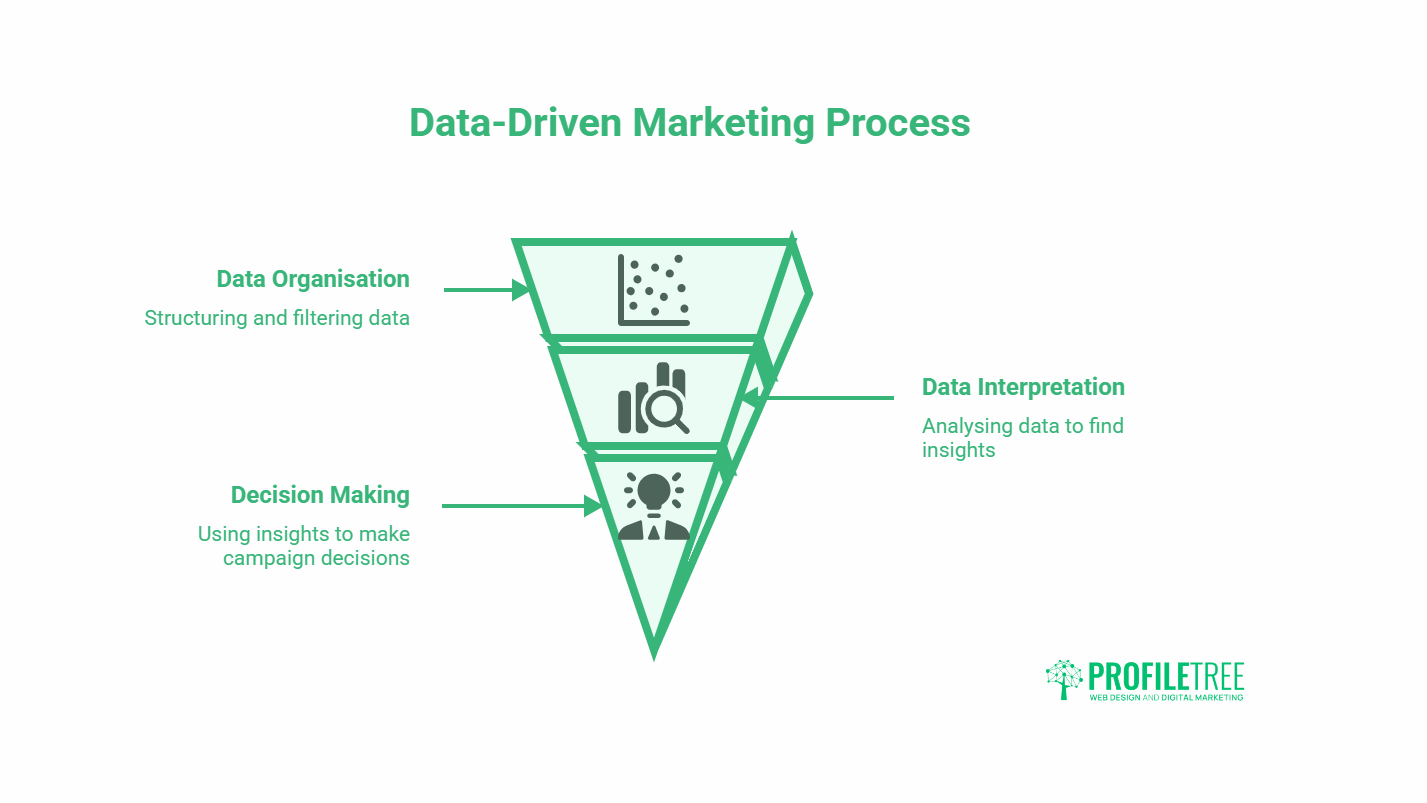
Data-driven marketing is the practice of making campaign decisions based on observed evidence rather than prior assumptions. The process is not complicated, but it does require the right infrastructure and a clear sense of what you are trying to measure.
Collecting the Right Data Points
Before any analysis is possible, the data needs to exist in a form you can use. That means setting up Google Analytics 4 correctly, connecting your CRM to your ad platforms, and making sure your email platform reports click and open data in a way that can be cross-referenced with purchase behaviour.
The most valuable data for SME marketers typically comes from four places: website behaviour (what pages people visit and for how long), campaign performance (which ads and emails drive actions), customer transaction history (what people buy and how often), and search query data (what terms people use to find you). Google Search Console and GA4 are free starting points for most businesses.
The Role of Marketing Analytics
Analytics sits between the raw data and the decision. It is the process of organising, filtering, and interpreting what you have collected so that it points toward a clear action.
In practice, this might mean identifying that 60% of your form submissions come from mobile users but your mobile conversion rate is half that of desktop, which tells you something specific needs fixing. Or it might mean discovering that one email subject line generates three times the click rate of another, which gives you a principle to apply to future sends. Analytics turns numbers into questions, and good questions into better campaigns.
Data Quality: Why It Matters More Than Volume
There is a common assumption that more data is always better. In marketing, this is rarely true. Duplicate customer records, misattributed conversions, and poorly configured tracking produce large datasets that lead to wrong conclusions. Before drawing any insight from your data, it is worth asking how the data was collected, whether the tracking is set up correctly, and whether the numbers reflect actual behaviour or platform reporting quirks.
A small, clean dataset from a properly configured GA4 account will produce more reliable decisions than a large, messy one from a system that has never been audited.
Using Big Data to Improve Audience Targeting
One of the most direct applications of big data in marketing is audience targeting. Instead of making broad assumptions about who your customers are, you can build segments based on actual observed behaviour.
Building Audience Segments from Real Data
Segmentation based on data moves beyond demographics. Rather than targeting “women aged 35 to 54 in Belfast”, you can build an audience of people who have visited your pricing page twice in the last 30 days without converting, or customers who purchased once over six months ago and have not returned. Both of these are behavioural segments that give you something specific to say, rather than a demographic bucket to broadcast at.
Platforms like Google Ads, Meta Ads Manager, and Klaviyo all support audience segments built from first-party data. The starting point is having that data flowing correctly from your website and CRM.
Personalisation at Scale
Personalisation in marketing does not require a large team. With the right data connections, an SME can send an email that references the specific product category a customer browsed, or serve a retargeting ad that shows the exact product someone added to a cart. These are not technically difficult to set up; they require clean data, a platform that supports segmentation, and a clear brief on what each segment should receive.
The difference in performance between a generic broadcast and a behavioural segment is significant. Open rates, click rates, and conversion rates all improve when the message matches what the recipient has already shown interest in.
Campaign Optimisation Through Data Analysis
Data does not just tell you who to target. It tells you what to say, where to say it, and how much to spend.
Reading Campaign Performance Data
Every campaign generates data as it runs. The question is whether that data is being reviewed regularly enough to make a difference. A common pattern is to launch a campaign, let it run for four weeks, then review the results. By that point, a significant portion of the budget has been spent on combinations that were not working.
More frequent reviews, even at a weekly level, allow for budget reallocation toward what is performing and away from what is not. This does not require advanced tools. A consistent habit of checking cost per click, cost per conversion, and return on ad spend against a defined target is enough to make materially better decisions over the course of a campaign.
Predictive Analytics: What It Is and When It Helps
Predictive analytics uses historical data to forecast future behaviour. In a marketing context, this might mean predicting which customers are most likely to churn, which leads are most likely to convert, or which products are likely to see increased demand in the next quarter.
For SMEs, the most accessible form of predictive analytics is built into the platforms you are probably already using. Google Analytics 4 includes predictive audiences such as “likely to purchase” and “likely to churn”, built from your own data. These can be applied directly to your ad targeting without any additional data science capability.
“Big data in marketing is often framed as something only large enterprises can use, but the reality is that most SMEs are already sitting on enough data to make meaningfully better decisions. The gap is usually not the data itself but having a clear process for reviewing it and acting on what it shows.” — Ciaran Connolly, Founder, ProfileTree
The Role of Machine Learning in Marketing Decisions
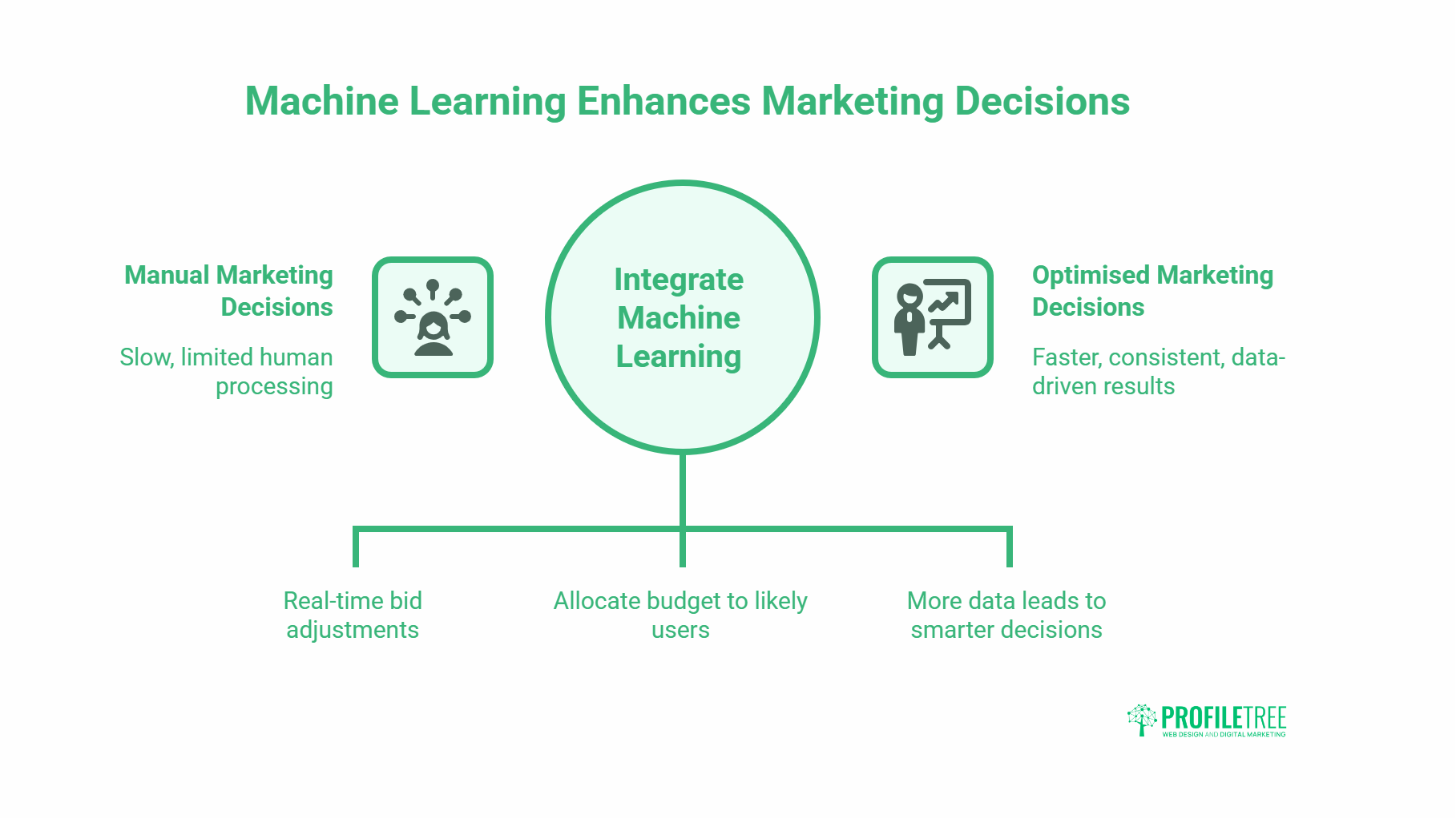
Machine learning has changed what is possible in marketing optimisation, not by replacing human judgement but by handling the volume and speed of decisions that humans cannot process manually.
What Machine Learning Does in Practice
In paid advertising, machine learning is already embedded in the platforms most businesses use. Google’s Smart Bidding adjusts bids in real time based on dozens of contextual signals, including device, location, time of day, and search query specifics. Meta’s ad delivery system allocates budget toward users most likely to take the action you have specified, based on patterns in your conversion data.
These systems work better when they have more data to learn from. A campaign with 50 conversions a month will produce smarter automated decisions than one with five, because the machine learning algorithm has more signal to work from.
Where Human Oversight Still Matters
Machine learning optimises toward the goal you set. If the goal is misspecified, the optimisation will be efficient but wrong. A common example: optimising for clicks rather than conversions will produce high traffic and poor results, because the algorithm finds the cheapest clicks, not the most valuable ones. Setting the right objectives, defining the right conversion events, and reviewing the outputs regularly are where human judgment remains essential.
As part of a broader AI transformation strategy, businesses are increasingly integrating machine learning tools into their campaign planning and reporting workflows, with the goal of making the data review process faster and more consistent.
Marketing Spend Efficiency: Where Data Has the Biggest Impact
One of the clearest returns from data-driven marketing is the reduction in wasted spend. When you can see exactly which channels, campaigns, and audiences are driving conversions, you can stop funding the ones that are not.
Attribution: Knowing Which Channel Gets the Credit
Attribution is the process of determining which marketing touchpoints contributed to a conversion. Without proper attribution, it is easy to over-invest in the last channel a customer used before converting (often direct or branded search) and under-invest in the earlier touchpoints that built awareness and consideration.
Multi-touch attribution models, available in GA4 and most ad platforms, distribute credit across the journey. This does not produce a perfect answer, but it produces a more honest one than last-click alone. For businesses running search, social, and email alongside each other, understanding how these channels interact is the difference between cutting a high-performing channel because its last-click numbers look weak and keeping it because the full-journey data shows it is generating leads that eventually convert through other routes.
Practical Budget Allocation from Data
A straightforward approach to data-informed budget allocation: review your cost per acquisition by channel each month, identify the two channels with the lowest CPA and the highest volume capacity, and shift a portion of budget from your highest CPA channel toward those. Do this gradually, not all at once, and measure the effect over 60 to 90 days before drawing conclusions.
This is not a complex process. It requires a monthly habit of looking at the right numbers and the willingness to follow what they show rather than what you assumed before the campaign started. ProfileTree’s digital marketing services include campaign reporting and budget strategy for SMEs who want this kind of structured approach without building an in-house data team.
Data Management Challenges for SMEs
The benefits of data-driven marketing are clear. The practical barriers are also real, particularly for businesses without dedicated data or technology teams.
Connecting Data Sources That Do Not Talk to Each Other
Most SMEs accumulate data in separate systems: a CMS that holds website content, a CRM that holds customer records, an email platform, and one or more ad accounts. These systems rarely share data automatically, which means the full customer picture exists in no single place.
The options for connecting these systems range from manual exports and spreadsheet merges (slow, error-prone, but free) to integration platforms like Zapier or Make (mid-range cost, suitable for most SMEs) to customer data platforms built for enterprise use (expensive, often unnecessary at SME scale). The right choice depends on the volume of data you are working with and how often you need it to update.
Maintaining Data Quality Over Time
Data quality degrades. Email addresses become invalid. CRM records go stale. Tracking configurations break when websites are updated. A data asset that is accurate when first built will produce misleading outputs 18 months later if it has not been maintained.
The minimum viable approach to data quality for an SME marketing operation: a quarterly audit of your GA4 configuration to check that key conversion events are still firing correctly, an annual clean of your email list to remove hard bounces and long-term non-openers, and a regular review of your CRM for duplicate or incomplete records.
Privacy, Consent, and GDPR
Data-driven marketing in the UK and Ireland operates within GDPR constraints. The most relevant rules for marketers: you must have a lawful basis for processing personal data (usually consent or legitimate interest), you must be transparent about how data is used, and you cannot use data collected for one purpose for another without additional consent.
For practical campaign use, this means your email list must be opt-in, your retargeting audiences must be built from users who have given consent via your cookie banner, and your data retention policies must be documented and followed. Working with a content marketing and digital strategy partner who understands these constraints helps avoid compliance issues that can be more costly than any campaign inefficiency.
Turning Data Into a Marketing Strategy
Data alone does not produce better marketing. The decisions made from data do. The gap between having access to analytics and actually improving campaign performance is almost always a process gap, not a technology gap.
Building a Data Review Habit
The most effective change most SME marketing teams can make is to establish a consistent rhythm of data review. This does not need to be sophisticated. A weekly 30-minute review of your top three or four campaign metrics, a monthly look at channel performance and cost per acquisition, and a quarterly assessment of whether your overall marketing mix is producing the outcomes you need will put most businesses ahead of the majority of their competitors.
The key is that each review produces a decision, not just an observation. “Our Facebook cost per lead increased 40% this month” is an observation. “We’re reducing Facebook budget by 20% and testing LinkedIn for the same audience” is a decision. Data has done its job when it changes what you do next.
From Data to Website and Campaign Design
Data-driven decisions should flow through to the work that actually reaches customers: website design, ad creative, email content, and landing pages. When data shows that mobile users convert at half the rate of desktop users, that is a call for a web design and development review. When it shows that a particular email subject line outperforms others by a factor of three, that is a principle to carry into every subsequent campaign.
The distance between insight and action should be as short as possible. The longer the data sits in a report without influencing anything, the less value it provides.
Conclusion
Big data gives SMEs the same analytical advantages that larger organisations have used for years, at a fraction of the cost and complexity. The tools are accessible; the data is already being generated. What turns that into better marketing is a consistent habit of review, clear objectives, and the willingness to follow what the data shows rather than what was assumed before it was collected. If you want a structured approach to data-driven digital marketing, get in touch with the ProfileTree team.
Frequently Asked Questions
What is big data in marketing?
Big data in marketing refers to the collection and analysis of large, varied datasets to inform campaign decisions. This includes website behaviour, customer transaction history, ad platform performance data, email engagement metrics, and social media signals. For SMEs, the practical application is less about handling massive data volumes and more about connecting the data sources you already have and reviewing them consistently. Platforms like Google Analytics 4, your CRM, and your ad accounts together generate more than enough data to make meaningfully better decisions than gut instinct alone.
How can small businesses use big data without a data team?
Most of the tools that make big data practical for small businesses are already built into platforms you may be using: Google Analytics 4 includes predictive audiences and attribution modelling; Google Ads and Meta Ads Manager both use machine learning to optimise delivery; and email platforms like Mailchimp or Klaviyo report on segmented performance automatically. The key is configuring these tools correctly, reviewing the outputs on a regular schedule, and making decisions based on what the data shows. Many SMEs work with a digital marketing agency to set up the infrastructure and establish a reporting rhythm before managing it in-house.
What is data-driven marketing?
Data-driven marketing is the practice of making decisions about campaigns, channels, messaging, and budget allocation based on observed evidence rather than prior assumptions. Instead of deciding where to spend based on where you have always spent, or what to say based on what sounds right, data-driven marketing uses real performance data to guide those choices. At its simplest, this means reviewing your cost per acquisition by channel each month and reallocating budget toward what is working.
What is the difference between predictive analytics and descriptive analytics?
Descriptive analytics tells you what happened: how many people visited your website, what your email open rate was, and how many conversions a campaign generated. Predictive analytics uses historical patterns to forecast what is likely to happen next: which customers are most likely to buy again, which leads are most likely to convert, and which audience segments are likely to respond to a given message. For most SMEs, descriptive analytics is the more immediately useful starting point. Once you have a clear picture of past performance, predictive tools like GA4’s built-in audiences can layer on forecasting without requiring a data science team.
How does GDPR affect data-driven marketing in the UK?
GDPR applies to any processing of personal data about individuals in the UK or EU. For marketers, the most relevant requirements are: you must have a lawful basis for using personal data in your campaigns (typically consent for email marketing and legitimate interest for some other uses); you must be transparent about how data is used; and you cannot use data collected for one purpose for another without additional consent. In practice, this means your email list must be opt-in, your retargeting audiences must be built from consenting users, and your cookie banner must accurately reflect what data is being collected. Non-compliance carries significant fines and reputational risk.
What tools do SMEs typically use for data-driven marketing?
The most common tools at SME level: Google Analytics 4 for website behaviour and attribution; Google Search Console for organic search performance; Google Ads and Meta Ads Manager for paid campaign data; an email platform with segmentation reporting (Mailchimp, Klaviyo, or Campaign Monitor); and a CRM to connect customer records to campaign activity (HubSpot and Zoho are common at SME scale). Connecting these systems, even partially, produces a much clearer picture than reviewing each in isolation. Integration tools like Zapier or Make can link platforms without custom development for most standard use cases.