
Green Marketing Practices: A Guide for UK and Irish SMEs
Table of Contents
Green marketing practices have shifted from optional to expected for businesses across the UK and Ireland. Customers are scrutinising environmental claims more closely, regulators are acting on misleading ones, and procurement teams are making sustainability credentials a condition of doing business. The pressure is real but so is the opportunity for businesses that can back their claims with evidence.
This guide covers what green marketing actually involves, how the 4 Ps apply when sustainability is part of your offer, what UK law requires from environmental claims, and how to build a digital presence that communicates your credentials without overstepping.
What Is Green Marketing?
Green marketing is the practice of promoting products, services, or business practices on the basis of their environmental benefits. Those benefits might relate to how something is made, what it’s made from, how it’s packaged, how it’s delivered, or what happens to it at the end of its life.
The term is often used interchangeably with sustainable marketing, but there’s a useful distinction. Sustainable marketing takes a broader view, encompassing social responsibility, long-term business ethics, and environmental impact. Green marketing, in its more specific sense, focuses on the environmental dimension: carbon footprint, material sourcing, energy use, waste reduction, and the communication of those factors to customers.
For SMEs in the UK and Ireland, green marketing matters on two levels. First, customers increasingly factor environmental credentials into their purchasing decisions, particularly in B2C sectors such as food, hospitality, retail, and construction. Second, UK procurement frameworks and larger corporate supply chains increasingly require suppliers to demonstrate ESG (Environmental, Social and Governance) credentials, meaning green marketing isn’t just consumer-facing; it also supports your ability to win B2B contracts.
The Green Marketing Mix: Reimagining the 4 Ps
The standard marketing mix of Product, Price, Place and Promotion holds up well when applied to green marketing, but each element requires a different set of questions.
Product: Life Cycle Assessment in Practice
A genuinely green product is one in which the environmental impact has been assessed across its full lifecycle, from raw material extraction through manufacture, distribution, use, and disposal. This approach, known as Life Cycle Assessment (LCA), provides the evidence base for green claims.
For SMEs, a full LCA may not be feasible. A practical starting point is to identify where your product or service has the greatest environmental impact and address it first. A food producer might focus on packaging and sourcing in the supply chain. A digital agency or professional services firm might look at server energy use, remote working policies, or paper consumption. The key is specificity: you can only make credible green claims about things you’ve actually measured.
Certifications provide third-party validation of product credentials. In the UK and Ireland, relevant bodies include the Soil Association (organic), the Forest Stewardship Council (paper and wood products), the Carbon Trust (carbon footprint verification), and Fairtrade. These are not marketing add-ons; they are independently verified claims that carry weight with both consumers and procurement teams.
Price: Justifying the Green Premium
Sustainable products typically cost more to produce, and that cost is usually passed on. Marketing a price premium during a cost-of-living squeeze requires a clear value narrative, one that moves the conversation from “this costs more” to “this lasts longer, uses less energy, or saves you money over time.”
The psychological framing matters. Research consistently shows that consumers accept a green premium when they trust that it reflects genuine practice rather than positioning. That trust comes from specificity, third-party validation, and consistent communication over time, not from a single campaign.
Place: Supply Chain and Distribution
Where and how products are distributed has its own environmental footprint. For businesses with physical supply chains, this might mean local sourcing, reduced delivery miles, consolidated logistics, or choosing distribution partners with their own environmental commitments.
For service businesses and digital agencies, “place” translates to questions about infrastructure: where are your servers hosted, what is your hosting provider’s energy policy, are you using renewable energy for your office operations? These are answerable questions, and the answers can form part of a credible sustainability narrative.
Promotion: Communicating Without Overstepping
This is where green marketing most commonly goes wrong. The promotion element must be grounded in what is actually true and verifiable, not what sounds good. The legal framework for this is covered in detail below, but the principle is straightforward: only claim what you can prove.
Effective green promotion tells a specific story. “Our packaging is made from 80% recycled PET” is a claim. “We’re eco-friendly” is a risk. The first invites scrutiny; the second invites regulatory attention.
Navigating the UK CMA Green Claims Code
The CMA Green Claims Code was published in September 2021, following a review of environmental claims in consumer markets. It provides six core principles that all green claims must meet to be legally compliant under UK consumer protection law.
1. Claims must be truthful and accurate. Businesses must not create a false impression about the environmental impact of a product or service, whether through words, images, or omission of relevant information.
2. Claims must be clear and unambiguous. Vague terms like “green”, “sustainable”, “natural” or “eco-friendly” are not compliant unless backed by specific, verifiable evidence. If a claim could mean different things to different people, it needs clarification.
3. Claims must not omit or hide important information. A product cannot be marketed as carbon-neutral if its carbon-neutrality depends on offset schemes that are not explained. Packaging cannot be described as “recyclable” if it’s only recyclable in facilities that most consumers cannot access.
4. Comparisons must be fair and meaningful. If you claim to be “greener than competitors” or “50% lower emissions than last year”, the basis for that comparison must be disclosed and accurate.
5. Claims must consider the full lifecycle. A product made from recycled materials but that requires high energy to use or generates significant waste at the end of life cannot be promoted purely on the recycled-materials angle without acknowledging the full picture.
6. Claims must be substantiated. Every green claim must be supported by solid, verifiable evidence, held before the claim is made, not assembled after the fact in response to a challenge.
The ASA has taken enforcement action against several UK brands for non-compliant green claims, including major advertisers in the energy, travel and FMCG sectors. For SMEs, the risk is reputational as much as regulatory: a complaint upheld by the ASA becomes public, and the coverage routinely outweighs the benefit of the original campaign.
The practical implication is that a green marketing strategy needs legal review alongside creative development. Before any environmental claim is used in advertising, on a website, or on social media, it should be tested against these six principles.
5 Green Marketing Strategies for UK and Irish Businesses
Effective green marketing starts with what your business actually does, not what it plans to do. The strategies below are grounded in verifiable action, giving you something specific to communicate and something specific for customers and regulators to check.
Radical Transparency and Traceability
The most defensible green marketing position is one where customers can see exactly what you’ve done and verify it. This means publishing specific metrics (not vague commitments), naming your certification bodies, and updating your claims as your performance changes.
Innocent Drinks has built significant brand equity through consistent, specific communication about its environmental actions, publishing annual sustainability reports, setting measurable targets, and being explicit when it misses them. That last point matters: honesty about shortcomings builds more trust than an implausible record of continuous improvement.
For SMEs, a sustainability page on your website that documents your current position, targets, and progress creates a credible foundation for any marketing claims. It also protects you if you’re ever challenged, because the evidence is already public.
Ethical Certifications as Marketing Assets
Third-party certification transforms a company’s claim into a verifiable fact. In B2B markets, particularly, certifications carry more weight than self-described credentials. ISO 14001 (environmental management systems), B Corp certification, and sector-specific schemes, such as the Green Tourism Business Scheme for hospitality, give buyers a standardised basis for comparison.
Certification is not a one-time event; it requires ongoing compliance and periodic audit. That commitment itself is a marketing signal, because it demonstrates that environmental practice is embedded in operations rather than applied as a communications layer.
Content Marketing Built Around Genuine Action
Content marketing is the primary mechanism through which green credentials reach and persuade audiences. A sustainability commitment that lives only in a press release is invisible. The same commitment documented through a blog series, a behind-the-scenes video, a supplier story, or a staff interview becomes a credible, searchable asset.
For businesses in sectors where environmental credentials matter, food production, construction, hospitality, and professional services, content that explains specific actions, describes real decisions, and acknowledges trade-offs builds authority that general advertising cannot replicate. It also creates a trail of evidence supporting compliance with the CMA Green Claims Code.
ProfileTree’s content marketing work with SMEs across Northern Ireland and Ireland consistently shows that sustainability content performs better when it’s specific and operational, rather than values-based and aspirational. “We switched to a supplier with certified sustainable palm oil because our original supplier couldn’t provide traceability documentation” is more credible and more interesting than “we’re committed to sustainable sourcing.”
Video Production for Sustainability Storytelling
Documentary-style video is arguably the most effective format for communicating environmental credentials, because it shows rather than tells. A factory tour showing material sourcing, a piece to camera from a founder explaining why they made a specific decision, or footage of a certification audit in progress, these create a level of specificity that written claims rarely achieve.
For SMEs considering video marketing, sustainability content offers a practical starting point: it’s story-driven, it’s differentiated from competitors who aren’t doing it, and it generates the kind of trust signals that influence both consumer purchasing and B2B procurement decisions.
Digital Marketing Strategy That Reflects Reality
An ethical digital marketing strategy for a business with genuine green credentials will use those credentials throughout the digital channel mix, but in proportion to their significance and with the specificity the CMA requires.
SEO content should target the specific claims your business can make: “sustainable [product category] [location]”, “certified organic [service/product]”, or “carbon-neutral delivery” rather than generic terms like “eco-friendly.” Social media should document actions, not broadcast positions. Email marketing can share progress against sustainability targets with subscribers who’ve opted into that narrative.
The common thread is that the digital marketing strategy must be downstream of actual practice. There is no credible green marketing strategy for a business that hasn’t first done the operational work.
Green Marketing in the B2B Sector
Most green marketing guidance assumes a B2C context, a consumer choosing between products on a shelf. For B2B businesses, the situation differs in two important ways.
First, procurement in larger organisations increasingly requires suppliers to demonstrate ESG credentials as a condition of appointment. The UK Government’s Procurement Policy Note 06/21, for example, requires suppliers bidding for major government contracts to publish a Carbon Reduction Plan. Privately, many large corporations apply comparable requirements to their supply chains. For SMEs seeking to supply larger businesses, green credentials are moving from a nice-to-have to a qualifying requirement.
Second, B2B purchasing decisions involve more scrutiny and a longer evaluation cycle than most consumer purchases. Claims that might go unchallenged in a B2C setting will be examined in detail during supplier qualification. This makes the CMA Green Claims Code’s requirement for substantiated, specific claims even more critical in B2B contexts.
The practical implication is that B2B green marketing should be built around documentation: certification evidence, carbon footprint data, supply chain policies, and sustainability reporting. The website’s sustainability section, case studies demonstrating specific environmental performance, and content that explains the business’s approach in operational detail are more persuasive to a procurement team than any advertising campaign.
How to Avoid Greenwashing: A Risk Framework
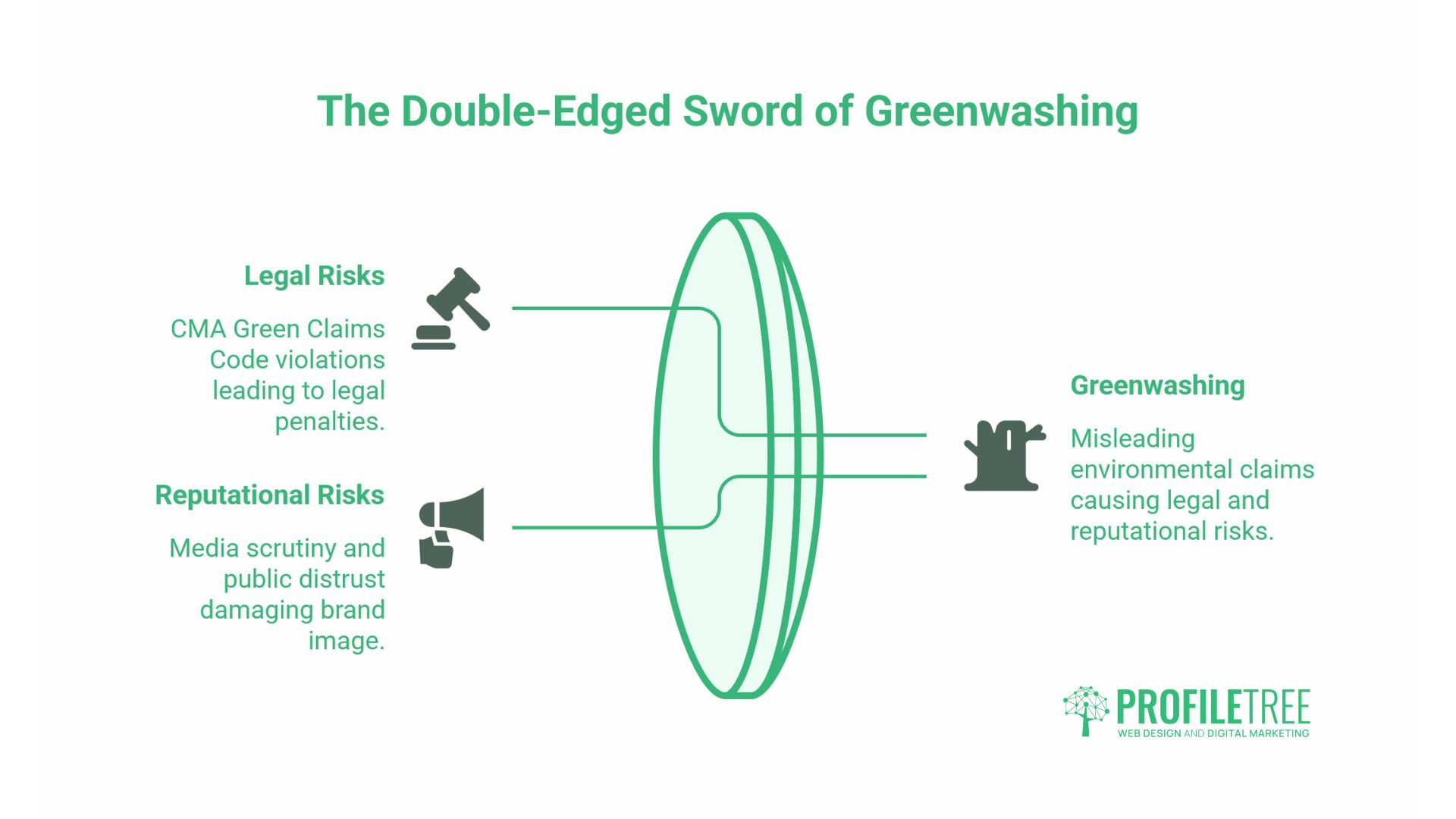
Greenwashing is the practice of making environmental claims that are misleading, unsubstantiated, or designed to create a false impression of a product’s or organisation’s environmental performance. It is both a legal risk under the CMA Green Claims Code and a reputational risk in a media environment that actively investigates and publicises it.
The most common greenwashing patterns in UK marketing are:
Vague language. Terms like “eco-friendly, “” natural, “sustainable”, “green”, and “earth-friendly” mean nothing specific. Any of these terms used without qualification or substantiation in advertising may be non-compliant.
Hidden trade-offs. Promoting one environmental attribute while obscuring significant negative impacts elsewhere. A product marketed as “made from recycled materials” that generates significant carbon emissions in manufacture and is non-recyclable at the end of life is engaging in a hidden trade-off.
Irrelevant claims. Claiming something is “CFC-free” when CFCs have been legally prohibited for decades adds nothing and potentially misleads consumers into believing the product has a credential it doesn’t.
Selective disclosure. Publishing sustainability data only when performance is positive, or comparing only metrics with strong performance, creates a misleading overall picture.
The practical test before any green claim is published: if a well-informed, sceptical consumer or journalist examined this claim in detail, would it hold up? If the answer is uncertain, the claim needs either more specific substantiation or a different formulation.
| Problematic claim | Compliant alternative |
|---|---|
| “Eco-friendly packaging” | “Packaging made from 80% recycled card, fully recyclable at kerbside” |
| “We’re carbon neutral” | “Our direct operations are carbon neutral, verified by [body]; we’re working to reduce Scope 3 emissions” |
| “Sustainably sourced” | “100% of our timber is FSC-certified; full supplier list available on request” |
| “Green energy” | “Our Belfast office runs on renewable electricity supplied by [named provider] under a REGO-backed tariff” |
Digital Training and Building Internal Capability
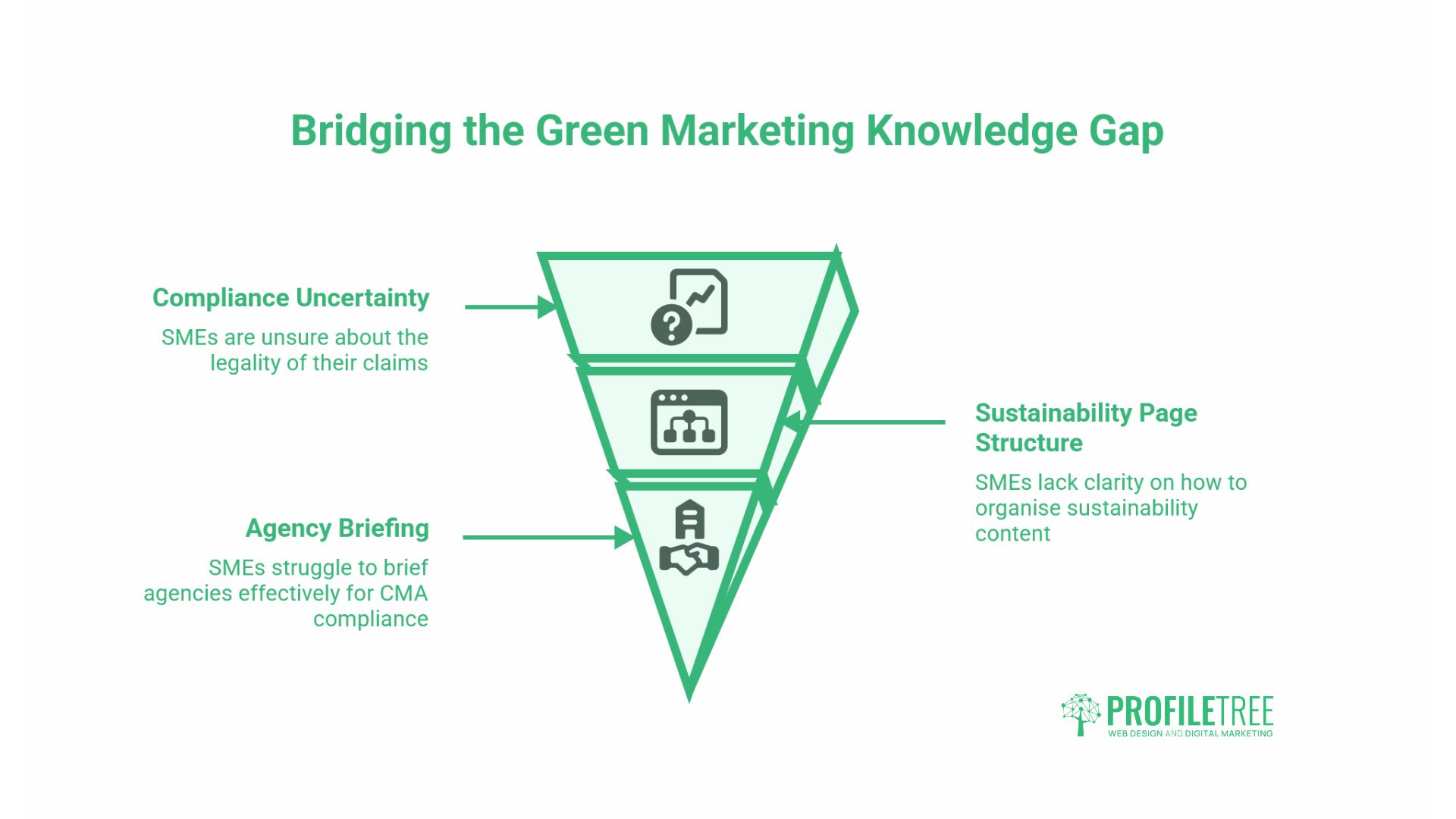
One of the more practical gaps for SMEs approaching green marketing is the internal knowledge deficit. Most businesses know roughly what they want to say but are uncertain whether their claims are compliant, how to structure a sustainability page, or how to brief external agencies to produce content that meets CMA requirements.
Digital training that covers content compliance, marketing communications, and digital strategy can build the capability to manage green marketing in-house, particularly useful for businesses where sustainability is a genuine operational commitment rather than a communications exercise.
ProfileTree’s digital training work with SMEs across Northern Ireland and Ireland covers the practical application of content strategy, including how to approach compliance-sensitive topics like sustainability claims. The goal is not to outsource every piece of content, but to build the judgment needed to produce it responsibly.
Conclusion: Green Marketing Practices
Green marketing done well is an exercise in operational honesty communicated through digital channels. The businesses that build lasting credibility in this space are those that do the environmental work first, document it specifically, and communicate it in the way the CMA Green Claims Code requires: truthful, unambiguous, complete, and substantiated.
For SMEs in the UK and Ireland, the competitive opportunity is real. Most competitors are either silent on sustainability or make vague claims that regulatory guidance has flagged as risky. A business that can demonstrate specific, verified environmental credentials through a well-built digital presence is differentiated and protected.
FAQs
What is the CMA Green Claims Code?
Published by the Competition and Markets Authority in September 2021, the Green Claims Code sets out six principles businesses must meet when making environmental claims under UK consumer protection law. Claims must be truthful, unambiguous, complete, fair in comparisons, accurate across the product lifecycle, and substantiated by evidence held before the claim is made.
What are the 4 Ps of green marketing?
Product, Price, Place, and Promotion each carry specific environmental considerations: Product covers lifecycle assessment and certifications; Price covers credibly communicating a green premium; Place covers supply chain and infrastructure decisions; Promotion covers making environmental claims in a legally compliant way.
What are the most common greenwashing mistakes?
The most common are using vague terms like “eco-friendly” or “natural” without specific evidence, and making claims that omit significant negative impacts elsewhere in the product lifecycle. The ASA has issued rulings against UK brands for both.
Does green marketing work for B2B businesses?
Yes, and it is increasingly a commercial requirement. UK government procurement policy and many corporate supplier qualification processes now require evidence of environmental commitments as a condition of appointment.