
Voice Search Optimisation: A Practical Guide for UK and Irish SMEs
Table of Contents
Voice search is no longer a future trend to prepare for. Your customers are already using it. When someone asks their phone “where’s the nearest web design agency in Belfast?” or “who does SEO in Northern Ireland?”, Google returns a direct spoken answer. On smart speakers, that means one result. On smartphones, there is often a spoken answer alongside a visual results page, but most people act on the spoken answer first.
Whether your business appears in that answer depends almost entirely on decisions made before the search happens: how your website is structured, how your content is written, and whether your local presence is properly set up. This guide explains what voice search optimisation involves, why it matters to SMEs across the UK and Ireland, and what practical steps you can take to improve your visibility.
What Is Voice Search Optimisation?
Voice search optimisation is the process of preparing your website, content, and local listings so that your business appears when someone uses a voice assistant to search for what you offer. That includes searches made on a smartphone using Google, via Siri on an iPhone, via Amazon Alexa, or via Google Home on a smart speaker.
The core difference between voice and text search is how people phrase queries. When someone types, they use shorthand: “SEO agency Belfast.” When they speak, they use natural language: “What’s the best SEO agency in Belfast for small businesses?” Voice search optimisation means writing and structuring your content to match those fuller, more conversational queries.
This matters for three reasons. First, voice queries have strong local intent: a large proportion of voice searches are looking for businesses or services nearby. Second, voice search surfaces a primary answer rather than a ranked list, so the threshold for appearing is higher than in standard organic results. Third, the signals that determine voice search rankings overlap heavily with those that determine whether your content appears in Google’s AI Overviews, making voice search optimisation part of a broader, future-proofing strategy.
The Three Categories of Voice Search
Understanding what people are searching for helps you write content that matches their intent. Voice queries broadly fall into three categories.
- Discovery searches have local intent. Coffee shop near me”, “web designer in Derry”, “accountant in Belfast.” These are the searches that send customers through your door. They rely on your Google Business Profile and local SEO signals.
- Informational searches are question-based. “How does SEO work?”, “What is structured data?”, “How long does a website redesign take?” These queries reward content that gives clear, direct answers in plain language.
- Transactional searches show intent to act. “Book a consultation with a digital agency”, “get a quote for web design in Northern Ireland.” These are commercially valuable and reward businesses with clear contact information and fast, mobile-friendly websites.
How Voice Search Differs from Traditional Text Search
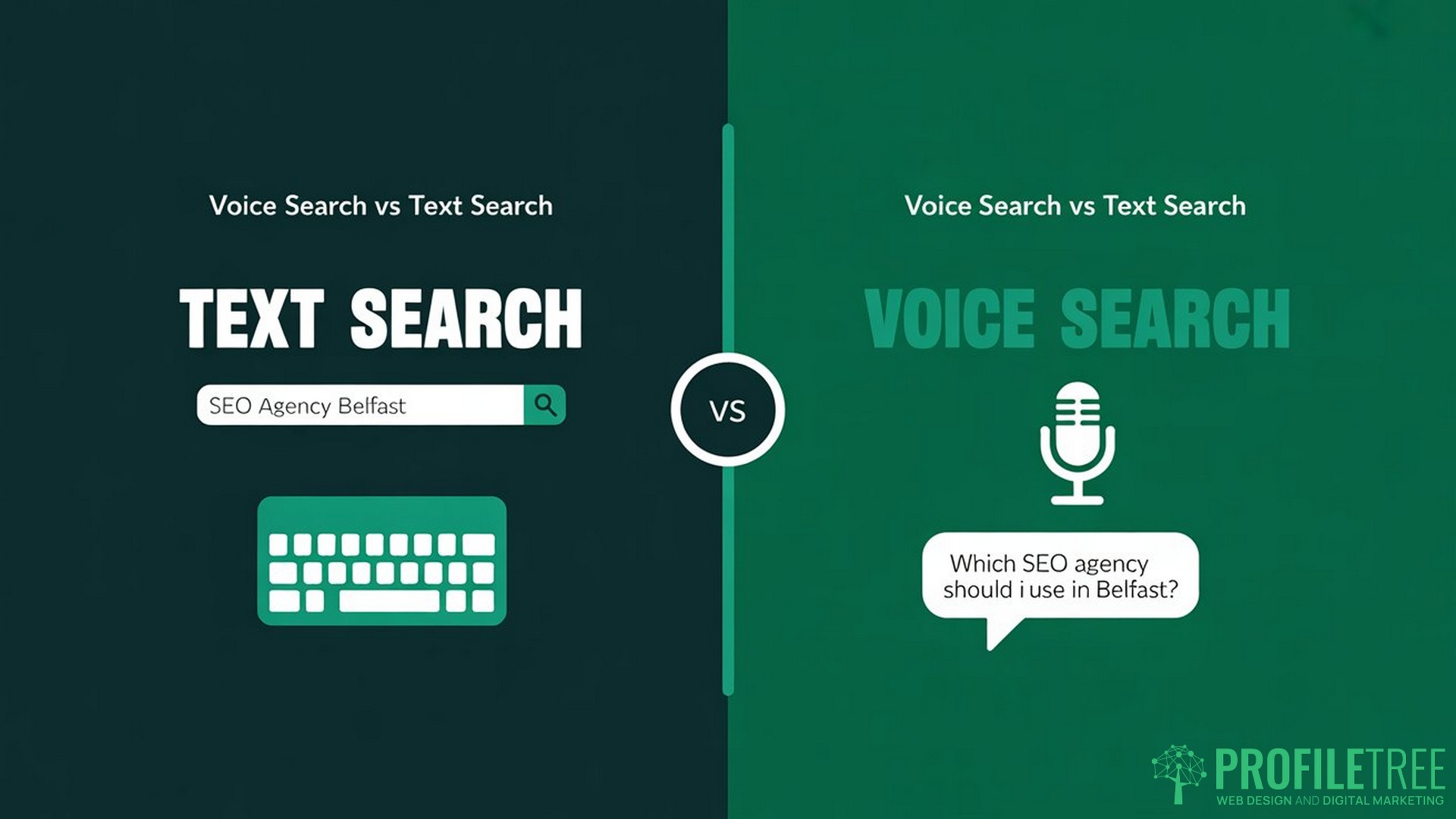
The table below shows how the same search intent looks in typed versus spoken form. The difference in phrasing has direct consequences for which keywords you target and how you structure your content.
| Search Type | Typed Query | Voice Query | Intent Category |
|---|---|---|---|
| Finding an agency | “SEO agency Belfast” | “Which SEO agency should I use in Belfast?” | Discovery |
| Understanding a service | “what is voice SEO” | “How does voice search SEO work?” | Informational |
| Getting a price | “website design cost NI” | “How much does a website cost in Northern Ireland?” | Transactional |
| Finding a location | “digital marketing agency near me | “Is there a digital marketing agency near me open now?” | Discovery/Local |
Typed searches are keyword fragments. Voice searches are questions or full sentences. If your content is written only for the fragment version, it will struggle to appear for voice queries.
One practical implication: your FAQ sections, subheadings, and introductory paragraphs should be written as full questions and direct answers, not as keyword-stuffed headings. A heading like “What does voice search optimisation involve for UK SMEs?” performs better for voice than “Voice Search Optimisation Tips.”
The 7-Step Voice Search Framework for UK and Irish Businesses
This is where the practical work happens. Voice search optimisation is not a single tactic. It is a set of overlapping adjustments to your website, your content, and your local presence. Work through these in order.
1. Get Your Google Business Profile Right First
For any voice query with local intent, Google’s first source of information is your Google Business Profile (GBP). If your profile is incomplete, outdated, or inconsistent with your website, your chances of appearing in a voice result are low, regardless of how well-optimised your site is.
Check that your business name, address, and phone number are identical across your GBP and your website. Add your services, your opening hours, and a clear description of what you do and where you do it. Businesses that respond to reviews regularly and keep their profiles updated tend to perform better in local search, including voice.
For SMEs in Northern Ireland and Ireland, this means being specific: include “Belfast,” “Northern Ireland,” or the relevant city in your description and service areas. Voice searches for local businesses are geographically precise.
If you want to understand how voice search and local SEO connect in more depth, our local SEO guide covers the full picture for Northern Ireland businesses.
2. Research Conversational, Question-Based Keywords
Standard keyword research tools surface the fragment versions of queries. For voice search optimisation, you need the long-tail, question-based versions. Start by looking at the “People Also Ask” boxes in Google for your main service terms. These are often direct voice query formats.
Tools like Google Search Console show you the actual queries people use to find your site. Filtering for queries that run to seven words or more is a useful practical approach, as longer queries tend to reflect conversational or voice-style searches more than short typed fragments do. Use the phrasing patterns you find there to shape new content sections and FAQ entries.
You are not replacing short-tail keywords. You are adding the conversational layer on top of them. A page targeting “web design Belfast” should also include content that answers “How do I find a web design company in Belfast?” and “What does web design cost for a small business in Northern Ireland?”
3. Build in Schema Markup and Structured Data
Schema markup is code added to your website that tells search engines what your content means, not just what it says. For voice search, two types of schema are particularly valuable.
- The FAQPage schema marks up your frequently asked questions so Google can extract them as direct answers to voice queries. If someone asks, “How long does a website redesign take?” and your FAQ page has that question with a clear, direct answer, the FAQPage schema makes it significantly easier for Google to surface your answer.
- Speakable schema specifically identifies sections of a page that are suitable for text-to-speech output. It signals to Google that a particular paragraph or section is formatted as a clear, direct answer. While Google has not confirmed Speakable schema as a direct ranking factor, it aligns your content with how voice results are selected and is worth implementing on key service and FAQ pages.
As Ciaran Connolly, founder of ProfileTree, puts it: “Schema isn’t just for bots any more. It’s the script you’re giving the AI to read your business details to a potential customer.” Without it, you are leaving the interpretation entirely to the search engine.
ProfileTree’s web development team builds schema markup into every website we deliver because it serves voice search, AI citation, and standard organic rankings simultaneously.
4. Prioritise Page Speed and Mobile Performance
Voice searches happen predominantly on mobile devices. If your website loads slowly on a mobile connection, or if elements shift around as the page loads, Google will not use it as a voice search source. Core Web Vitals are a confirmed Google ranking signal, and they apply to voice search eligibility as they do to standard organic rankings.
Practical improvements include compressing images to WebP format, removing unnecessary third-party scripts, and using a reliable hosting provider with servers close to your users. A site built on WordPress with good hosting and a lightweight theme can consistently achieve the performance scores needed.
If you are unsure how your site performs, Google’s PageSpeed Insights tool gives you a score and a list of specific issues to fix. Aiming for mobile scores above 90 is a reasonable practitioner benchmark, though Google has not published a specific score threshold for voice search eligibility. What matters is closing the gap between your current performance and a fast, stable mobile experience.
5. Structure Content for Position Zero
Voice assistants consistently read from the featured snippet, also called Position Zero. This is the answer box that appears above the regular search results. Winning it for a relevant question means your answer is what gets read out.
To target Position Zero, write answer-first content. State the direct answer to a question in the first two sentences of a paragraph, then expand with supporting detail. Keep your direct answer under 50 words. Use the exact question phrasing in the heading above the answer.
For example, if you want to appear when someone asks “What is structured data for voice search?”, your H3 heading should be “What Is Structured Data for Voice Search?” and the first two sentences of that section should give a complete, standalone answer before you expand on it.
This is also the format from which Google’s AI Overviews are extracted. Voice search optimisation and AI Overview optimisation are largely the same discipline.
6. Write How Your Customers Actually Speak
This is where UK and Irish SMEs have an advantage that global content factories cannot replicate. Voice recognition has improved significantly at processing regional accents and local language patterns, including Northern Irish, Scottish, and Irish English syntax. The way your customers phrase queries in Belfast or Cork is different from how they phrase them in Chicago.
Practical applications: Use the local terms your customers use, not the formal industry terms. If people in your area say “wee business” or “local tradesman,” those phrases belong in your content. Write FAQ answers the way you would explain something to a customer face-to-face. Read your content aloud. If it sounds unnatural when spoken, it will not perform well in voice search.
This is also why content created without local knowledge tends to underperform for Northern Ireland businesses. Generic content written for a global audience does not match the specific phrasing your local customers use.
7. Build Local Authority Through Backlinks and Citations
Voice search for local queries draws on the same authority signals as local SEO: backlinks from local directories, press mentions, and trusted local websites. Being listed accurately on Yell, the NI Business Info directory, and relevant local Chamber of Commerce sites builds the citation profile that supports local voice rankings.
For SMEs in Northern Ireland, appearances in local press and on regional business websites carry genuine weight. These are not just link-building exercises. They are trust signals that tell Google your business is a credible local entity.
Voice Search in the Age of AI: Gemini, ChatGPT, and SearchGPT
Most voice search guides still describe the technology as it worked in 2020. The reality in 2025 and beyond is that voice queries on smartphones and smart speakers are increasingly processed by generative AI rather than legacy keyword-matching algorithms.
When someone uses the Google Assistant to ask a complex question, the response is increasingly generated by Gemini, Google’s AI, particularly for conversational or multi-part queries. When someone uses SearchGPT or Perplexity with voice input, those systems pull from web content using retrieval-augmented generation. The implication is significant: voice search optimisation and AI visibility are now the same thing.
Content that performs well in AI Overviews tends to share specific characteristics. It is long-form and covers a topic in depth. It is structured with clear question-based headings and direct answers. It includes tables, structured comparisons, and specific examples. It has an FAQ page schema and clear entity signals: your business name, location, and service category are explicitly stated and consistent across the page.
If you have been investing in content marketing and structured SEO, that investment is already working across both voice search and AI-driven search. The signals are unified. What changes is the output format: instead of a blue link, your content becomes a spoken or generated answer.
For SMEs thinking about how to approach this, ProfileTree’s AI implementation services cover practical steps for making your digital presence visible across both traditional and AI-driven search. Our digital training programmes also cover this ground for teams who want to build these skills in-house.
Measuring Your Voice Search Performance
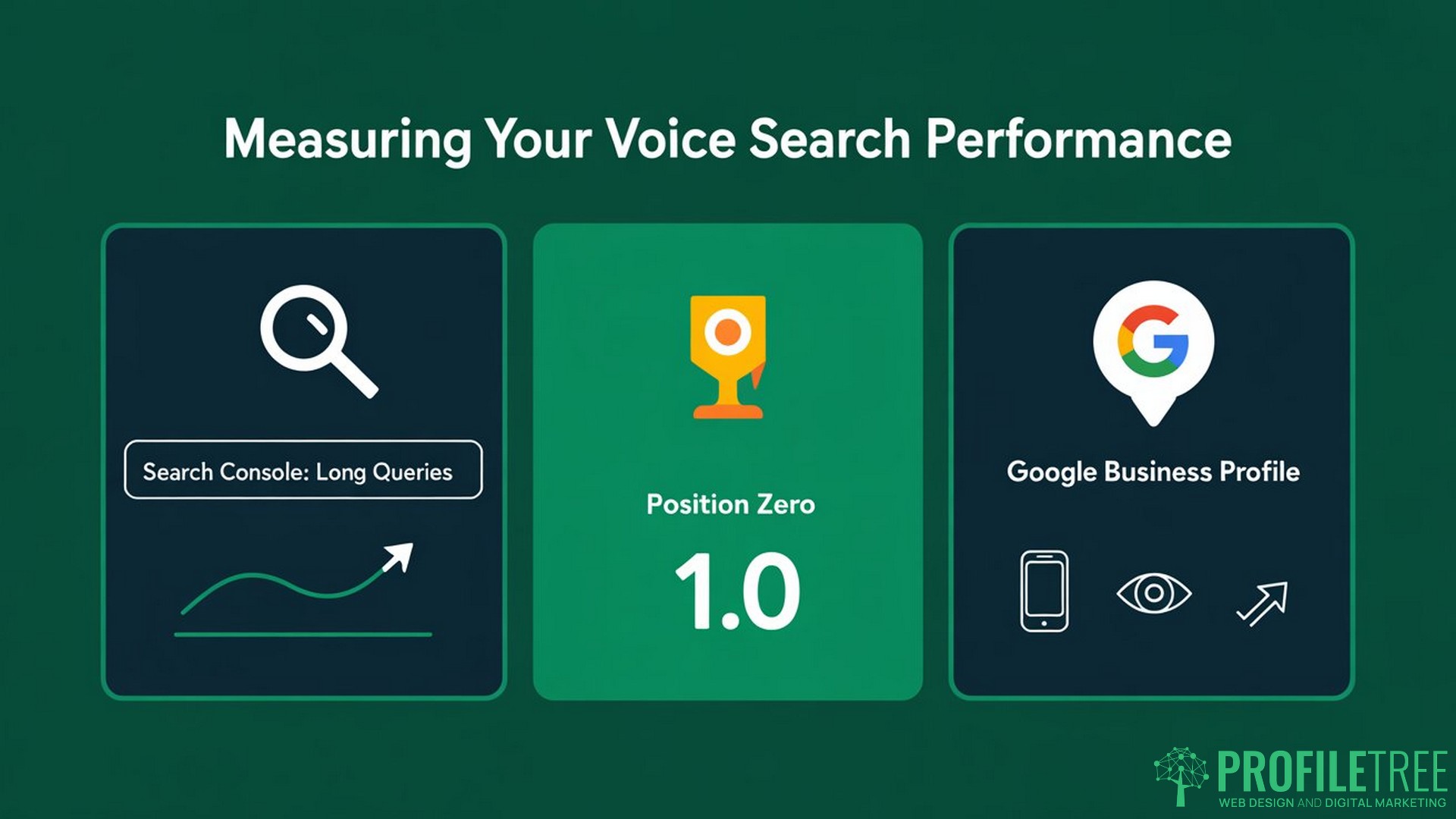
Voice search does not have a dedicated report in Google Search Console. You measure it indirectly, but the signals are clear enough to be useful.
Filtering your Search Console query report for longer, question-style queries is a practical starting point, as these tend to reflect conversational and voice-style searches more than short typed terms. Track their impressions and click-through rates over time. If you implement the steps in this guide and those figures improve, voice search optimisation is working.
Also, watch your Position Zero appearances. In Search Console, queries where your average position sits close to 1.0 are likely featured snippet appearances, which are the primary source for voice answers.
Track your Google Business Profile insights separately. Views, calls, and direction requests from your GBP are direct proxies for local voice search performance. A growing call volume from your GBP, without a corresponding increase in website traffic, often indicates that voice searches are resolving at the GBP level rather than clicking through to your site.
Voice search optimisation is not a separate discipline from good SEO. It is the same work, applied with more attention to how people speak, how content is structured, and how local presence is maintained. The businesses that appear in voice results are those with fast, well-structured websites, clear local signals, and content that answers real questions directly.
If your website was built several years ago and has not been reviewed for mobile performance, schema markup, or conversational content structure, that is where to start. ProfileTree works with SMEs across Northern Ireland, Ireland, and the UK to build and improve websites that perform well across both traditional and AI-driven search. Get in touch to discuss what a technical SEO review could uncover for your business.
Frequently Asked Questions
What is the best way to optimise for voice search?
Focus on three areas in order of priority. First, make sure your Google Business Profile is complete and accurate, as local intent drives most commercial voice queries. Second, write content that answers questions in plain, direct language, and use FAQ sections with exact question phrasing. Third, add FAQPage and Speakable schema markup so search engines can easily extract your answers. Page speed on mobile underpins all of it.
Does voice search affect my standard SEO rankings?
Voice search and organic rankings respond to the same core signals: page authority, content quality, mobile performance, and structured data. Improving your voice search optimisation will generally improve your standard rankings as well. The most direct overlap is in featured snippets: winning Position Zero for a query means your answer is both the featured snippet and the likely voice result.
What are the three categories of voice search?
Discovery (or local) searches look for businesses and services nearby: “web design agency near me.” Informational searches ask how things work or what they mean: “How does schema markup help SEO?” Transactional searches show intent to take an action: “Book a consultation with a digital marketing agency in Belfast.” Each category requires a different optimisation approach: local SEO for discovery, structured Q&A content for informational, and clear calls to action with fast mobile performance for transactional.
How do accents and regional language affect voice search in the UK?
Modern voice recognition systems, particularly Google, have significantly improved at processing regional accents, including Northern Irish, Scottish, Welsh, and regional English dialects. The more practical implication for content is that you should write and structure your FAQ content using the local language patterns and phrasing your customers actually use. If your customers say “near me” or use local terminology, that belongs in your content. Regional specificity also helps with local intent matching.
Is voice search optimisation the same for Alexa, Siri, and Google?
The voice processing engines differ, but the underlying content sources are broadly consistent. Google Assistant draws from your website content, Google Business Profile, and structured data. Siri draws primarily from Google and Apple Maps, with Bing as a secondary source. Alexa has historically drawn primarily from Bing, though its underlying AI architecture has been evolving, so this is worth monitoring. Optimising for Google covers the majority of voice search traffic in the UK and Ireland and serves as the most reliable foundation across all platforms.
What is the Speakable schema, and do I need it?
Speakable schema is a type of structured data that identifies sections of your page as suitable for text-to-speech output. It tells Google which paragraphs contain clear, self-contained answers that work well when read aloud. Google has implemented it but has not confirmed it as a direct ranking factor. For any business seriously investing in voice search optimisation, it is worth including on key service and FAQ pages, as it aligns your content intent clearly with how voice results are selected.
How long does it take to see results from voice search optimisation?
Results vary depending on your starting point. If your Google Business Profile is incomplete and you bring it up to standard, you may see improvement in local voice appearances within a few weeks. Content and schema changes generally take longer to reflect in ranking data, often several months, depending on how frequently Google crawls your site and how competitive your target queries are. Technical improvements to page speed tend to show in Core Web Vitals scores relatively quickly, though their downstream effect on search visibility takes longer to measure.