
Customer Data Privacy in Digital Marketing
Table of Contents
Every business collecting customer information online carries a legal and commercial responsibility. Get it wrong and the consequences range from regulatory fines to lasting damage to your reputation. Get it right and data privacy becomes a genuine advantage: customers who trust a brand share more, buy more, and stay longer.
This guide covers what SMEs need to know about customer data privacy in digital marketing: how the main regulations apply, where the commercial risks lie, and what practical steps you can put in place today.
What Is Customer Data Privacy?
Customer data privacy refers to a person’s right to control how their personal information is collected, stored, and used. In digital marketing, this covers everything from email addresses and purchase histories to browsing behaviour, location data, and cookie-based tracking.
The data businesses collect fall into several categories. First-party data comes directly from customers through website interactions, form submissions, or in-store activity. Third-party data is purchased or obtained from external sources. Cookies record user behaviour across the web. Consent records document when and how customers agreed to data collection.
Each category carries different obligations. First-party data collected transparently, with clear consent, is the most legally sound and the most commercially valuable. It reflects a genuine relationship between your business and your audience. Digital marketing strategy services can help businesses build this privacy-conscious approach into their wider marketing plans, from deciding what data to collect to establishing how it should be used across campaigns and customer communications.
Legal Frameworks Every Digital Marketer Must Know
Understanding the key regulations is the starting point for any data privacy strategy. Two frameworks affect most SMEs operating in or targeting customers in Europe and North America.
GDPR: The Core Standard for UK and EU Businesses
The General Data Protection Regulation sets the standard for how personal data is handled across the UK and the European Union. It applies to any business that collects data from UK or EU residents, regardless of where the business is based.
Under GDPR, businesses must obtain explicit consent before collecting personal data, give individuals the right to access and delete their information, and notify the relevant authority of a data breach within 72 hours. Fines for serious non-compliance reach up to £17.5 million in the UK (or €20 million in the EU), or 4% of annual global turnover, whichever is higher.
Practical compliance steps include appointing a Data Protection Officer if you process data at scale, conducting regular data protection impact assessments, and building privacy considerations into new projects from the outset rather than adding them retrospectively.
CCPA: What US-Facing Businesses Need to Know
The California Consumer Privacy Act grants similar rights to California residents: the right to know what data is collected, the right to request deletion, and the right to opt out of the sale of personal data. Businesses have 45 days to respond to consumer data access requests. Intentional violations carry fines of up to $7,500 per incident.
If your business markets to US customers, the CCPA is worth understanding even if you’re based in the UK. The trend across US states is toward stronger consumer data rights, broadly following the GDPR model.
The Wider Regulatory Direction
GDPR and CCPA are not outliers. Governments across the world are strengthening data protection laws, driven by growing public concern about how personal information is used online. Businesses that treat compliance as a minimum standard rather than a ceiling are better placed to adapt as regulations develop.
How Data Privacy Builds (or Breaks) Customer Trust
The Commercial Case for Strong Privacy Practices
Customer trust is directly tied to how a brand handles personal data. Research consistently shows that data misuse is among the top reasons consumers lose confidence in a company. A significant breach can shift public perception quickly, and the reputational damage often outlasts the financial penalty.
The reverse is also true. Brands that are transparent about data use, make consent straightforward, and handle information with care attract customers who are more willing to share their data. That sharing enables better personalisation, which in turn improves marketing performance. Privacy and performance are not in conflict.
“Ethical data use isn’t just a policy; it’s part of our culture at ProfileTree. Taking care of customer data builds the kind of trust that underpins long-term client relationships.”
What Happens After a Breach
Data breaches carry financial costs (IBM’s 2023 Cost of a Data Breach Report put the global average at $4.45 million), but the longer-term cost is the erosion of customer confidence. Businesses that respond quickly with clear, honest communication limit the damage. Those who delay or obscure what happened tend to suffer disproportionately.
A response plan should cover: immediate containment, notification to the relevant supervisory authority within the regulatory timeframe, direct communication to affected customers, and a clear account of what steps have been taken to prevent recurrence.
Practical Steps for Managing Customer Data
Collect Only What You Actually Need
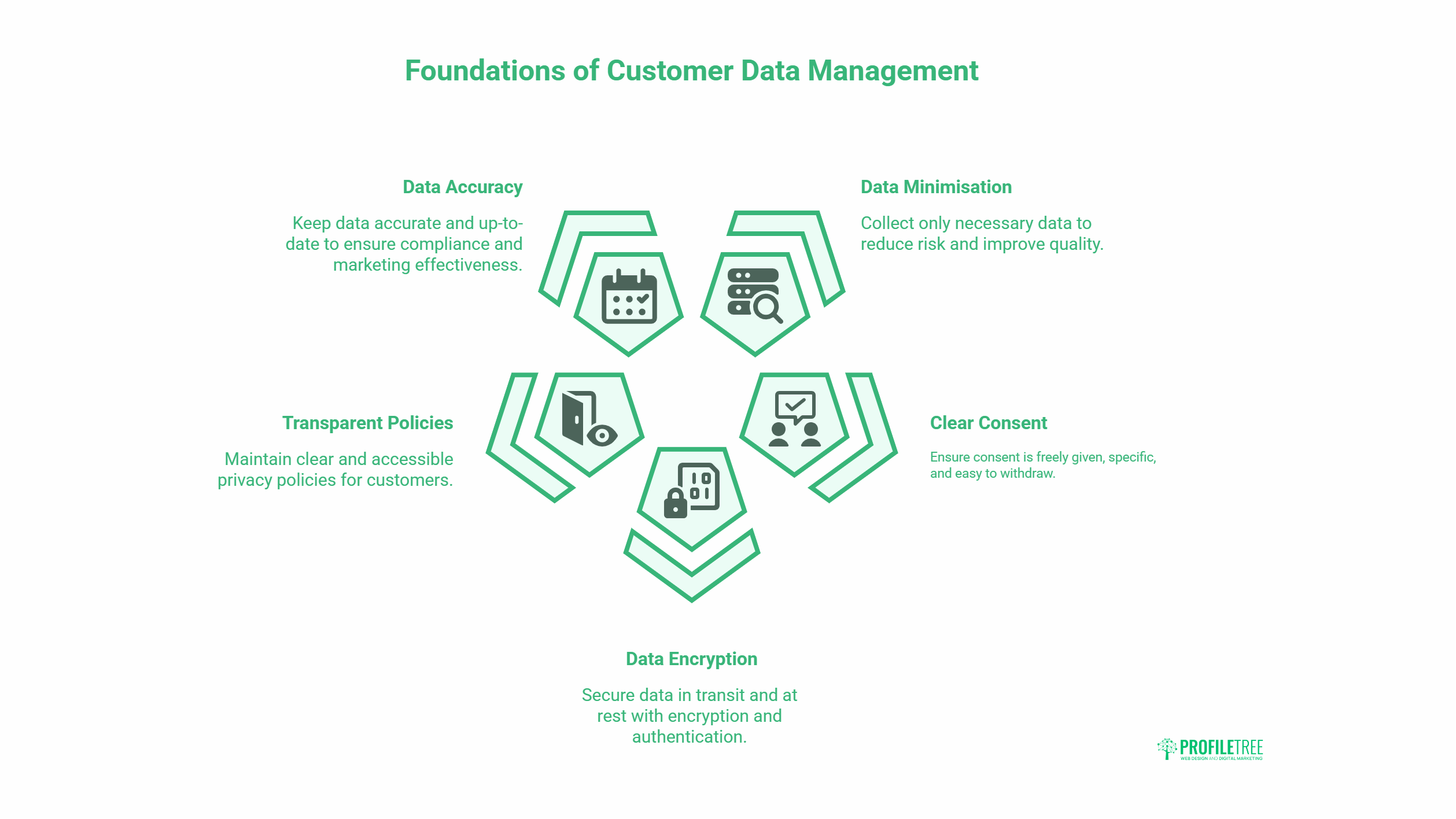
Data minimisation is one of the most practical privacy principles. Collect only the information required for the task in hand. If an email address is sufficient for a newsletter sign-up, do not ask for a phone number and a date of birth as well. Less data means less risk and simpler management.
This principle also improves data quality. Smaller, focused datasets are easier to keep accurate and up to date. Outdated or incorrect data distorts marketing efforts and can cause compliance issues if customers have requested corrections that were not applied.
Make Consent Clear and Easy to Withdraw
Consent must be freely given, specific, informed, and unambiguous. Pre-ticked boxes, buried privacy policies, and vague statements about “personalised experiences” do not meet GDPR standards. The consent mechanism should explain what data is being collected and why, in plain language.
Equally, withdrawing consent must be as easy as giving it. Unsubscribe links, clear cookie preference controls, and accessible account settings are not just legal requirements; they are signals to customers that their preferences are respected.
Encrypt and Secure Data at Every Stage
Encryption converts personal data into a coded format that is unreadable without the correct key. This applies to data in transit (moving between systems) and data at rest (stored on servers or devices). SSL certificates, secure server configurations, and two-factor authentication on internal systems all form part of a solid security foundation.
Limit access to personal data on a need-to-know basis within your organisation. Regular security audits help identify vulnerabilities before they become incidents.
Maintain Transparent Privacy Policies
A privacy policy should tell customers, in plain language, what data is collected, how it is used, who it is shared with, and how long it is retained. Lengthy legal documents full of jargon do not satisfy the spirit of GDPR’s transparency requirement.
Review your privacy policy whenever you introduce new data collection practices, change a third-party tool, or update your marketing approach. An outdated policy creates both a compliance gap and a trust gap.
Keep Data Accurate and Up to Date
Under GDPR, individuals have the right to correct inaccurate personal data. Beyond the legal obligation, accurate data produces better marketing outcomes. Regular audits of your contact database, clear processes for handling data correction requests, and integrations that keep records synchronised across systems all contribute to data quality.
Data Privacy in Advertising and Email Marketing
Targeted Advertising and Consent
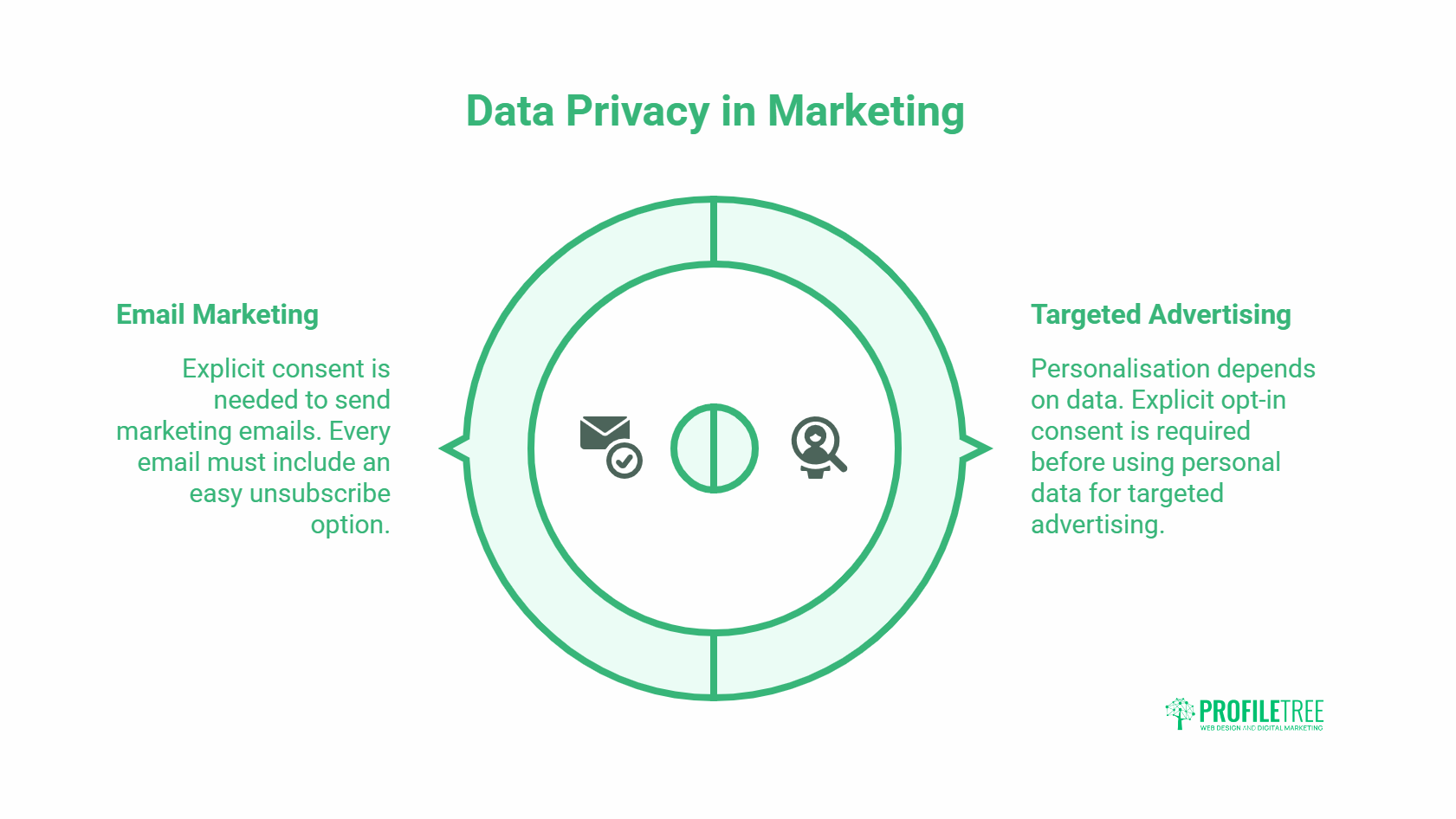
Personalisation in advertising depends on data. The legal requirement under GDPR is explicit opt-in consent before using personal data for targeted advertising. This applies to cookie-based tracking, remarketing audiences, and any form of behavioural targeting.
An opt-in approach, where users actively choose to allow data use, produces smaller but more engaged audiences than default opt-out or implied consent. Customers who have chosen to share their data are more receptive to personalised content.
Google’s advertising services require advertisers to obtain user consent before using cookies for personalised ads in the UK and EU. If you run paid campaigns through any major platform, check the platform’s specific consent requirements and confirm your consent collection aligns with them.
For businesses developing their digital marketing strategy, building a consent-first approach into campaign planning from the start is significantly easier than retrofitting it later.
Email Marketing and Data Rights
Email marketing is one of the most regulated channels precisely because it involves direct use of personal contact details. The basics: you need explicit consent to send marketing emails, every email must include an easy unsubscribe option, and unsubscribe requests must be actioned promptly.
Beyond the legal minimum, treating subscriber data with care produces practical benefits. Clean, consented lists have higher deliverability rates and better engagement metrics. They also reflect an actual audience interested in your business.
For SMEs building content-driven email programmes, privacy-compliant data collection is the foundation. Content marketing services that prioritise building a genuinely opted-in audience tend to produce stronger long-term returns than volume-driven approaches relying on purchased lists.
How AI and Automation Affect Data Privacy
AI-powered tools are increasingly common in digital marketing: personalisation engines, automated email sequences, predictive analytics, and chatbots. Each introduces new data processing questions.
The key principle is unchanged: you need a lawful basis to process personal data, regardless of whether a human or an algorithm is doing the processing. If your AI tools are making decisions based on personal data (which emails to send, which products to recommend, which customers to target), those decisions must be underpinned by valid consent or another lawful basis under GDPR.
Where AI tools involve automated decision-making with significant effects on individuals, GDPR grants those individuals the right to request human review of the decision. This is particularly relevant for credit assessments, recruitment tools, and personalised pricing.
Businesses integrating AI into their marketing operations should document how personal data flows through automated systems, verify that third-party AI tools have data processing agreements in place, and review data retention settings within those tools.
For a practical overview of how AI transformation can be approached responsibly, see AI transformation services for SMEs.
Privacy-First Digital Marketing: What It Looks Like in Practice
Privacy-first marketing is not about doing less. It is about building marketing programmes on a foundation that customers understand and accept. The practical markers are: consent collected clearly and stored properly; data used only for the purposes it was collected; transparency maintained through accessible policies and easy preference controls; and security measures that match the sensitivity of the data held.
The businesses that handle this well tend to see it reflected in the quality of their customer relationships. Audiences who trust a brand with their data engage more genuinely. That engagement, in turn, gives the business better signals about what those customers actually want.
For SMEs building or rebuilding their digital presence, privacy considerations belong at the foundation level alongside web design and development: in the site architecture, the consent management setup, and the data handling practices built into every tool and platform used.
Frequently Asked Questions
Why does customer data privacy matter for small businesses?
Small businesses are not exempt from data protection law. GDPR applies to any organisation collecting personal data from UK or EU residents, regardless of size. Beyond legal compliance, handling customer data responsibly builds the kind of trust that improves retention and word-of-mouth. A data breach is proportionally more damaging for a small business because it lacks the crisis communications infrastructure that a large organisation has.
What data can a business legally collect from website visitors?
You can collect data that visitors have actively consented to share, or data that falls under another lawful basis, such as legitimate interest. For cookies and tracking, UK GDPR requires opt-in consent for anything beyond strictly necessary cookies. You cannot collect data that you do not have a lawful basis for, regardless of how useful it might be for targeting.
What is the difference between GDPR and CCPA?
Both regulate how businesses handle personal data, but they apply in different jurisdictions. GDPR covers UK and EU residents and applies to any business that processes their data. CCPA covers California residents and applies to businesses meeting certain thresholds (revenue, data volumes, or percentage of revenue from selling personal data). CCPA broadly mirrors GDPR’s principles but has some differences in scope and enforcement mechanisms. If you market to both UK/EU and US customers, you may need to satisfy both.
How should a business respond to a data breach?
Under UK GDPR, a breach that poses a risk to individuals must be reported to the Information Commissioner’s Office within 72 hours of becoming aware of it. If the breach is likely to result in a high risk to individuals, those individuals must also be notified directly. Beyond the legal requirement, clear and prompt communication to affected customers, with a plain-language explanation of what happened and what steps have been taken, limits reputational damage.
Does data privacy affect SEO or digital marketing performance?
Directly, no. Privacy practices are not a Google ranking factor. Indirectly, yes: businesses that collect consent properly have more accurate audience data, which improves targeting efficiency. Consent-based first-party data is also increasingly valuable as third-party cookies are phased out across browsers. Businesses investing in privacy-first data collection now are building an asset that will matter more as the advertising environment continues to shift.
What is a Data Protection Officer, and does my business need one?
A Data Protection Officer (DPO) is responsible for overseeing data protection strategy and GDPR compliance. Under GDPR, you must appoint a DPO if you are a public authority, carry out large-scale systematic monitoring of individuals, or process special category data at scale. Many SMEs do not meet these thresholds, but appointing someone with clear data protection responsibility, even informally, is good practice regardless.