
Human-AI Collaboration: A Practical Guide for SME Digital Teams
Table of Contents
Most business owners approaching AI for the first time ask the wrong question. They ask: “What can AI do?” The more useful question is: “What should my team still own, and what can AI handle reliably without supervision?” Getting that division right is the foundation of effective human-AI collaboration, and it is where most SMEs either succeed quickly or stall entirely.
This guide is written for business owners and marketing managers in Northern Ireland, Ireland, and the UK who want a practical framework for building human-AI workflows, not a theoretical overview of the technology. It covers how to identify an effective strategy for human-AI collaboration in work processes, where the handoff between people and tools should sit, how to keep your team genuinely in control, and what this looks like specifically for digital marketing, content, and SEO operations.
What Human-AI Collaboration Actually Means in Practice
Human-AI collaboration is the structured process of dividing tasks between people and AI tools so that each handles what it does reliably, with a human making the decisions that require judgment, context, or accountability.
It is worth being specific about this, because a lot of the conversation around AI in business conflates two very different things: using AI as an automation tool versus building it into a genuine working process. The first is straightforward. You set up a chatbot to handle FAQ responses, or you use an AI tool to generate first-draft copy. The second is more demanding. It requires your team to understand where AI outputs need review, where they can be trusted, and where a human decision is non-negotiable.
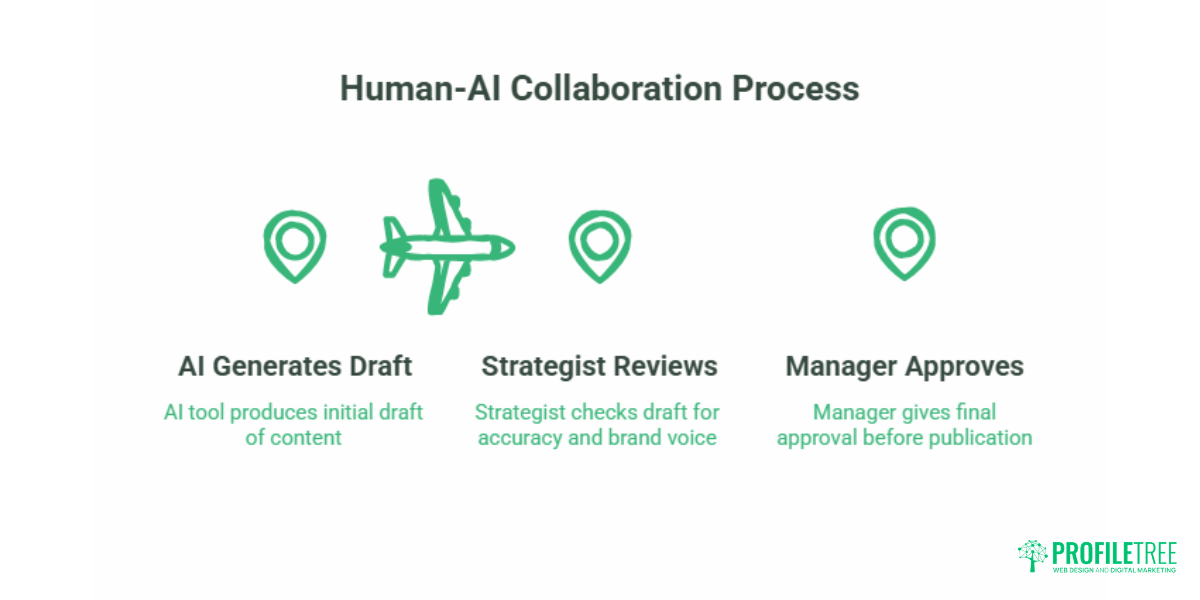
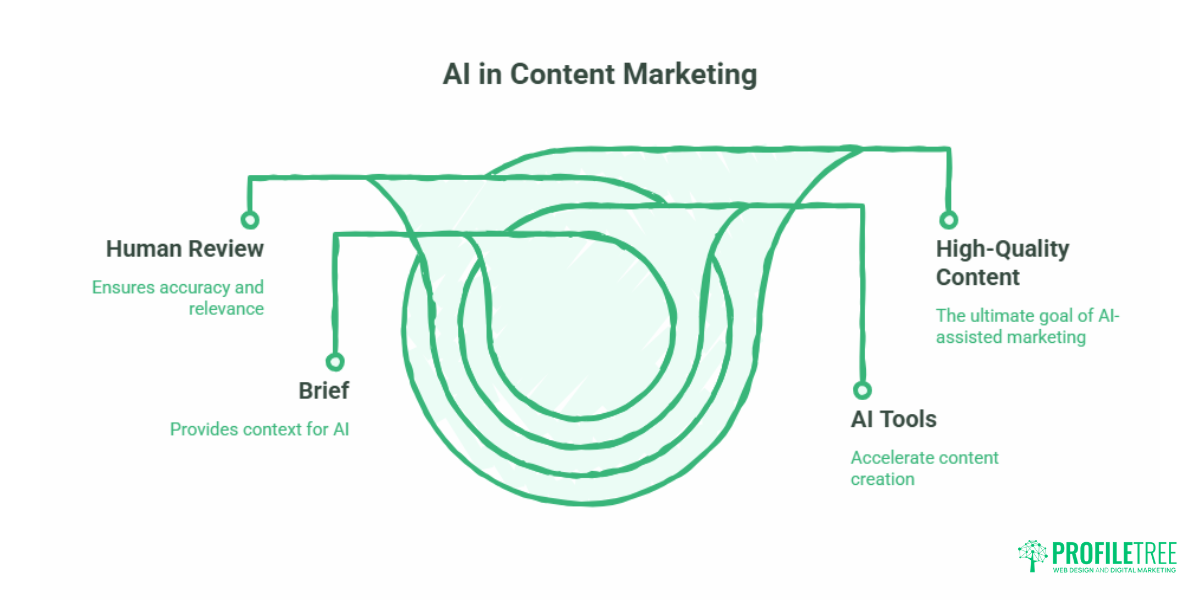
For SMEs, the practical version of this is usually a content or marketing workflow. A team member uses an AI writing tool to produce a draft. A strategist reviews it for accuracy, brand voice, and local context. A manager approves it before publication. That three-stage process is human-AI collaboration at its most basic, and getting the review stage right is where most businesses lose the efficiency gains they were hoping for.
The Tasks Where AI Adds Reliable Value
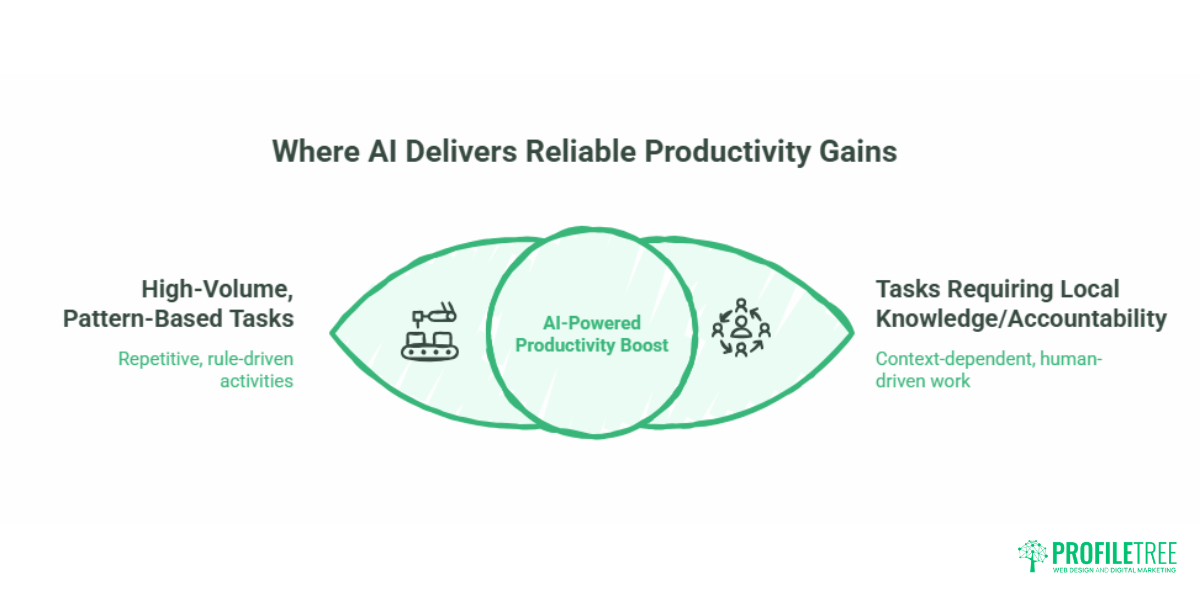
AI tools perform consistently well on tasks that are high-volume, pattern-based, and do not require local knowledge or accountability:
- Research aggregation: pulling together summaries from multiple sources on a defined topic
- First-draft generation: producing structured text from a brief, prompt, or outline
- Data pattern recognition: identifying trends in analytics, keyword data, or audience metrics
- Repetitive formatting: resizing, reformatting, or categorising content at scale
- Scheduling and distribution: automating the timing and delivery of content or communications
These are the tasks that eat disproportionate time in small teams. Offloading them to AI tools, with appropriate review, is where the productivity gain is real.
The Tasks That Stay with Humans
AI does not handle the following reliably, and in a UK or Irish SME context, specifically, these require human ownership:
- Strategic decisions: which markets to enter, which audiences to prioritise, how to position against local competitors
- Brand voice and local nuance: understanding how Northern Irish or Irish audiences read tone, humour, and cultural references that AI misreads consistently
- Relationship-dependent communication: client conversations, partnership negotiations, community engagement
- Ethical and legal review: compliance with UK GDPR, the ICO’s guidance on automated decision-making, and sector-specific regulations
- Quality accountability: the final sign-off before anything goes to a client or is published
This division is not about what AI can theoretically do with enough prompting. It is about what your team can trust, review efficiently, and stand behind.
How to Identify an Effective Strategy for Human-AI Collaboration in Work Processes
The most common mistake SMEs make when implementing AI is treating it as a single decision rather than a process design exercise. They choose a tool, give team members access, and expect productivity to improve. What usually happens instead is inconsistent output quality, a lack of clarity about who is responsible for review, and tools that quietly get abandoned within three months.
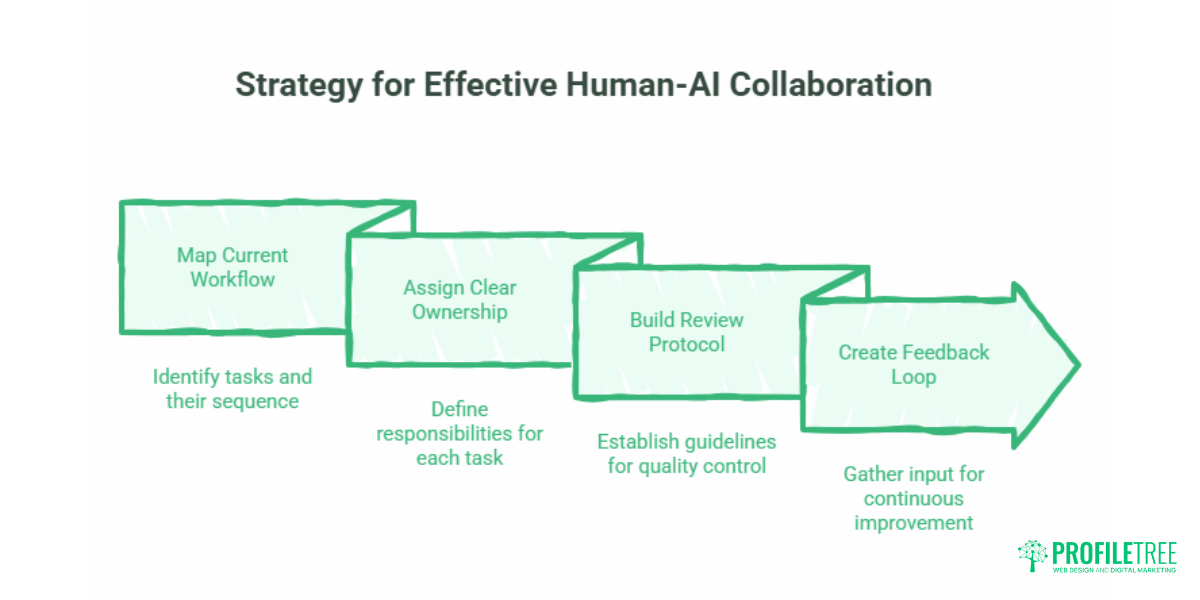
An effective strategy for human-AI collaboration in work processes requires four things: task mapping, clear ownership, a review protocol, and a feedback loop.
Step 1: Map Your Current Workflow by Task Type
Before introducing any AI tool, list the tasks your team repeats most often. For a typical digital marketing function in an SME, this might include writing social posts, drafting blog content, reporting on campaign performance, responding to enquiries, and creating ad copy. Against each task, ask two questions: How much of this task is pattern-based versus judgement-based? And what would the cost of an error be?
High-pattern, low-error-cost tasks (such as generating social media caption options) are good candidates for AI assistance. Low-pattern, high-error-cost tasks (such as writing a client-facing proposal or responding to a complaint) should stay with experienced team members, at least initially.
Step 2: Assign Clear Ownership at Each Stage
Every AI-assisted workflow needs a named human at the review stage. If nobody owns the review, nobody reviews it. This sounds obvious, but in small teams where everyone is doing several jobs, review steps get skipped under pressure.
A content workflow might look like this: a junior team member uses an AI tool to generate a blog draft from a brief; a senior content person edits for accuracy, voice, and SEO; the account manager does a final read before publication. Each stage has a named owner and a defined standard. The AI produces the raw material; humans make every substantive decision about what gets published.
Step 3: Build a Review Protocol
The review protocol defines what a human is checking for at each stage. Without this, reviews become inconsistent and over-reliant on individual judgment. For content workflows, a practical protocol might cover: factual accuracy (are the claims verifiable?); brand voice (does this sound like us, or like generic AI output?); local relevance (does this make sense for our specific audience?); compliance (does anything here raise a data, legal, or ethical flag?).
ProfileTree’s digital training programmes cover exactly this kind of protocol design with SME teams across Northern Ireland and the UK, working through the practical steps of building AI into existing processes without creating new risks.
Step 4: Create a Feedback Loop
The final step is the one most businesses skip. Feedback loops close the gap between what AI tools produce and what your team actually needs. If a writer is making the same type of correction to AI-generated drafts every week, that correction should be built into the prompt or brief. If a particular AI output format is never used, stop generating it.
The feedback loop does not have to be formal. A monthly check-in where team members flag what is and is not working, combined with updates to your standard prompts and briefs, is usually enough to keep the workflow improving.
Building the Human-AI Handoff for Digital Marketing Teams
The handoff is where most human-AI collaboration frameworks fall apart. It describes the exact point at which a human stops and an AI starts, and vice versa. In digital marketing, the most useful way to map this is against the stages of a campaign or content workflow.
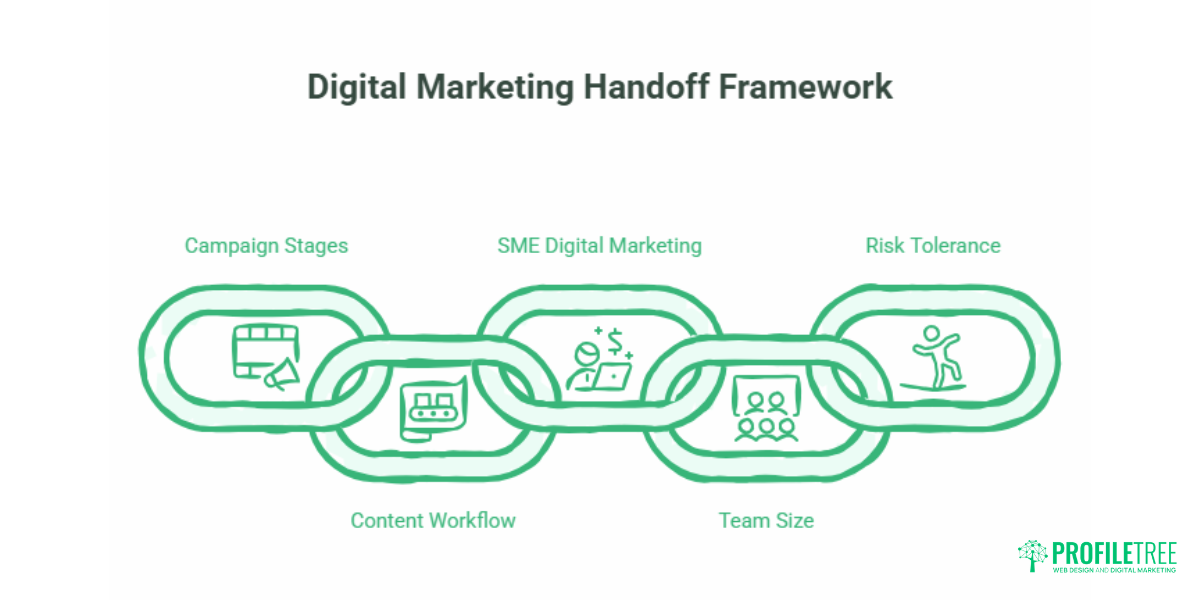
The table below outlines a practical handoff structure for an SME digital marketing function. It is not prescriptive; the right split for your team will depend on your tools, your team size, and your risk tolerance. But it gives a starting point for the conversation.
| Stage | AI Role | Human Role |
|---|---|---|
| Strategy and brief | None | Human defines the goal, audience, and constraints |
| Keyword and topic research | Aggregate data, surface patterns | Humans define the goal, audience, and constraints |
| Content drafting | Generate first draft from brief | Human rewrites for voice, accuracy, and local context |
| SEO optimisation | Suggest internal links, meta descriptions | Human approves, adjusts for search intent |
| Distribution and scheduling | Automate timing and channel delivery | Human sets the rules; reviews performance |
| Analytics and reporting | Identify trends and anomalies in data | Humans set the rules; reviews performance |
| Client and audience communication | Draft initial responses | Human reviews and sends; never AI-only for complaints |
The SEO workflow in particular benefits from this kind of structured handoff. AI tools are useful for generating keyword clusters, drafting meta descriptions, and identifying content gaps from data. But the decisions about which pages to prioritise, how to differentiate from competitors ranking for the same terms, and how to position a local business in a specific market require human judgement. ProfileTree’s SEO services are built around this principle: the analytical work is tool-assisted, but the strategy is human-led.
“The businesses we work with that get the most from AI are the ones where someone in the team has taken the time to understand what the tool is actually doing,” says Ciaran Connolly, founder of ProfileTree. “AI is genuinely useful for volume tasks and first drafts. But it needs someone who knows the market, knows the client, and knows what good looks like to make the output worth using.”
AI and Content Marketing: Where the Efficiency Gains Are Real
Content marketing is the area where human-AI collaboration is most mature in practice, and where the risks are also most visible. For SMEs producing regular blog content, social media, email newsletters, or video scripts, AI tools can compress the time required for first drafts significantly. The question is whether the resulting content is good enough to publish after review, or whether it creates more work than it saves.
The answer depends almost entirely on the quality of the brief and the robustness of the review process. AI tools produce better outputs when given more context: a clear target audience, a specific angle, examples of the tone you want, and any claims or facts that need to be included. Vague prompts produce generic output that takes longer to fix than it would have taken to write from scratch.
For content marketing specifically, the most productive human-AI workflows tend to treat AI as a research and structure tool rather than a finished-copy tool. A writer uses AI to pull together background information, generate an outline, and produce a rough first pass. The writer then rewrites substantially, injecting specific examples, local context, and genuine opinions. The result is content that is faster to produce but still carries the quality signals that matter for search and for the reader.
Where AI-generated content tends to fail without strong human review is in the areas that matter most for a local business: specific references to the Northern Ireland or Irish market, accurate claims about regulations or industry standards, and a tone that matches how your actual audience talks and thinks.
Training Your Team to Work Effectively Alongside AI
The gap between businesses that get genuine value from AI and those that do not is rarely about the tools themselves. It is about whether the people using them understand both the capabilities and the limitations of what they are working with.
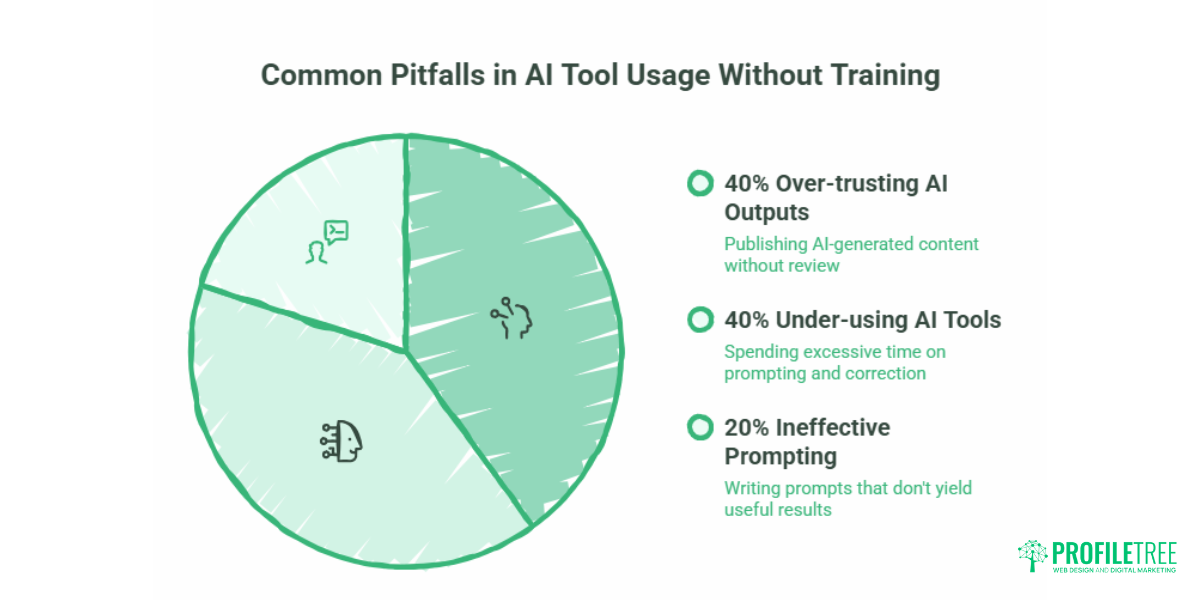
Most team members who are handed an AI tool without training will use it in one of two ways: they will over-trust it, publishing outputs without adequate review, or they will under-use it, spending time on prompting and correction that exceeds the time saved. Neither produces good results.
Effective AI training for SME teams covers four practical areas: how to write prompts that produce useful outputs; how to review AI-generated content against a defined standard; how to recognise the specific failure modes of the tools you are using (factual errors, tone drift, generic phrasing); and how to build those review steps into existing workflows without creating bottlenecks.
This is not a one-day workshop job. The most effective training is delivered in stages alongside actual workflow implementation, so team members can apply what they are learning in real tasks rather than hypothetical exercises. ProfileTree’s digital training services are structured around this approach: short, practical sessions mapped to the specific tools and workflows each team is already using.
For businesses earlier in their AI adoption journey, it is also worth understanding that team resistance to AI tools is a real and common challenge. The concern is rarely about the technology itself; it tends to be about job security, about the perceived loss of creative ownership, and about being asked to change established ways of working without understanding why. Addressing those concerns directly, before rolling out new tools, is usually more important than the implementation itself.
Data, Privacy, and the UK Regulatory Context
One of the most significant content gaps in most guidance on human-AI collaboration is the UK and Irish regulatory dimension. For businesses operating under UK GDPR and the ICO’s guidance on automated decision-making, AI implementation carries specific obligations that US-centric resources typically ignore.
The core principle from the ICO is that individuals have the right not to be subject to solely automated decisions that have a significant effect on them, and businesses must be able to explain the basis for any AI-assisted decision when asked. In practice, for an SME using AI in marketing, the relevant implications are around data handling: specifically, what customer data is being passed into AI tools, whether those tools process it on servers outside the UK or EU, and what consent has been obtained for that processing.
The practical rule for most SMEs is straightforward: do not pass identifiable personal data into public AI tools unless you have verified the tool’s data processing terms and satisfied yourself that they are compliant with your obligations. For AI tools used internally to process business data (analytics, keyword research, and content drafting from non-personal source material), the risk profile is lower.
The ethics and legalities of digital marketing in a UK context cover this territory in more detail. For businesses considering AI implementation at a more significant scale, a compliance review before deployment is not optional.
How to Maintain Brand Voice When Using AI
This is the question that comes up most consistently from marketing managers who have started using AI tools: the content is technically correct, but it does not sound like us. The generic, slightly formal, vaguely American tone that AI tools default to is incompatible with most SME brands, which have spent years developing a specific voice that their audience recognises.
The solution is not to avoid AI tools. It is to give them enough context to produce outputs that are at least closer to your voice before the human review stage. This means building a brand voice reference document: a short description of your tone (formal or conversational, serious or light, what words you never use), two or three examples of content you consider to represent your voice well, and any specific phrases, terms, or references that belong to your brand.
This document becomes part of every AI brief. It does not guarantee perfect output, but it significantly reduces the gap between what AI produces and what your team needs to publish. The review step still matters; the document reduces the amount of work that step requires.
For businesses where brand voice is a commercial differentiator, this level of AI management is worth the investment. For businesses where the content function is primarily informational, and volume matters more than distinctiveness, a lighter version of the same approach is usually enough.
AI Collaboration in Specific Digital Functions
SEO and Content Strategy
AI tools have become genuinely useful for keyword research, content gap analysis, and internal linking suggestions. The risk is over-reliance on AI-generated content at scale without adequate differentiation. Google’s helpful content assessments are designed to identify and demote content that provides no information gain beyond what already exists, regardless of whether it was written by a human or a machine. For SMEs, the solution is the same as it has always been: produce content that reflects specific expertise, local knowledge, and genuine opinions that are not available elsewhere. AI can help structure and draft that content; it cannot replace the expertise itself.
Web Design and Development
AI-assisted design tools are increasingly useful for generating layout options, accessibility audits, and image asset creation. They do not replace the need for a developer or designer who understands user experience, brand consistency, and the technical constraints of the specific platform being built on. For SMEs considering a new website or a significant redesign, AI tools are most useful in the early stages of concept development; the build itself still requires human skill and judgement. ProfileTree’s web design and development services for SMEs are built around this principle, using AI where it accelerates the process without compromising the quality of the final product.
Video and Social Media
Video scripts and social media content are well-suited to AI-assisted first drafts, particularly for high-volume output like weekly social posts or short-form video series. The review stage for video content is especially important because errors in tone or factual accuracy are more visible and harder to correct once published. For businesses producing video content as part of their marketing strategy, building the AI review step into the production workflow rather than treating it as an afterthought makes the difference between content that works and content that creates problems.
The Skills Your Team Needs to Work Effectively With AI
The job descriptions that matter most in an AI-augmented team are not the ones that define what AI tools will do. They are the ones that define what humans will do differently as a result.
In practice, this means developing what some practitioners call the “AI orchestrator” capability: the ability to define the task clearly enough that AI tools produce useful outputs, to review those outputs against a defined standard, to identify where AI has failed and correct it, and to build the feedback loop that improves outputs over time. This is not a technical skill. It is a blend of editorial judgement, process design, and domain knowledge.
For most SMEs, the team members who develop this capability fastest are the ones who already have strong domain knowledge in their area, combined with a willingness to experiment. They understand what good output looks like, which means they can recognise when AI has produced something substandard and articulate why. That combination is harder to develop from the technical side than from the domain side.
Investing in digital skills training for existing team members is usually more effective than hiring AI specialists, at least at the SME scale. The goal is not to turn your team into AI engineers; it is to make them confident, critical users of the tools that are available.
Frequently Asked Questions
How do I identify an effective strategy for human-AI collaboration in work processes?
Start by mapping your existing workflows and identifying the tasks that are high-volume and pattern-based. These are the strongest candidates for AI assistance. Then define clear ownership at the review stage: every AI-assisted output needs a named human who checks it against a defined standard before it is used. Build a feedback loop to improve your prompts and processes over time. The strategy is less about choosing the right tool and more about designing a workflow where humans and AI each do what they do best.
What are the main challenges in integrating AI into human decision-making?
The most common challenges are inconsistent output quality, a lack of clarity about who owns the review step, and team members either over-trusting or under-using AI tools due to insufficient training. In a UK and Irish context, data compliance is also a practical challenge: businesses need to understand what customer data is being processed by their AI tools and whether that processing is consistent with their GDPR obligations.
How can SMEs maintain brand voice when using AI-generated content?
Build a brand voice reference document that describes your tone, provides examples of content that represent it well, and lists any phrases or references that belong to your brand. Include this document in every AI brief. This reduces the gap between raw AI output and your voice before the human review stage, which makes the review step faster and more consistent.
What is a human-in-the-loop model, and why does it matter?
A human-in-the-loop model is a workflow in which AI performs tasks, but a human must review, intervene, or approve at defined checkpoints. It matters because it keeps accountability with the people who understand the context, the audience, and the consequences of an error. For most SMEs, this is not a formal framework; it is simply a clear process that defines where human review happens and who is responsible for it.
Which tasks should stay with humans in an AI-assisted digital marketing team?
Strategy, final approvals, client communication, compliance review, and anything where an error would damage a relationship or create a legal risk should stay with humans. AI is reliable for volume tasks with a defined pattern; it is not reliable for tasks that require local knowledge, ethical judgment, or accountability.
How much does it cost to implement AI tools for a small business team?
The cost range is very wide. Many capable AI writing and research tools have plans starting at £20 to £50 per user per month. The higher cost is usually the time required to build effective workflows and train the team to use tools well, which is often underestimated. Businesses that invest in that setup phase tend to see sustainable efficiency gains; those that skip it often find the tools are quietly abandoned within a few months.