
McDonald’s Marketing Strategy: A Business Owner’s Guide
Table of Contents
McDonald’s marketing strategies have been studied, borrowed from, and written about more than those of almost any other brand in history. The reasons are not hard to find. The company operates in over 100 countries, serves tens of millions of customers every day, and has maintained a consistent identity for more than 7 decades while adapting to markets as diverse as Belfast, Mumbai, and São Paulo. That kind of durability does not come from a single clever campaign or a memorable jingle. It comes from a set of strategic disciplines applied consistently over time.
This article examines how McDonald’s marketing strategies are actually structured, what makes them resilient across different markets and economic conditions, and what the underlying principles mean for businesses working at a fraction of McDonald’s scale. The same frameworks behind a brand worth more than £40 billion can be translated, in adapted form, by a manufacturer in Northern Ireland, a hospitality business in Dublin, or a retailer expanding into new UK markets. The scale is different. The logic is not.
The “Accelerating the Arches” Framework
McDonald’s current strategic direction is built around what the company calls “Accelerating the Arches”, an internal framework organised around three pillars: Maximise the core menu, Commit to the chicken and coffee opportunity, and Strengthen digital, delivery, and drive-thru.
What makes this worth examining isn’t the specifics of burgers or coffee. It’s the discipline. McDonald’s chose a small number of strategic priorities and built everything around them. Advertising, store layouts, app features, and local promotions all point back to the same three pillars. There’s no distraction.
For most businesses, the failure mode is the opposite: too many priorities, inconsistent messaging, and marketing activity that doesn’t reinforce a coherent direction. Building a clear strategic framework before investing in campaigns is something ProfileTree works through with clients as part of digital marketing strategy development, because the best-executed campaign still underperforms when the strategy it sits within hasn’t been defined.
McDonald’s Marketing Mix: The 7 Ps
The four Ps of marketing, Product, Price, Place, and Promotion, are standard business school territory. McDonald’s operates across all seven, including People, Process, and Physical Evidence. Each one rewards closer examination.
Product: Core Range and Local Adaptation
McDonald’s menu varies more than most people realise. The Big Mac is available in over 100 countries. The McArabia is not. In India, the Maharaja Mac (using chicken rather than beef) has been a permanent menu item for decades. In the UK, the McPlant emerged in response to a demonstrable shift in consumer preferences, backed by a robust product development process rather than a reactive add-on.
The principle for any business: your core offer needs to be consistent and reliable, while your extensions need to be genuinely responsive to local demand. Product decisions should be driven by customer insights, not trend-chasing. This connects directly to understanding how social media marketing drives sales; the data you gather through customer interaction informs product positioning just as much as it informs paid campaigns.
Price: Value Tiers and Psychological Pricing
In the UK, McDonald’s operates across visible price tiers. The Saver Menu sits at one end; the Signature Collection at the other. The gap between them isn’t accidental; it allows McDonald’s to serve value-seeking customers without cheapening the brand perception for those willing to spend more.
Psychological pricing (£4.99 rather than £5.00) is well-documented and still effective. What’s less discussed is how McDonald’s uses bundling to raise average transaction values. A meal deal consistently costs less per item than buying components separately, which encourages higher spend while reinforcing the value perception.
Place: Distribution as a Marketing Decision
Location strategy at McDonald’s is not a property matter divorced from marketing. The decision to locate near schools, retail parks, motorway services, and high streets is a deliberate marketing choice that matches physical availability to the highest-frequency purchase occasions.
The drive-thru, introduced in the 1970s, now accounts for a significant share of McDonald’s UK revenue. More recently, digital ordering through the MyMcDonald’s app and third-party delivery platforms has added channels without reducing the primacy of the physical estate. Understanding how place functions within the marketing mix helps businesses think about distribution not as logistics but as a competitive tool.
Promotion: Campaigns Built on Cultural Truth
McDonald’s advertising works because it tends to find things people already believe about the brand and amplify them, rather than asserting things the brand wishes were true. The “Famous Orders” campaign, working with artists like Travis Scott and BTS to promote their real McDonald’s orders, is a clear example. The brand didn’t invent a celebrity connection; it found genuine ones and built a promotion around them.
The “WcDonald’s” anime campaign, which leaned into the brand’s decades-long presence in anime and gaming culture, followed the same logic. These marketing campaigns succeed because they’re culturally accurate, not because they’re loud.
People, Process, and Physical Evidence
The three extended Ps matter less in isolation and more in combination. McDonald’s “Experience of the Future” restaurant redesign, self-service kiosks, table service in some locations, and updated interiors are physical evidence investments that change how customers perceive the brand without changing the product. The process (ordering, waiting, receiving food) has been repeatedly compressed and simplified.
For service businesses, these three Ps are where brand perception is actually formed. What customers experience in person will always outweigh what they read in an advert.
Digital Transformation: Data, Apps, and First-Party Loyalty
The most significant strategic shift McDonald’s has made in the past decade is not a menu change or a campaign. It’s the accumulation of first-party customer data through the MyMcDonald’s Rewards app.
When a customer orders through the app, McDonald’s learns what they ordered, when, where, and in what combination. Over millions of customers and transactions, this creates a data asset that supports genuinely personalised offers, not “here’s 20% off anything” but “here’s an offer on the thing you ordered three times last month.”
This is the difference between promotional spend that erodes margin and promotional spend that increases frequency among existing customers. The app now has over 50 million active users globally, and the UK adoption rate has grown steadily since the launch of MyMcDonald’s Rewards UK.
McDonald’s has also worked with IBM on AI-powered drive-thru ordering, using machine learning to suggest menu items based on factors including time of day, weather, and current promotional periods. Some trials have been paused, but the direction of travel is clear: the physical experience will be increasingly shaped by digital intelligence.
For businesses considering their own digital marketing strategy, the McDonald’s app story offers a useful frame. The goal isn’t to build technology for its own sake; it’s to create a mechanism that turns single transactions into ongoing relationships. That’s achievable at a much smaller scale, email capture at the point of sale, loyalty programmes for hospitality businesses, and CRM integration for service businesses. The principle is the same even when the budget isn’t.
Iconic Campaigns and Cultural Relevance
McDonald’s has produced numerous campaigns that have entered popular culture. “I’m Lovin’ It” has been the brand’s global strapline since 2003, the longest-running strapline of any major fast food chain. Rather than treat this as a liability (tired, overexposed), McDonald’s has repeatedly refreshed the creative around it while keeping the line itself unchanged. The consistency is deliberate.
More recent campaigns demonstrate a willingness to be self-aware. The “Raise Your Arches” campaign, which ran in the UK and elsewhere, never showed food; it simply showed people exchanging a knowing eyebrow raise. The campaign assumed audiences would complete the association themselves. It was effective precisely because it trusted existing brand equity rather than building it from scratch every time.
The Szechuan Sauce moment, a 2017 incident in which limited-release sauce from a 1998 promotion generated chaotic demand after appearing in the TV series Rick and Morty, was handled with an unusual degree of self-deprecating transparency. Rather than issue a corporate response, McDonald’s acknowledged the chaos, apologised directly to customers who queued unsuccessfully, and committed to a proper re-release. The podcast “The Sauce,” produced by McDonald’s to document the fiasco, is one of the more unusual examples of crisis marketing in recent brand history.
The lesson for any business: campaigns that acknowledge reality tend to outperform campaigns that project an aspirational image disconnected from what customers actually experience. Brand storytelling that draws on genuine moments, including imperfect ones, builds more durable trust than polished promotional copy.
Localisation and Trust: The UK and Ireland Strategy
Most coverage of McDonald’s marketing focuses on the US. The UK and Ireland operation has its own strategic texture, and it’s worth examining separately.
The Monopoly promotion is a near-perfect example of gamification applied to a mass market. Running every autumn, it creates a predictable seasonal revenue spike through a mechanism so embedded in UK consumer culture that it generates unprompted conversation. The campaign works partly because it has run long enough to become an event rather than a promotion; customers plan visits around it in a way they would for a limited-time sporting sponsorship.
Supply chain transparency has become a genuine marketing lever in the UK. McDonald’s UK campaigns around “100% British and Irish beef,” the visible commitment to local sourcing, and partnerships with UK and Irish farmers directly address the most common consumer reservations about fast food quality. The “Down Douglas Road” campaign in 2023, which followed a Northern Ireland beef farmer supplying McDonald’s, is an example of content marketing that carries genuine credibility because its sourcing claim is verifiable.
Sustainability messaging has shifted from the periphery to the centre in the UK context. The removal of plastic toys from Happy Meals in the UK, the introduction of paper packaging across the estate, and the rollout of EV charging points at drive-thrus are all positioned as substantive actions rather than PR gestures. Whether or not customers scrutinise the specifics, the overall impression of a brand taking its environmental obligations seriously is a meaningful trust signal in the UK market.
For businesses trading in Northern Ireland and the Republic of Ireland, the localisation principle is directly applicable. Customers in these markets respond to authenticity about local connections, suppliers, staff, and community involvement in ways that generic national campaigns miss. This is precisely where content marketing transparency creates commercial value that advertising spend cannot replicate.
What SMEs Can Take From This
McDonald’s operates at a scale most businesses will never approach. That’s not a reason to dismiss the strategic lessons, it’s a reason to translate them carefully.
On brand consistency: McDonald’s invests heavily in keeping its core identity consistent across thousands of locations and dozens of markets. Most SMEs underinvest in this. Brand voice consistency across a website, social channels, email, and customer service interactions is achievable at any budget, it requires discipline, not spend.
On data and digital loyalty: A loyalty programme doesn’t require an app with 50 million users. A well-structured email list with meaningful segmentation delivers the same fundamental benefit: turning one-time buyers into repeat customers. If your business doesn’t have a mechanism for this, it should.
On localisation: McDonald’s treats local relevance as a deliberate strategic choice, not a default. An SME operating across Belfast, Dublin, and regional UK markets should be making active decisions about what’s consistent across those markets and what’s adapted to each. Applying the same content to all three without adjustment is a missed opportunity.
On campaigns: McDonald’s campaigns succeed because they are built on genuine cultural insight, not on what the brand wishes consumers thought about it. Before investing in any campaign, the most useful question is: what do customers already think, feel, and know about this business? Build from that, not against it.
At ProfileTree, working with SMEs across Northern Ireland, Ireland, and the UK, the patterns that hold across almost every sector are the same ones McDonald’s demonstrates at scale: clarity of strategy, consistency of messaging, and a genuine understanding of the customer.
As Ciaran Connolly, ProfileTree’s founder, puts it: “The businesses that get the most from digital marketing aren’t the ones with the biggest budgets. They’re the ones who are clear about who they’re talking to, consistent in how they show up, and honest about what they can actually deliver.”
McDonald’s and the Rise of AI-Driven Marketing
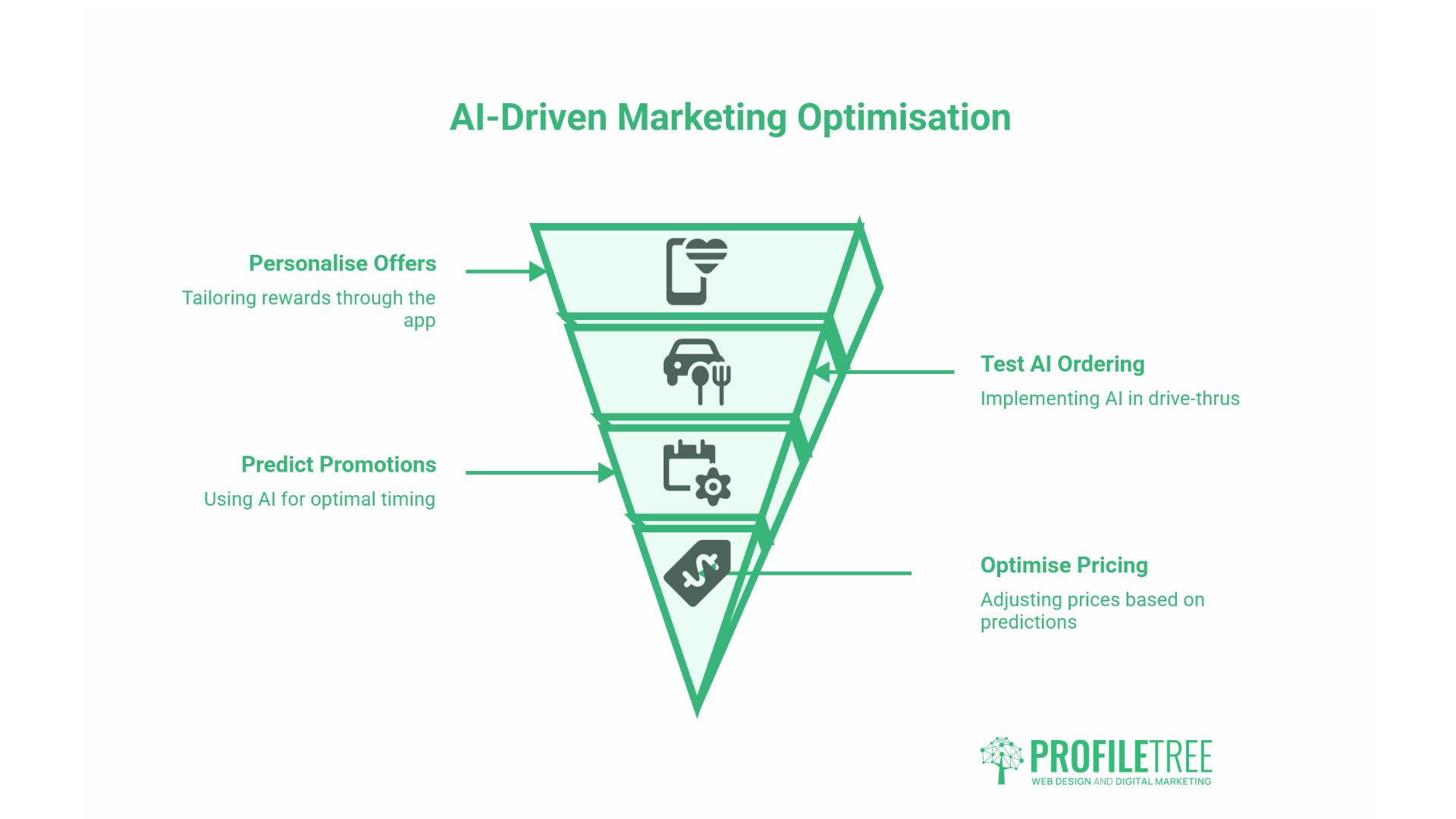
Artificial intelligence is no longer a peripheral part of McDonald’s marketing operation. The brand has used machine learning to personalise offers through the MyMcDonald’s Rewards app, tested AI-powered ordering in drive-thrus, and applied predictive modelling to promotional timing and menu pricing. The underlying logic is straightforward: the more accurately you can predict what a customer wants and when, the less you spend reaching people with the wrong message at the wrong moment.
For SMEs, the practical entry point into AI-driven marketing is far more accessible than a global app rollout. Tools that score leads by likelihood of conversion, platforms that automate email sequences based on customer behaviour, and analytics dashboards that surface which content is actually driving enquiries are all within reach for businesses with modest budgets. The gap between McDonald’s AI capability and what a Belfast retailer or Dublin hospitality group can access today is narrower than most business owners realise. ProfileTree’s AI implementation and training work with SMEs is built around exactly this: identifying where AI tools create genuine commercial value rather than adding complexity without return.
Video and Content Marketing: How McDonald’s Builds Attention
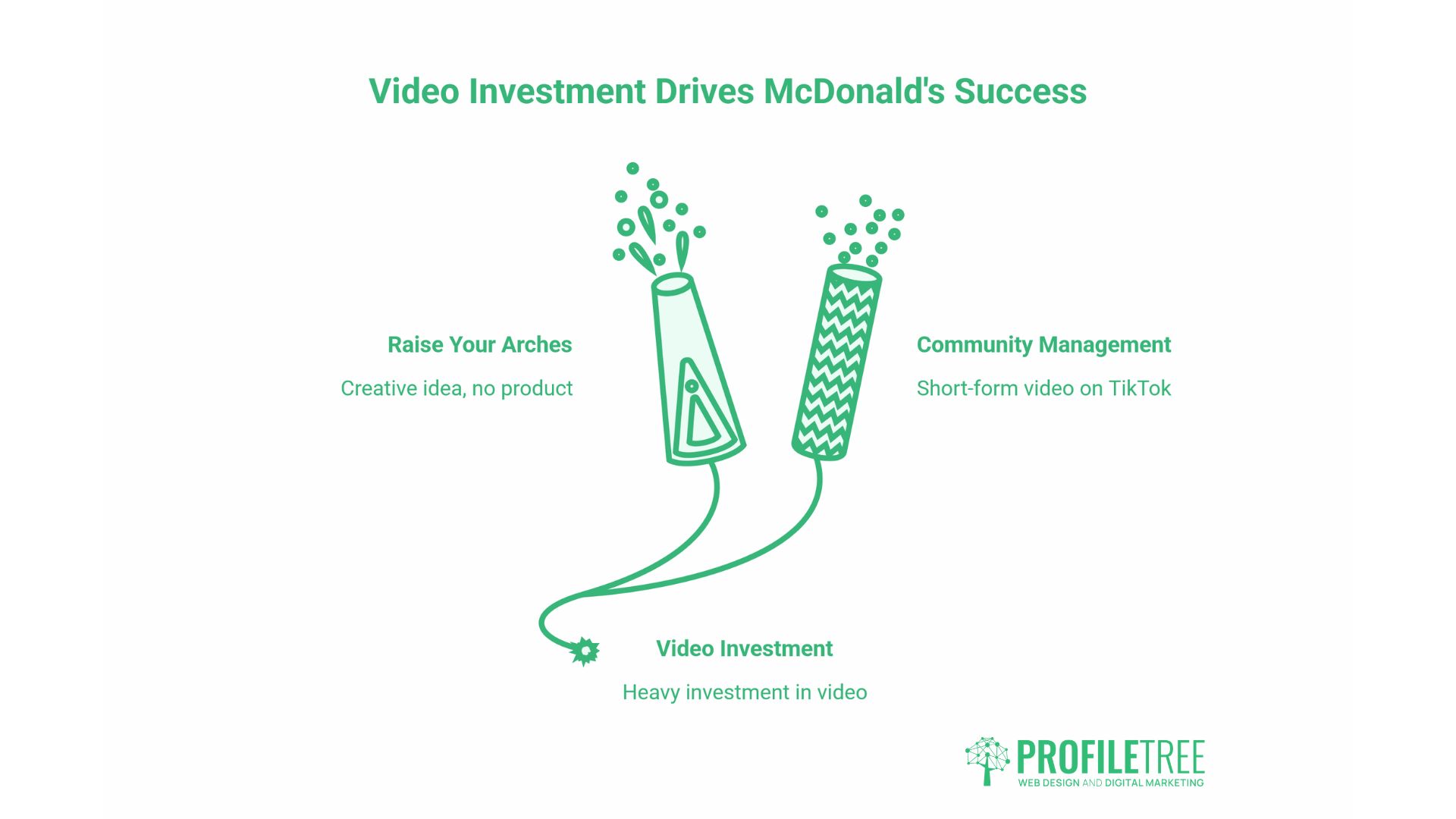
McDonald’s invests heavily in video, and the returns are visible. The “Raise Your Arches” campaign ran predominantly as video content across TV and digital platforms, and its success came not from production budget alone but from a creative idea sharp enough to work without showing the product at all. More recently, short-form video across TikTok and YouTube Shorts has become a central channel for the brand’s community management strategy, with response-style content performing alongside produced campaigns.
The principle transfers directly to smaller businesses. Video does not require a broadcast budget to build genuine audience attention. A 90-second explainer about a service, a behind-the-scenes look at how a product is made, or a straightforward answer to a question customers ask repeatedly can outperform polished advertising when the content is genuinely useful or interesting. ProfileTree’s video production work with businesses across Northern Ireland and Ireland starts from this premise: the most effective video content is built around what the audience actually wants to know, not what the business wants to say about itself.
Conclusion: McDonald’s Marketing Strategies
McDonald’s marketing endures because its fundamentals are sound: a clear strategic framework, a consistent brand identity, deliberate local adaptation, and genuine investment in customer relationships. Those principles are not the exclusive property of a global corporation. Any business, at any scale, can apply the same logic to its own market. If you want to build a digital marketing strategy that works as hard as your business does, talk to the ProfileTree team.
FAQs
What is McDonald’s primary marketing strategy?
McDonald’s organises its marketing around the “Accelerating the Arches” framework, focusing on the core menu, chicken and coffee growth, and investments in digital, delivery, and drive-thru. Brand consistency across markets over decades is as much a strategic choice as any individual campaign.
What are the 4 Ps of McDonald’s marketing mix?
Product covers a standardised core menu with locally adapted extensions; price operates across visible tiers supported by bundling and psychological pricing. Place matches physical locations and digital channels to high-frequency purchase occasions; promotion builds campaigns on genuine cultural insight rather than aspirational claims.
How does McDonald’s use digital marketing?
The MyMcDonald’s Rewards app converts transactions into first-party customer data, supporting personalised offers and repeat visits. On social media, McDonald’s focuses on community management and responsiveness rather than broadcast advertising.
What is McDonald’s target audience in the UK?
McDonald’s UK serves a broad demographic, with pricing tiers structured to serve families, students, commuters, and professionals within a single visit. The Saver Menu anchors value-seeker positioning while the Signature Collection addresses quality-focused customers.