
Shopify Platform Strategy: How to Build an E-commerce Store That Actually Sells
Table of Contents
Shopify gives any business a capable platform for selling online. What determines success is not the platform itself but the strategy behind it. From how you structure your product range to how you drive traffic and convert visitors into buyers, every decision shapes your results. This guide covers the strategic thinking behind a high-performing Shopify store, with practical steps you can apply whether you are launching your first store or trying to get more from an existing one.
For businesses looking to strengthen their digital foundations beyond the platform, ProfileTree’s web design and development services cover custom Shopify builds focused on conversion, speed, and search visibility.
What Makes a Shopify Platform Strategy Different from Just Having a Shopify Store?
Most e-commerce stores are built rather than designed. Someone picks a theme, adds products, and waits for sales. A strategy starts with the end goal and works backwards: who you are selling to, what they need, how they search for it, and what will persuade them to buy from you rather than someone else.
A Shopify platform strategy covers five connected areas:
- Store architecture and product organisation
- Search engine visibility and organic traffic
- Marketing and customer acquisition
- Conversion rate and checkout experience
- Retention, repeat purchases, and customer lifetime value
Without a plan across all five, improving one area in isolation rarely moves overall revenue. Businesses that treat these as connected systems consistently outperform those that treat them as separate tasks.
Understanding the Shopify Ecosystem Before You Build
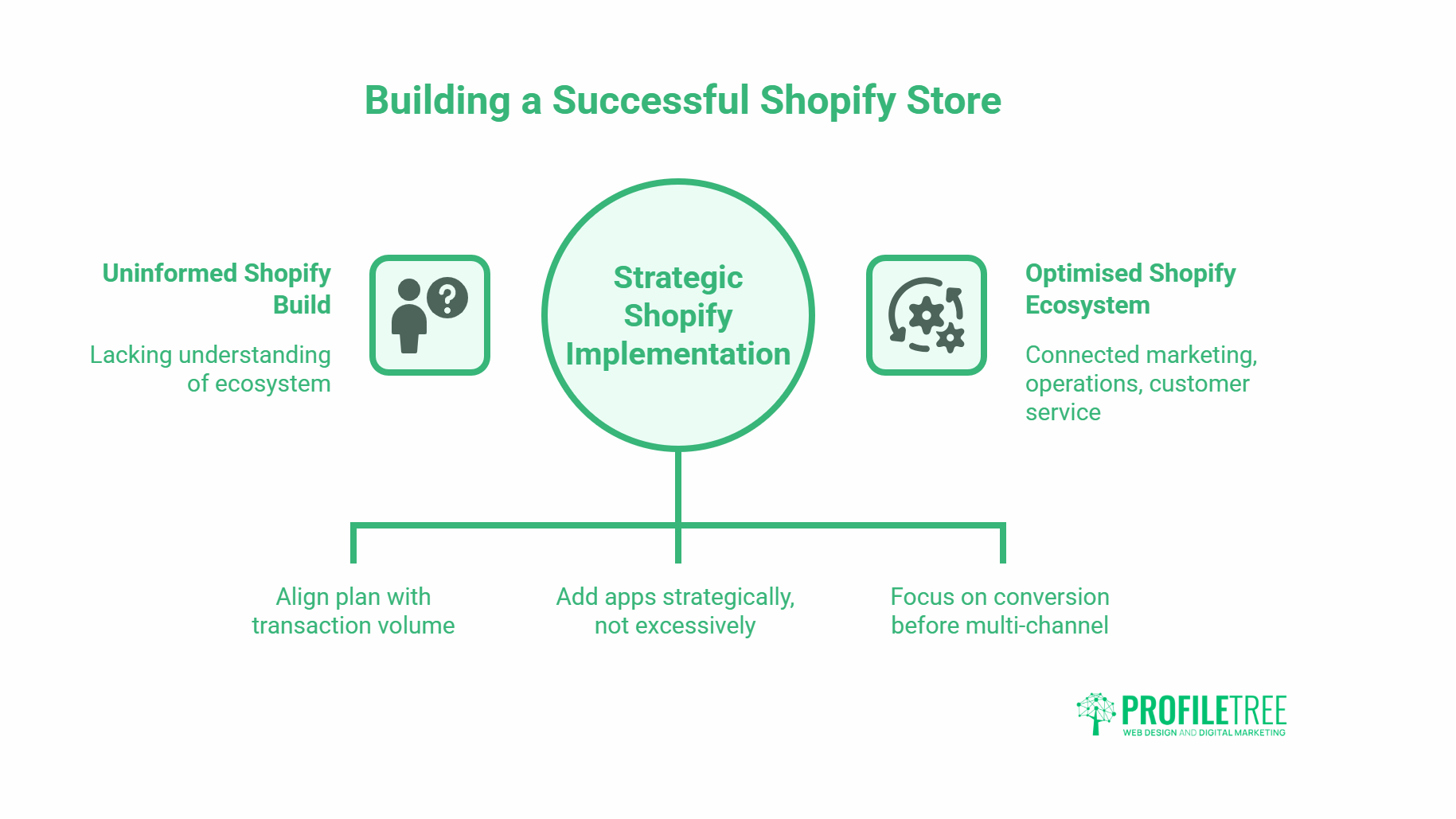
Shopify is more than a website builder. It is an ecosystem of tools, integrations, and sales channels that can connect your store to your marketing, operations, and customer service.
Core and Plus: Choosing the Right Plan
Standard Shopify suits most small and medium businesses. Shopify Plus is designed for high-volume merchants who need advanced automation, custom checkout scripting, and dedicated support. The decision between them is primarily about transaction volume and complexity, not ambition. Many businesses spend years on standard Shopify before their needs genuinely require Plus.
The App Store: Power and Risk
Over 8,000 apps extend Shopify’s functionality. That is a significant asset, but app sprawl is a real problem. Each additional app adds load time to your store, increases your monthly costs, and creates potential conflicts. Before adding an app, ask whether the problem it solves is genuinely affecting your sales. If not, leave it out.
Sales Channels Beyond Your Store
Shopify connects directly to Google Shopping, Meta (Facebook and Instagram), TikTok Shop, and marketplaces including Amazon. For most SMEs, the priority should be getting the core store right first. Multi-channel selling adds complexity; address it once your conversion rate justifies the operational effort.
Defining Your Product Vision and Value Proposition
Before building or restructuring a Shopify store, you need clear answers to two questions: what are you selling, and why should someone buy it from you rather than elsewhere?
What Your Product Vision Should Cover
A product vision is not a mission statement. It is a practical description of what you offer, who it is for, and what problem it solves. For an SME on Shopify, this typically means:
- A clearly defined product range (not everything to everyone)
- Pricing that reflects your market position
- A specific audience with identifiable needs
- A reason to choose you over lower-cost alternatives
Writing a Value Proposition That Works in E-commerce
Your value proposition needs to be visible within the first few seconds of someone landing on your store. It should answer three things: what you sell, who it is for, and what makes it different. Generic phrases like “quality products at great prices” tell the visitor nothing. Specific statements like “handmade ceramics for professional kitchens, delivered across the UK in 48 hours” immediately qualify the audience and set expectations.
Building a Shopify Marketing Strategy That Drives Qualified Traffic
A well-built Shopify store with no traffic produces no sales. Getting the right people to your store is the most important ongoing investment you will make.
SEO for Shopify: Getting the Basics Right
Shopify handles some technical SEO automatically, including canonical tags and sitemap generation. What it does not do is write good titles, descriptions, or product copy for you. These have a direct impact on how your pages rank and how often people click through from search results.
Key SEO priorities for a Shopify store:
- Product page titles that include specific, searchable terms
- Meta descriptions that describe what the product is and who it suits
- Category page content that provides genuine context, not just a list of products
- Descriptive image alt text for every product image
- Page loading speed, particularly on mobile
Shopify’s URL structure for product pages adds /products/ to every URL. This is fixed and has no meaningful impact on rankings, but collection and page URLs can be customised and should reflect the actual search terms your customers use.
Content Marketing as a Long-Term Traffic Channel
Blog content on a Shopify store serves a practical purpose: it attracts search traffic from people who are not yet ready to buy but are researching products in your category. A guide on how to choose the right product, a comparison of options, or a post answering common questions can bring in consistent organic traffic over months and years.
This is where a structured content strategy pays off. ProfileTree’s content marketing services help e-commerce businesses plan, create, and publish content that builds organic visibility and supports product sales.
Paid Advertising: When It Makes Sense
Paid ads on Google and Meta can generate immediate traffic, but they require a positive return on ad spend to be worth sustaining. Before investing significantly in paid advertising, confirm that your conversion rate is acceptable. Sending paid traffic to a store with conversion rate problems wastes budget. Organic and content channels build value over time; paid channels can accelerate growth once the fundamentals are solid.
“Most businesses want to jump straight to advertising when they should be fixing the store first. Paid traffic amplifies what is already working, so if the product pages, checkout, or messaging are weak, ads make the problem more expensive, not better,” says Ciaran Connolly, founder of ProfileTree.
Optimising Your Shopify Store for Conversion
Traffic without conversion produces nothing. The conversion rate of a typical Shopify store varies significantly by sector, but the consistent factors that improve it are the same across almost every category.
Product Page Fundamentals
The product page is where most purchase decisions are made or lost. High-converting product pages share these characteristics:
- Clear, accurate product titles that match how people search
- Multiple high-quality images, including context shots showing the product in use
- Descriptions that address both features and the specific benefit to the buyer
- Visible social proof: reviews, ratings, or trust signals
- A clear call to action that is easy to find without scrolling
Checkout Experience and Cart Abandonment
Cart abandonment is one of the most consistent challenges in e-commerce, with industry averages typically above 70%. The most common causes are unexpected costs at checkout (shipping, fees), a requirement to create an account, and a checkout process that takes too many steps.
Shopify’s default checkout is well-optimised, but there are consistent improvements worth making: showing shipping costs early in the journey, offering guest checkout, and keeping the number of form fields to a minimum.
Mobile Optimisation
More than 60% of Shopify traffic typically comes from mobile devices. If your theme is not properly optimised for small screens, buttons are too small to tap accurately, or images load slowly on mobile connections, you are losing a significant proportion of potential sales. Test your store on actual mobile devices, not just a browser’s responsive preview.
Using AI and Automation to Run a Smarter Shopify Store
AI tools are increasingly practical for e-commerce businesses of any size. They are not a replacement for strategy, but they reduce the time cost of repetitive tasks and surface patterns in data that would otherwise go unnoticed.
AI for Product Descriptions and Content
Generating product descriptions manually across a large catalogue is time-consuming. AI writing tools can produce first drafts at speed, though these need editing for accuracy, brand voice, and SEO. The practical approach is to use AI for the initial draft and apply human editing for tone, accuracy, and differentiation.
Predictive Inventory and Demand Forecasting
Shopify’s analytics show what has sold and when. Third-party tools and AI integrations can extend this into forward-looking forecasts, helping to avoid both overstocking and stockouts. For seasonal products or businesses with variable demand, this has a direct impact on cash flow and customer satisfaction.
AI-Driven Personalisation
Product recommendation engines, personalised email sequences, and dynamic pricing tools all use AI to tailor the customer experience based on behaviour. These are available through Shopify apps and, for higher-volume stores, through deeper integrations.
For businesses across Northern Ireland and the UK looking to bring AI into their marketing and operations, ProfileTree’s AI transformation services cover practical implementation for SMEs, without the complexity that enterprise solutions typically require.
Scaling Your Shopify Store: What Actually Changes
Scaling a Shopify store is not about switching to Shopify Plus. It is about building the systems, content, and customer relationships that allow revenue to grow without a proportional increase in time or cost.
Wholesale and B2B on Shopify
Shopify Plus includes a dedicated wholesale channel. Standard Shopify can support B2B selling through apps and custom pricing rules, though with more limitations. If B2B revenue is a significant part of your business model, this is worth factoring into your platform decision early.
Expanding into New Markets
Shopify Markets allows stores to sell in multiple currencies and languages from a single back-end. For businesses in Northern Ireland and Ireland, this is particularly relevant given the border between two currencies. Setting up multi-currency pricing and localised shipping rates removes friction for customers in different regions.
Building Partnerships and Integrations
As a Shopify store grows, the value of clean integrations with fulfilment, accounting, customer service, and marketing platforms increases. The goal is a set of tools that share data reliably, so you are not manually reconciling systems. ProfileTree’s digital marketing services include strategy and implementation support for businesses building connected e-commerce systems.
Common Shopify Strategy Mistakes to Avoid
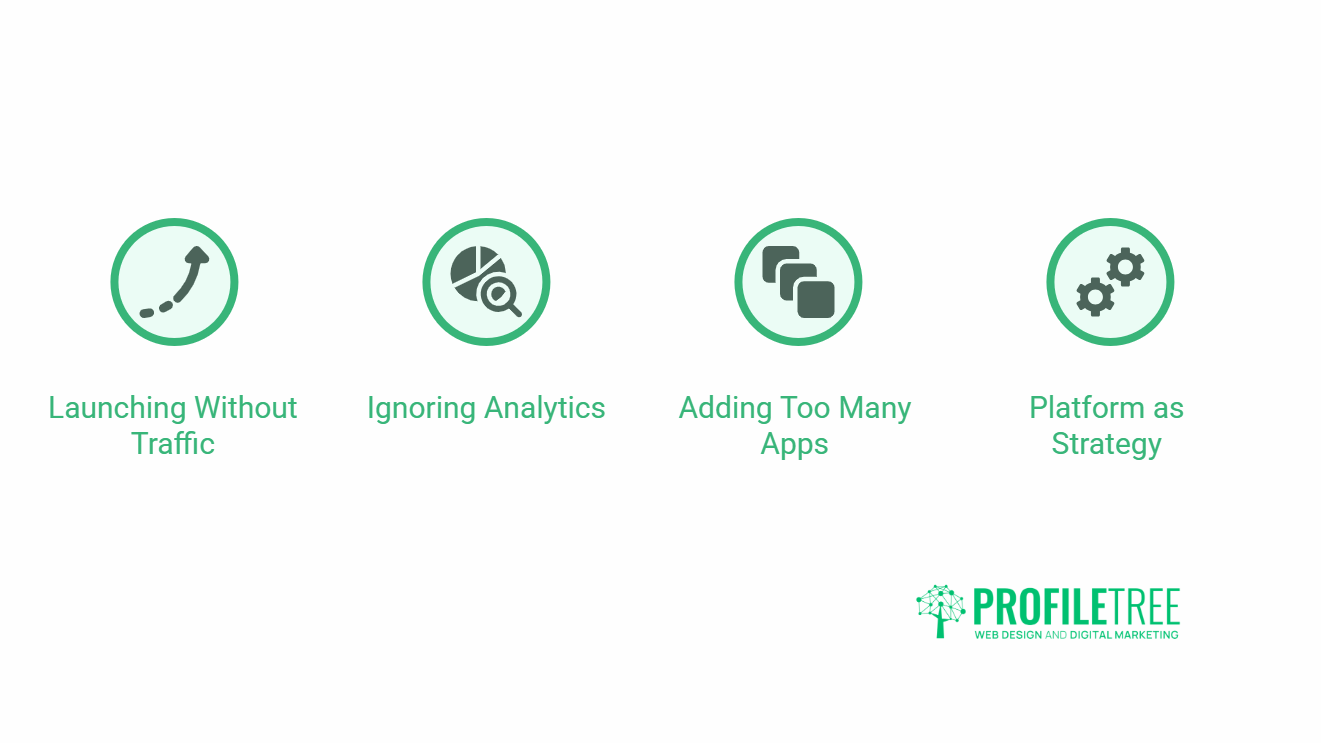
The most frequently seen problems in Shopify stores are not technical. They are strategic.
Launching Without a Traffic Plan
A new Shopify store with no SEO foundation, no social presence, and no budget for paid advertising will receive no visitors. Before launch, identify at least two traffic channels you will actively develop.
Ignoring Analytics
Shopify’s built-in analytics show where customers come from, what they look at, and where they leave. Google Analytics (now GA4) gives a deeper picture. Reviewing this data regularly, even weekly, allows you to identify problems and opportunities that are invisible without it. See Google’s official Analytics documentation for setup guidance.
Adding Too Many Apps Too Quickly
App overload is common and genuinely damaging. Every app slows your store slightly; collectively, they can make a once-fast store sluggish. Audit your app list every quarter and remove anything not delivering measurable value.
Treating the Platform as the Strategy
Shopify is a capable platform. It does not generate a strategy, attract customers, or write compelling product copy. The businesses that succeed on Shopify treat it as infrastructure and invest in the strategy around it.
Frequently Asked Questions About Shopify Platform Strategy
How much does it cost to build and run a Shopify store?
Shopify plans start at around £25 per month for the basic plan, rising to £65 for standard and £105 for Advanced. Shopify Plus starts at approximately $2,300 per month. Add to this the cost of a theme (free options exist; premium themes typically cost $150 to $350), any paid apps, and transaction fees if you do not use Shopify Payments. A professionally built custom store from an agency typically ranges from £3,000 to £15,000 depending on complexity.
Is Shopify good for SEO?
Shopify handles technical SEO reasonably well out of the box. The areas that require more attention are product and collection page content, site speed, and internal linking structure. It is not as flexible as WordPress for SEO, but it is a solid foundation for most e-commerce businesses.
When should I upgrade to Shopify Plus?
Shopify Plus makes sense when you are processing high transaction volumes (typically above $1 million annually), need custom checkout scripting, require advanced automation, or have complex B2B requirements. Many businesses upgrade before they need to; the standard plans handle significant growth without issues.
How long does it take to rank a Shopify store in search results?
New stores with no domain authority typically take three to six months to start seeing organic traffic for targeted keywords, and longer for competitive product categories. Consistent content publishing, good technical SEO, and building backlinks all accelerate this timeline.
What is the average Shopify conversion rate?
Conversion rates vary significantly by sector. Shopify’s own data suggests an average across its platform of around 1.4%, though well-optimised stores in strong niches consistently achieve 3% to 5%. Understanding your current rate and working to improve it is often more profitable than increasing traffic.
Do I need a developer for a Shopify store?
Not always. Shopify’s no-code editor handles most store customisations. A developer becomes necessary when you need custom functionality, significant theme modifications, or integrations that apps do not cover adequately. For a business-critical store, having a developer available for ongoing support is worth the investment.
How should I handle shipping for customers in Northern Ireland and Ireland?
Shipping to Northern Ireland follows UK rules post-Brexit. Shipping to the Republic of Ireland requires different customs documentation for some goods. Shopify’s shipping zones handle this distinction, but you need to configure them correctly and be clear with customers about delivery timescales and any potential duties.
Building a Shopify Strategy That Lasts
A successful Shopify platform strategy is not a one-time project. It is an ongoing process of improving your store, expanding your content, testing what works, and adapting to changes in how people search and shop online.
The businesses that build sustainable e-commerce revenue are the ones that treat their Shopify store as a commercial asset requiring consistent attention, not a website that runs itself. If you want to build a store structure that ranks, converts, and grows, talk to the ProfileTree team about your Shopify project.