
Salesforce for Marketers: A Practical Guide to the Platform
Table of Contents
Salesforce is one of the most widely licensed marketing platforms in the world. It is also one of the most underused. Many UK and Irish businesses pay for Marketing Cloud or Account Engagement (Pardot) and then spend the next six months wondering why the results do not match the sales pitch. This guide cuts through the platform overview and explains what Salesforce actually does for marketing teams, which product is right for your business, and what you need in place before you spend a penny on licenses.
Whether you are evaluating Salesforce for the first time or trying to get more out of a licence you already hold, the sections below cover the platform’s core tools, the Marketing Cloud versus Account Engagement decision, UK compliance requirements, and the honest reality of the learning curve involved.
What Is Salesforce for Marketers?
Salesforce began as a sales CRM and has grown into a family of connected cloud platforms. For marketing teams, the two most relevant products are Salesforce Marketing Cloud and Salesforce Account Engagement (formerly Pardot). They are separate products built for different use cases, which is the first thing most guides fail to explain clearly.
Salesforce Marketing Cloud is built for B2C marketing at scale. It handles email, SMS, push notifications, paid social advertising, and customer journey automation across large contact databases. Retailers, travel businesses, financial services providers, and consumer brands are its natural home. The platform’s central concept is the “Customer 360”: a single profile that pulls together every interaction a contact has had with your brand, across every channel, and uses that data to decide what to send them next and when.
Salesforce Account Engagement (Pardot) is built for B2B marketing, specifically for businesses with longer sales cycles and smaller, higher-value contact lists. It focuses on lead nurturing, lead scoring, and aligning the marketing team’s activity with the sales team’s pipeline in Salesforce Sales Cloud. A professional services firm, a SaaS company, or a manufacturer selling to trade buyers would typically fall into this category.
The mistake many SMEs make is buying Marketing Cloud when Account Engagement is a better fit, or vice versa. The two products have different pricing structures, different feature sets, and very different technical demands. Choosing the wrong one is expensive to unwind.
Marketing Cloud vs Account Engagement: Which Is Right for Your Business?
This is the question most buyers should answer before anything else, and most vendor conversations skip past it too quickly.
Key Differences for B2B vs B2C Marketers
| Marketing Cloud | Account Engagement (Pardot) | |
|---|---|---|
| Best suited to | B2C, high-volume consumer marketing | B2B, longer sales cycles, trade buyers |
| Contact database size | Tens of thousands to millions | Typically under 100,000 |
| Primary channels | Email, SMS, social ads, push | Email, landing pages, forms |
| CRM alignment | Connects to Sales Cloud via Marketing Cloud Connect | Natively built on Sales Cloud |
| Ease of use | Steep; requires dedicated resource | Moderate; marketers can self-manage with training |
| UK entry pricing (approx.) | From £1,250/month (Growth) | From £1,250/month (Growth) |
| Ideal team size | Dedicated marketing ops or agency support | Solo marketer to small team |
If your business sells to other businesses, has a sales team using Salesforce CRM, and your marketing activity is primarily about generating and nurturing leads for those salespeople, Account Engagement is almost certainly the right starting point. Marketing Cloud is a serious enterprise platform. It rewards organisations that have clean data, a dedicated administrator, and a clear multi-channel strategy. For most SMEs in Northern Ireland and Ireland, considering Salesforce for the first time, the internal resources needed are not yet in place.
Pricing Structure and Licensing Realities in the UK
Salesforce pricing is published on the Salesforce UK website, but the listed prices rarely reflect the total cost of ownership. Both Marketing Cloud and Account Engagement charge per contact in your database, which means costs rise as your list grows. Implementation costs sit on top of licensing, and most mid-market UK businesses will need either a certified Salesforce partner or an internal Salesforce administrator to properly configure the platform.
A realistic budget for a UK SME implementing Account Engagement from scratch, including licences, initial configuration, and basic training, is typically in the range of £20,000 to £40,000 for the first year when all costs are considered. Marketing Cloud implementations at enterprise scale run considerably higher. These are not reasons to avoid Salesforce, but they are reasons to go in with clear eyes.
The Core Pillars: Studios, Builders, and Data Cloud
For those who have already committed to Marketing Cloud, the platform is organised around a set of “Studios” (channel-specific tools) and “Builders” (automation and data tools).
Email, Mobile, and Advertising Studios
Email Studio is where most Marketing Cloud users spend the majority of their time. It handles campaign creation, audience segmentation, send scheduling, and performance reporting. Segmentation is particularly strong: you can filter your contact database by behaviour, demographics, purchase history, or CRM data from Sales Cloud, and build audience segments that update dynamically as contact records change.
Mobile Studio covers SMS, push notifications, and in-app messaging. For UK marketers, SMS requires careful attention to PECR consent rules (see the compliance section below), but for businesses where SMS is a proven channel, the scheduling and personalisation capabilities are genuinely useful.
Advertising Studio connects your Salesforce contact data to paid social and display advertising, primarily through Facebook, Instagram, Google, and LinkedIn. The practical application: you can suppress existing customers from acquisition campaigns, or build lookalike audiences from your best-performing contacts.
Journey Builder: Automating the UK Customer Path
Journey Builder is Marketing Cloud’s workflow automation tool, and it is where the platform genuinely earns its cost for businesses with complex, multi-step customer communications.
A journey is a sequence of actions triggered by a contact’s behaviour or data. A straightforward example: a contact submits an enquiry form on your website, they receive an immediate acknowledgement email, then a follow-up three days later if they have not responded, then a targeted offer seven days after that if they have visited your pricing page. All of this runs automatically once the journey is configured.
The more powerful use cases involve branching logic. A contact who opens the first email takes one path; a contact who does not takes another. A contact whose job title indicates senior decision-maker gets different content than a contact at the coordinator level. This kind of segmentation-driven personalisation is what separates a well-configured Journey Builder from a basic email autoresponder.
Building effective journeys requires clear thinking about the customer’s path before they touch the platform. The strategic planning work (mapping what a customer needs to hear, in what order, based on what they have done) is where most implementations stall. ProfileTree’s digital marketing strategy work often starts at exactly this point: helping businesses define the customer journey in plain language before any platform configuration begins.
The “Non-Technical” Reality: Is Salesforce Actually Easy?
Most Salesforce marketing material answers this question with a confident “yes.” The honest answer is more nuanced.
Managing the Learning Curve: Trailhead vs Practical Experience
Salesforce provides a free online learning platform called Trailhead, which offers structured learning paths for both Marketing Cloud and Account Engagement. The content is well-produced, and Trailhead certifications are recognised credentials in the industry. For a marketing manager who wants to develop genuine platform competence, Trailhead is a sensible starting point.
The gap between completing Trailhead modules and confidently running campaigns in a live environment is real, though. The platform has a significant number of moving parts, and the consequences of misconfiguring something (sending to the wrong segment, triggering a journey with an error, or mishandling consent data) are commercially and legally significant. Most UK businesses implementing Salesforce for the first time will need external support for at least the first three to six months, either from a certified implementation partner or through structured training.
This is not a knock on the platform. It reflects the reality that Salesforce is built to handle very complex marketing operations, and that complexity comes with a learning investment. The businesses that get the most from Salesforce are those that treat implementation as a project, not a purchase. They define their goals, map their data, train their team, and phase their rollout, rather than expecting the platform to produce results the week the licences are switched on.
ProfileTree’s digital training programmes have worked with marketing teams at this stage: not teaching platform features from a manual, but helping teams build the practical skills to use those features confidently in their specific business context. The digital training video below gives a sense of how that process works.
Compliance and Data: GDPR and PECR in Salesforce
This section addresses something most Salesforce guides written for US audiences skip entirely. UK and Irish marketers operating within Salesforce have specific legal obligations under the UK GDPR, the EU GDPR (for Irish and EU-based contacts), and the Privacy and Electronic Communications Regulations (PECR).
PECR and email marketing: PECR governs electronic direct marketing in the UK. For business-to-consumer email, you generally need prior consent unless the soft opt-in applies (the contact bought from you recently and you are marketing similar products). For B2B email to corporate email addresses, the rules are slightly different, but legitimate interest must be demonstrable. Salesforce’s consent data fields need to be mapped carefully to your actual consent records; the platform does not enforce this automatically.
Double opt-in workflows: For businesses building lists from website forms, a double opt-in journey in Marketing Cloud, where a new subscriber receives a confirmation email and must click to be added to your main list, is the safest approach for UK and EU contacts and is relatively straightforward to configure in Journey Builder.
Right to be forgotten: Under UK GDPR, contacts can request deletion of their personal data. Salesforce supports this through its data deletion request tools, but the process needs to be configured and tested. Contacts deleted from Marketing Cloud also need to be handled consistently in any connected Sales Cloud records.
Data residency: For Irish businesses with EU-based contacts, data residency may be a consideration post-Brexit. Salesforce offers EU data residency options, but these require specific configuration and may affect pricing.
ProfileTree has a guide to GDPR-compliant web forms that covers the consent architecture that should underpin any data flowing into a platform like Salesforce: how to design GDPR-compliant web forms.
The Migration Roadmap: Moving from HubSpot or Mailchimp
A significant proportion of businesses researching Salesforce are not starting from scratch. They are running their marketing on HubSpot, Mailchimp, ActiveCampaign, or a similar platform and are considering migrating.
The decision to migrate is not primarily about features. It is almost always about scale, CRM integration, and internal resources. If your business is growing, your contact database is expanding, and your sales team is already using Salesforce CRM, the case for bringing your marketing onto the same platform is clear. If your business is small, your sales process is informal, and you do not have a dedicated marketing operations resource, the simpler platform is usually the right answer.
Data Cleansing and Mapping Framework
Migration projects routinely take longer than planned, and the reason is almost always data quality. A contact database that has been accumulating records for several years will typically contain duplicates, outdated contact information, inconsistent field naming, and gaps in consent records. Cleaning this data before migrating, rather than moving the problem into a new platform, is the single most important step in a successful migration.
A basic pre-migration data audit should cover:
- Duplicate contact identification and resolution
- Consent record completeness (do you have a documented basis for marketing to each contact?)
- Field mapping between the source platform and Salesforce’s data model
- Suppression list export (contacts who have opted out must remain suppressed in the new platform)
- Historical engagement data that you want to retain versus data that can be left behind
The temptation to skip this step in the interest of moving quickly is understandable. The consequence is a Salesforce instance that inherits all the problems of the previous platform and adds a few new ones.
Ciaran Connolly, founder of ProfileTree, the Belfast-based digital agency, puts it plainly: “Most Salesforce migration projects we’ve reviewed stall in the first quarter because the data wasn’t ready. The platform is only as good as what you put into it. A week spent cleaning your contact database before migration is worth more than months of reconfiguration after it.”
Salesforce and Your Digital Marketing Strategy
Salesforce is a tool, not a strategy. The businesses that treat it as the latter (buying the licences and expecting the results to follow) consistently underperform those that treat it as the execution layer for a clearly defined marketing plan.
What a well-configured Salesforce instance actually does is give you the ability to act on your strategy with precision: to send the right message to the right person at the right moment, based on data rather than guesswork. But the strategy itself, covering decisions about who to target, what to say, how to structure the customer journey, and what success looks like, has to come first.
This is where ProfileTree’s digital marketing strategy service connects to the platform conversation. Businesses that engage strategy support before or alongside a Salesforce implementation consistently get more from the platform because they arrive with clear answers to the questions the platform will ask: What segments matter? What does a good lead look like? What is the journey from first contact to conversion? What should the follow-up sequence say?
For SMEs considering how digital marketing investment fits into a broader growth plan, the guide to building a digital marketing strategy to attract investors provides a useful framework for thinking about the commercial logic before committing to any particular platform.
Content, SEO, and the Inbound Funnel That Feeds Salesforce
Marketing Cloud and Account Engagement are outbound tools. They handle what happens once a contact is in your database. They do not generate that contact in the first place.
The inbound funnel that feeds Salesforce comes from SEO, content marketing, paid search, and social. A business whose website is not generating organic enquiries will not fix that problem by implementing Salesforce; it will simply have a more sophisticated system for managing the low volume of contacts it was already getting.
For UK and Irish SMEs, building that inbound pipeline typically means investing in organic search visibility through well-structured content that answers the questions buyers are searching for. When that content converts visitors into contacts via a website form, those contacts can flow directly into Salesforce via an integration, triggering the appropriate journey automatically.
The practical implication: Salesforce implementation and SEO investment should not be treated as separate budget conversations. They serve the same funnel. A website that ranks well and converts well fills Salesforce with quality contacts. A Salesforce configuration that communicates well with those contacts turns them into customers. ProfileTree’s SEO services operate at the top of that funnel; the CRM works at the bottom.
For a broader view of how email fits into this model, the guide to using email marketing effectively covers the channel fundamentals that apply regardless of the platform you use to send.
Salesforce Marketing Career Paths and Certifications
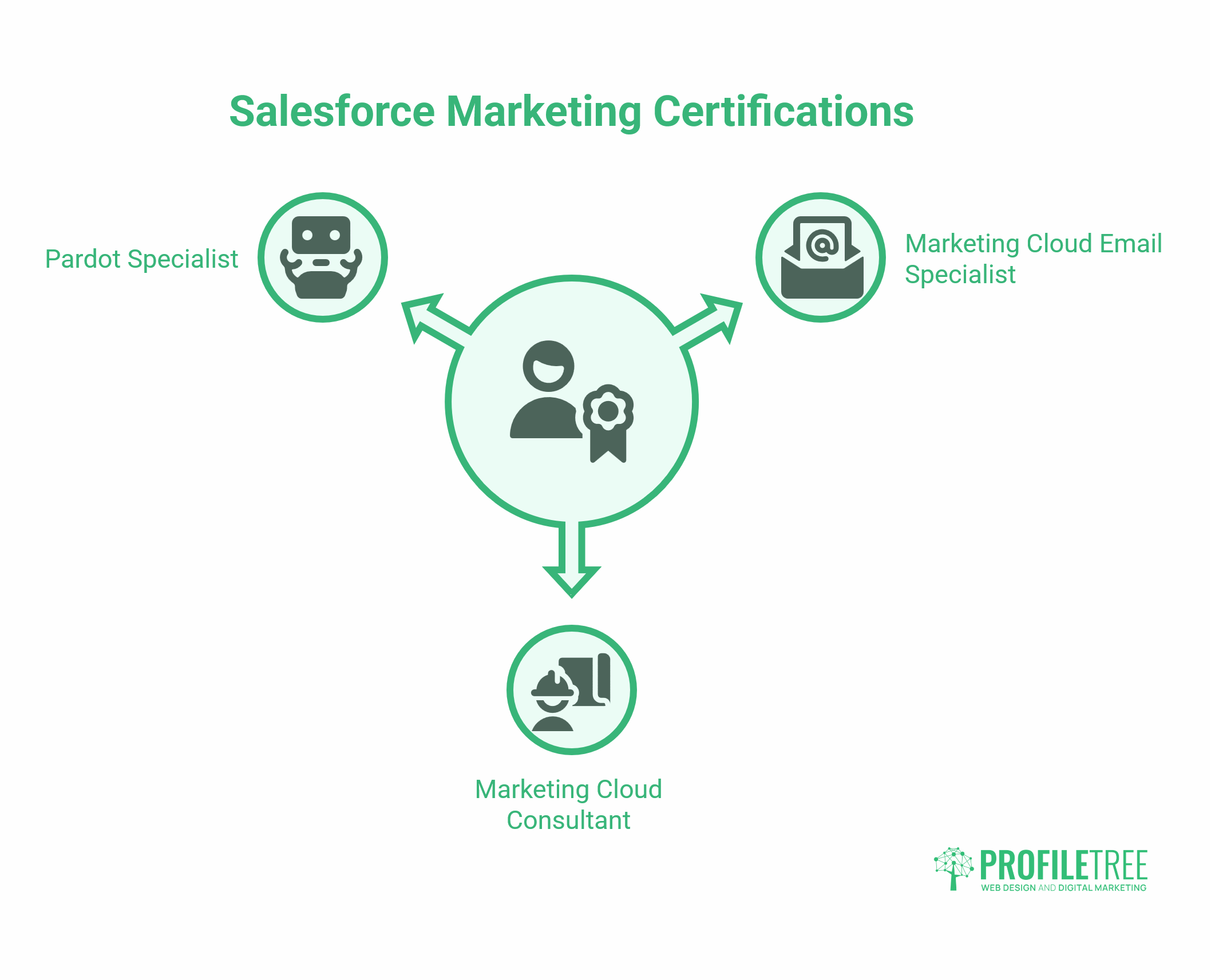
For marketing professionals looking to build Salesforce expertise as a career asset, the certification structure is well established. Salesforce offers specific credentials for marketers, including the Marketing Cloud Email Specialist, Marketing Cloud Consultant, and Pardot Specialist certifications.
Trailhead is the starting point for all of these. The platform offers structured learning paths for each certification, and its content is updated regularly. For those considering a career move into marketing operations or CRM management, Salesforce certification is a recognised differentiator in the UK and Irish job market.
The practical skills gap that certifications do not fully address is experience with live client data in complex environments. Businesses that want their marketing teams to develop genuine platform competence (rather than examination knowledge alone) benefit from supervised hands-on work, ideally within a structured training programme. ProfileTree’s digital training for businesses includes this kind of applied learning for teams that need to build skills they can use immediately, not just qualifications they can put on a CV.
For AI-related capabilities within Salesforce, including Einstein features for predictive lead scoring and AI-driven personalisation, training-your-team articles on working with AI tools are a useful complement to the platform-specific Salesforce training.
Conclusion
Salesforce is a serious platform that rewards serious preparation. For UK and Irish SMEs, the right starting point is usually Account Engagement rather than Marketing Cloud, a clear strategy before any configuration begins, and honest internal assessment of data quality and available resource. ProfileTree’s digital marketing strategy and training services work with businesses at exactly this stage. If you are evaluating Salesforce or trying to get more from a licence you already hold, get in touch with the team to discuss where to start.
FAQs
Is Salesforce Marketing Cloud the same as Salesforce CRM?
No. Salesforce CRM (Sales Cloud) manages prospects, accounts, and pipelines for sales teams. Marketing Cloud is a separate product for multi-channel campaign management. The two connect through Marketing Cloud Connect but are sold and licensed independently.
What is the difference between Pardot and Marketing Cloud?
Account Engagement (Pardot) is built for B2B marketing: lead nurturing, lead scoring, and alignment with a Sales Cloud pipeline. Marketing Cloud is built for high-volume B2C marketing across email, SMS, social, and paid channels. For most SMEs in Northern Ireland and Ireland, Account Engagement is the more practical starting point.
How much does Salesforce cost for a UK marketing team?
Both products start at roughly £1,250 per month for the Growth tier (published Salesforce UK pricing). This covers licences only. A realistic first-year budget including implementation, configuration, and training is typically between £20,000 and £40,000 for an SME.
Do I need to know how to code to use Salesforce?
Account Engagement requires no coding for day-to-day use. Marketing Cloud is more demanding: advanced personalisation uses AMPscript, and Data Extension management benefits from SQL knowledge. Most UK businesses will need an administrator or external support for anything beyond standard configurations.