
Online Reputation Management: A UK & Ireland Guide
Table of Contents
When a potential customer searches your business name, what do they find? For most SMEs in Northern Ireland, Ireland, and the UK, the answer is a mix of Google reviews, directory listings, and whatever content happens to rank, much of it outside their direct control. Online reputation management (ORM) is the practice of actively shaping that picture, replacing chance with strategy.
This guide covers everything a business owner or marketing manager needs to understand about ORM: what it is, why the UK and Irish markets have specific considerations that US-focused guides miss, and how to build a practical approach that works without expensive agencies or questionable tactics.
What Is Online Reputation Management?
Online reputation management is the ongoing process of monitoring, influencing, and improving how your business appears across search results, review platforms, and social media. It combines SEO, content marketing, and review management to give businesses more control over what a prospective customer sees when they look you up.
ORM vs. PR: Understanding the Difference
Traditional public relations focuses on broadcast: press releases, media coverage, and controlled messaging pushed outward. ORM works differently. It is reactive and responsive by design, addressing what already exists online and working to shift the balance of what search engines surface. A PR campaign might earn a positive article in a trade publication. ORM ensures that the article is what someone finds when they search your brand name, rather than a three-star Trustpilot thread.
Why Search Results Are Your Reputation
For most SMEs, a Google search of the business name is the first step a prospect takes before contacting the business. What ranks on page one is, in practical terms, your public reputation. A well-managed ORM strategy uses SEO techniques, structured content, and active review management to ensure the first page is as accurate and positive as possible.
The Cost of Ignoring It
Research from BrightLocal consistently shows that a significant proportion of consumers read online reviews before visiting a local business, and that negative reviews cause a measurable drop in enquiries. For service businesses in sectors like hospitality, legal, healthcare, and trades, a few unaddressed negative reviews on Google or Trustpilot can materially affect revenue. The cost of addressing reputation problems reactively is almost always higher than the cost of managing proactively.
The Four Pillars of Online Reputation: The PESO Model
A structured ORM strategy covers four media types, each serving a different function.
Paid Media
Paid media includes Google Ads, sponsored social content, and display advertising. In the context of ORM, paid search is most useful for controlling what appears when someone searches your brand name. If negative results are ranking, running paid ads for your own brand name gives you a guaranteed first-position listing while the organic strategy catches up. It is a short-term tool, not a long-term solution.
Earned Media
Earned media is coverage you did not pay for: press mentions, backlinks from credible publications, guest contributions, and podcast appearances. In ORM terms, earned media matters because third-party sites mentioning your business in a positive context can rank for your brand name. A positive feature in a regional business publication, for example, may hold page one position for years. Earning consistent media coverage is one of the most durable ORM strategies available to UK and Irish SMEs.
Shared Media
Shared media is your presence on social platforms: what you post, how you respond, and how your audience engages with your content. Social profiles frequently rank in branded searches, meaning a well-maintained LinkedIn company page or an active Facebook Business profile can occupy page-one real estate that might otherwise be held by an unrelated result. Social activity also signals to search engines that a business is active and legitimate.
Owned Media
Owned media is everything you publish directly: your website, blog, and YouTube channel. This is the most controllable and most durable pillar of ORM. A consistent content marketing programme that publishes genuinely useful articles about your services, expertise, and market builds a deep library of indexed content associated with your brand. Over time, this content displaces less relevant or less positive results simply by volume and relevance.
The UK and Irish Legal Landscape: GDPR and the Right to Be Forgotten
This is where most ORM guides fall short. The majority are written for a US audience and ignore the legal tools available to businesses and individuals in the UK and EU. If you are based in Northern Ireland, Ireland, or anywhere in the UK, you have specific rights that change what is possible.
How UK GDPR Affects Search Results
Under the UK General Data Protection Regulation (UK GDPR), individuals have the right to request that search engines delist certain search results. This is commonly referred to as the Right to Be Forgotten, also known as the Right to Erasure. The right applies to personal data that is inaccurate, no longer relevant, or disproportionate relative to the original purpose for which it was published. It is not an automatic entitlement and does not apply to matters of genuine public interest.
For businesses, the equivalent mechanism is narrower. A company cannot file a Right to Be Forgotten request for content about itself in the same way an individual can. However, if search results contain information about named individuals within the business (directors, employees) that meet the criteria, those individuals may be able to request removal.
Filing a Removal Request with Google UK
Google operates a dedicated form for Right to Be Forgotten requests in the European Economic Area and the UK. You can access it via Google’s Search Help Centre. The process requires you to identify the specific URLs, explain why the content meets the removal criteria, and provide supporting documentation if applicable. Google reviews each request and notifies the relevant publisher before removing results.
The Information Commissioner’s Office (ICO) oversees UK GDPR enforcement and provides guidance on making data removal requests. If Google rejects your request, you can escalate to the ICO. Their website (ico.org.uk) includes a template for raising complaints.
When to Involve a Solicitor
For most straightforward reputation issues, a solicitor is not needed. Where a solicitor becomes relevant is when content is potentially defamatory (false statements of fact presented as true), when a data breach has led to harmful content being published, or when a platform has refused to remove content that meets the legal criteria for removal. UK defamation law differs meaningfully from US law in that claimants do not need to prove damage in the same way, and the burden of proof differs. A solicitor specialising in media and communications law can advise whether a formal complaint or legal action is proportionate.
Platform-Specific Removal Processes
Beyond Google, several platforms have their own removal and response processes relevant to UK businesses. Trustpilot allows businesses to flag reviews that violate its guidelines, including fake or incentivised reviews. Glassdoor UK has an employer response function and a separate process for flagging reviews that breach its community standards. For forum content on sites such as Mumsnet or Reddit, removal generally requires a direct approach to the site’s moderation team with a clear explanation of why the content breaches their terms, or, in more serious cases, a legal notice.
Building a Proactive ORM Strategy: Step by Step
The most effective ORM work happens before there is a problem to manage. A proactive strategy puts businesses in a position where positive content dominates before any negative content appears.
Step 1: Audit Your Digital Footprint
Start by searching your business name in Google and Bing, both in a logged-out browser and in incognito mode to avoid personalised results. Record what appears on page one: each result, its URL, and whether it is positive, neutral, or negative. Do the same for your business name plus common modifiers: your business name plus “reviews,” your business name plus your town or city, your business name plus your primary service. This gives you a realistic baseline.
Also, check the data. If you have Google Search Console access, the ORM statistics breakdown on ProfileTree provides useful context on how review signals affect search visibility and consumer behaviour.
Step 2: Claim and Optimise Every Profile
Your Google Business Profile is the single most important profile for local ORM. It appears prominently in branded searches, drives directions and calls, and is the platform where most UK consumers leave reviews. Ensure every field is complete: business name, address, phone number, website, hours, and category. Add photos regularly. The Google My Business statistics that matter for local visibility show how completion rates correlate with search appearance frequency.
Beyond Google, claim profiles on Trustpilot, Yelp UK, Checkatrade (if relevant to your trade), and any industry-specific directories that rank for your category. An unclaimed profile is one you cannot respond to.
Step 3: Set Up Monitoring
Free monitoring tools include Google Alerts (set alerts for your business name, key staff names, and your primary products or services). For more detailed social monitoring, tools such as Mention or Brand24 offer paid plans that track mentions across forums, news sites, and social platforms in near real time. The goal is to know about mentions quickly enough to respond before they compound.
Step 4: Build Your Owned Content Library
A structured content marketing programme is the most durable investment in ORM available to SMEs. Publishing regular articles, guides, and case studies on your own website creates a growing library of indexed content associated with your business. Over 12 to 24 months, this content builds enough authority to secure multiple page-one positions for branded searches, leaving less space for third-party content you cannot control.
ProfileTree’s content marketing services for businesses across Northern Ireland and Ireland focus specifically on this long-game approach: building topical authority through consistent publication rather than chasing individual quick wins.
Managing Reviews: From Google to Glassdoor UK
Review management is the most immediate and visible element of ORM for most SMEs. How you respond to reviews signals to both search engines and prospective customers how you operate as a business.
Handling Negative Reviews on Google Business Profile
The first rule is to respond to every negative review, without exception, within 48 hours. A response does three things: it shows the reviewer their concern has been heard, it demonstrates to other prospective customers that the business takes service seriously, and it can influence whether Google surfaces the review prominently. The response should acknowledge the issue specifically, avoid defensive language, and offer a practical next step (a direct email address or phone number to continue the conversation off-platform).
Do not ask Google to remove a negative review simply because it is negative. Google will only remove reviews that violate its policies (spam, fake, offensive content, or content that includes personal information). Requesting the removal of a legitimate negative review wastes time and can create the impression of suppression if the reviewer posts publicly about the attempt.
The Ethics and Legality of Incentivising Reviews in the UK
This is worth stating clearly: incentivising reviews (offering discounts, gifts, or any benefit in exchange for a positive review) is prohibited by Google’s policies and by the UK Competition and Markets Authority (CMA) guidelines. The CMA has taken enforcement action against businesses in this area, with consequences including fines and mandatory corrective action. Asking customers to leave honest reviews after a completed transaction is entirely legitimate. Offering anything in return is not.
Responding to Trustpilot and Glassdoor UK
Trustpilot operates a flagging system for reviews that violate its guidelines. Businesses can flag reviews as fake, incentivised, or not relating to a genuine transaction, and Trustpilot’s content integrity team reviews flagged submissions. Legitimate critical reviews should be responded to rather than flagged. For Glassdoor UK, the employer response function allows businesses to post a public response to any employee review, which is visible to all subsequent viewers. Ignoring Glassdoor reviews on the assumption that candidates do not read them is a mistake, particularly for businesses that are hiring.
SEO as the Foundation of Long-Term Reputation Control
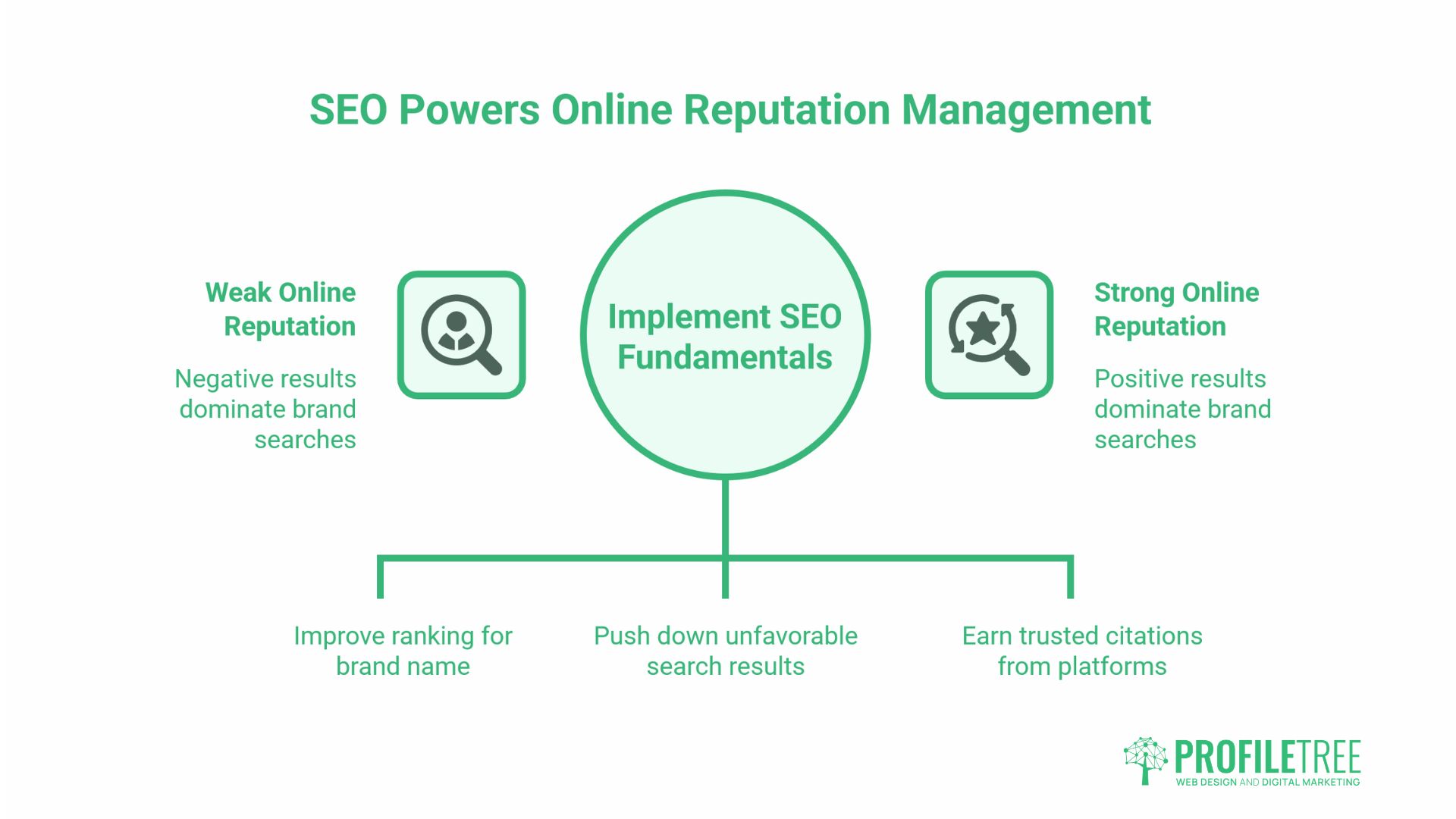
Search engine optimisation is not a separate discipline from ORM. It is the mechanism by which ORM works. The pages that rank for your brand name, the content that suppresses negative results, and the authority that earns you trusted platform citations all depend on SEO fundamentals.
How Content Suppression Works
Content suppression is the organic alternative to legal removal. Where a negative result ranks on page one, publishing and promoting positive, authoritative content about the same topic can, over time, push the negative result to page two or beyond. This works because search engines rank pages based on relevance and authority. If you publish ten pages of high-quality, well-structured content about your business and services, each earning backlinks and engagement, those pages collectively outcompete a single negative result that has no ongoing investment.
This is why a professionally executed SEO strategy is the most reliable long-term ORM tool available. The ethical and legal dimensions of digital marketing are directly relevant here: content suppression is entirely legitimate, whereas some shortcut tactics (fake reviews, spammy link profiles) carry real legal and algorithmic risks.
Brand SERPs: Owning Your Own Name
A brand SERP is the set of results that appear when someone searches your business name. For a well-managed business, page one of the brand SERP should include your website, your social profiles (LinkedIn, Facebook, Twitter/X), your Google Business Profile, and one or two positive third-party mentions, such as directory listings or press coverage. If you do not have enough owned and claimed content to fill page one, you are leaving space for results you cannot control.
Google’s YMYL Framework and Reputation
Google applies additional scrutiny to pages covering health, finance, legal, and other “Your Money or Your Life” topics. For businesses in these sectors, reputation signals carry extra weight in ranking decisions. If you operate in financial services, healthcare, legal services, or any regulated industry in the UK or Ireland, building a demonstrably strong online reputation is not just a marketing consideration; it is a ranking factor. The implications of Google’s YMYL framework for content strategy are particularly relevant for service businesses in these categories.
Crisis Management: A 48-Hour Response Framework
Reputation crises rarely give warning. A viral complaint, a damaging news article, or a coordinated negative review campaign can appear without notice. Having a documented response framework in place before a crisis occurs significantly reduces damage.
The First 48 Hours
Within the first two hours of identifying a reputation issue, assign a single point of contact to coordinate the response. Do not allow multiple staff members to respond independently on different platforms. Gather the facts before making any public statement: what happened, when, who was affected, and what has already been done. An incomplete response that has to be corrected later compounds the damage.
Between two and 24 hours, issue a factual, calm public acknowledgement on whichever platform the issue originated. This should confirm you are aware of the situation and are actively addressing it. Avoid defensive language, blame attribution, or promises you cannot keep. Move the detailed conversation to a private channel (direct message, email, or phone) as quickly as possible.
Between 24 and 48 hours, publish a fuller response or update that outlines what has been done and, where relevant, what will change. If the issue has attracted press attention, prepare a short media statement for any journalist enquiries. Do not ignore press contact.
Content Response: Publishing Your Way Through a Crisis
For longer-term reputation damage that does not qualify for legal removal, a planned content response is often the most effective strategy. This involves publishing a substantial piece of owned content that directly, accurately, and from your perspective addresses the topic of the negative coverage. This content, if well-optimised, can rank for the same queries that surface the negative coverage and provide a balanced account that prospective customers can find.
ORM Tools for UK and Irish Businesses
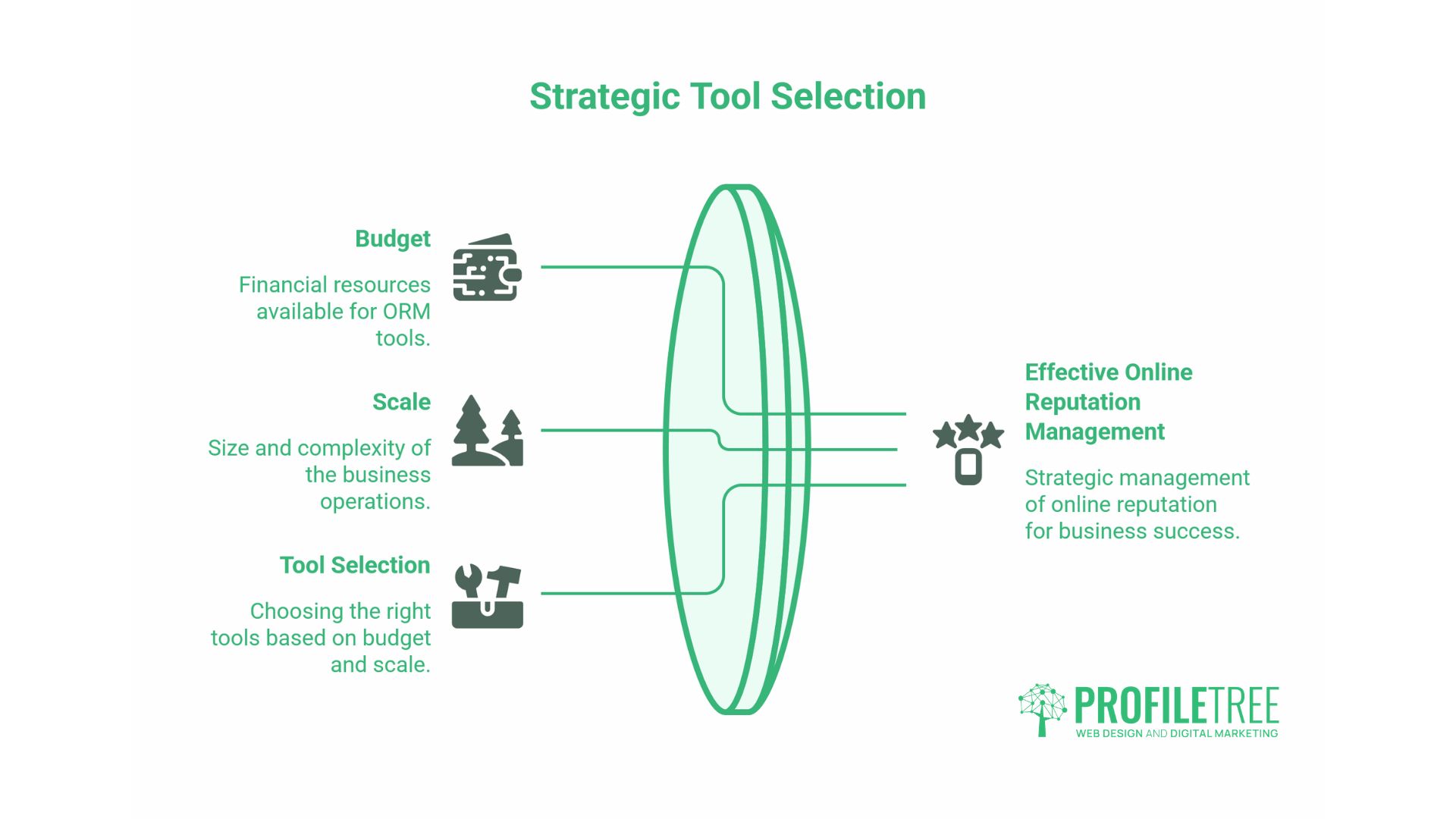
The right combination of tools depends on budget and scale. The following are realistic options at different price points, with no commercial relationship to ProfileTree.
Free options include Google Alerts for brand mention monitoring, Google Business Profile’s built-in review management, and native social media notifications. These are adequate for businesses receiving a low volume of mentions.
Mid-range options include Mention (from approximately £20 per month), which monitors mentions across news, blogs, and social platforms in near real time, and Semrush’s brand monitoring module, which adds backlink tracking and sentiment analysis for businesses already using Semrush for SEO.
Higher-investment tools such as Brandwatch and Sprinklr are built for larger organisations managing high volumes of mentions across multiple markets. For most Northern Ireland and Irish SMEs, these are unnecessary.
For businesses wanting to understand how social media activity connects to sales outcomes, the data on engagement and conversion rates provides useful context for building the case for social media investment as an ORM tool.
Digital Training: Building ORM Capability In-House
Not every business needs to outsource every element of reputation management. For SMEs with an in-house marketing team or a business owner willing to invest in developing their own skills, ProfileTree’s digital training programme covers the tools, processes, and decision frameworks needed to proactively manage reputation without relying entirely on external resources.
Training covers Google Business Profile management, basic SEO for content suppression, review monitoring and response protocols, and social media management for brand consistency. Building this capability internally means reputation management becomes a daily habit rather than a reactive project triggered by a crisis.
Conclusion
Online reputation management is not a single campaign or a one-time fix. It is the ongoing work of publishing good content, maintaining accurate profiles, responding promptly to reviews, and understanding the specific legal tools available in the UK and Irish market. The businesses that manage their reputation most effectively treat it as a routine business process rather than an emergency response. If you want to understand how a structured digital strategy can give you more control over what prospective customers find when they search your name, get in touch with the ProfileTree team.
FAQs
Can I legally force Google to remove a negative search result?
In most cases, no. Google removes content that violates its own policies (spam, fake reviews, personal information), but not legitimately published negative content. Under UK GDPR, individuals can apply for delisting when specific criteria are met; the ICO provides guidance on eligibility. Legal removal through defamation action requires a solicitor.
How long does ORM take to show results?
Content suppression through SEO typically takes three to six months before new content ranks reliably. Profile improvement depends on volume; a business receiving several reviews per month can see meaningful rating improvements within 2 to 3 months.
Is it illegal to buy five-star reviews in the UK?
Yes. The CMA treats incentivised reviews as a misleading commercial practice under the Consumer Protection from Unfair Trading Regulations 2008. This covers paying for reviews, offering discounts in exchange for reviews, and selectively inviting only satisfied customers to leave feedback.
How do I handle a fake Google review?
Open the review in Google Business Profile, click the three-dot menu, and select “Report review,” choosing the most accurate policy violation reason. Google’s team assesses flagged content, though removal is not instant. Keep a record of the process in case you need to demonstrate proactive action later.