
How to Build a Shoppable Content Strategy That Actually Converts
Table of Contents
Shoppable content lets a shopper buy a product without leaving the platform where they discovered it, whether that’s an Instagram Reel, a TikTok video, or a blog post with embedded product tags. For UK and Irish SMEs, getting it right depends less on which platform is used and more on whether the website, catalogue and content behind it are set up to support it.
Shoppable content has moved from a novelty to a standard part of how UK and Irish consumers discover and buy products online. Whether a Belfast retailer is tagging products in an Instagram Reel or a fashion brand is testing TikTok Shop UK, the fundamentals stay the same: reduce the distance between seeing something and buying it. Done well, it turns passive browsing into active purchasing. Done badly, with an out-of-sync catalogue or a broken checkout link, it damages the trust it was supposed to build.
This guide covers what actually works for SMEs across Northern Ireland, Ireland and the UK, including the technical groundwork most guides skip, the compliance requirements almost none of them mention, and where a website or content partner genuinely earns its place in the process.
What Is Shoppable Content?
Shoppable content is any digital media that allows a viewer to purchase a product without switching contexts. It removes the traditional friction of navigating from a post to a website, to a product page, to checkout. The transaction begins where the discovery happens.
In practice, this covers tagged product images on Instagram, clickable items in TikTok videos, shoppable pins on Pinterest, product shelves attached to YouTube videos, and, increasingly, shoppable elements embedded directly in a brand’s own website content. What they share is the intent to collapse the customer journey into as few steps as possible.
It’s worth distinguishing shoppable content from basic social media advertising. An advert drives traffic to a website. Shoppable content processes the transaction within the platform itself or connects directly to a product page with a single tap. That distinction matters when a business is trying to work out where its shoppable content strategy should actually sit: is it a social media tactic, a website feature, or both?
For most SMEs, it should be both. A shoppable content strategy that lives entirely on rented platforms (Instagram, TikTok, Pinterest) leaves a business exposed to algorithm changes and platform fees it doesn’t control. Building shoppable elements into owned web design and content gives a retailer a channel that isn’t subject to someone else’s terms of service.
Why This Matters for UK and Irish SME Retailers
UK e-commerce has grown as a share of total retail, but so has the cost of converting acquired traffic. Abandoned cart rates remain stubbornly high; the Baymard Institute’s aggregated research puts the average at around 70%. Shoppable content attacks that problem at its root: fewer steps between intent and purchase means fewer chances to drop off.
The shift in consumer behaviour reinforces this. A 2024 Ofcom report found that over 60% of UK adults aged 18 to 34 encounter products through social media, ahead of search engines, which means the channel where discovery happens is increasingly where purchase happens too.
For SMEs in Northern Ireland and across the UK, native shoppable content platforms, including Instagram Shopping, TikTok Shop UK and Pinterest product pins, are free to set up and integrate directly with Shopify, BigCommerce and WooCommerce catalogues. The barrier to entry is lower than most retailers assume, but the barrier that does exist is rarely the platform itself. It’s whether the catalogue behind the platform is accurate, and whether the website it eventually points to can handle the traffic.
Beyond the Feed: Making Your Own Website Shoppable
Most shoppable content guides stop at social platforms. That’s a gap worth exploiting, because on-site shoppable content, meaning product tags embedded directly in blog articles, lookbooks or landing pages, is a less-discussed but genuinely effective format. If a retailer’s analytics show traffic landing on content-heavy pages such as buying guides or style articles, adding shoppable product tags within that existing content can convert readers who are already engaged, without needing new traffic at all.
This is where the shoppable content format a business chooses starts to depend on infrastructure rather than creativity. A blog post with product tags needs a website built to support them: fast loading times, a product feed that stays in sync with stock, and a checkout flow that doesn’t add friction back in at the last step. This is a responsive web design and e-commerce SEO job as a content one, and it’s usually where DIY attempts at shoppable content fall over. A retailer can create excellent product-in-context photography and still lose the sale if the linked page is slow, unclear about pricing, or built on a template that wasn’t designed for commerce.
Five Practical Pillars of Shoppable Content
An effective shoppable content strategy needs more than tagging products in posts. The businesses that see results tend to follow a consistent set of principles across content creation, who’s involved, and how they test and refine.
Visual Storytelling Over Hard Selling
On TikTok or Instagram, users are in a discovery mindset, not a buying one. Shoppable content that leads with a price or a promotional headline interrupts that mindset and tends to perform poorly. Content that shows a product in context, a skincare routine, a kitchen being used, a jacket worn on a specific type of day, lets viewers picture themselves owning the item before they’ve consciously considered buying it.
TikTok’s own commerce research found that organic-style content achieved higher view-through and click-through rates than standard product ads. The approach works not by hiding commercial intent but by making the product feel earned within the content rather than forced. For UK brands specifically, there’s a tone consideration too: British consumers respond poorly to high-pressure sales language. A matter-of-fact demonstration, “here’s what this does and why I like it”, tends to land better than superlatives.
Producing this kind of content consistently is a content marketing function rather than a one-off shoot. A retailer needs a content calendar that keeps product-in-context material flowing, not a single polished campaign that runs out of steam after a month.
Community-Led Growth via UGC and Micro-Influencers
User-generated content remains one of the most cost-effective inputs for shoppable content. When real customers document their experience with a product, the result is both social proof and reusable creative. Brands such as Gymshark and Lounge Underwear have built large commercial operations partly on this model, with much of their most-viewed shoppable content made by customers or micro-influencers rather than an in-house production team. Consumers consistently rate UGC as more trustworthy than brand-produced creative, and micro-influencers with 5,000 to 50,000 relevant followers tend to outperform macro-influencers on engagement and cost for UK audiences.
For an SME without an existing library of customer content, building UGC into a brand strategy is something worth planning deliberately rather than hoping it happens organically. That can mean a simple request built into the post-purchase email, or a small incentive for customers who tag the brand in their own shoppable-style posts.
Technical Integration Across Platforms and the Website
Shoppable content on social platforms only works if the product catalogue behind it is accurate and up to date. A tagged product showing an old price, or linking to an out-of-stock item, actively damages conversion and trust. Technical integration, connecting a product catalogue via Meta Commerce Manager, TikTok’s product sync, or Pinterest’s catalogue tool, ensures the shoppable content reflects real-time stock and pricing.
For e-commerce managers using Shopify or BigCommerce, this integration is straightforward via native connectors. WooCommerce users need a plugin (Facebook for WooCommerce handles Meta platforms; TikTok for WooCommerce handles TikTok Shop). The setup itself takes a few hours, but keeping it accurate over time, particularly for a retailer with a large or fast-changing catalogue, is closer to ongoing website development and maintenance work than a single afternoon task. This is also where SKU-level tagging matters: each shoppable tag needs to point to the exact product variant, not a generic category page, or the customer lands somewhere that doesn’t match what they clicked.
The Multi-Channel One-Click Journey
A customer might discover a product in a TikTok video, save a Pinterest pin about it, and complete the purchase via an Instagram checkout link three days later. Every point in that journey should offer a direct path to purchase. Practically, this means consistent product imagery and pricing across platforms, checkout links that load correctly, and no conflicting offers across channels.
Coordinating this across TikTok, Instagram and Pinterest without duplicating effort is a social media management task, covering channel strategy, content scheduling and consistency checks, rather than something most SME teams can run alongside their day-to-day work indefinitely. It’s also worth thinking about the mobile experience specifically, since most UK social commerce traffic comes from phones, and checkout friction on a small screen loses sales that a desktop checkout would have kept.
Data-Driven Iteration
The most successful shoppable content programmes treat creative as a hypothesis, not a finished product. A hook that works in January may not work in March. Platform analytics provide reasonably granular data: views, saves, link clicks, and attributed purchases are all trackable within Meta, TikTok and Pinterest dashboards. Setting up Google Analytics 4 with custom events adds a useful second layer, particularly for tracking what happens after the click, on the retailer’s own site rather than inside the platform.
A sensible cadence for most SMEs is a monthly review: which formats and hooks drove the highest link-click rate, which products converted, and where the funnel drop-off is happening. This kind of review sits naturally within a broader digital marketing strategy process, using the same audit-plan-deliver-review cycle a business would apply to any other channel, rather than treating shoppable content as a separate experiment outside normal reporting.
The UK Compliance Layer: ASA Rules for Shoppable Posts
This is the section most guides skip, which is why it matters. The Advertising Standards Authority (ASA) and its sister body, the Committee of Advertising Practice (CAP), apply strict rules to commercial content in the UK. Shoppable content, particularly influencer posts and branded partnerships, falls squarely within these rules, and the consequences of getting it wrong aren’t only financial. A public ruling can damage brand reputation in ways that take years to repair.
Labelling and transparency. If there’s a commercial relationship, whether a brand is paying an influencer, gifting products, or running a paid partnership, the shoppable content must be clearly labelled as an advertisement before the viewer engages with it. A hashtag reading “#Ad” at the end of a caption doesn’t satisfy this on its own; the disclosure needs to be upfront and unambiguous. Instagram’s “Paid Partnership” label meets that platform’s requirement, and TikTok’s “Branded Content” toggle serves the same function. Brands shouldn’t rely on influencers to self-disclose; checking the disclosure is in place before content goes live is the brand’s responsibility, not just the creator’s. Full guidance is available directly from the ASA and CAP.
Pricing accuracy. A less-discussed compliance area is pricing accuracy within shoppable tags. If a tag shows a price that has changed, or a promotional price that has expired, the brand may be in breach of consumer protection law around unfair trading practices. The practical fix is live pricing that pulls from the product catalogue, rather than static prices set at the point of content creation, which most platform integrations natively support. For manually created shoppable posts, a monthly review cycle to ensure linked prices remain accurate is a reasonable minimum.
Platform Breakdown: Where to Invest for UK Brands
Not every shoppable content platform delivers equal value across all product categories. Instagram and TikTok remain the two leading visual commerce platforms for shoppable content among UK SMEs, but Pinterest and YouTube deserve more attention than most retailers give them.
| Platform | Transaction Fee | UK User Base | Setup Difficulty | Ideal For |
|---|---|---|---|---|
| TikTok Shop UK | Up to 5% (variable) | Under-35s, mobile-first | Moderate | Video-first impulse buys |
| Instagram Shopping | No direct fee (via checkout) | 18–44, lifestyle brands | Easy (Meta Commerce Manager) | Visual storytelling, fashion |
| Pinterest Shopping | No fee for organic pins | 25–54, planning intent | Moderate | Home, DIY, fashion discovery |
| YouTube Shopping | No fee for tagged products | Broad, 18–65+ | Moderate (needs merch shelf) | Long-form demos, tutorials |
TikTok Shop UK has grown rapidly since its 2023 launch, particularly among under-35s. Its algorithm surfaces shoppable content to users who don’t yet follow the brand, giving SMEs a discovery advantage that’s harder to achieve on Instagram without paid promotion, though the trade-off is a variable commission fee on completed sales.
Pinterest is undervalued by many UK brands as a shoppable content platform. Its user base skews toward planning intent, people researching purchases they intend to make, rather than impulse-scrolling, which tends to produce higher-quality traffic even if the volume is lower. For home improvement, interiors, fashion and gifting categories, Pinterest’s shoppable pins can keep driving traffic and conversions months after publication, which no other platform matches.
YouTube Shopping suits brands where product education matters: cooking equipment, electronics, fitness gear, and similar categories where a demonstration builds purchase confidence. YouTube Shorts also supports product tagging, so there are options across long and short formats. This is where video production becomes directly relevant, since a well-shot demonstration video tends to outperform a phone clip for anything where the customer needs to see how a product actually works. For products that benefit from a short explainer rather than a full demo, animation can do the same job without needing a physical product on camera at all.
Measuring ROI: Beyond the Like Button
Likes and views aren’t business metrics. Shoppable content should be judged against metrics that directly connect to commercial outcomes.
| Content Format | Avg. CTR | Avg. CVR | Top Platform |
|---|---|---|---|
| Shoppable Live Stream | 9–12% | 2–4% | TikTok, Instagram Live |
| Shoppable Feed Post | 1.5–3% | 0.5–1.5% | Instagram, Pinterest |
| Shoppable Story / Reel | 3–6% | 1–2% | Instagram, TikTok |
| Shoppable Video (YouTube) | 1–2% | 0.5–1% | YouTube |
The most meaningful metric is attributed revenue, found within each platform’s analytics under “Purchases” or “Checkouts initiated.” Cross-referencing this with Google Analytics 4 provides a more complete picture, particularly for purchases that are completed on the retailer’s own site rather than in-platform.
Beyond revenue, it’s worth tracking the save rate, the ratio of saves to impressions. A high save rate indicates purchase intent that hasn’t converted yet: it’s a lead, not a loss. Retargeting users who’ve saved a shoppable post is one of the more cost-effective strategies available on Instagram and Pinterest.
As Ciaran Connolly, founder of ProfileTree, said, “Most SMEs judge shoppable content by likes because that’s the number the app shows them first. The number that actually matters is what happens after someone clicks through to the website, and that’s usually where the real problems sit.”
Where an Agency Genuinely Fits
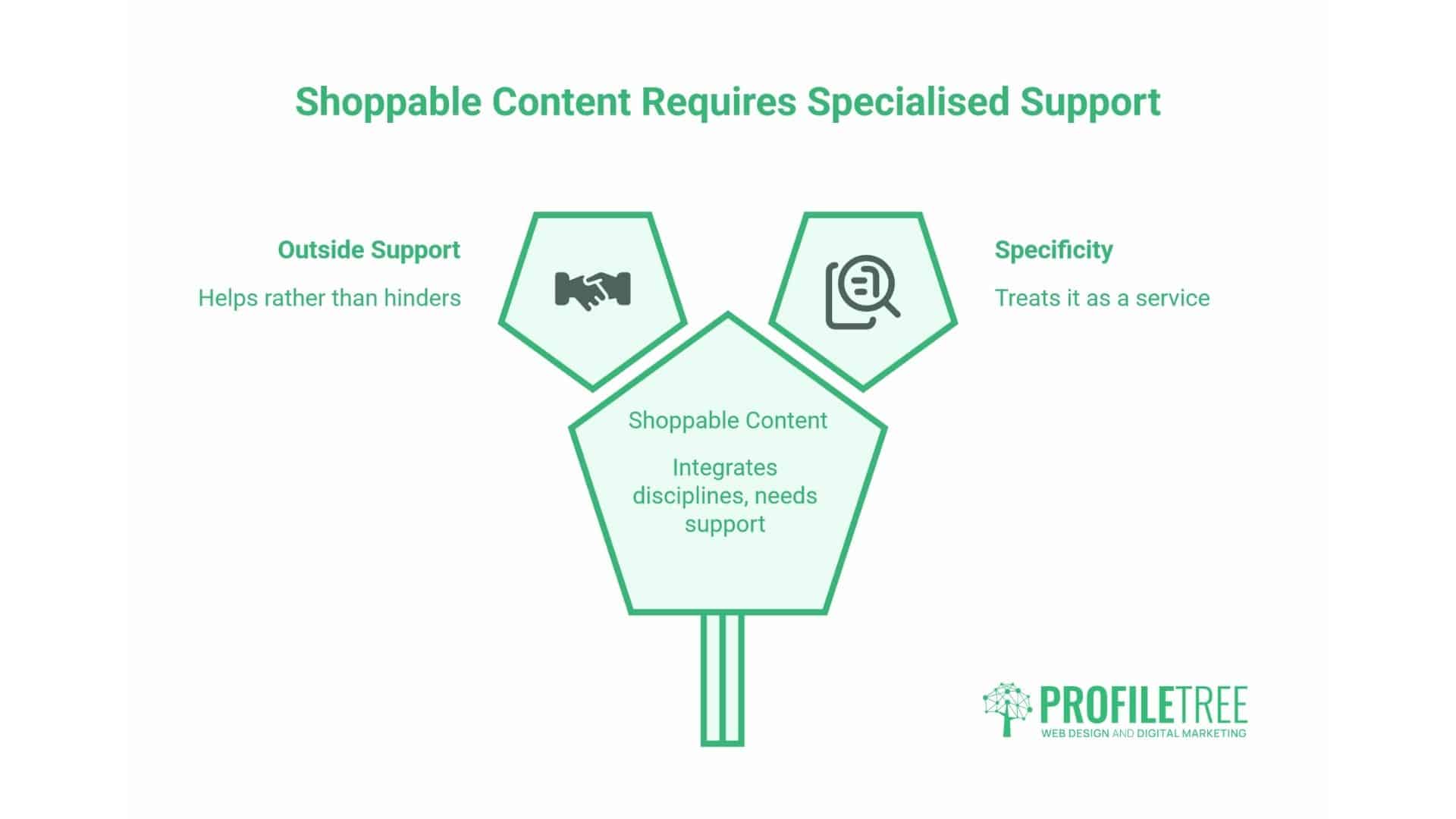
Shoppable content sits at the intersection of several disciplines, and it’s worth being specific about where outside support actually helps rather than treating it as a single service.
Website and catalogue integration. Getting a WooCommerce, Shopify or BigCommerce catalogue properly synced to Meta, TikTok and Pinterest, and keeping it accurate as stock and pricing change, is a web development task. For retailers building on-site shoppable content into blog pages or lookbooks, this also means the underlying site needs to be fast and mobile-optimised, since a slow product page undoes the friction reduction that shoppable content is meant to deliver.
Content and video production. Consistent product-in-context photography, UGC campaigns, and demonstration videos for YouTube Shopping all need planning and production capacity that most SME marketing teams don’t have spare. Content marketing support here means keeping a steady pipeline of shoppable-ready material rather than a single campaign burst.
Organic social management. Coordinating shoppable posts across TikTok, Instagram, and Pinterest, checking that disclosure labelling is in place, and maintaining a consistent multi-channel journey are ongoing organic social media management functions. This is worth noting clearly: this covers organic strategy, content and community management, not paid advertising spend.
Digital marketing strategy and reporting. Bringing GA4 tracking, save-rate analysis and monthly performance reviews together into one reporting cycle, rather than checking four separate platform dashboards, is where a wider digital marketing strategy engagement adds most value.
SEO for e-commerce. On-site shoppable content, product pages and category structure all interact with search visibility. E-commerce SEO work ensures that the pages a shoppable tag eventually lands on are built to rank and convert, not just to look right in a screenshot.
Building a Shoppable Content Strategy That Lasts
Shoppable content works when it serves the viewer first and the brand second. That means choosing platforms where an audience is genuinely active, creating content that earns its place in a feed rather than interrupting it, and building the technical foundations, catalogue sync, accurate pricing, and correct compliance labelling that let every piece of content actually complete a sale.
For UK and Irish brands, the compliance dimension isn’t optional, and pricing accuracy requirements have teeth. Getting it right from the outset protects the brand and tends to improve consumer trust and conversion.
Retailers weighing up where to start, whether that’s catalogue integration, content production or platform strategy, can get in touch with ProfileTree to talk through what’s realistic for their current setup.
FAQs
What’s the difference between Instagram Shopping and TikTok Shop UK?
Instagram Shopping suits brands with an existing following and polished visuals, with a smoother checkout via Meta Commerce Manager. TikTok Shop UK charges a commission but gives stronger organic discovery, since its algorithm surfaces content to non-followers more readily.
Do I need a large budget to start with shoppable content?
No. Instagram Shopping, TikTok Shop UK and Pinterest product pins are all free to set up. A synced product catalogue and a phone camera with good natural light are enough to begin.
Can shoppable content work if I don’t have a large following?
Yes. TikTok’s algorithm can surface shoppable content to people who don’t follow the brand, and Pinterest rewards planning-intent searches over follower count.
What platforms support shoppable video content?
TikTok, Instagram Reels and Stories, YouTube (including Shorts), and Pinterest Idea Pins all support shoppable video. Live shopping is available on TikTok and Instagram Live.