
Conversational AI for Small Business: A Practical Guide for UK and Irish SMEs
Table of Contents
Plenty of small business owners have heard the pitch by now: add a chatbot, save time, never miss a lead. The reality is more specific than that. Conversational AI genuinely can reduce the administrative load on small teams, answer customer questions at 11 pm, and qualify enquiries before they reach your inbox. But the technology only delivers those outcomes when it is chosen carefully, set up correctly, and kept within the limits of what a local business actually needs.
This guide covers what conversational AI is, how it differs from basic chatbots, where it adds real value for SMEs across the UK and Ireland, and what to check before you commit to a platform or supplier.
What Are Conversational Interfaces?
A conversational interface is any system that lets users interact with software through natural language, whether typed or spoken, rather than through menus, buttons, or forms. The category covers everything from a simple FAQ bot on a local tradesperson’s website to voice-activated assistants built into smart devices.
Within that broad category, there is an important distinction worth understanding before you spend anything.
Chatbots vs Conversational AI: What Is the Difference?
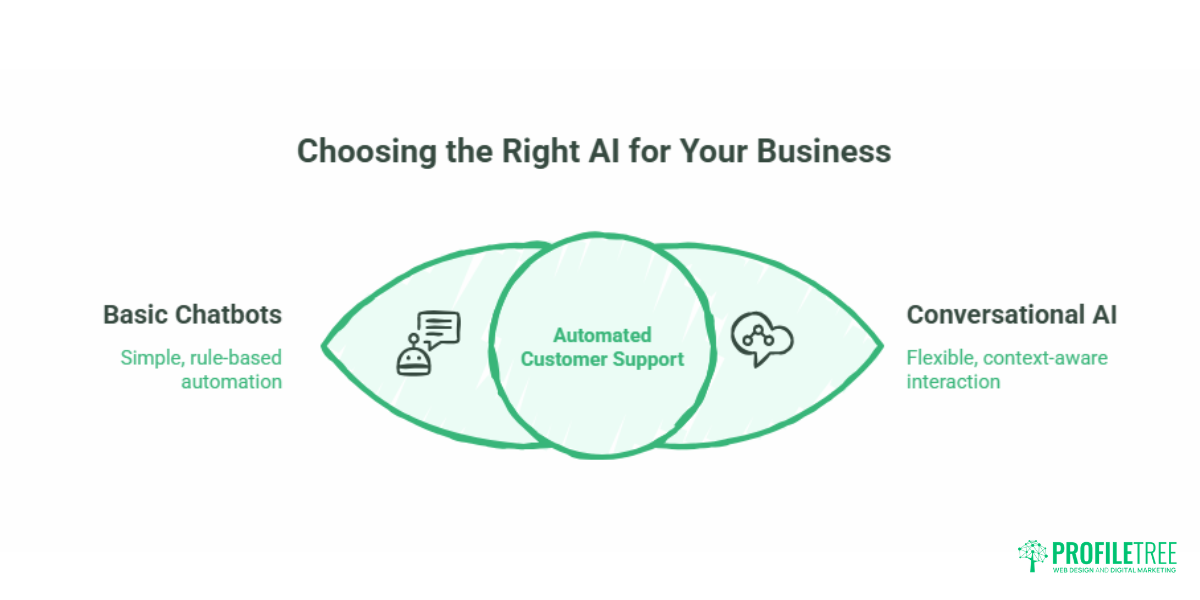
A basic chatbot follows a fixed decision tree. You type a question, it matches keywords against a list of pre-written responses, and you get an answer. If your question does not match one of the expected patterns, the bot fails. These systems are cheap to set up and fine for very narrow use cases, such as displaying your opening hours or directing people to a booking link.
Conversational AI is different. It uses natural language processing (NLP) to interpret meaning rather than match keywords. The system can understand variations in phrasing, maintain context across a multi-turn conversation, and generate responses that fit the specific question asked. Modern conversational AI platforms are powered by large language models that have been trained on vast datasets, which is what allows them to handle the kind of unstructured, unpredictable questions a real customer might ask.
For most small businesses considering this for the first time, the practical question is: do you need the rule-based simplicity of a basic chatbot, or the flexibility of a proper conversational AI system? The answer depends on how varied your customer enquiries are and how much of the conversation you want to automate beyond simple signposting.
The Business Case: Why Are UK SMEs Looking at This Now?
The timing is not arbitrary. Several pressures have converged that make conversational AI more relevant to small businesses than it was even three years ago.
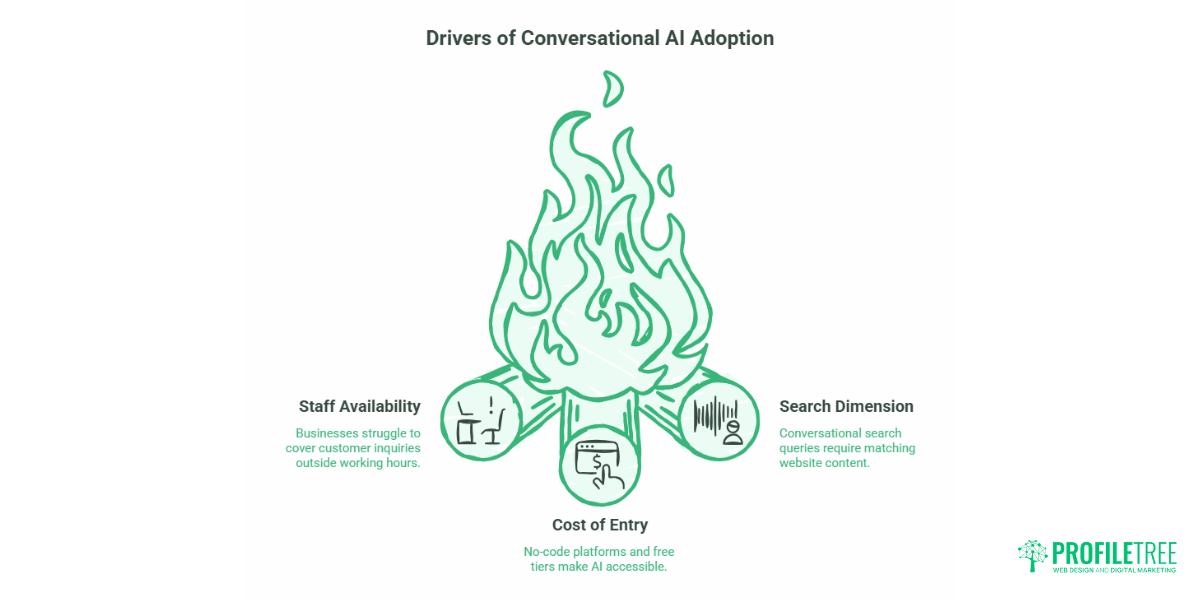
Staff availability remains a genuine constraint across many sectors in Northern Ireland and the Republic of Ireland. Businesses in hospitality, professional services, and trades regularly report difficulty covering enquiries that arrive outside working hours. A customer who cannot get a response by the next morning will often move on to whoever answers first.
At the same time, the cost of entry has dropped significantly. Platforms that previously required developer resources to configure are now accessible through no-code interfaces. Many offer free or low-cost tiers that give smaller businesses a way to test the technology before committing to monthly fees.
There is also a search dimension that is easy to overlook. As more users interact with voice assistants and AI-powered search tools, the queries reaching your website are increasingly conversational in structure. Content and on-site tools that match that interaction style perform better in AI-driven results. ProfileTree’s work on <a href=”https://profiletree.com/voice-search-seo/” target=”_blank” rel=”noopener noreferrer”>voice search SEO</a> has shown that businesses optimised for natural language queries are better positioned as search behaviour continues to shift.
Five Practical Use Cases for UK and Irish Small Businesses
The following examples reflect realistic applications for the kinds of businesses ProfileTree works with across Northern Ireland, Ireland, and the UK. None of them requires enterprise-level budgets or a dedicated IT team.
Automated Booking and Appointment Handling
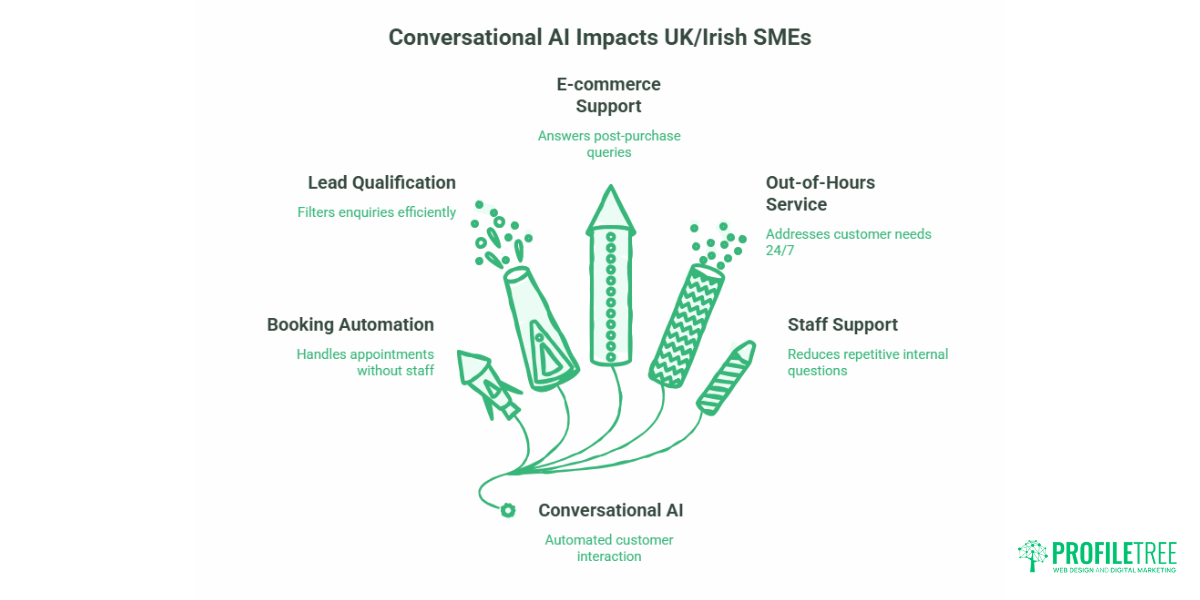
Service businesses, from physiotherapy clinics to plumbers to beauty salons, receive a high volume of enquiries that follow a predictable pattern: availability check, pricing question, and booking confirmation. A conversational AI tool integrated with your existing calendar system (Google Calendar, Calendly, or booking platforms like Acuity) can handle the full cycle without human involvement. The customer gets an immediate response at any hour; the business owner gets a confirmed booking in the diary without lifting the phone.
This is one of the clearest cases where the return on investment is measurable. If your current setup means missed enquiries after 6 pm, and those enquiries represent bookings worth £40–£200 each, the maths is straightforward.
Lead Qualification for Professional Services
Solicitors, accountants, mortgage brokers, and other professional services firms often face a volume of initial enquiries that do not all warrant the same level of attention. A conversational interface on the website can ask the qualifying questions, gather basic information about the enquiry type, assess urgency, and route the lead appropriately, either booking a consultation directly or flagging it for follow-up.
This is especially useful for firms where the initial call is often spent establishing whether the enquiry is even in scope. Moving that filtering stage to an automated conversation saves fee-earner time without reducing the quality of the client experience.
E-commerce and Order Support
For businesses selling through Shopify or WooCommerce, conversational AI can handle common post-purchase queries: order status, return policies, and delivery windows. Integrating the tool with your fulfilment system means the AI can pull live order data rather than giving generic answers. UK-based e-commerce businesses using Sage or Xero for inventory management should check whether the platform they are evaluating has native integrations or API access before signing up.
Out-of-Hours Customer Service
This is the most common starting point for small businesses. A conversational interface that can answer your 20 most frequently asked questions, capture a contact form response when it cannot help, and flag urgent enquiries for next-day follow-up addresses the single biggest gap most SMEs have: responsiveness outside business hours.
The key to making this work is content quality. The AI is only as helpful as the information you give it. Businesses that invest time in writing clear, accurate answers to genuine customer questions get substantially better results than those who deploy a platform with minimal setup.
Internal Knowledge and Staff Support
Less commonly discussed but genuinely useful for businesses with more than five or six staff: a conversational interface trained on your internal documentation, policies, and procedures can reduce the number of repetitive questions that reach managers or senior staff. This is particularly relevant for businesses that have grown quickly, where onboarding new staff is a recurring pressure.
The “Personal Touch” Question
The concern most frequently raised by small business owners in the UK and Ireland is not cost or technical complexity. It is the fear of losing the warmth and personal quality that differentiates a local business from a large corporation.
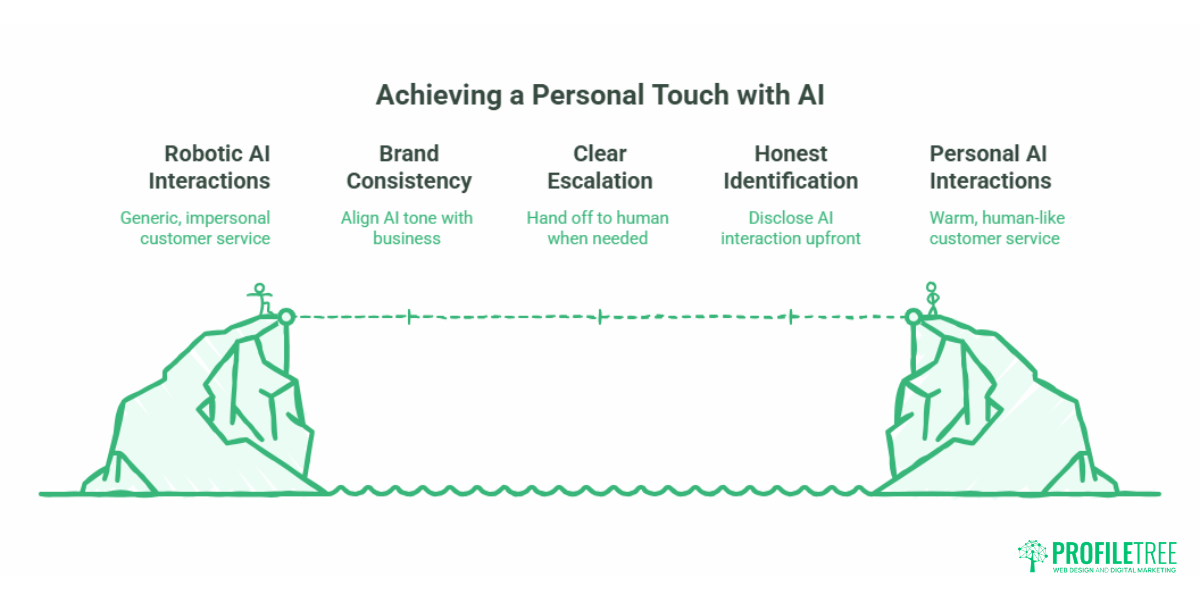
This is a legitimate concern and not one that should be dismissed. A poorly configured AI that gives robotic, generic responses, or one that fails to hand off to a human when the situation calls for it, can actively damage the customer relationship it was meant to support.
The answer is not “AI or human” but “AI and human.” The most effective implementations use conversational AI to handle the predictable, low-stakes interactions, while making it genuinely easy for a customer to reach a person when they need to. This means:
- Clear escalation triggers: the AI should recognise when a conversation has moved beyond its capability and prompt the customer to call or send an email
- A brand-consistent tone: the language, formality level, and personality of the bot should reflect your business, not the default template from the platform
- Honest identification: customers should know they are interacting with an automated system, not a human; this is also a UK regulatory expectation
Getting the tone right requires effort upfront. The businesses that do it well treat the AI’s responses the same way they would treat any customer-facing copy: written carefully, reviewed against real customer language, and updated when they get feedback that something is not landing well.
Ciaran Connolly, ProfileTree founder, puts it plainly: “The technology is not the hard part. Writing the responses in a way that actually sounds like your business, and training the system on the questions your specific customers ask, is where the work is. That is also where the value comes from.” <!– EDITORIAL NOTE: Quote flagged for Ciaran’s approval before publication –>
UK and ROI Compliance: What You Need to Know Before You Deploy
This is the section most US-based guides skip entirely, and it matters considerably more for businesses operating under UK and Irish law.
GDPR and the UK Data Protection Act
Any conversational AI tool that collects personal data from users, including names, email addresses, phone numbers, or enquiry content, is processing personal data under UK GDPR (for businesses in Great Britain) and the EU GDPR (for businesses in the Republic of Ireland or those with EU customers). Before deploying any platform, you need to be clear on:
Data residency: Where is the data stored? Several popular US-based AI platforms store conversation data on servers in the United States. This creates a data transfer compliance issue under both UK and EU GDPR unless the provider has appropriate transfer mechanisms in place (Standard Contractual Clauses or an adequacy decision). Check this before you sign up, not after.
Retention and deletion: How long does the platform retain conversation logs? Can you delete individual records on request? UK GDPR gives individuals the right to erasure; your platform needs to support this in practice, not just in policy.
Privacy notice: If your AI interface collects personal data, your website’s privacy notice must disclose this, including what data is collected, why, how long it is kept, and who it is shared with.
Consent for marketing: If your conversational interface captures contact details and you intend to use those for marketing follow-up, you need a lawful basis for doing so. Consent under UK GDPR must be freely given, specific, and unambiguous. A pre-ticked checkbox is not consent.
The Information Commissioner’s Office (ICO) publishes guidance on AI and automated decision-making that is worth reading before you select a platform. The ICO’s guidance on AI and data protection{target=”_blank”} is the authoritative reference point for businesses in Great Britain.
For businesses in the Republic of Ireland, the Data Protection Commission (DPC) is the relevant supervisory authority and publishes equivalent guidance for Irish businesses.
Accessibility Under the Equality Act
Conversational interfaces deployed on UK business websites should meet accessibility standards under the Equality Act 2010. This means ensuring that users who rely on screen readers or other assistive technologies can access and use the interface, and that the tool does not create a worse experience for users with disabilities than the standard website navigation does.
How to Choose a Conversational AI Platform: Key Criteria for SMEs
The market for conversational AI tools ranges from free, self-service chatbot builders to enterprise platforms costing thousands of pounds per month. The following criteria are the most relevant for small businesses in the UK and Ireland when evaluating options.
| Criterion | What to Check |
|---|---|
| UK/EU data hosting | Does the provider offer EU or UK-based data storage? Is there a DPA (Data Processing Agreement) available? |
| Integration with your existing tools | Does it connect with your CRM, booking system, or e-commerce platform (Shopify, Xero, Sage)? |
| WhatsApp Business API | Many UK customers prefer WhatsApp. Does the platform support the official API? |
| No-code configuration | Can you build and update the AI’s responses without developer support? |
| Escalation to human | Can conversations be handed off to a live agent or email workflow cleanly? |
| Pricing in GBP/EUR | Are costs transparent and predictable, or based on usage tiers that could spike unexpectedly? |
| Training on your own data | Can you upload your own content (FAQs, product documentation) to train the AI’s responses? |
Widely used platforms among UK SMBs include Tidio, Intercom, and ManyChat (for social and WhatsApp channels). Each has different strengths and pricing structures. The right choice depends on your existing tech stack and where most of your customer conversations currently happen.
Natural Language Processing: How Conversational AI Actually Works
Understanding the basics of how conversational AI processes language helps you configure it better and set realistic expectations with your team and customers.
When a user sends a message, the system performs three tasks in sequence. First, natural language understanding (NLU) interprets the intent behind the message, identifying what the person is trying to achieve rather than just matching keywords. Second, dialogue management tracks the context of the conversation, so the system knows that “what about Thursday?” is a follow-up to a booking question, not a standalone query. Third, natural language generation (NLG) constructs a response that fits the specific context and answers the identified intent.
The quality of each stage depends on the underlying model and, critically, on the training data and configuration you provide. A platform trained on generic business language will perform worse than one you have specifically trained on your products, services, pricing, and the actual questions your customers ask.
For a practical grounding in how NLP applies to business communications, <a href=”https://profiletree.com/natural-language-processing-communications/” target=”_blank” rel=”noopener noreferrer”>ProfileTree’s overview of NLP in communications</a> covers the core concepts without requiring a technical background.
Voice-Activated Interfaces: A Separate Consideration
Conversational interfaces are not only text-based. Voice user interfaces (VUIs), including Amazon Alexa skills, Google Assistant integrations, and in-browser voice search, represent a distinct deployment scenario with different technical requirements and different user expectations.
For most small businesses, voice is relevant primarily through its influence on search behaviour rather than through building dedicated voice applications. Users querying a voice assistant ask questions in full sentences: “Is there a plumber near me open on Saturday?” rather than typing “plumber Belfast Saturday.” Content structured to answer those longer, natural language queries performs better in voice search results.
The overlap with conversational AI strategy is significant. Businesses that invest in building clear, question-and-answer-structured content for their website, the same content that powers a well-configured chatbot, are also building the kind of content that voice search surfaces. These are not separate projects; they reinforce each other.
<a href=”https://profiletree.com/voice-search-statistics/” target=”_blank” rel=”noopener noreferrer”>Voice search usage data</a> continues to show growth, particularly among mobile users, and the queries being made are increasingly specific and local.
Five Steps to Implement Conversational AI in Your Business
Moving from interest to deployment does not need to take months. The following sequence applies to the majority of small business implementations.
Step 1: Define the single most valuable use case. Do not try to automate everything at once. Identify the one interaction type that costs you the most time or causes the most customer frustration. Start there.
Step 2: Audit your existing answers. Before selecting a platform, write down the 20 questions your customers ask most often, along with the correct answers. This content is the foundation of every conversational AI implementation. Without it, no platform performs well.
Step 3: Choose a platform that fits your data requirements. Using the criteria above, select a platform that handles your GDPR obligations, integrates with your existing tools, and is genuinely configurable without developer involvement.
Step 4: Build, test with real users, and iterate. Deploy a limited version to a segment of your traffic or on a single page. Gather the actual conversations the AI has, identify where it fails or gives poor responses, and update the content accordingly. The first version will not be perfect; the goal is to learn quickly.
Step 5: Add the human handoff before you go live. Before the interface is visible to customers, confirm that the escalation path works: that a user who says “I need to speak to someone” gets a clear route to a phone number, email, or live chat, and that out-of-hours escalations are captured and followed up.
For businesses working with ProfileTree’s <a href=”https://profiletree.com/services/digital-training/” target=”_blank” rel=”noopener noreferrer”>digital training programme</a>, conversational AI setup is covered as part of the AI implementation modules, including platform selection, content structure, and GDPR compliance for UK and Irish businesses.
How Conversational AI Connects to Your Wider Digital Strategy
A chatbot or voice interface does not exist in isolation. The value it delivers depends on the quality of the website it sits on, the SEO that drives traffic to it, and the content strategy that determines what it knows and how it speaks.
Businesses that see the best results from conversational AI have typically already done the foundational work: a well-structured website, clear service pages, and content that accurately reflects what they offer. The AI amplifies that foundation. It does not compensate for gaps in it.
This is the framing ProfileTree brings to <a href=”https://profiletree.com/implementing-ai-chatbots-for-smes/” target=”_blank” rel=”noopener noreferrer”>AI chatbot implementation for SMEs</a>: the technology is one component of a digital strategy, not a standalone solution. Understanding where conversational AI fits in the broader picture, alongside your SEO, your content, and your web infrastructure, is what separates implementations that deliver measurable results from ones that sit unused three months after launch.
For businesses thinking about this more broadly, <a href=”https://profiletree.com/smes-successfully-implementing-ai-solutions/” target=”_blank” rel=”noopener noreferrer”>how SMEs can successfully implement AI solutions</a> covers the wider decision framework, including when AI tools are worth the investment and when simpler approaches are more appropriate.
The acceleration in AI-driven customer interaction has also shifted the picture for <a href=”https://profiletree.com/impact-of-ai-on-customer-relationship-management/” target=”_blank” rel=”noopener noreferrer”>AI’s impact on customer relationship management</a>, an area where the line between conversational interfaces and CRM is increasingly blurred for growing businesses.
Conclusion
Conversational AI is a practical tool for small businesses, not a future technology to revisit in a few years. The platforms are accessible, the use cases are clear, and the compliance framework, while demanding, is navigable with the right advice. The businesses that benefit most are those that start with a specific problem, invest in the content that powers their AI, and treat the personal element of customer interaction as something to design for rather than something the technology will handle by default. If you want to understand where conversational AI fits within a broader digital strategy for your business, get in touch with the ProfileTree team.
Frequently Asked Questions
How much does conversational AI cost for a small business?
Entry-level platforms typically range from free (with limited features) to £30–£80 per month for small business tiers. Costs increase with conversation volume, the number of integrations you need, and whether you require UK or EU data hosting. Platforms like Tidio and ManyChat offer free plans that are sufficient for testing. Purpose-built or custom-trained solutions cost considerably more and are generally only appropriate for businesses with high enquiry volumes. The more useful calculation is return: if a tool handles ten enquiries per week that would otherwise take 15 minutes each of staff time, the cost justifies itself quickly at any reasonable hourly rate.
What is the difference between a chatbot and conversational AI?
A chatbot follows fixed decision trees and matches keywords to pre-written responses. It cannot handle questions it was not specifically programmed for. Conversational AI uses natural language processing to interpret meaning and generate contextually appropriate responses, giving it far more flexibility in handling unpredictable customer queries. For most small businesses, the distinction matters when customer enquiries are varied and do not fit a narrow script.
How do I make sure conversational AI complies with UK GDPR?
Check four things before deploying any platform: where conversation data is stored (ideally UK or EU servers), whether the provider offers a Data Processing Agreement, how long data is retained, whether individual records can be deleted on request, and whether your privacy notice discloses the use of AI tools. The ICO’s guidance on AI and data protection is the definitive reference for UK businesses.
Can I use conversational AI on WhatsApp?
Yes, via the WhatsApp Business API. Several conversational AI platforms, including ManyChat and Tidio, support WhatsApp Business API integration. You need a verified WhatsApp Business account and a compliant opt-in mechanism before sending proactive messages. WhatsApp is a high-conversion channel for many UK and Irish SMBs, particularly in sectors where customers already communicate informally.
Will my customers know they are talking to a bot?
Under ICO guidance and general best practice, conversational AI should identify itself as an automated system rather than impersonating a human agent. Most customers accept this readily when the interaction is genuinely helpful. What damages trust is a bot that tries to pretend to be human and then fails on a straightforward question. Clear identification combined with a clean handoff to a human when needed produces a better customer experience than either extreme.
Do I need a developer to set up conversational AI?
Not for most standard platforms. Tools like Tidio, Intercom’s basic tier, and ManyChat are configured through visual interfaces that do not require coding knowledge. You will need developer involvement if you want deep integrations with custom-built systems, bespoke training on proprietary data, or deployment within a complex web infrastructure. For the majority of small business use cases, the no-code options are sufficient.
How long does it take to see results?
A basic implementation, covering your most common FAQs and a booking or contact flow, can be live within a week for most businesses. Measurable results in terms of enquiries captured or staff time saved typically become visible within the first month of active deployment. The quality of your initial content (the answers you train the system on) is the biggest single factor in how quickly it performs well.