
Quantum-Driven Interaction Web Design: What Developers Need to Know
Table of Contents
Quantum computing is no longer confined to research labs. Its principles are already shaping how designers and developers think about user interfaces, data-heavy dashboards, and the next generation of web applications.
This guide cuts through the theory and focuses on what quantum-inspired thinking means in practice: how it changes UI logic, where UK and Irish industries are already moving, and how developers can simulate probabilistic behaviour in standard browsers today.
From multi-state UI elements to entangled components and predictive friction reduction, the sections below map out what quantum-driven interaction design looks like for modern web apps, and what your team should be preparing for now.
Beyond Binary: Why Web Logic Is Shifting
Traditional web interfaces operate on binary logic: a button is on or off, a form is submitted or not, a user is logged in or logged out. This model works well for simple transactions, but it starts to break down when applications need to handle multiple concurrent states, complex datasets, or probabilistic outcomes. Quantum-inspired design challenges that rigidity at its core.
The Limits of Boolean Interfaces
Most of the friction users experience in high-complexity web apps comes from interfaces that cannot represent uncertainty. A dashboard that loads partial data has no native way to communicate “processing three of seven data streams” without a developer manually coding a custom state. This is a Boolean limitation: the system sees loading or loaded, nothing in between.
Quantum-inspired logic introduces probabilistic states. A UI element can exist in a superposition of conditions until the system collapses it into a final output, reflecting how humans actually experience decision-making processes. Rather than forcing false certainty on the user, the interface communicates the full picture.
From Data Processing to Interface Philosophy
Quantum computing offers a fundamentally different model for handling information. Quantum bits, or qubits, can exist as 0, 1, or any combination simultaneously, a property called superposition. When applied to interface thinking, this unlocks designs where components respond to probability distributions rather than hard-coded triggers.
This is not science fiction. Developers working with probabilistic machine learning models already manage outputs that are not binary. The leap to quantum-inspired UX is a matter of extending that thinking into the visual layer. Our article on AI and machine learning advancements covers how these methods are progressing across industry sectors.
Why UK Developers Should Pay Attention Now
The UK Government’s National Quantum Strategy committed over £2.5 billion to quantum technologies between 2024 and 2034. This investment is not abstract: it flows into fintech firms in London, MedTech startups in Dublin’s Silicon Docks, and advanced manufacturing companies across Northern Ireland and the Midlands.
For web developers and product designers in these sectors, the question is not whether quantum-driven design will arrive; it is whether your team will be equipped to build for it when clients start asking. Understanding the principles now puts you several steps ahead of competitors who are still treating it as someone else’s problem.
Classical vs Quantum Interaction Design: A Comparison
The table below highlights the key differences between classical and quantum-inspired approaches to interface design.
| Dimension | Classical Interaction Design | Quantum-Inspired Design |
|---|---|---|
| Input Logic | Binary (true/false) | Probabilistic (weighted states) |
| State Management | Boolean toggles | Superposition of multiple states |
| User Feedback | Instant or loading | Evolving, confidence-scored |
| Component Relationships | Direct API triggers | Entangled updates across shared state |
| Error Handling | Reactive (after failure) | Predictive (interference cancellation) |
The Core Pillars of Quantum UX
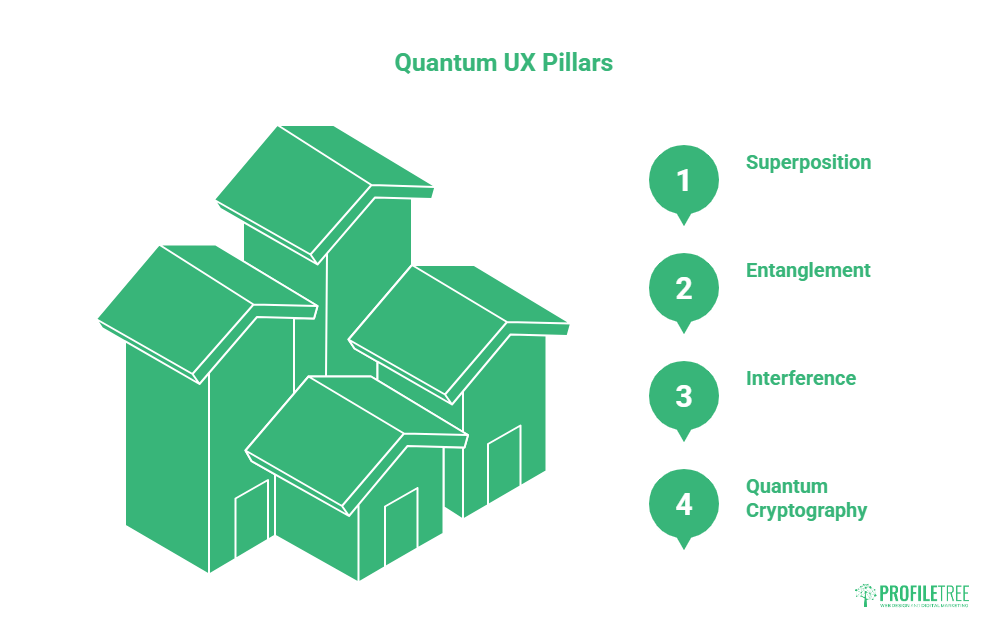
Three principles from quantum mechanics translate most directly into interface design: superposition, entanglement, and interference. Each one addresses a different class of problem that complex web applications face, and each offers a concrete design pattern that teams can explore today using classical hardware.
Superposition: Multi-State UI Elements
In quantum mechanics, a particle exists in multiple states simultaneously until it is observed and collapses into one. In UX terms, this maps to components that need to communicate several conditions at once without forcing a false resolution.
Consider a financial dashboard processing a transaction. In a classical system, the button shows “processing”, and the user waits. A superposition-inspired approach would display a confidence-weighted output: “87% likely to clear, two checks pending.” The component lives in a meaningful intermediate state rather than hiding complexity behind a spinner.
This pattern is already used in predictive search interfaces, where results appear and shift in real time as more data resolves. Extending it to form validation, data pipelines, and approval workflows reduces user anxiety in high-stakes environments. Designers working on advanced web platforms can explore how web design skills are evolving to meet these demands.
Entanglement: Linked Components That Share State
Quantum entanglement describes a situation where two particles are connected such that the state of one instantly determines the state of the other, regardless of the distance between them. For interface design, the analogy is powerful: components that update in response to a shared probabilistic state rather than through sequential API calls.
Imagine a logistics dashboard where a change in warehouse inventory automatically collapses the state of delivery-time estimates, cost projections, and route-planning widgets simultaneously. In a classical system, each of those updates requires a separate request. An entanglement-inspired architecture shares a single probabilistic state object, and the UI reads from that source continuously.
This reduces latency in data-heavy applications and produces more coherent interfaces. When components respond to the same underlying truth, users perceive the system as intelligent rather than mechanical.
Interference: Cancelling Friction Before It Occurs
In quantum computing, interference is used to amplify paths that lead to correct answers and suppress paths that lead to wrong ones. Translated into UX, this is the principle of predictive friction reduction: designing systems that identify and cancel user errors before they complete a wrong action.
Modern web apps already gesture at this through inline validation and autocomplete, but quantum-inspired interference goes further. It uses probabilistic models of user behaviour to pre-empt confusion: greying out options a user is unlikely to need based on their current context, surfacing warnings before a user reaches a dead end, or restructuring a form dynamically based on the most probable journey.
This is particularly relevant for e-commerce checkouts, SaaS onboarding flows, and any application where abandonment at a specific step indicates a recurring friction point. Understanding user psychology through search psychology and intent provides the behavioural foundation for these predictive models.
Quantum Cryptography and Web Security
Beyond UX patterns, quantum computing also changes the security landscape for web applications. Quantum Key Distribution (QKD) creates communication channels that are theoretically immune to eavesdropping, because any interception collapses the quantum state and alerts the parties involved.
For web developers handling sensitive user data, particularly in regulated sectors like healthcare or financial services, the arrival of practical quantum cryptography will require a fundamental rethink of encryption standards. NIST published its first set of post-quantum cryptographic standards in 2024, and compliance timelines are already being written into enterprise security roadmaps. Teams responsible for user data protection should be monitoring these developments closely.
Designing for Uncertainty: UI Patterns for Probabilistic Outcomes
One of the most significant gaps in the current design discourse is an honest answer to what it feels like to use an interface that does not know the answer yet. Quantum-inspired systems, by definition, deal in probabilities, not certainties, and designing for that experience requires a different set of UI patterns than most teams currently use.
Communicating Confidence Scores to Users
Humans are more comfortable with uncertainty when it is quantified. Research in behavioural economics consistently shows that vague uncertainty (“your order might be delayed”) causes more anxiety than probabilistic uncertainty (“your order has an 80% chance of arriving on Thursday”).
Quantum-inspired interfaces can adopt confidence-score displays: progress indicators that show not just completion percentage but certainty level. A medical diagnostic tool might show “High confidence: 91%” alongside a result, rather than a flat output. A contract approval system might display which reviewers have contributed data and what weight their input carries in the final recommendation.
This requires designers to think carefully about how to present probabilistic language without alarming users or creating decision paralysis. The solution is usually specificity: concrete numbers with brief explanations outperform vague qualifiers every time.
Progressive State Disclosure
Classical loading screens hide complexity. Quantum-inspired design reveals it progressively. A data-heavy application might show a skeleton layout that populates section by section as each data stream resolves, with each section displaying a lightweight confidence indicator until fully loaded.
This pattern reduces perceived wait time significantly. Users who see partial results arrive feel that the system is working, even if the final output takes the same total time. It also builds trust: an interface that shows its working is harder to distrust than one that goes dark and then suddenly produces an answer.
Handling “Collapsed” States Gracefully
When a quantum system is observed, it collapses into a definite state. In UX terms, this is the moment of commitment: when a user submits a form, confirms a transaction, or finalises a selection. Good quantum-inspired design makes this moment feel deliberate and clear.
A collapsed state should always feel qualitatively different from a superposition state. Transitions, confirmation language, and visual weight changes all contribute to signalling that the system has moved from probabilistic to definite. Without this distinction, users lose confidence in whether their action was registered correctly.
Accessibility Considerations in Probabilistic Interfaces
Probabilistic interfaces introduce new accessibility challenges. Screen reader users need explicit confidence score announcements. Users with cognitive disabilities may find dynamic state changes disorienting without adequate context. Colour-coded certainty indicators must meet WCAG contrast requirements and cannot rely on colour alone.
These considerations are not afterthoughts. They should be built into the design system from the start, particularly for applications serving regulated sectors where accessibility compliance is a legal requirement rather than a best practice. The principles of responsible digital work outlined in our overview of digital marketing ethics apply equally to interface design decisions.
UK and Ireland’s Quantum Leap: Industry Applications
The UK and Ireland are not passive observers in the quantum transition. Both governments have invested substantially in quantum research infrastructure, and the commercial sectors most likely to adopt quantum-driven web interfaces first are already operating in these regions.
Fintech: High-Frequency Trading Dashboards
London’s financial technology sector handles billions of data points daily through web-based trading platforms and risk dashboards. The limitation of classical interfaces in this environment is real: dashboards that refresh sequentially cannot keep pace with high-frequency data without lag, and binary risk signals fail to communicate the nuance of positions that sit in genuinely ambiguous territory.
Quantum-inspired dashboards are beginning to address this by using probabilistic state management to update multiple correlated metrics from a single shared state update, rather than cascading individual API calls. The result is a more coherent view of risk that updates in near-real time. Several fintech firms in London’s Square Mile and Canary Wharf are already exploring these architectures in prototype form.
MedTech: Genomic Data Visualisation in Dublin
Dublin’s Silicon Docks is home to a growing cluster of MedTech and digital health companies that handle some of the most complex datasets in any commercial sector: genomic sequencing data, clinical trial outputs, and multi-variable patient risk models. Classical interfaces struggle to present this complexity in a form that clinicians can act on quickly.
Quantum-inspired approaches allow designers to build dashboards where confidence intervals, data provenance, and risk probability are built into the visual layer from the ground up, rather than buried in footnotes or secondary screens. Northern Ireland’s own health tech sector, which serves both NHS and HSC systems, is similarly positioned to benefit as these design patterns mature. Exploring how Northern Ireland’s cities are developing as tech hubs gives useful context for the regional innovation landscape.
Cybersecurity: Post-Quantum Web Architecture
The arrival of quantum computing capable of breaking current RSA encryption, an event referred to in the security industry as “Q-Day,” is not a theoretical future event. NIST’s post-quantum cryptographic standards are a direct response to credible near-term risk. For web developers, this means that security architecture choices made today will either need to be rebuilt or will seamlessly accommodate post-quantum standards.
Developers who understand quantum principles can begin building web applications with cryptographic agility: systems designed to swap out encryption algorithms without structural changes. This is not just good practice; it is increasingly appearing in enterprise procurement requirements and public sector contracts across the UK and Ireland.
Logistics and Supply Chain: Optimising Complex Variables
Quantum annealing, a specialised quantum technique for solving optimisation problems, has direct applications in route planning, warehouse management, and supply chain coordination. Companies across Northern Ireland’s manufacturing and logistics sectors are managing increasingly complex variable sets that classical computing handles inefficiently.
Web applications that surface quantum annealing outputs need interfaces built for probabilistic recommendations: “Route A is optimal with 94% confidence; Route B reduces risk in high-traffic scenarios.” Designing these displays clearly requires a design vocabulary that classical UX frameworks do not yet fully provide.
Implementation: Running Quantum-Inspired Design in the Browser Today
The most common misconception about quantum-driven interaction design is that it requires quantum hardware. It does not. Developers can simulate quantum logic on classical hardware today using available tools, and the resulting interfaces deliver measurable UX improvements without waiting for quantum computers to become commercially viable.
WebAssembly and Quantum Simulation
WebAssembly (Wasm) allows near-native code execution in the browser, making it possible to run computationally intensive quantum simulations as part of a web application. Libraries such as Qiskit (Python-based, compilable via Pyodide) and quantum-inspired JavaScript wrappers can handle probabilistic calculations client-side without server round-trips.
This means a web application can run a quantum-inspired personalisation algorithm locally, updating the interface in real time based on the user’s session behaviour. For applications where latency matters, such as financial tools or live diagnostic dashboards, this approach reduces perceived response time significantly.
Quantum-Inspired Algorithms on Classical Hardware
Quantum-inspired algorithms are classical approximations of quantum methods, designed to run efficiently on standard processors while capturing much of the performance advantage. Simulated annealing, for example, mimics quantum tunnelling to solve optimisation problems faster than brute-force approaches. Tensor network methods approximate quantum entanglement for machine learning tasks.
These tools are available now, in Python, JavaScript, and Rust, and they integrate with standard web development stacks. A team building a React or Vue application can implement quantum-inspired state management today without any specialised hardware. Our coverage of machine learning techniques for SMEs outlines accessible entry points for businesses exploring these methods.
Practical Steps for Web Development Teams
For development teams looking to begin incorporating quantum-inspired patterns, the entry point is state management. Replacing Boolean state with probabilistic state objects is a code-level change that does not require new infrastructure. Libraries like XState already support statechart-based state management that can accommodate multi-state logic.
From there, teams can layer in confidence-score displays, progressive state disclosure patterns, and interference-inspired predictive validation. Each of these is an incremental improvement on standard practice, not a wholesale rewrite. ProfileTree’s web development services help businesses navigate these architectural decisions and build applications that are ready for the next wave of interface complexity.
The Quantum UX Readiness Framework
Before committing to quantum-inspired design patterns, it is worth assessing whether your application genuinely needs them. The following questions help determine readiness:
- Does your application handle five or more concurrent variables in a single view?
- Do users experience significant anxiety during high-latency calculation periods?
- Are there recurring drop-off points that suggest users are confused by state transitions?
- Does your security architecture need to accommodate post-quantum cryptographic standards?
- Are your clients operating in fintech, MedTech, logistics, or another data-intensive sector?
If three or more of these apply, quantum-inspired design patterns are likely to deliver measurable UX and performance improvements. If fewer apply, focus on strengthening classical fundamentals first before adding architectural complexity. Understanding how the quantum era is reshaping business technology provides further context for making this decision at the right time.
Conclusion
Quantum-driven interaction design is not a distant concept reserved for technology researchers. The principles are applicable now, the tools exist, and the sectors most affected are already operating across the UK and Ireland. Teams that begin building probabilistic thinking into their design vocabulary today will be significantly better positioned when quantum-ready applications become a client expectation rather than a competitive advantage.
ProfileTree works with SMEs across Northern Ireland, Ireland, and the UK to design and build web applications that are technically grounded and commercially effective. Speak to our web development team about how quantum-inspired approaches could improve your application’s UX and future-readiness.
FAQs
What is quantum-driven interaction design?
Quantum-driven interaction design applies principles from quantum mechanics, specifically superposition, entanglement, and interference, to the logic and visual layer of digital interfaces. It allows web applications to communicate probabilistic states, handle multiple concurrent conditions, and reduce user friction through predictive design patterns.
Do I need a quantum computer to build quantum-inspired web apps?
No. Current quantum-inspired web applications run entirely on classical hardware. Developers use quantum-inspired algorithms, WebAssembly for in-browser simulation, and libraries like Qiskit to approximate quantum behaviour without specialised infrastructure.
What is a superposition state in a UI?
A superposition state in UI design describes a component that simultaneously represents multiple conditions before resolving into a single output. For example, a data field might display “Verifying, 78% confidence” rather than a loading spinner, reflecting the actual probabilistic state of the underlying system.
How does quantum-inspired design improve user experience?
It reduces perceived latency by showing users progressive partial results rather than hiding all processing behind a loading screen. It reduces friction by anticipating and cancelling user errors before they occur. It builds trust in data-heavy applications by displaying confidence scores rather than delivering binary outputs that give no indication of how certain or provisional a result is.
Which UK industries are adopting quantum-inspired design first?
Fintech, cybersecurity, and high-end logistics are the earliest adopters. London-based trading platforms are already exploring probabilistic dashboard architecture. MedTech firms in Dublin and Northern Ireland are applying these patterns to genomic data visualisation.