
Animated Explainer Video Production for Northern Ireland SMEs
Table of Contents
Most Northern Ireland businesses know they need video. Fewer know which type to commission, how much to spend, or where to start. Animated explainer videos sit in a particularly useful spot: they can explain a complex product, introduce a new service, or answer a common customer question in 90 seconds, without the logistics of a live shoot.
This guide on animated explainers is written for business owners and marketing managers weighing up whether professional animation is worth the investment. It covers animation styles, the production process, realistic costs, funding options available to NI businesses, and how to get the most from a finished video once it exists.
You will find a comparison of 2D, 3D, and motion graphics formats, answers to the questions businesses most commonly ask before briefing an agency, and a clear breakdown of what different budgets actually buy.
Why Animated Explainer Videos Deliver ROI for NI Brands
Before comparing formats or calculating budgets, it helps to understand why animation outperforms other video formats for certain business objectives. The format has specific strengths that align well with the challenges most SMEs face when communicating online.
What Animation Does That Live Video Cannot
Live video requires physical locations, on-screen talent, and production scheduling. Animation has none of those constraints. A Belfast accountancy firm can visualise the PAYE process without anyone standing in front of a camera. A software company can demonstrate a workflow that does not yet exist in physical form.
This makes animation particularly well-suited to businesses whose products or services are intangible, technical, or difficult to demonstrate visually. Professional services, SaaS platforms, financial products, and B2B services all benefit from the format for this reason.
Audience Retention and the Case for Short Animation
Viewers retain significantly more information from video than from text alone, and animated video holds attention in ways that talking-head formats often do not. The visual movement, simplified graphics, and structured narrative all work together to keep viewers watching past the point where they would normally scroll away.
The practical implication for an NI business is straightforward: a 90-second animated explainer placed above the fold on a service page will, in most cases, increase the time visitors spend on that page. Longer dwell time sends a positive signal to Google, which matters for pages targeting competitive local search terms.
Pairing your video strategy with a broader short-form video content approach gives you assets that work across your website and your social channels from the same production investment.
Animation in the Northern Ireland Digital Landscape
Northern Ireland has a growing creative industries sector, with Belfast increasingly recognised as a production hub. Commissioning animation locally means working with a team that understands the regional market, the tone that resonates with NI audiences, and the practical realities of selling to both the domestic market and across the border into the Republic.
Local production also means face-to-face briefings, shared time zones, and no communication lag. For businesses that have previously tried offshore animation and received a generic result that did not reflect their brand, the difference is significant. You can read more about the broader business environment in this guide to Northern Ireland’s leading cities, which gives useful context on the regional landscape ProfileTree operates across.
Comparing Animation Styles: Which Format Suits Your Business?
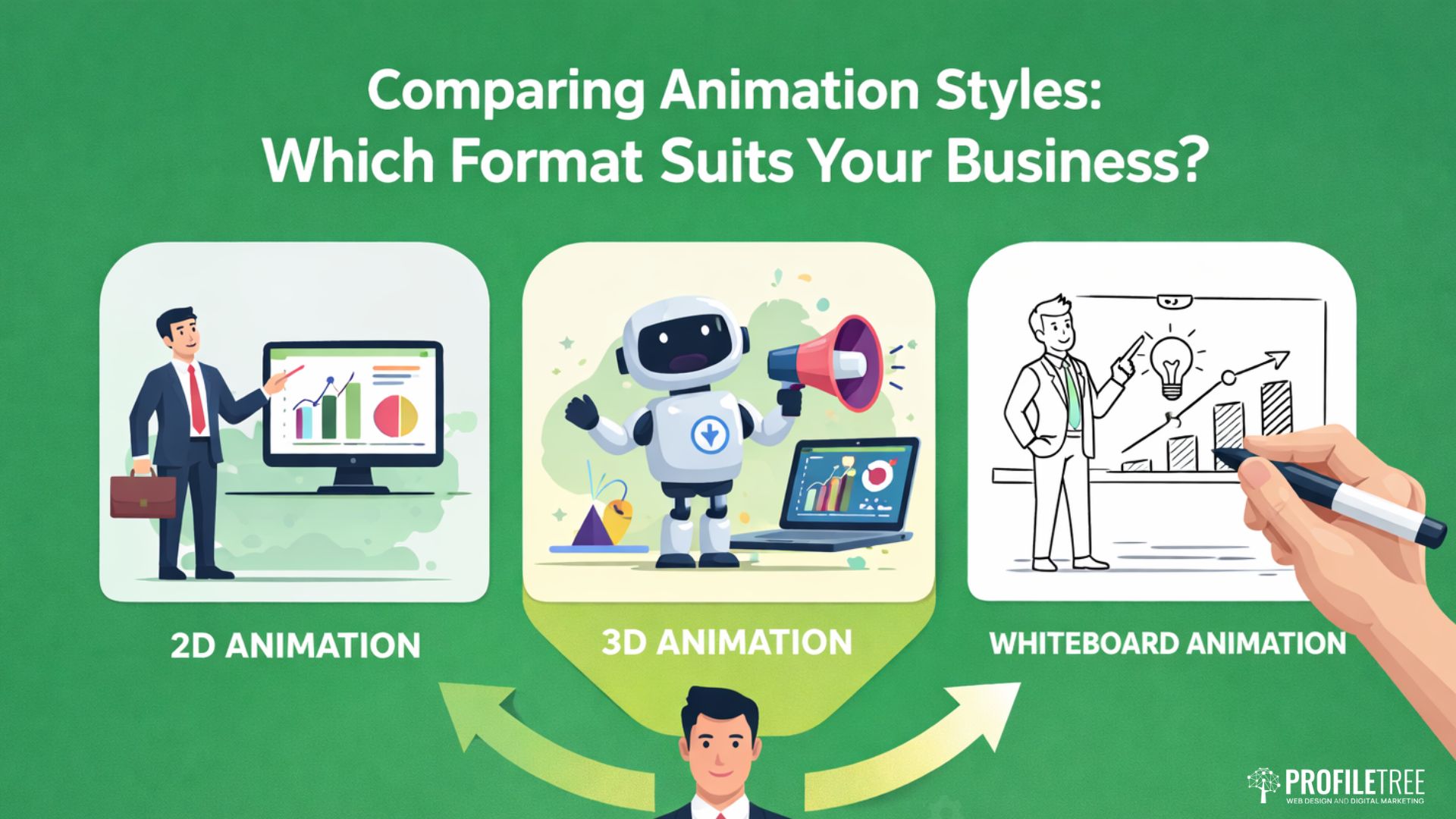
Not all animated explainer videos look or function the same way. The three main formats available to NI businesses each come with different production timelines, cost ranges, and use cases. Choosing the wrong one is a common and avoidable mistake.
2D Vector Animation: The Versatile All-Rounder
2D animation is the most widely used format for business explainer videos. Characters, icons, and environments are drawn as flat vector graphics, then animated using software to create movement. The style is clean, scalable, and works well across screen sizes from a desktop landing page to a smartphone screen.
For Northern Ireland SMEs in retail, hospitality, professional services, or consumer-facing sectors, 2D animation is usually the right starting point. Production timelines typically run four to six weeks for a 60 to 90-second video, and costs at the agency level generally start around £2,000 to £3,500, depending on complexity and script length.
3D Animation: High-Impact for Technical and Manufacturing Sectors
3D animation renders objects and environments in three dimensions, allowing for product visualisations, architectural walkthroughs, and engineering demonstrations that 2D simply cannot replicate. It is the format of choice for manufacturing businesses, engineering firms, and technology companies that need to show how something physically works.
Northern Ireland has a strong advanced manufacturing and engineering sector, and 3D animation serves these businesses well when the product itself is the story. The trade-off is cost and time: 3D production typically runs from £4,000 upward and requires a longer timeline, usually six to ten weeks for a short piece.
Motion Graphics: Clarity for Data-Heavy and Corporate Content
Motion graphics sit between live video and full animation. They use animated text, icons, charts, and branded visual elements rather than characters or narrative scenes. The format is particularly effective for financial businesses, professional services firms, and any organisation that needs to communicate statistics, processes, or compliance information in an accessible way.
A Northern Ireland accountancy practice, legal firm, or financial adviser looking to explain a process or a regulatory change will often find motion graphics the most cost-effective and appropriate choice. Production costs are generally lower than full 2D animation, and the format is faster to update when content changes.
| Style | Typical Cost (NI Agency) | Lead Time | Best For |
|---|---|---|---|
| 2D Vector | £2,000 to £3,500+ | 4 to 6 weeks | SMEs, consumer brands, professional services |
| 3D Animation | £4,000 to £10,000+ | 6 to 10 weeks | Manufacturing, engineering, tech product demos |
| Motion Graphics | £1,500 to £2,500+ | 3 to 5 weeks | Finance, legal, data-heavy corporate content |
All prices and figures in this guide are indicative UK examples and correct at the time of writing; use them as a benchmark rather than fixed quotations.
Understanding which format suits your goals is the first conversation worth having with any agency. Viewing examples of animated video production across different sectors helps set realistic expectations before a brief is written.
The Production Process: What to Expect from Brief to Delivery
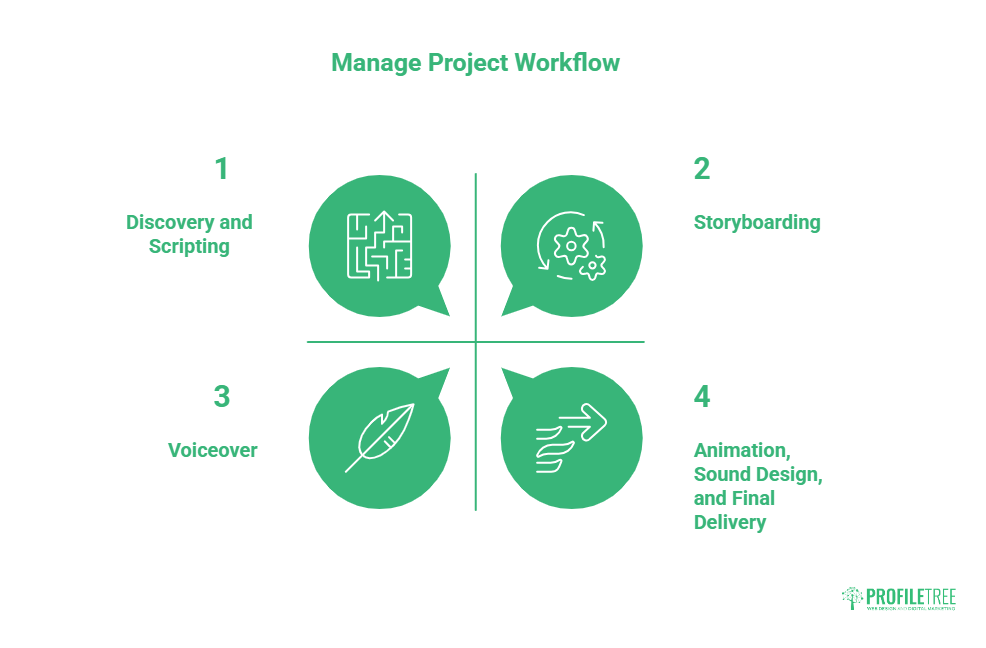
One of the most common frustrations businesses report with animation projects is a lack of clarity about what happens when and what is expected of them at each stage. A transparent production process makes the experience far less stressful and significantly improves the final result.
Discovery and Scripting: Getting the Message Right First
Good animation starts with a good script, and a good script starts with a clear brief. Before any visuals are discussed, a professional agency will want to understand your audience, your core message, your preferred tone, and what you want the viewer to do after watching.
For NI businesses, the tone question matters more than it might seem. There is a meaningful difference between a script written for a Belfast SME targeting local clients and one written for a company pitching to buyers in London or Dublin. The right agency will ask about this, not assume a generic corporate register is appropriate for every context.
The script is the most important document in the entire project. Changes at script stage cost very little. Changes after animation has begun cost considerably more, in both time and budget.
Storyboarding: Visualising the Journey Before Animation Begins
Once the script is approved, the production team creates a storyboard: a visual plan of the video, frame by frame. This is where clients see how their message will be told visually, and it is the right moment to request changes to scene compositions, character design, or the sequencing of information.
A storyboard should never be skipped or treated as a formality. It is the checkpoint between the written concept and the animated execution, and reviewing it carefully saves significant revision time later.
Voiceover: Local Accents Versus Neutral Delivery
The voiceover choice is one that NI businesses often underestimate. A Northern Irish accent builds immediate local credibility and warmth for businesses whose clients are primarily based in Belfast or across Northern Ireland. It signals that the company is genuinely of the region, not presenting a polished but generic corporate face.
For businesses with an export angle or a cross-border audience that extends into the Republic of Ireland or Great Britain, a neutral British or Irish accent often travels better. The right choice depends on where most of your customers are, and both options can be accommodated by a local production team with access to a professional voiceover network.
Animation, Sound Design, and Final Delivery
With approved storyboards and recorded voiceover in hand, the animation team brings the visuals to life. Sound design, music beds, and any additional audio effects are added at this stage. The final video is then rendered and delivered in the formats your business needs: typically MP4 for web use, with additional exports for social platforms if required.
A professional agency will deliver source files alongside the final export. Retaining source files means the video can be updated in the future without rebuilding from scratch, which is relevant for any business whose pricing, product range, or branding is likely to change. For context on how video fits into a wider content strategy, ProfileTree’s work in video storytelling shows how the production and strategic layers connect.
Costs, Budgets, and Funding for Video Production in Northern Ireland
Cost is the conversation most businesses want to have early, and most agencies delay until later. This section provides a straightforward breakdown of what different budget levels buy and where NI businesses may be able to offset some of those costs through available funding.
As Ciaran Connolly, founder of ProfileTree, puts it: “A professionally produced animated explainer is not a marketing luxury for Northern Ireland businesses in 2026. It is a core digital asset that works on your website, across your social channels, and in sales conversations. The businesses that treat video as optional are already at a disadvantage to those that do not.”
Tiered Pricing: What Your Budget Actually Buys
At the entry level, around £1,500 to £2,000, you can typically commission a short motion graphics piece of 45 to 60 seconds with a template-influenced visual style. This is a workable option for businesses with a very limited budget and a simple message, but the result will not be bespoke and the agency’s creative input will be limited.
At £2,500 to £4,000, the range that suits most NI SMEs for a first commission, you can expect a fully custom 2D animation of 60 to 90 seconds with original character design, a professionally recorded voiceover, bespoke music, and a script developed through the agency’s process. This is the range where the investment becomes genuinely impactful.
Above £4,000, you move into more complex 2D work with multiple scenes and characters, or into 3D animation for product and technical applications. At this level, the production is a significant asset that typically serves the business for two to three years before an update is needed.
Invest NI and Regional Grant Opportunities
Northern Ireland businesses have access to several funding routes that can reduce the net cost of a professional video production. Invest NI’s Digital Development and Innovation voucher programmes have historically supported SMEs in adopting digital tools and capabilities, with eligible costs sometimes covering agency commissions for digital content.
Local councils across Northern Ireland also operate enterprise grant schemes that may include digital marketing activity. The availability and eligibility criteria for these schemes change, so the most reliable approach is to contact your local council’s enterprise team or Invest NI directly before commissioning a project.
It is worth noting that the grant application process itself benefits from a clear digital strategy document. ProfileTree’s work in digital marketing in Northern Ireland provides context on the regional digital landscape that is relevant to any funding conversation.
AI in Animation Production: Keeping Costs Down Without Losing Quality
AI tools are increasingly used in professional animation workflows to speed up specific tasks, such as generating reference imagery, automating lip-sync to voiceover, or accelerating the rendering of secondary scene elements. Used by experienced animators, these tools reduce production time without compromising the creative quality that distinguishes a professional agency from a DIY tool.
This is meaningfully different from using consumer AI animation apps to generate a video without a professional brief, script, or creative direction. The output of the latter is generic by design. The value in professional animation lies not in the software used to create it, but in the strategic thinking, scripting, and creative execution that underpin the visuals. Businesses interested in how AI is reshaping creative production more broadly will find ProfileTree’s writing on text-to-video AI a useful reference point for understanding where the technology is heading.
Distributing Your Video: Getting the Most From the Investment
Commissioning a professional animation and then uploading it once to YouTube without a distribution plan is one of the most common mistakes NI businesses make with their video investment. The video itself is the asset; distribution is how it earns its return.
Website Placement: Where Your Video Does the Most Work
The most valuable placement for an animated explainer is above the fold on the page whose content the video explains. For a professional services firm, that is the relevant service page. For a product business, it is the product page. Placing it on a generic “About Us” page or burying it in a blog post significantly reduces its commercial impact.
Page speed and load performance matter when embedding video. A video that slows your page down will cost you in both user experience and search rankings. The technical implementation, including lazy loading and appropriate file formats, should be handled carefully. ProfileTree’s broader work in creating interactive content covers how video and interactive elements can be built into pages without harming performance.
YouTube as a Search Channel
YouTube is the second-largest search engine globally, and Northern Ireland businesses consistently underuse it. An animated explainer uploaded to a well-optimised YouTube channel with a descriptive title, detailed description, and accurate tags can generate organic search traffic independently of your website.
For B2B businesses in particular, a potential client who finds your explainer video through a YouTube search is often further along in their buying process than someone who finds you through a Google search. They are already asking the question your video answers. ProfileTree’s video marketing services include YouTube channel strategy and optimisation for businesses that want to treat the platform as a lead generation channel rather than a video library.
Social Media and the NI B2B Sales Cycle
Animated explainer videos are highly shareable on LinkedIn, which remains the dominant platform for B2B lead generation in Northern Ireland. A 60-second version of your explainer, formatted for square or vertical display, gives you a professional content asset that works in the LinkedIn feed without requiring ongoing production effort.
Facebook and Instagram can carry the same assets to consumer audiences. The key is formatting: social platforms compress and crop video differently from website embeds, so exporting platform-specific versions of the video at the point of production is worth requesting from your agency.
Thinking about how your video fits into a wider brand storytelling strategy from the outset means each asset you produce reinforces the others, rather than existing as an isolated piece of content.
Why Choosing a Northern Ireland Animation Studio Makes a Difference
The global market for animation services is enormous, and businesses in Belfast can access studios anywhere. The case for commissioning locally is not about protectionism; it is about the practical advantages that come from working with a team embedded in the same market you are selling into.
Local Knowledge and Regional Authority
A Belfast-based animation team understands the tone that works for a Northern Ireland audience. They know the cultural references that land, the formality levels that suit different sectors, and the regional business context that shapes how buyers in NI respond to marketing content. That knowledge does not travel well when you outsource to a studio in a different time zone with no experience of the regional market.
ProfileTree has worked with SMEs across Northern Ireland, Ireland, and the UK since 2011, completing more than 1,000 digital projects. That breadth of experience across sectors, from hospitality and tourism to manufacturing, professional services and technology, means the animation team brings genuine sector-specific judgement to the briefing process, not just technical production skills.
Face-to-Face Collaboration and the Briefing Advantage
Complex creative projects benefit from in-person conversations. When a business owner can sit across a table and explain what they want the video to achieve, the nuances that get lost in email exchanges become clear immediately. Revision cycles shrink. The creative team can ask follow-up questions that change the direction of a script before a single frame has been animated.
Working with a local NI agency also makes it easier to integrate video production into a broader digital strategy conversation. If your animation project is part of a wider SEO, content marketing, or website redesign programme, having your agency teams working from the same office eliminates the coordination overhead that comes with managing multiple suppliers across different locations. Explore ProfileTree’s full range of digital marketing channels to understand how animation fits within a joined-up approach.
Supporting the Northern Ireland Creative Economy
Northern Ireland’s creative industries sector is a genuine strength of the regional economy. Commissioning animation locally supports that sector and keeps production investment circulating within the NI economy. For businesses that have a public-facing corporate responsibility position or public sector contracts where local supplier engagement matters, this is a practical as well as commercial consideration.
Conclusion
Animated explainer videos are a practical investment for Northern Ireland SMEs when they are commissioned strategically, produced professionally, and distributed with a clear plan. The format choices, cost tiers, and funding routes covered in this guide give you the information needed to approach a project with realistic expectations. A well-executed animation works across your website, your social channels, and your sales process for two to three years from a single production investment.
Whether you are at the early research stage or ready to brief a project, ProfileTree’s animation team works with Northern Ireland businesses across all sectors to develop animated explainer videos that serve a clear commercial purpose. Get in touch with ProfileTree to discuss your animated video project.
FAQs
How long does the production process take?
A 60 to 90-second 2D animated explainer typically takes four to six weeks from an approved brief to final delivery. Motion graphics projects can move faster, sometimes three to four weeks, while 3D animation projects usually require six to ten weeks. The timeline depends on how quickly the client can approve the script and storyboard at each review stage.
Can I get a grant for video production in Northern Ireland?
Northern Ireland SMEs may be able to offset some of the cost of professional animation through Invest NI’s Digital Development or Innovation voucher programmes, or through enterprise grant schemes run by local councils. Eligibility criteria and funding availability change, so the most reliable step is to contact Invest NI or your local council enterprise team directly before commissioning a project.
Should I use a Belfast accent for the voiceover?
The answer depends on your primary audience. A Northern Irish accent builds immediate local credibility for businesses whose clients are mainly based in NI. For companies with a cross-border audience, clients across Great Britain, or an export focus, a neutral British or Irish accent often travels more easily.
What is the ideal length for a business animated explainer?
Sixty to ninety seconds is the range that consistently performs well for conversion-focused explainer videos. This is enough time to state the problem, explain the solution, and include a clear call to action. Videos longer than two minutes see a significant drop in completion rates on most platforms.
Do I own the rights to the animation once it is finished?
With a reputable NI agency, yes. You should receive full ownership and licensing rights to the finished animation, along with source files. Confirm this before signing a contract. Some lower-cost production services retain rights to template elements used in the video, which can restrict how you use or update the asset in the future.