
Conversion Rate Optimisation: A Practical CRO Guide
Table of Contents
Most businesses invest heavily in driving traffic to their website. Far fewer put the same effort into what happens once visitors arrive. Conversion rate optimisation (CRO) closes that gap. It’s the structured process of making deliberate, evidence-backed changes to increase website conversion rates. Done well, CRO doesn’t just lift conversion numbers; it reduces cost per acquisition and stretches the value of every pound spent on paid media.
This guide covers what conversion rate optimisation is, how the five-step process works, how to run valid tests under UK privacy regulations, and what separates CRO programmes that generate lasting growth from those that chase short-term quick wins.
What Is Conversion Rate Optimisation?
Conversion rate optimisation is the process of increasing the percentage of website visitors who complete a specific desired action. Understanding the basics gives you the foundation to apply more advanced techniques effectively.
Defining Conversion Rate
A conversion is any action your website is designed to drive. For an e-commerce site, it’s usually a completed purchase. For a service business, it’s more likely to be a contact form submission, a phone call, or a quote request. Micro-conversions (newsletter sign-ups, video plays, PDF downloads) signal engagement and warm traffic towards the macro-conversion. The conversion rate is calculated by dividing conversions by total sessions and multiplying by 100: 60 enquiries from 2,000 sessions equals a 3% conversion rate.
From Button Colours to Behavioural Strategy
CRO has evolved well beyond testing button colours and headline fonts. Modern conversion rate optimisation draws on behavioural economics and analytics to understand the psychology behind user decisions. Loss aversion explains why urgency signals can be effective when used honestly. Social proof explains why named testimonials outperform generic five-star ratings. Cognitive load theory explains why forms with too many fields kill conversions. Understanding these principles changes what you test and why: instead of randomly trialling design changes, you build hypotheses grounded in what’s actually holding specific users back.
The Business Case for CRO
Understanding why conversion rate optimisation pays off financially helps you make the case internally and prioritise it correctly alongside other digital investments.
The argument for CRO is straightforward. Most paid digital channels (Google Ads, Meta, LinkedIn) have become considerably more expensive over the past five years. Average cost-per-click in the UK has risen sharply across most competitive categories. If your conversion rate stays flat while your media spend rises, you’re paying more for the same result.
CRO inverts that pattern. Doubling your conversion rate from 2% to 4% on the same traffic volume effectively halves your customer acquisition cost. Lower CAC means you can bid more aggressively in paid channels or redirect budget to campaigns you previously couldn’t justify. For SMEs in Northern Ireland and the UK, where budgets are tighter, that discipline of systematic testing and honest analysis is worth more than any specific tool.
The CRO Process: A Five-Step Framework
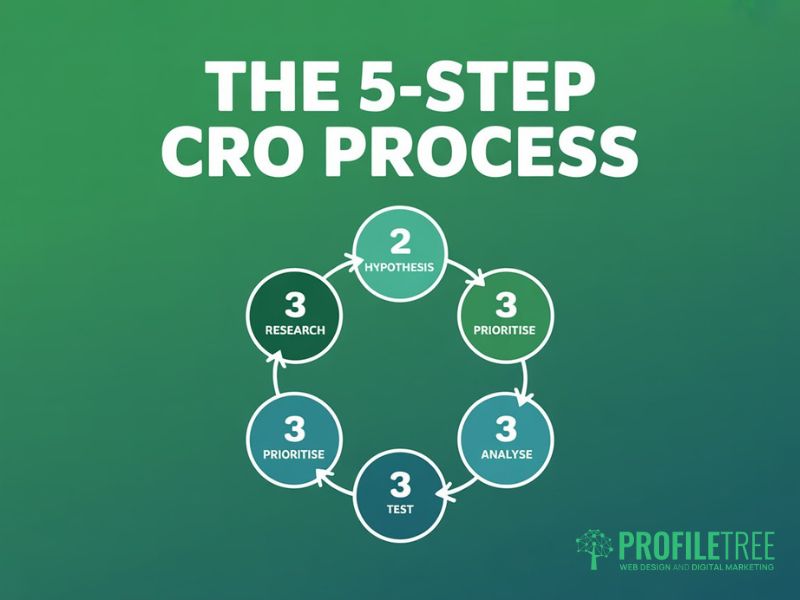
Effective conversion rate optimisation follows a repeatable cycle. Each stage feeds into the next, which is why experienced practitioners describe it as a loop rather than a project with a finish line.
Step 1: Research, Quantitative and Qualitative
Before you test anything, you need to understand what’s happening on your site and why. Research falls into two categories, and you’ll need both.
Quantitative research (data from analytics platforms) tells you what’s happening. GA4 session data, funnel reports, and scroll depth analysis reveal where visitors drop off, which pages have unusually high exit rates, and where traffic enters and exits the website conversion funnel. Heatmaps and click maps from tools such as Hotjar add a visual layer, showing where users click, where they stop scrolling, and which elements they ignore.
Qualitative research tells you why. On-site surveys, exit intent polls, and user interviews surface the actual objections that data alone cannot show. A common finding from conversion rate optimisation audits: visitors leave a pricing page not because the price is too high, but because they could not find an answer to one specific question.
| Method | What It Shows | Example Tool | Limitation |
|---|---|---|---|
| GA4 Funnel Analysis | Drop-off points in a defined sequence | Google Analytics 4 | Tells you what, not why |
| Heatmaps | Click and scroll behaviour visually | Hotjar, Microsoft Clarity | Sampling bias on low-traffic pages |
| Exit Intent Surveys | Reasons visitors leave before converting | Hotjar, Typeform | Self-report bias |
| User Interviews | Deep context on decision-making | Moderated sessions | Time-intensive; small sample |
Step 2: Hypothesis Formation
A properly formed hypothesis separates a meaningful test from a guess. Use the ‘If-Then-Because’ framework: ‘If we replace the generic hero image with a photograph of the Belfast office and team, then form submission rate will increase because survey data shows visitors want reassurance that ProfileTree is a local, accessible business.’ Hypotheses without a ‘because’ are hunches; the ‘because’ connects the proposed change to actual research findings.
Step 3: Prioritisation Using the ICE Score
You will always have more test ideas than capacity to run them. The ICE framework (Impact, Confidence, Ease) provides a consistent way to rank them.
Score each test idea across three dimensions: Impact (potential uplift if it wins), Confidence (strength of evidence behind the hypothesis), and Ease (development effort required). Run high-scoring combinations first. The value is not the precise number but the discipline of grounding prioritisation in evidence rather than opinion.
Step 4: Testing
A/B testing (split testing) is the workhorse of conversion rate optimisation. Traffic’s split between a control version (A) and a variant (B), and performance is measured against a defined metric. The result’s statistically valid only when you reach a sufficient sample size and run the test for a minimum period, typically at least two full business weeks to smooth out day-of-week variation.
Common mistakes: ending tests too early, running overlapping tests that contaminate results, or changing the variant mid-test. VWO and GA4’s built-in experimentation covers most SME needs.
Step 5: Analysis, Learning from Both Wins and Losses
Most conversion rate optimisation guides stop at ‘implement the winning variant.’ That misses half the value. A test that fails isn’t a wasted effort. It’s evidence. Ask: Was the hypothesis wrong? Was the sample size insufficient? Did the change affect a metric we weren’t measuring? A post-test review extracts learning regardless of outcome and prevents teams from repeating the same losing tests in slightly different forms.
Privacy-First CRO: Running Valid Tests Under UK and EU Regulations
UK and European privacy regulations affect every stage of a conversion rate optimisation programme. Ignoring this reality produces unreliable data and exposes your business to compliance risk.
The UK GDPR and the Privacy and Electronic Communications Regulations (PECR) both apply to tracking and analytics on UK websites. When a large proportion of visitors decline cookie consent, your analytics data reflects only the opted-in minority. Depending on your industry, that could mean 30% to 50% of sessions are untracked, which means tests need to run longer to reach statistical significance, and heatmaps may only reflect a self-selected subset of your audience.
Privacy-First Analytics Options
Server-side tracking reduces reliance on browser-based cookies and can be configured to collect analytics data without personal identifiers. Platforms such as Piwik PRO and Matomo offer EU-hosted analytics that can reduce the need for cookie consent banners while remaining compliant with UK GDPR. For most SMEs, the practical starting point is checking that GA4 consent mode is configured correctly, and pairing quantitative data with qualitative methods that do not rely on tracking cookies at all.
CRO for B2B Versus E-commerce: Two Different Problems

The principles of conversion rate optimisation are universal, but the tactics that work in e-commerce rarely translate directly to B2B. Understanding which approach fits your context determines where you focus your testing effort and which research methods will give you the most reliable results.
E-commerce CRO
E-commerce conversion optimisation is volume-driven. You’ve got enough traffic to run statistically valid A/B tests quickly, and each conversion has a measurable immediate value. The primary focus areas are product pages, the checkout flow, and basket abandonment recovery: the three points in the e-commerce conversion funnel where most revenue is lost.
On product pages, the highest-impact changes typically involve trust signals (reviews, ratings, returns policy visibility) and the clarity of the add-to-basket action. On checkout, reducing form fields, offering guest checkout, displaying security indicators, and providing multiple payment options each contribute to improved completion rates. Mobile deserves its own testing programme: in the UK, more than 60% of e-commerce browsing happens on mobile, and checkout abandonment on mobile runs substantially higher than on desktop.
B2B CRO: Optimising for High-Value, Low-Volume Conversions
B2B conversion rate optimisation presents a different challenge. A professional services firm generating ten qualified enquiries a month from 500 visitors cannot run traditional A/B tests and reach statistical significance in any reasonable timeframe. Qualitative methods carry more weight here: client interviews, review mining from Google and Trustpilot, and analysis of the questions that come through contact forms provide actionable insight without requiring large sample sizes.
For B2B landing pages, the most common blockers are: unclear articulation of the problem being solved, insufficient social proof, and a CTA that asks for too much commitment too early. The Black Box Belfast noted after working with ProfileTree: “Received really useful training from Laura, helped us improve our SEO and digital engagement.”
Landing Page Optimisation: The 15-Minute Hygiene Audit
Landing pages are the primary battleground for conversion rate optimisation. A good user experience and a clear conversion path go hand in hand here. Run through this checklist before committing to any formal testing programme:
- H1 is clear and directly addresses the visitor’s specific intent, not a clever slogan
- The value proposition is visible above the fold on both desktop and mobile
- There is one primary call to action, not three competing options
- Trust signals are present near the CTA: reviews, testimonials, or security badges
- The form asks only for information genuinely required at this stage
- Page load time is under three seconds on mobile
- Navigation is minimal; landing pages should not leak traffic to other pages
- The page matches the ad or email that brought the visitor there; message continuity reduces bounce
Any item you can’t tick on this list is a test candidate. Fix the most fundamental issues first; there’s no point testing headline variants on a page that loads in eight seconds.
ProfileTree’s web design and digital marketing team works with businesses across Northern Ireland and the UK to audit and improve landing page performance. Explore our web design services in Belfast, or get in touch to discuss a structured CRO review for your site.
Building a Testing Culture in Your Business
Sustainable conversion rate optimisation isn’t a project with a defined end date. The most common obstacle is the HiPPO problem: Highest Paid Person’s Opinion, where website changes default to whoever is most senior in the room rather than whoever has seen the data. The cure isn’t political; it’s structural. An agreed testing process depersonalises the disagreement and keeps prioritisation grounded in evidence rather than seniority.
A testing culture means treating every material change to a conversion page as an opportunity to learn. Document test results, including failures, so institutional knowledge accumulates. Published CRO ‘best practices’ are averages across thousands of different sites; some will apply to yours, many won’t. The only way to know is to test.
For teams new to structured digital optimisation, ProfileTree’s digital marketing training programmes cover analytics, data interpretation, and the fundamentals of evidence-based decision making.
Putting CRO Into Practice
Conversion rate optimisation is one of the most commercially direct disciplines in digital marketing. Every improvement multiplies the value of every pound spent on traffic. The process isn’t complicated, but it requires consistency: research before testing, hypotheses grounded in evidence, tests run long enough to generate reliable results, and everything documented. For businesses just starting out, the most valuable first step is spending a few hours in your analytics identifying where visitors are dropping out of the website conversion funnel.
If you want support in auditing your current conversion performance or developing a structured CRO programme, get in touch with the ProfileTree team. We work with businesses across Northern Ireland, Ireland, and the UK to build digital programmes grounded in data.
FAQs
1. What is a good conversion rate for UK businesses?
There’s no single benchmark. Average e-commerce conversion rates in the UK sit between 1% and 4%, with wide variation by sector; B2B lead generation typically runs at 2% to 5% for form completions, though high-intent pages can reach 15% or more. Sector averages are a starting point, not a target. ‘Better than last month’ is the metric that matters most, evaluated against your own baseline and the quality of traffic you’re sending to each page.
2. How long should I run an A/B test?
The minimum is two full business weeks to account for day-of-week variation in user behaviour. You’ll need at least 100 conversions per variant before a result has statistical meaning. For low-traffic pages, tests may need to run for several weeks or months. If you cannot reach significance in a reasonable timeframe, switch to qualitative research instead.
3. Does conversion rate optimisation affect my SEO?
Positively, in most cases. Improved user experience signals (lower bounce rates, longer session durations, higher pages-per-session) are correlated with stronger search rankings. Pages that convert better tend to be pages that clearly match search intent, which is itself a ranking factor.
The main risk is technical. Some A/B testing scripts, if implemented incorrectly, can cause Cumulative Layout Shift (CLS), a Core Web Vital that affects search ranking.
4. How much traffic do I need before CRO is worthwhile?
There’s no hard minimum, but traditional A/B testing becomes unreliable below around 1,000 monthly sessions on the specific page you are testing. Below that threshold, qualitative methods (user interviews, customer surveys, session recordings) provide more actionable insight per pound spent than any formal conversion rate optimisation test could.
Low-traffic sites benefit most from reviewing the fundamentals (landing page hygiene, form friction, trust signals) before investing in a formal testing programme. Many businesses in this position find that fixing obvious conversion blockers identified through user research delivers more improvement than any A/B test could.
5. What is the difference between CRO and UX design?
User experience design focuses on creating a product that is usable, accessible, and meets users’ needs. Conversion rate optimisation focuses on a specific commercial outcome: increasing the rate at which visitors take a defined action on your website. UX is the methodology; CRO is the goal.
In practice, the two are deeply connected. Most conversion blockers are UX problems: forms that are hard to complete, pages that don’t load quickly, and navigation that confuses visitors. A CRO programme without good UX thinking tends to optimise the wrong things.