
Social Media Branding: Build a Consistent Brand Voice
Table of Contents
Most UK businesses now show up on social media. Far fewer have a consistent social media brand that people actually recognise. There is a real difference between having active accounts and having a brand, and that gap is where most SMEs quietly lose ground to better-prepared competitors.
Social media branding is the practice of presenting your business with a consistent identity across every platform: the same visual style, the same social media brand voice, and the same core message, adapted appropriately for each channel. When it works, your audience recognises you before they even read your name.
This guide covers the practical building blocks of social media branding for UK businesses: how to define your brand voice, build a social media style guide, adapt for different platforms, maintain brand voice consistency when using AI tools, and stay on the right side of UK advertising regulations.
What Is Social Media Branding?
Social media branding is the process of shaping how your business looks, sounds, and feels on social platforms. It goes well beyond a logo and a colour palette. It covers every touchpoint: the language you use in captions, the way you handle comments, the imagery you choose, and the values you signal through the content you share.
Your social media brand is the personality your business projects online. Done well, it builds recognition and trust over time. Done inconsistently, it makes your business look disorganised, even if the underlying product or service is excellent. The social media brand voice you develop is often what people remember most, because tone and personality stick longer than any visual.
Perception vs. Reality: Your Brand as a Digital Handshake
Your brand does not exist in your style guide. It exists in the minds of the people who encounter it. Every post, reply, and piece of shared content either reinforces or undermines the impression you want to create. A single tone-deaf response to a complaint can undo months of carefully crafted content.
This is why brand perception management matters. Social media gives businesses a direct line to their audience, but it also gives that audience a direct line back. How you handle that two-way communication is as much a part of your social media branding as any visual element.
The Four Pillars of a Strong Social Media Brand
A well-built social media brand rests on four distinct pillars. Weakness in any one of them undermines the others. Most businesses focus heavily on visual identity and neglect the rest, which is why so many social media presences feel polished but impersonal.
Lucidpress research found that consistent brand presentation across channels increases revenue by up to 23%. The mechanism is straightforward: recognition reduces the cognitive effort required to trust a business, and brand voice consistency is a large part of what produces that recognition.
Visual Identity: Colours, Typography, and Imagery
Visual identity is the most immediately obvious element of social media branding. It covers your logo and its usage rules, your brand colour palette with specific hex codes, the typefaces you use in graphics, and the photographic or illustrative style you apply consistently across posts.
The practical goal is simple: someone scrolling past your post should recognise it as yours from the thumbnail alone, before reading a single word. If your posts could be mistaken for a competitor’s, your visual identity needs work. For UK SMEs, this does not require an expensive brand refresh. It requires discipline: picking a palette, sticking to it, and applying it consistently to every piece of created content.
Social Media Brand Voice and Tone
Your social media brand voice is the consistent personality your business expresses in writing. Tone is how that personality adapts to context: your voice on a crisis response post will be different from your voice on a celebratory announcement, but both should be recognisably the same brand.
UK audiences tend to respond better to understated authority than to the enthusiastic, superlative-heavy style common in American marketing. Self-deprecating humour, direct language, and a lack of corporate buzzwords all play well, depending on the sector. A law firm and a craft brewery will have very different voices, but both should be authentic.
Define three to five voice attributes for your brand, for example: direct, knowledgeable, approachable, and pragmatic. Use them as a filter when reviewing content before it goes out. If a caption does not sound like those attributes in action, rewrite it.
Value Proposition: What You Actually Offer Followers
One of the most overlooked questions in social media branding is: Why should someone follow you? Follower counts are a vanity metric. What matters is whether the people who encounter your content find it valuable enough to stay engaged.
Your content value proposition should be distinct from your commercial offer. You might sell web design, but your social media might be worth following because it gives practical digital marketing advice for small businesses in Northern Ireland. That is a reason to follow. ‘We build websites’ is not.
Community Governance: How You Interact in Comments
The comments section is part of your brand. How quickly you respond, how you handle negative feedback, and what language you use in replies all contribute to the impression your brand creates. Brand voice consistency in comment management is as important as consistency in published content.
Establish clear internal guidelines: response-time targets, escalation routes for complaints, tone guidelines for difficult interactions, and a policy on which comments are removed. Many brands invest heavily in content creation and then let an inconsistent comments strategy undo it.
Developing Your Social Media Style Guide
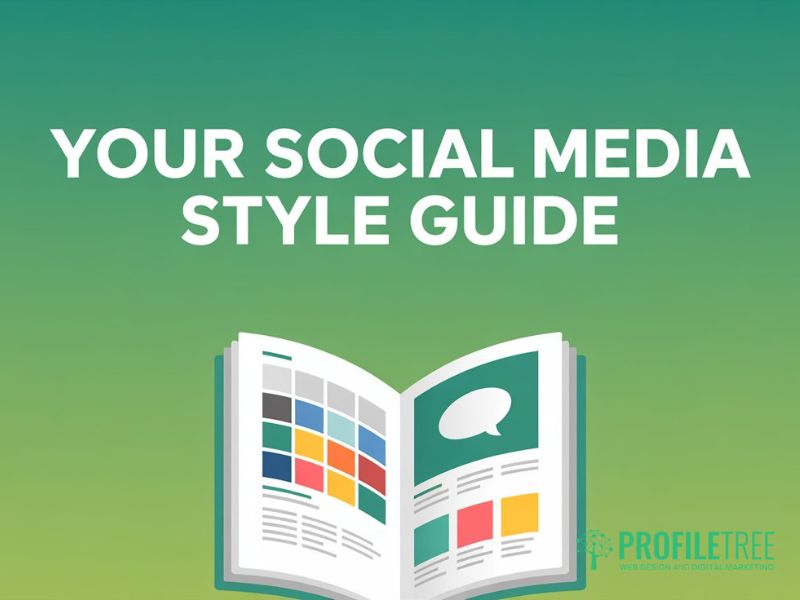
A social media style guide is the document that makes brand voice consistency repeatable, regardless of who is creating the content. Without one, every new team member, freelancer, or agency reboots your brand from scratch. The social media style guide is not optional if you want your brand to hold together across multiple contributors and platforms.
The guide should be practical enough to actually use. A 60-page PDF that nobody opens is not a style guide; it is a filing exercise. Aim for a concise, visual document that answers the most common questions a content creator would have.
Language Guidelines and Brand Voice
Your language guidelines should specify the vocabulary and register that define your social media brand voice. This includes preferred terminology, phrases to avoid, the degree of formality, and how you address your audience (second-person ‘you’, first-person plural ‘we’, and so on).
Include real examples: a before-and-after showing how the same message sounds in your brand voice versus a generic alternative. Examples are far more useful than abstract descriptions, and they give your team a concrete reference point when they are unsure whether a piece of content is on-brand.
AI Guardrails for Brand Voice Consistency
AI tools are now part of most content workflows, and they create a specific brand voice consistency challenge. AI-generated content defaults to safe, generic phrasing that strips out the personality markers that make your brand recognisable.
Your social media style guide should include explicit AI guardrails: phrases and structures the AI should not use, topics it should not comment on without human review, and a requirement that all AI-generated content is edited through the lens of your voice attributes before publishing.
At ProfileTree, we help businesses build AI implementation frameworks that include brand governance safeguards alongside efficiency gains. The goal is to use AI as a production accelerant, not a tool that erodes brand voice consistency over time.
Creating a Response Matrix for Customer Service
A response matrix maps common customer service scenarios to approved response frameworks. It should cover complaint handling, compliment responses, questions that require escalation, and situations requiring no response, such as bad-faith trolling or competitor activity.
The matrix does not script responses word for word, which tends to produce robotic replies. Instead, it specifies the tone, the key messages to include or avoid, and the action required. A team member consulting it should be able to write a response that sounds human and is on-brand every time.
Platform-Specific Branding Strategies
No two social media platforms are the same. Your core identity remains constant, but the format, tone, and content type must adapt to each platform’s culture and audience expectations. The social media style guide you build should have a section for each active platform, translating your brand standards into platform-specific guidance.
| Platform | Primary Audience | Content Vibe | Essential Brand Assets |
|---|---|---|---|
| Professionals, B2B decision-makers | Authoritative, thought leadership | Company page, headshots, case study posts | |
| Consumer, lifestyle, B2C | Visual storytelling, aspirational | Consistent grid aesthetic, Reels style guide | |
| TikTok | Under-35, rapidly growing B2B | Entertaining, authentic, informal | Sound strategy, creator tone of voice |
| Broad, local community, 35+ | Community-led, conversational | Group strategy, events, local content | |
| X (Twitter) | News-led, professional | Real-time, direct, opinionated | Crisis response protocol, brand voice guide |
LinkedIn: Professional Authority and Thought Leadership
LinkedIn rewards depth. Long-form posts, expert commentary, and evidence-based analysis consistently outperform promotional content on the platform. For UK B2B businesses, it remains the highest-value platform for brand building among professional audiences.
Your LinkedIn brand should position your business as a knowledgeable voice in your sector. Share opinions, not just information. Comment on industry developments with a clear point of view. Let the people behind the business be visible, because LinkedIn’s algorithm favours personal profiles over company pages. Your social media brand voice on LinkedIn should lean towards the authoritative end of your range.
Instagram and TikTok: Visual Storytelling and Authenticity
Both platforms prioritise authentic, visually engaging content over polished corporate production. For most SMEs, this is good news: smartphone footage and real behind-the-scenes content routinely outperforms expensive studio production.
The social media branding challenge on these platforms is maintaining consistency without looking formulaic. Use consistent filters or colour grading, recurring content formats such as a weekly tip series or Friday Q&A, and a recognisable on-camera personality where possible. Your social media brand voice on these platforms will naturally be more informal, but it should still be recognisably yours.
X and Threads: Real-Time Brand Personality
Real-time platforms amplify both the best and worst of your brand voice. A sharp, well-timed observation can reach far beyond your follower base. An ill-judged comment in a tense moment can create a reputational problem that takes weeks to manage.
The key discipline for X and Threads is having a clear policy on what your brand will and will not comment on. Brand voice consistency in a crisis requires a different gear: slower, more considered, explicitly empathetic. Your social media style guide should address this specifically, with example responses for common high-pressure scenarios.
Compliance and Ethics: The UK Perspective

UK social media marketing is regulated in ways that most American-produced guides simply do not address. Getting this wrong is not just an ethical issue; it carries real regulatory risk. Every business running UK social media marketing activity needs a working understanding of the relevant rules.
ASA and CMA Guidelines for UK Businesses
The Advertising Standards Authority (ASA) and the Competition and Markets Authority (CMA) both have jurisdiction over branded social media content. The ASA’s CAP Code applies to paid social ads and to organic posts that promote a product or service. The CMA’s guidelines cover consumer protection obligations, including requirements around pricing claims and endorsements.
For most UK SMEs, the practical implications are: price claims must be accurate and not misleading; testimonials and reviews shared on social media must be genuine; and any content produced in exchange for payment or incentive must be clearly identified as advertising.
Influencer Partnerships and the AD Disclosure Rules
If your brand works with influencers, bloggers, or content creators, UK law requires that any commercial relationship be clearly disclosed. Posts must be labelled AD, Advert, or Paid Partnership in a prominent position, not buried in hashtags or at the end of a long caption.
This applies even when payment is in products rather than cash. The ASA has pursued enforcement action against both brands and creators for nondisclosure. Build disclosure requirements into your influencer briefing documents as standard, and make sure your brand voice guidelines cover how disclosures should be written to stay on-brand without obscuring the commercial nature of the content.
Five Steps to Execute Your Social Media Branding Strategy
Consistent social media branding does not happen through inspiration. It happens through the process. These five steps give you a repeatable framework for building and maintaining brand voice consistency across your channels.
Step 1: Perform a Social Media Audit
Before building anything new, assess what you currently have. Pull your last 90 days of content across every active platform and ask: Does this all look and sound like the same brand? What is the quality range? Where are the gaps in brand voice consistency?
A social media audit should also cover account completeness (profile photos, bios, contact information), follower demographics, and top-performing content by type. This baseline tells you what is working and what needs to change before you invest time in new assets.
Step 2: Define Your Digital Persona
Your digital persona is the character your brand plays on social media. Document it clearly: three to five voice attributes, a description of the audience you are addressing, and a set of example posts that capture the tone correctly. Include examples of what your brand would not say, which is often more useful than examples of what it would.
This persona document becomes the foundation of your social media style guide. Every content decision should be testable against it: Does this post sound like us?
Step 3: Content Pillar Development
Content pillars are the three to five recurring themes that your social media content consistently covers. For a web design agency, this might be: client results, digital marketing advice, behind-the-scenes content, and industry commentary. Every piece of content should map to a pillar.
Pillars provide structure without constraining creativity. They also make content planning much faster, because you are never starting from a blank brief.
ProfileTree’s content marketing strategy for SMEs covers how to build pillar content that supports both brand and SEO objectives.
Step 4: Asset Creation and Templates
Templates reduce production time and enforce visual consistency. Create Canva or Adobe Express templates for your recurring content formats: quote cards, tips posts, event announcements, and case study graphics. Lock the colours and fonts so they cannot be accidentally changed.
Your asset library should also include approved logo files, profile photos, cover image specifications for each platform, and your brand colour palette in an accessible format. Pair these with your social media style guide so that anyone producing content has everything they need in one place.
Step 5: Iteration Through Analytics
Brand voice consistency is not the same as brand rigidity. Review your social media performance quarterly and look for signals that your positioning needs to evolve: shifts in audience demographics, changes in how competitors present themselves, or feedback that your content is missing the mark.
The metrics that matter for brand health are not follower count or reach. They are sentiment (how people talk about you), share of voice (how prominent you are in your topic area), and engagement rate (how many people who see your content actually respond to it).
Measuring the ROI of Social Media Branding

Brand investment is harder to measure than campaign spend, which is why many businesses underinvest in it. The return is real but diffuse: it shows up in higher conversion rates, lower cost per acquisition, and stronger customer retention over time.
Moving from Vanity Metrics to Sentiment and Share of Voice
Follower counts and impression numbers are easy to report and largely meaningless as business metrics. A business with 500 engaged followers in its target market will outperform a competitor with 50,000 disengaged ones every time.
More useful measures include: net sentiment (the ratio of positive to negative brand mentions), share of voice within your sector’s social conversation, branded search volume growth over time, and the percentage of new business enquiries that arrive with existing brand awareness. Social listening tools such as Mention, Brandwatch, or Sprout Social give you access to most of these metrics. Strong social media branding, maintained with brand voice consistency over time, is what moves these numbers.
ProfileTree’s digital marketing strategy service connects social media branding to commercial performance metrics.
Building a Social Media Brand Your Audience Recognises
Social media branding is not a project with a completion date. It is an ongoing discipline: showing up with the same visual identity, social media brand voice, and values across every platform and interaction. The businesses that do this well are rarely the ones with the biggest budgets. They are the ones who made clear decisions about who they are and stuck to them.
A well-maintained social media style guide, regularly reviewed and consistently applied, is the single most practical tool for achieving brand voice consistency at scale. Build it once, keep it current, and use it as the quality filter for everything your brand publishes.
If you want support developing a UK social media marketing strategy that builds brand equity alongside measurable commercial results, take a look at ProfileTree’s social media marketing services for UK businesses.
FAQs
1. What is social media branding?
Social media branding is the practice of presenting your business with a consistent identity across social platforms, covering visual style, tone of voice, and core messaging. It shapes how your audience perceives and recognises your business online, independently of any individual post or campaign.
2. How do you develop a social media brand voice?
Start by identifying three to five personality attributes that reflect your business, for example: direct, knowledgeable, and approachable. Document how those attributes translate into specific language choices: words you use, words you avoid, and the level of formality. Capture everything in a social media style guide your whole team can reference, with real examples of on-brand and off-brand copy.
3. What are the four pillars of social media branding?
The four pillars are visual identity (how your brand looks), social media brand voice and tone (how it sounds), value proposition (why your audience should follow you), and community governance (how you interact with your audience). Strength in all four produces a brand that is both recognisable and trustworthy.
4. Does social media branding affect SEO?
Indirectly, yes. Strong social media branding increases branded search volume over time, and branded search is one of the signals Google uses to assess brand authority. A recognisable brand also earns more backlinks and shares organically, both of which contribute to search performance over time.
5. How often should I update my social media branding?
Run a full brand audit every six months, reviewing visual consistency, brand voice consistency, and audience fit across all platforms. Minor updates, such as refreshed templates or updated profile images, can happen quarterly. A complete rebrand should only be triggered by a major strategic shift, not by trend cycles.