
Twitter (X) for Customer Service and Engagement
Table of Contents
Twitter, now officially rebranded as X, remains one of the most important platforms for public-facing customer service. The platform may have a new name and owner since Elon Musk’s acquisition in 2022, but its core value for businesses has not changed: it is where customers air complaints, ask questions, and expect fast answers in full view of anyone who cares to look.
“The businesses we see getting the most from Twitter aren’t necessarily the ones with the biggest following,” says Ciaran Connolly, founder of ProfileTree. “They’re the ones who treat every public interaction as an opportunity to demonstrate that they actually care about their customers.”
The stakes are real. According to Sprout Social’s 2026 Social Media Content Strategy Report, customer support is the second biggest thing consumers want brands to prioritise on X, and for 18% of social media users the platform is a top destination for customer service. Get it right and about one in three users, 34% of survey respondents, bought a product or service after a positive experience on X.
This guide covers how to set up your account for support, structure your responses, use the platform’s features effectively, and build engagement that strengthens your brand over time. If you want your wider digital presence to back up what you are doing on social, our digital marketing services can help you join the dots.
Why Twitter/X Still Works as a Customer Service Channel
X remains strong as a customer service channel: 78% of businesses using X deploy it for customer service, and the average response time on X is 2.8 hours, 2.1 times faster than email at 6.1 hours.
Twitter’s public nature is the thing that makes it genuinely different from email or live chat. When you resolve a problem openly, everyone who reads that thread sees your response. That visibility works in your favour when you handle things well, and works against you when you do not.
A few characteristics make X particularly useful for customer service teams:
- Speed expectation is built in. 78% of customers who reach out to a brand on Twitter want a reply within an hour. That expectation can feel demanding, but a quick, helpful reply creates an outsized positive impression relative to the effort involved.
- Public resolution builds credibility. When a customer posts a complaint and receives a thorough, professional reply, the exchange is visible to anyone who searches for your brand. A resolved complaint becomes a trust signal for prospective customers.
- The character limit forces clarity. Short replies require you to get to the point. That discipline, applied to customer service, often produces clearer, more useful answers than the lengthy email responses many support teams default to.
- The platform’s audience is influential. X has around 586 million monetizable monthly active users globally, with 59% using the platform as a news source. The audience skews toward professionals, journalists, and decision-makers, which means a complaint left unanswered is visible to exactly the kind of people whose opinions carry weight.
X Rebrand: What Changed for Businesses
Before going further, it is worth addressing the platform shift directly. Twitter was rebranded as X in July 2023 following Elon Musk’s acquisition. The domain twitter.com now redirects to x.com, and the app is labelled X on both iOS and Android. Despite the rebrand, no native feature has been removed; accessibility and discoverability of some features have changed, but the core infrastructure, user data, and protocols remain intact.
For day-to-day customer service purposes, the practical changes worth knowing are:
- Posts are now officially called “posts” rather than tweets, though “tweet” remains widely used colloquially
- X Chat has rolled out as an encrypted DM replacement with video calling capability
- X opened DMs to non-followed accounts with Premium, making it easier for customers to contact brands privately
- The blue verification system now operates through paid X Premium subscriptions rather than the previous editorial verification process
The name change has not altered X’s role as a customer service channel. It remains the place where customers post complaints publicly and expect a response.
Setting Up Your Twitter/X Account for Customer Service
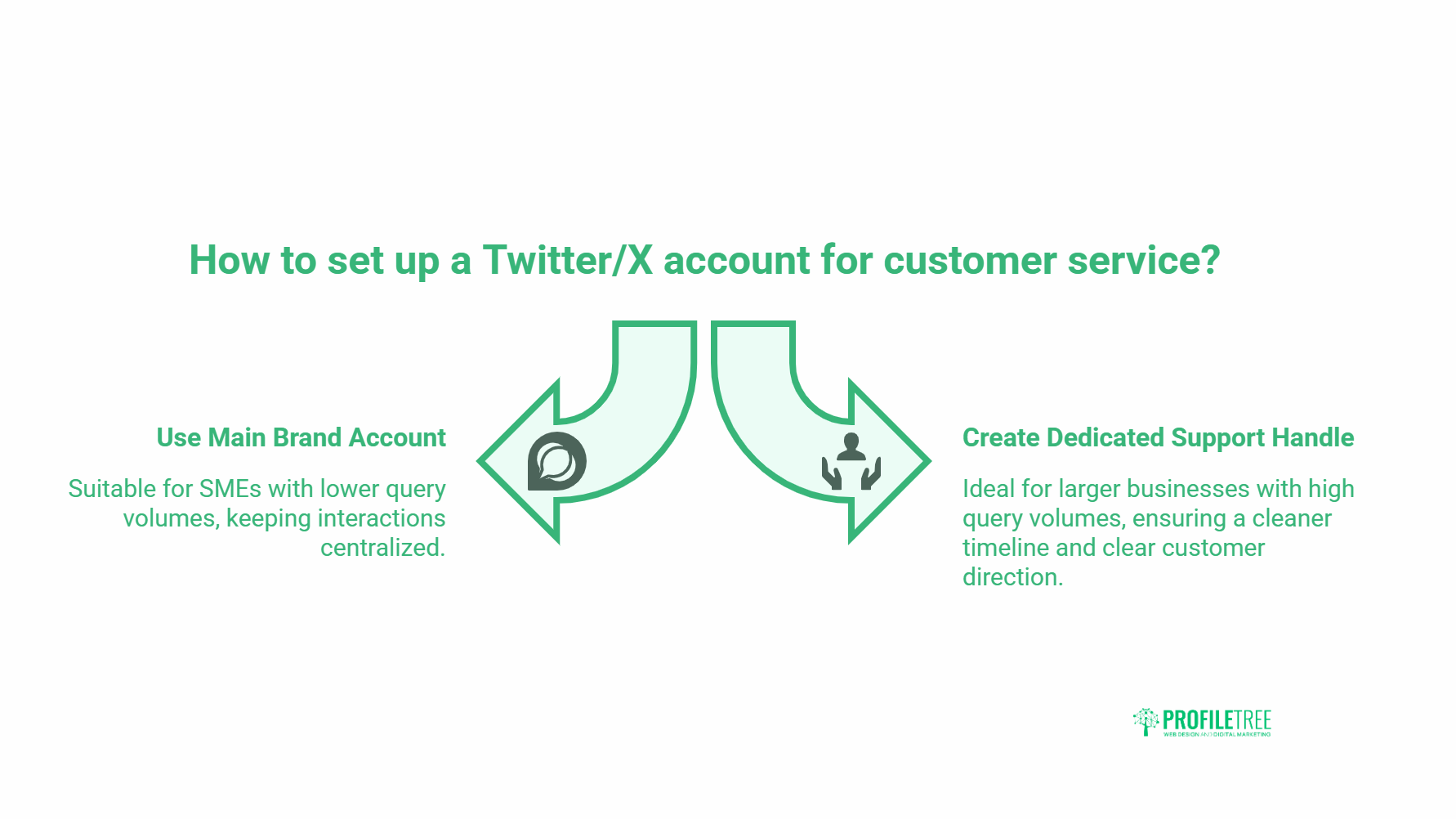
Before you can use X effectively for support, the account needs to be configured properly. There are two approaches: using your main brand account for all interactions, or creating a dedicated support handle (for example, @BrandSupport) that handles queries separately.
Dedicated support handles work well for larger businesses receiving high query volumes. They keep the main timeline cleaner and signal exactly where customers should direct service questions. For most SMEs, a single well-managed brand account is sufficient, provided it is monitored consistently.
Profile Setup
Your profile picture should be your logo, not a generic stock image. The bio should make clear that customer queries are welcome. Something direct works better than clever: “We’re here to help. Post or DM us for support.” Include a link to your support page or main contact page in the bio.
Response Time Targets
Set internal targets before you start. Social media response targets for top-performing brands sit at under one hour during business hours. For most SMEs, realistic benchmarks are:
- Public mentions and replies: within two hours during business hours
- Direct Messages: within two to four hours during business hours
- Out-of-hours urgent queries: acknowledged the same business day
Whatever your targets, be consistent. A customer who gets a quick reply on Tuesday and nothing for 18 hours on Thursday will notice the discrepancy more than they would notice a slightly slower but reliable standard.
Monitoring Tools
Managing X for customer service without a monitoring tool is difficult once query volumes grow. Tools such as Hootsuite, Buffer, Agorapulse, or Sprout Social allow you to track brand mentions, set up keyword alerts, and assign conversations to team members. At minimum, set up alerts for your brand name, common product names, and common misspellings of your brand.
How to Respond to Customer Complaints on X
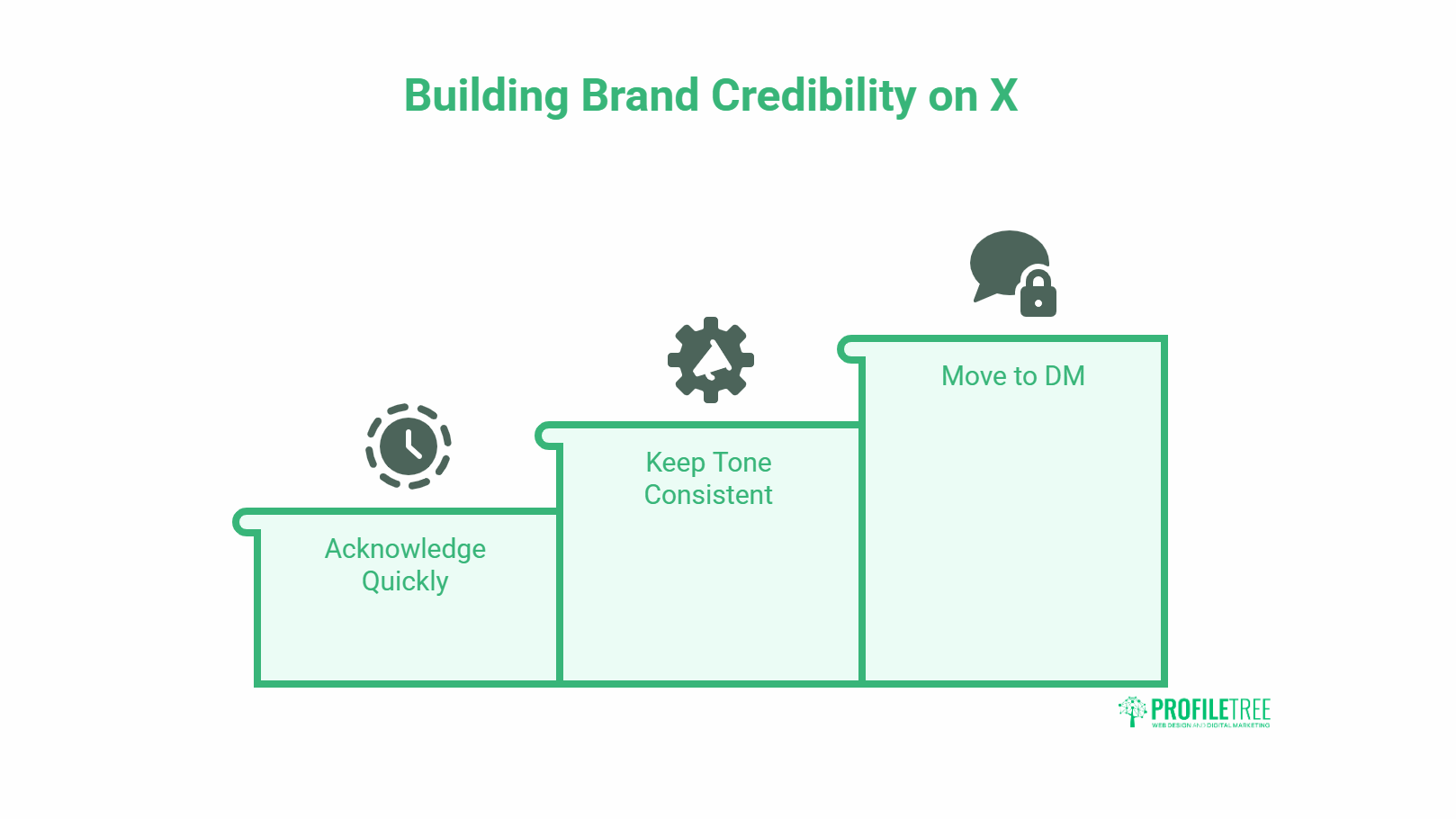
The way you respond to complaints is where brand credibility is built or damaged. The same principles apply regardless of your industry.
Acknowledge Quickly, Resolve Properly
Speed of acknowledgement matters more than speed of resolution. A customer who posts a complaint and receives a prompt “We’ve seen this and we’re looking into it” reply feels heard. A customer who posts and gets silence for several hours does not.
The acknowledgement does not need to promise a fix. It needs to confirm that a real person has read the message and is taking it seriously.
Keep the Tone Consistent
However you speak on your main feed, use the same tone for customer service interactions. If your brand voice is friendly and informal, a stiff corporate response to a complaint will feel jarring. The one useful adjustment is to increase warmth slightly when dealing with a frustrated customer, without abandoning your brand voice entirely.
Move Sensitive Conversations to DM
Public responses are good for demonstrating responsiveness. But some conversations need more space than a short post allows, and some details such as order numbers, account information, and personal data should never be shared publicly.
The standard approach is to reply publicly to acknowledge the issue, then direct the customer to DMs for resolution. Something like: “We’re sorry to hear this. Could you send us a DM with your order reference and we’ll get this sorted for you now?” This keeps the public record showing you responded, while moving the substantive conversation somewhere appropriate.
31% of business customer interactions on X now happen via DM rather than public posts, which suggests customers are increasingly comfortable using the private channel when it is made easy to access.
Using X’s Features Effectively for Customer Service
X has several features beyond basic replies that make customer service more efficient and engagement more consistent.
Direct Messages and X Chat
DMs on X now generate 1.2 billion messages per day. X Chat, launched as an encrypted DM replacement with video calling, has expanded what is possible in private conversations with customers. For higher-volume accounts, automated welcome messages and quick replies within DMs can reduce response time without replacing the human follow-up that actually resolves the issue.
If you enable the option to allow anyone to DM you, you make it easier for customers to reach out without posting publicly, which many customers prefer when raising sensitive issues.
X Spaces
X Spaces allows users to host live audio conversations, which businesses can use for Q&A sessions, product announcements, or industry discussions. X Spaces boosts session time by 9 minutes for live participants, making it a useful tool for deeper engagement than standard posts allow. For SMEs, a monthly Spaces session answering common customer questions can build genuine community and reduce repetitive support queries over time.
Communities
X Communities have grown to more than 840,000 active groups with a total of 126 million members in 2026, and generate 2.7 times more engagement than the general feed. For businesses with a defined niche or sector, creating or actively participating in a relevant community builds visibility with a targeted audience rather than broadcasting to a general feed.
Polls
Polls are an underused engagement tool. They take under a minute for a follower to complete and generate replies and reposts that a standard text post rarely does. Use them for light market research, product feedback, or to start a conversation about a topic your audience cares about. Keep poll questions specific; four concrete options perform better than vague general questions.
Building Engagement Beyond Customer Service
X’s value for brands goes beyond reactive support. The accounts that build genuine audiences use the platform to share useful content, join relevant conversations, and create a presence worth following.
Content That Works on X
Short-form video has surpassed text-based posts on X, with 37% of users most likely to interact with short-form video from brands. Videos shorter than 60 seconds perform best, and more than four out of five user sessions on X include video.
That said, text posts still outperform link posts significantly on engagement rate, so when sharing content from your site, the tweet promoting it should extract one concrete insight rather than just sharing the title and a link. Our content marketing services can help you build a content strategy that performs across channels consistently, not just one platform at a time.
Timing
Brands see the most engagement on Tuesdays, Wednesdays, and Thursdays, with 12 to 6 pm tending to be the most engaging hours. These are general benchmarks; your own analytics will give you a more accurate picture for your specific audience.
Hashtags
Posts with hashtags receive 21% more engagement than those without. One or two relevant hashtags per post is the practical limit. More than two starts to look like a reach for visibility. For most SMEs, industry-specific or location-specific hashtags will perform better than broad trending hashtags with millions of competing posts.
Joining Conversations
Replying to relevant conversations in your industry, not just to queries directed at you, builds visibility and positions your account as an active participant rather than a broadcast channel. Use X Search to find conversations around topics you can contribute to meaningfully. Replies that add nothing to a conversation are ignored, or come across as opportunistic.
Integrating X Into Your Wider Digital Strategy
X works best within a wider digital strategy rather than operating as a standalone effort. The content you produce, the service pages you want to drive traffic to, and the customer relationships you build through social should be pulling in the same direction.
A few practical integration points:
- Your website and X should reinforce each other. If a customer service conversation references a specific product or service, linking to the relevant page on your website gives them somewhere to go with more detail. A well-structured web presence makes that kind of cross-channel consistency straightforward. Our web design and development services cover the technical foundation that makes this possible.
- AI tools are changing how customer queries get handled. According to Zendesk’s Customer Experience Trends Report 2026, 71% of organisations now use digital channels primarily for first contact, including social media messaging. Automated first-response systems, sentiment analysis, and query routing are accessible to businesses of all sizes. If you are considering how AI could improve your customer service operations, our AI transformation services cover what is practical for SMEs at different stages.
- Track what is working. X’s native analytics provide data on impressions, engagement rate, and follower growth. For customer service specifically, track response time, resolution rate, and the volume of queries escalating to DMs versus those resolved publicly. Those numbers tell you more than follower counts do.
Measuring X Performance for Customer Service
Vanity metrics such as follower counts and likes matter less than operational metrics when assessing customer service performance.
The numbers worth tracking are:
- Average first response time: How long before a customer query receives a reply? The industry benchmark for top-performing brands is under one hour during business hours.
- Resolution rate: What percentage of queries raised on X are resolved without escalating to another channel?
- Sentiment trend: Are replies and mentions trending more positive or more negative over time?
- DM volume: Is the volume of private messages increasing? A rising DM proportion may indicate customers prefer to avoid public queries, which has implications for how you staff your monitoring.
- Post-interaction purchases: Sprout Social data shows that 34% of users bought a product after a positive brand experience on X, making this a commercially relevant metric to track alongside satisfaction scores.
X’s built-in analytics cover engagement and reach. For more detailed customer service metrics, a social media management tool with reporting capabilities will give you a cleaner view.
Twitter/X for Customer Service: FAQ
How quickly should a business respond to posts on X?
Customers expect responses within 15 minutes on X, and only 24% of businesses currently meet this expectation. For most SMEs, a realistic target is within one to two hours during business hours. The important thing is consistency: customers notice erratic response times more than a slightly slower but reliable standard.
Should you respond to negative posts publicly?
Yes. An initial public acknowledgement shows any observer that you take feedback seriously. Follow up with a DM to resolve the substance of the complaint privately. Never ignore negative public posts; silence reads as dismissal.
Is a dedicated X support account worth it for an SME?
For most SMEs, a single well-managed brand account is sufficient. A dedicated support handle makes more sense once query volume is high enough that support interactions would dominate the main timeline and confuse the brand feed.
What has changed with the Twitter to X rebrand for customer service?
The core customer service workflow has not changed. You still respond to public posts, move complex cases to DMs, and monitor brand mentions. The practical updates worth noting are the launch of X Chat as an encrypted DM system with video calling, the removal of the legacy blue check verification, and DMs now being open to non-followed accounts for Premium users.
Can X automation replace human customer service?
Automation can handle first responses, direct customers to relevant pages, and sort queries by type. It cannot replace the human judgement needed to resolve a complaint with nuance or handle a frustrated customer with genuine empathy. Use automation to improve speed of acknowledgement, not to avoid human engagement.
How do you handle abusive posts on X?
You are not obligated to engage with genuinely abusive content. Blocking or muting accounts that are abusive is appropriate. For complaints that are strongly worded but legitimate, maintain a professional tone and address the substance without matching the emotional level of the post.
Is X still worth using for SMEs in 2026?
Yes, for customer service and thought leadership specifically. 78% of businesses using X deploy it for customer service, and the platform’s user base of professionals, journalists, and decision-makers means that public interactions carry reputational weight. It requires consistent monitoring rather than high-volume posting to deliver value for most SMEs.