
AI Training Simulations: A Practical Guide for SMEs
Table of Contents
Most employee training programmes follow the same pattern. Someone builds a slide deck, books a room, and spends half a day walking a group through content they will largely forget within a week. It is not a criticism of the people running those sessions; it is a structural problem with passive learning. The information goes in, but without practice, pressure, and feedback, very little of it sticks.
AI simulations change that dynamic. Instead of watching content, employees practise in it. They handle a difficult client conversation, work through a compliance scenario, or respond to a leadership challenge, all inside a dynamic environment that adapts to what they do and say. For SMEs across Northern Ireland, Ireland, and the UK, this is no longer a technology reserved for large enterprise training departments. The tools are now accessible, costs have dropped, and the business case is increasingly straightforward.
This guide explains what AI simulations are, where they deliver results, how to implement them in a small or mid-sized business, and what to consider before choosing a provider.
What Are AI Simulations for Business Training?
An AI simulation is a training environment where the learner interacts with an AI-powered character, scenario, or system that responds dynamically to their input. Unlike traditional e-learning, where content follows a fixed path regardless of the learner’s actions, an AI simulation adapts in real time based on the learner’s decisions.
The technology behind most modern AI simulations centres on large language models (LLMs) and natural language processing (NLP). These systems can interpret what a learner says or types, assess the quality and appropriateness of the response, and generate a realistic reply that moves the scenario forward. The result is a training experience that feels closer to a real conversation than a test.
Generative AI vs. Traditional Branching Scenarios
Traditional branching scenarios offer a learner three or four pre-written choices at each decision point. They are better than linear e-learning, but the learner quickly realises the options are scripted. There is no genuine pressure, and no way to practise an unexpected situation.
Generative AI simulations remove the script. The learner responds in their own words, and the system interprets and reacts accordingly. A sales rep practising a difficult negotiation cannot choose from Option A, B, or C; they have to construct a real response, as they would with an actual client. That shift from selecting to constructing is where the learning value increases substantially.
| Feature | Traditional Branching | AI Simulations |
|---|---|---|
| Response type | Pre-set multiple choice | Open-ended, free text or speech |
| Adaptability | Fixed decision tree | Dynamic, responds to learner input |
| Feedback | Post-module summary | Real-time, contextual |
| Scalability | High, but static | High, with personalisation |
| Skill retention | Lower (passive selection) | Higher (active construction) |
| Setup cost | Lower | Moderate to higher |
Why SMEs Are Moving Towards AI Simulations
The case for AI simulations in larger organisations is well established. The more interesting question for most training managers at SMEs is whether the model works at a smaller scale, with limited budgets and without a dedicated L&D function.
The short answer is yes, provided the implementation is planned correctly.
Scaling Personalised Coaching Without the Headcount
One-to-one coaching produces the best learning outcomes. It is also expensive, time-intensive, and impossible to deliver consistently across a growing team. AI simulations approximate the personalised coaching experience at scale. Every employee works through scenarios at their own pace, receives feedback calibrated to their specific responses, and can repeat difficult situations as many times as needed without requiring a manager’s time.
For a professional services firm in Belfast with a growing team, running individual coaching sessions for every new starter across client communication, compliance, and technical procedures is not realistic. An AI simulation programme can deliver that practice layer without proportional cost increases as the team grows.
Reducing the Cost of Failure in High-Stakes Roles
Some roles carry real consequences for mistakes made during the learning curve. Customer-facing staff who handle complaints poorly, sales teams who misread a client’s concerns, or compliance officers who miss a regulatory flag; these are not abstract risks. AI simulations create a space where those mistakes can happen, be analysed, and be corrected before they occur in a live situation.
“The businesses we work with in Northern Ireland often tell us the same thing,” says Ciaran Connolly, founder of ProfileTree. “They cannot afford for training to happen on the job when the job involves real clients and real consequences. Simulation gives people the repetitions they need before it counts.”
Real-Time Feedback: Moving Beyond the Post-Training Assessment
The standard model of training assessment, a quiz at the end of a module, tells a learner whether they remembered information, not whether they can apply it. AI simulations assess performance continuously throughout the scenario. A sales simulation might track whether the learner identified the client’s key objection, whether they responded with empathy before moving to a solution, and whether they appropriately closed the conversation. That granular feedback arrives immediately, while the experience is fresh.
High-Impact Use Cases for SME Workforces
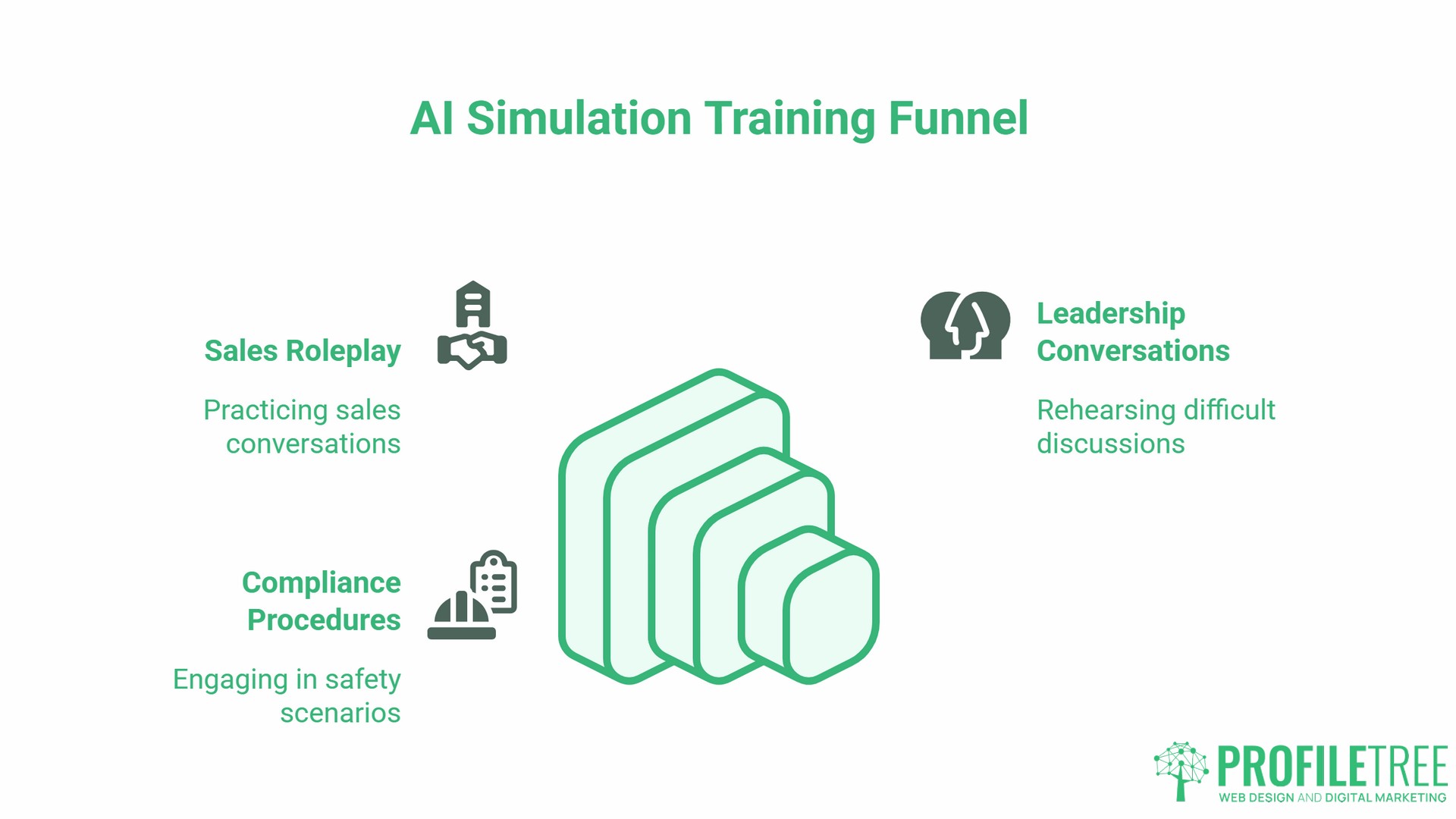
AI simulations work across a broad range of training contexts. These are the areas where SMEs in the UK and Ireland typically see the clearest return.
Sales and Negotiation Roleplay
Sales training is one of the strongest use cases for AI simulations. Roleplay with a manager is useful, but it is time-limited and inconsistent. An AI simulation can run an unlimited number of sales conversations, each with a different client persona, objection types, and emotional register. A new account executive can work through a high volume of simulated client conversations before taking a live call, building confidence and consistency that classroom training rarely produces.
For SMEs selling B2B services, which covers a large proportion of professional services, technology, and agency businesses across Ireland and Northern Ireland, this is a training gap that AI simulations close directly.
Leadership and Difficult Conversations
Soft skills training has historically been the hardest category to do well at scale. Role-playing a difficult performance review or a redundancy conversation in front of colleagues is uncomfortable in ways that undermine the learning. AI simulations remove that social pressure. A manager can practise delivering difficult feedback, navigating a conflict between team members, or handling a mental health disclosure, privately, repeatedly, and with detailed feedback on tone, structure, and empathy.
Compliance and Technical Safety Procedures
Compliance training is often the category most in need of improvement and least likely to receive investment. The content is typically dry, the assessments are easily gamed, and the retention rate is low. AI simulations can convert compliance scenarios into active decision-making exercises. A finance professional practising a suspicious transaction identification scenario, or a construction site manager working through a safety incident response, is significantly more engaged than someone clicking through a slide deck.
This matters particularly for UK-regulated sectors. FCA-regulated financial services firms, healthcare organisations operating under CQC standards, and businesses subject to the Health and Safety at Work Act all carry real liability when compliance training fails to translate into behaviour change.
The SME Roadmap: Implementing AI Simulations in Five Steps
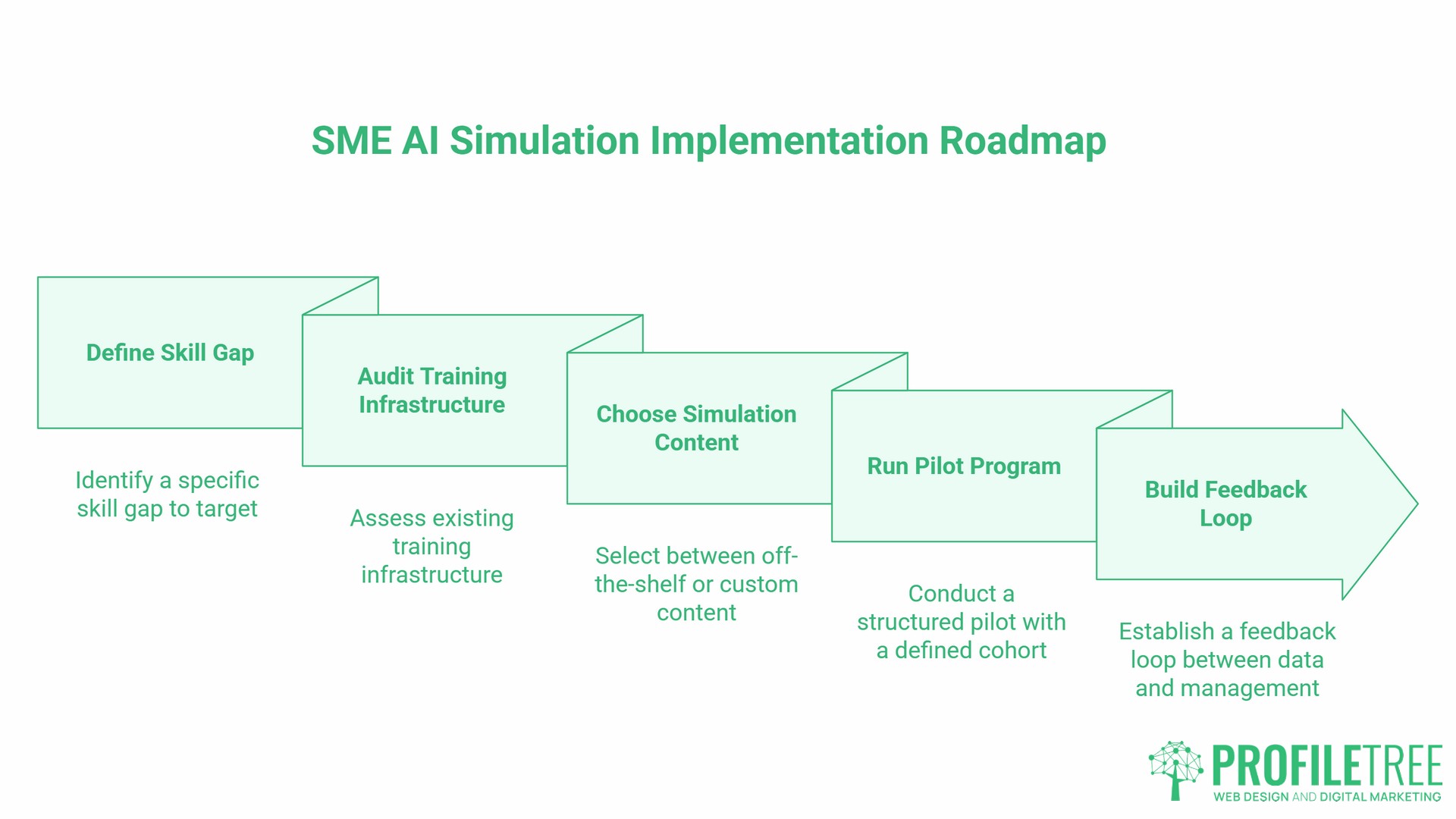
Most guides on AI simulations focus on why you should use them. This section focuses on how a small or mid-sized business actually goes from interest to a working pilot programme.
Step 1: Define the specific skill gap you are targeting. AI simulations work best when the scope is narrow. Do not begin with a plan to retrain the entire organisation. Pick one role, one skill gap, and one measurable outcome. A logistics firm in Dublin might start with new driver induction and compliance. A software company in Belfast might begin by handling sales objections for a new product line.
Step 2: Audit your existing training infrastructure. Before selecting a simulation platform, establish what you already have. Do you use a learning management system (LMS)? If so, does it support xAPI (Tin Can), which is the protocol most AI simulation platforms use to pass data back to your LMS? If your current LMS does not support xAPI, you may need to upgrade or replace it before a simulation platform can be integrated cleanly. ProfileTree’s web development team has worked with SMEs on technical readiness assessments before training technology rollouts of this kind.
Step 3: Choose between off-the-shelf and custom simulation content. Off-the-shelf AI simulation tools come with pre-built scenario libraries covering common training categories: customer service, compliance, and management skills. These can be deployed quickly and are appropriate for businesses that want to test the format without a large upfront investment. Custom simulations are built around your specific products, processes, and client types. They take longer to develop and cost more, but the specificity produces significantly better results for roles where generic scenarios are a poor fit.
Step 4: Run a structured pilot with a defined cohort. Start with a manageable group rather than a company-wide rollout. Set clear metrics before the pilot begins: completion rate, improvement in assessment scores, manager observation ratings, or a behavioural measure specific to the skill you are training. Give the pilot enough time to generate meaningful data before drawing conclusions, then use those findings to build the case for a wider rollout.
Step 5: Build the feedback loop between simulation data and management. The most underused element of AI simulation platforms is the analytics dashboard. Every interaction generates data: response quality scores, common failure points, and areas where learners consistently struggle. That information should flow to line managers and L&D leads so training can be adjusted in real time. This is not a passive reporting function; it is the mechanism that makes simulation-based training continuously improve.
ProfileTree’s AI implementation service supports SMEs through this process, from initial scoping and infrastructure assessment through to platform selection, content briefing, and ongoing optimisation.
GDPR and Data Privacy: What UK and Irish SMEs Need to Know
This is the area that global competitors in the AI simulation space most consistently underserve. Enterprise vendors assume their customers have legal teams to handle data compliance. SMEs typically do not.
Employee Data Sovereignty
AI simulations collect detailed behavioural data about employees: how they respond under pressure, where they make errors, and how quickly they improve. Under UK GDPR and the Irish Data Protection Commission’s guidelines, this constitutes personal data and, in many contexts, sensitive personal data. Before deploying any AI simulation platform, a business must establish where the data is stored, who has access to it, how long it is retained, and the legal basis for processing it.
The key questions to ask any AI simulation provider before signing a contract include: where are your servers located, do you offer a UK or EU-hosted data option, what is your data retention policy, and can you provide a Data Processing Agreement that meets ICO requirements.
The UK AI Safety Framework
The UK government’s AI Safety Institute has produced guidance on the responsible deployment of AI systems in workplace contexts. While this guidance does not yet carry the force of regulation, forward-thinking HR and L&D teams are beginning to build it into their procurement criteria. For SMEs, the practical implication is straightforward: choose platforms that demonstrate transparency into how their AI models make decisions and offer human oversight mechanisms rather than fully automated assessments.
How to Evaluate AI Simulation Providers
The market for AI simulation tools is growing quickly, and not all platforms are equal. These are the practical criteria that matter for SMEs.
Integration with Your Existing LMS
If your LMS does not support xAPI, investigate whether the simulation platform offers a standalone reporting dashboard or whether you will need to replace or supplement your LMS. Some platforms operate entirely independently of an LMS, which simplifies deployment but reduces visibility for managers who want training data alongside other HR metrics.
Total Cost of Ownership vs. Return on Investment
AI simulation platforms typically charge per seat, per module, or on a platform licence model. Per-seat pricing suits smaller cohorts; platform licences become cost-effective at scale. When calculating ROI, include the cost of the time your managers currently spend on manual roleplay and coaching, the cost of errors made by undertrained employees in live situations, and the cost of compliance failures. For most SMEs, the business case becomes clear once these hidden costs are made explicit.
ProfileTree’s digital training service helps SMEs assess which platforms fit their technical environment, budget, and training objectives before making a procurement decision.
Embedding AI Simulations Within a Broader Digital Training Strategy
AI simulations do not sit in isolation. They work best as part of a broader workforce development approach that includes structured content, manager-led feedback, and ongoing digital skills development.
For SMEs with limited internal L&D resources, ProfileTree’s digital training programmes provide a strategic framework for integrating simulation tools. That includes helping businesses identify which roles and skill gaps are best suited to simulation, which require different interventions, and how to measure the overall impact of a training investment.
Video content also plays a significant supporting role in simulation-based training programmes. Explainer videos that introduce a scenario context, demonstrate expected behaviours, or debrief a difficult simulation sequence improve learner preparation and retention. ProfileTree’s video production team has developed instructional and training support content for businesses across Northern Ireland and Ireland.
For SMEs in Northern Ireland, Ireland, and the UK exploring AI simulations as part of a wider workforce development strategy, ProfileTree’s digital training and AI implementation services provide the practical guidance to move from research to results.
Frequently Asked Questions
What is the difference between AI simulations and VR training?
These are separate technologies that are often confused. Virtual reality is a hardware and visual experience that places the learner inside a three-dimensional environment using a headset. AI simulations refer to the intelligence layer that drives the scenario: the system that interprets learner responses and generates realistic reactions. AI simulations run on a laptop or tablet without a headset. VR and AI can be combined, but most business training AI simulations require no specialist hardware.
Do I need a large internal dataset to deploy AI simulations?
No. Modern AI simulation platforms use pre-trained large language models that already understand natural language, professional communication patterns, and common business scenarios. What you typically provide is your specific business context: your products, your typical client types, your compliance requirements, and your terminology. That is a brief and a playbook, not a data engineering project.
How long does it take to deploy an AI simulation programme?
Off-the-shelf simulation tools can be configured and deployed relatively quickly for a pilot group. Custom-built simulations, which are designed around your specific business context, take longer to develop because of the content design and testing process. The timescale reflects the work involved in building realistic, relevant scenarios rather than technical implementation complexity.
Are AI simulations GDPR compliant?
The simulation platform itself does not determine compliance; how you configure and deploy it does. Responsible implementation requires a Data Processing Agreement with the provider, clarity on data storage location, a defined retention policy, and a legal basis for processing employee behavioural data. Platforms that offer UK or EU-hosted data options and provide Privacy by Design documentation are the safer choice for UK and Irish businesses.
Will AI simulations replace human trainers?
No. AI simulations automate the repetitive practice layer of training: the roleplay, the scenario repetition, and the consistent feedback at scale. They free human trainers and managers to focus on the areas where human judgment, relationships, and culture-building genuinely matter. Most organisations that deploy AI simulations find that their trainers become more effective because they can spend their time on the coaching conversations that require real human insight.
How do I measure the effectiveness of AI simulation training?
The most reliable measures combine simulation platform data, response quality scores, scenario completion rates, improvement over repeated attempts, with downstream behavioural indicators such as sales conversion rates, compliance audit results, customer satisfaction scores, and manager assessment ratings. Set your success metrics before the pilot begins so the data you collect is aligned to the outcomes your business actually cares about.