
Social Media Bullying Statistics and the Real Scale of Cyberbullying
Table of Contents
Social media bullying statistics look harder and more tangled in 2026 than most people expect. What started as name-calling on early networks has grown into a cross-platform problem that pulls in AI-generated images, coordinated harassment from automated accounts, and workplace abuse that follows people home from LinkedIn.
These figures reach children, teenagers and adults alike, with effects that run from dropping grades to serious mental health harm. The numbers also sit inside a shifting legal picture, especially across the UK and Ireland, where new duties now shape how platforms respond.
This guide sets out where the data stands, why AI has changed the threat, how well platforms actually act on reports, what UK and Irish law now requires, and the safeguarding steps that make a measurable difference for families, schools and businesses.
The Current Scale of Social Media Bullying Statistics
Social media bullying statistics point to a problem that is widespread rather than rare, and one that grows with age as young people open more accounts across more platforms. The headline pattern is steady across research: a large minority of children report some experience of online abuse, most often verbal, and adults are increasingly affected too.
Before the platform-by-platform detail, it helps to hold three points in mind. Abuse is common but under-reported. It concentrates where the reach is fastest. And time spent online is closely tied to exposure.
Prevalence Among Children and Young People
Survey research puts the share of children aged 10 to 18 who have faced some form of cyberbullying at roughly one in five, with higher self-reported rates in teen-only samples. Name-calling is the most common form, reported by around a third of teenagers, according to the Pew Research Centre.
The real total is almost certainly higher, because most incidents never reach a formal report. Schools and parents tend to see only the cases that escalate. Data on social media education shows how quickly usage patterns among school-age children have shifted, which matters for anyone planning safeguarding. Risk is not spread evenly either: research consistently finds higher rates of online abuse among LGBTQ+ young people, more appearance-based harassment aimed at girls, and more gaming-linked abuse reported by boys. Targeted support tends to work better than a single blanket policy. For businesses managing public-facing accounts, our social media marketing team can also help maintain clear moderation processes and appropriate responses when harmful interactions appear.
The Screen Time Connection
More hours online mean more contact with both peers and strangers, and fewer natural breaks from a device. During the pandemic, children spent far longer on screens than before, and reported cyberbullying rose sharply over the same period. The link is not purely coincidental: sustained, unstructured use raises the odds of meeting harassment and removes the recovery time an offline evening once gave.
The wider picture on screen time statistics helps explain why device habits belong in any safety conversation, not just content controls.
Which Platforms See the Most Abuse
Cyberbullying happens on every network, but it clusters where content spreads fastest and where anonymous accounts face the least friction. The type of abuse shifts by environment, so a single figure hides more than it reveals.
| Platform | Common harassment pattern |
|---|---|
| TikTok | Rapid algorithmic amplification of hostile comments to large audiences |
| Appearance-based abuse: direct messages that are harder to monitor | |
| X (Twitter) | Coordinated pile-ons, quote-post abuse and repeat targeting |
| Snapchat | Disappearing content makes evidence harder to keep |
| Group-based targeting across a wide age range | |
| A growing, and often overlooked, workplace harassment route |
Anonymity sits behind much of this. When a person can open a throwaway account, the social checks that exist offline fall away. For businesses running video campaigns, comment moderation and community handling are part of responsible channel management, as ProfileTree’s TikTok statistics data shows for UK audiences.
AI-Generated Harassment and the 2026 Threat Picture
The change that demands the most attention in 2026 is artificial intelligence. Bad actors no longer need technical skill to run a convincing harassment campaign. Free image tools and voice cloning have altered what abuse looks like, and the data is only starting to catch up with the shift.
Three vectors stand out this year: fabricated imagery, cloned audio, and automated accounts acting at scale. Each raises different questions for parents, schools and brands.
Deepfakes and Non-consensual Imagery
Older cyberbullying relied on real photos or written rumours. Today, a single public profile picture can be enough to generate fabricated imagery in seconds. Volumes of malicious deepfakes circulating on social platforms have risen steeply over the past two years, and educators increasingly report intercepting AI-altered images used to mock or defame pupils.
The harm is distinct. Fabricated media can travel across feeds faster than any correction, and victims describe a particular sense of powerlessness. Much of it goes unreported, since the content is often already seen before anyone acts. Part of what makes fabricated media so damaging is permanence: once an image or clip circulates, a victim can never be certain it has been fully removed, which stretches the distress well beyond the original incident. Tools that flag manipulated media are improving, and ProfileTree’s guide to AI content detection covers what to look for.
Voice Cloning and Audio Abuse
Beyond images, voice cloning has opened a route in audio-first spaces such as group chats, gaming servers and short-form clips. A few seconds of audio scraped from a public post can be turned into fake speech that damages a reputation or frightens a target. Reports of cloned-voice harassment in gaming communities have climbed since late 2024.
For organisations, the same AI that supports content production is being misused in ways that touch brand safety and staff wellbeing. Responsible adoption matters, which is why ProfileTree’s work on AI transformation pairs productivity gains with clear guidance on misuse.
Automated Accounts and Pile-ons
A rising share of coordinated harassment now involves automated account networks rather than single people. These accounts flood a target’s replies with synchronised abuse, creating a false impression of mass hostility and slipping past simple rate limits. The result feels overwhelming to the person on the receiving end, even when few real humans are involved.
Businesses weighing how automated systems affect their public presence can start with ProfileTree’s guidance on AI chatbots, which sets out where automation helps and where it needs human oversight.
Platform Accountability and the Reporting Gap
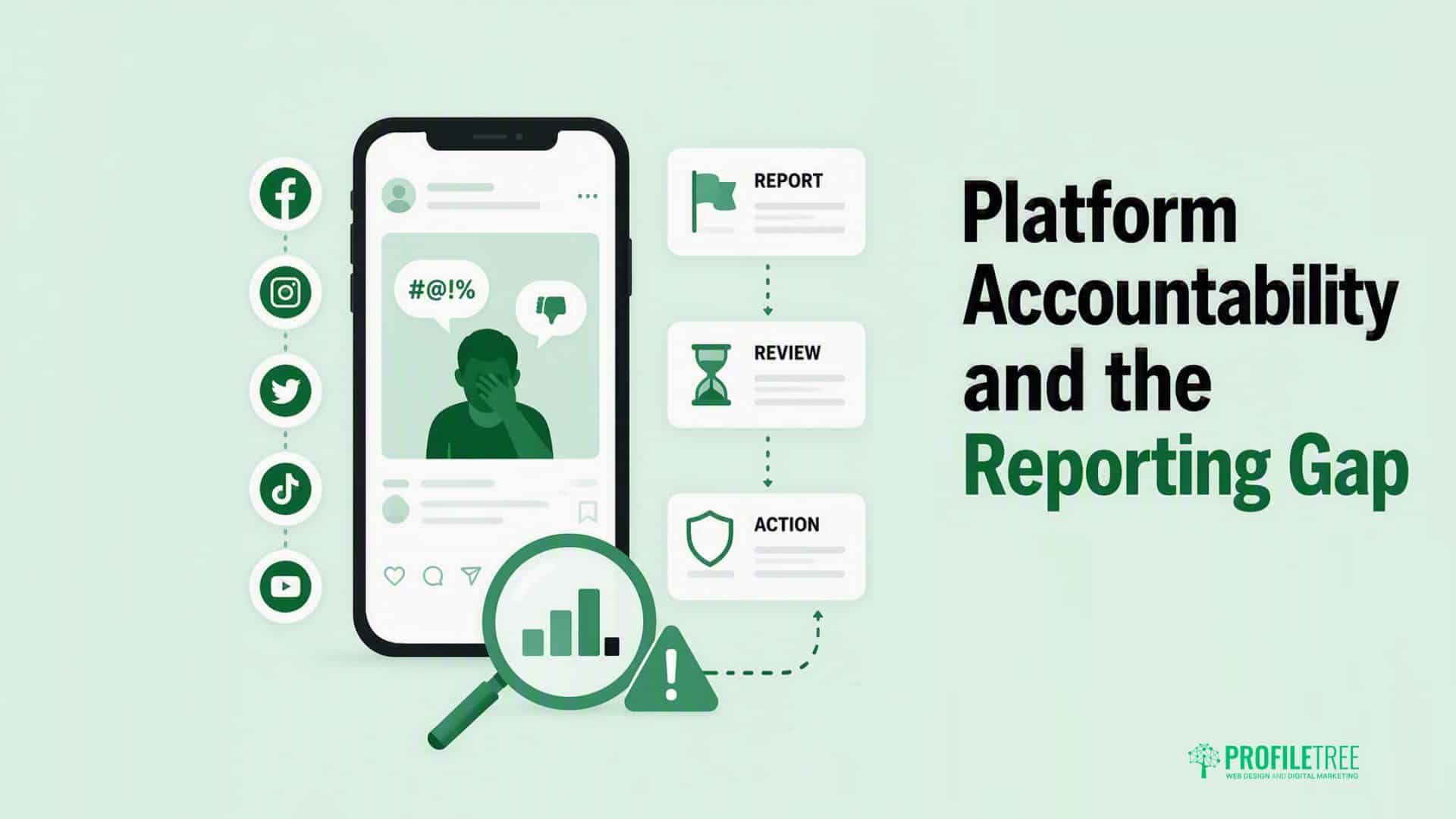
One of the steadiest findings across social media bullying statistics is the gap between what platforms promise and what victims experience. Understanding that gap matters for parents setting rules, employers writing policy, and any brand building audience trust over time.
The pattern breaks into three parts: how fast platforms respond, why so few people report at all, and how unevenly moderation works across regions.
How Quickly Platforms Respond
Despite automated flagging and stated standards, human review of serious reports can take many hours, and sometimes more than a day. During that window, the harmful content stays visible and keeps spreading. For fast-moving abuse, delay is not a minor detail; it is the difference between containment and wide exposure. Automated filters catch a share of obvious abuse at once, but context-dependent cases such as sarcasm, coded language or edited media still need a person to judge them, and that is where the wait builds.
Brands that depend on trust should treat moderation speed as a real risk factor. ProfileTree’s review of reputation management data shows how quickly unmanaged content can shape public perception.
Why Most Abuse Goes Unreported
The majority of victims never file a formal report, most often because they doubt anything will change. That reporting gap means official platform figures understate the true scale by a wide margin. It also means the visible statistics are the tip of a much larger problem. Fear of retaliation, embarrassment, and a belief that reporting simply will not help all play a part, and younger users in particular often assume nothing will change if they speak up.
Community handling can reduce the friction that stops people from speaking up. ProfileTree’s data on community management points to clear, trusted reporting routes as one of the strongest protective factors.
Uneven Moderation Across Regions
Moderation quality is far from uniform. In several markets across the Middle East, North Africa and Asia Pacific, reports have climbed while resolution rates lag behind Western markets, partly because systems struggle with local dialects and context. That imbalance leaves whole regions with weaker protection even as usage grows.
For any business making platform and hosting decisions that involve user-generated content, this disparity is worth factoring in. Sound website development choices can build in the moderation controls a public-facing site needs from the start.
The UK and Ireland Picture: Law, Work and Wellbeing
Most top-ranking content on this topic is heavily US-focused. The picture across the UK and Ireland is different, shaped by newer duties on platforms and by a growing recognition that abuse does not stop at 18. This regional detail is where the practical answers live.
Three threads matter here: the law now in force, the rise of workplace abuse, and the health effects that give the statistics their weight.
The Online Safety Act and Ofcom
The UK’s Online Safety Act 2023 placed new duties on platforms to assess and reduce the risk of illegal and harmful content, with Ofcom as the regulator overseeing compliance. Ireland has moved in parallel through its own online safety framework and media regulator. Together, these regimes have started to shift the burden from individual users towards the platforms that host the content.
The Act requires larger services to assess risk, act against illegal material such as threats and harassment, and give users tools to control who can contact them. Ofcom can order changes and impose penalties for failure to comply. In Ireland, Coimisiun na Meán oversees a similar framework under the Online Safety and Media Regulation Act, with binding codes for how platforms deal with harmful content.
The effect on reporting behaviour and platform response is still being measured, but the direction is clear: accountability is becoming a legal question as much as a moral one. Belfast and other Northern Ireland cities host a fast-growing base of digital-first businesses that now sit within these duties. A sound digital strategy should account for them.
Adult and Workplace Cyberbullying
Around one in three adults reports targeted harassment on professional or social platforms within a year, and most organisations are behind on it. LinkedIn pile-ons, group-chat abuse and anonymous review platforms are all documented routes, yet many workplace policies still cover only email and internal systems.
Employers should widen harassment and dignity-at-work policies to name social platforms directly, set a clear reporting process, and train managers to record digital evidence. ProfileTree’s analysis of LinkedIn for business shows why professional networks now demand the same duty of care as any other channel.
Under UK law, sustained abuse can fall within the Protection from Harassment Act and an employer’s health and safety duties, so leaving it unaddressed carries legal risk as well as reputational cost. The impact also shows in lost productivity and absence when staff are targeted, which is one reason dignity-at-work policies increasingly treat digital abuse as a business risk, not a private matter.
Mental Health and Physical Effects
The impact reaches well past the numbers. Victims commonly report anxiety, low mood and diminished self-worth, and severe, sustained abuse is linked in clinical research to a higher risk of self-harm and suicidal thoughts. Unlike playground bullying, online abuse follows a person into every space where they hold a phone.
Physical effects follow, too, from disrupted sleep to headaches driven by chronic stress. Anyone affected can find support and referral routes through NHS mental health services. The connection between platforms and well-being also shows up in ProfileTree’s data on self-esteem statistics.
Safeguarding and Responsible Digital Strategy
The aggregate figures are grim, yet the research also points to steps that work. Effective responses act at several levels at once: the individual, the family, the institution and the platform. No single measure is enough on its own.
The practical guidance below is split by audience, since a parent, a school and an employer each need a different first move.
Practical Steps for Parents and Schools
Parental involvement is one of the strongest protective factors. Children who can talk openly with a trusted adult are more likely to report abuse early and recover faster, so the single most useful habit a family can build is a calm, regular conversation about online life rather than a one-off warning. The first practical steps are to screenshot and keep evidence, report the content through the platform’s own tools, and contact the school when classmates are involved.
When keeping evidence, record the username, the date and time, the platform and the full web address of each post, and capture screenshots before blocking, since blocking can hide the content from view. A dated evidence log makes any later report to a school, an employer or the police far easier to act on.
Schools do best with clear reporting routes, a named lead for cyberbullying cases, and staff trained to spot the signs, not just the designated safeguarding leads. Structured digital training for staff and pupils gives everyone the same baseline.
Digital self-defence for every age
Prevention works best as a mix of technical controls and habits. Set accounts to private and review follower requests. Switch on comment filters to screen offensive language automatically. Use block and mute features early rather than after an incident, and audit privacy settings each quarter.
Knowing the reporting route for each platform before anything happens saves time under stress. For threats or content that may be criminal, reports can go to the police on 101, or 999 in an emergency. Keeping the evidence log to hand speeds any of these up. These habits sit naturally alongside a considered approach to social media marketing, where safe, well-moderated channels protect both people and brands.
What Responsible Organisations Should Do
For businesses, the duty runs beyond safeguarding into brand safety and staff care. Update policies to name digital platforms, define what workplace cyberbullying is, and give managers a clear escalation path. Build moderation and clear community rules into any channel that carries public comments.
How a brand appears in these spaces, and how its team responds when problems arise, is a strategic question as much as a technical one. ProfileTree’s approach to SEO services and content marketing treats audience trust as the asset it is.
Training helps most when it is regular rather than a one-off induction, so staff keep pace with new tactics as they appear. Building clear community rules and visible moderation into a channel from the start is far easier than adding them after an incident has already done the damage.
“We see this directly in the digital environments businesses build online. The same systems that amplify good content amplify harmful content just as efficiently. That is why responsible digital strategy means understanding the risks, not just the reach.” Ciaran Connolly, founder of ProfileTree, Belfast.
Where the Data Leaves Us
Social media bullying statistics describe a problem that is broad, under-reported and changing shape as AI tools spread. The clearest gains come from earlier reporting, faster platform action, stronger law, and habits that reduce exposure. For families, schools and businesses alike, the useful response is practical: keep evidence, use the tools, know the law, and build safer digital spaces by design.
Ready to build a safer, better-managed online presence? ProfileTree helps businesses across Northern Ireland, Ireland and the UK with responsible digital marketing and strategy. Talk to the team about protecting your brand and your people online.
FAQs
What Percentage of Young People Experience Social Media Bullying?
Roughly one in five children aged 10 to 18 has faced some form of cyberbullying, with higher rates in teen-only samples. Name-calling is the most common form, reported by around a third of teenagers. The true figure is likely higher because most cases go unreported.
Which Social Media Platform has the Most Cyberbullying?
No single platform dominates, but TikTok, Instagram, YouTube and Snapchat feature most often. TikTok’s reach amplifies abuse quickly, while Snapchat’s disappearing content makes evidence harder to keep.
Is Cyberbullying a Crime in the UK?
There is no single offence called cyberbullying, but behaviour can breach laws such as the Malicious Communications Act and the Communications Act, and the Online Safety Act 2023 places new duties on platforms. Serious cases can be reported to the police.
How has AI Changed Social Media Bullying?
AI is the fastest-growing factor. It enables deepfake images made from public photos, cloned-voice audio, and automated accounts that flood a target with coordinated abuse.
What is the Link Between Screen Time and Social Media Bullying?
More time online raises exposure to potential abuse and removes natural breaks from devices. Reported incidents rose sharply during periods when children spent far longer on screens.