
How to Find the Best Web Design Agency in the UK
Table of Contents
Choosing a web design agency in the UK means separating genuine technical partners from template shops, and the criteria matter more than most business owners expect. Hundreds of firms offer professional web design services, so the gap between a site that earns enquiries and one that quietly costs money usually comes down to how you evaluate agencies before signing anything.
The demand is real. Searches for a professional web design company, trusted website designers and a professional web design agency all circle the same worry: how do you tell the strong providers from the rest?
This guide covers what a professional agency should deliver, how to judge one on portfolio and reviews, what fair UK pricing looks like, the questions and warning signs that reveal quality, and how to build for AI search and long-term support.
What a Professional Web Design Agency Should Deliver
Not every firm offering professional web design services works to the same standard. The ones worth your budget ask about your business goals before they talk about colours, show evidence of real outcomes, and treat search performance as part of the brief rather than an add-on. Three qualities tend to separate them from the rest.
Design and Performance Built Together
A professionally designed website does several jobs at once. It builds credibility in the first few seconds, guides visitors toward the actions that matter to your business, and ranks well enough to bring in traffic without constant paid advertising. When looks are treated as the whole job, the other two usually suffer.
According to Ciaran Connolly, founder of ProfileTree: “Most SMEs come to us after a disappointing experience elsewhere. The previous agency focused entirely on how the site looked and gave no thought to how it would perform on Google or what would happen to conversions. Design and performance have to be built together from day one.”
SEO and Technical Foundations From Day One
That principle sits at the centre of how a strong team works, and it shapes the technical decisions taken before a single page is designed. URL structure, heading hierarchy, page speed and internal linking are all set during the build, not retrofitted afterward. ProfileTree, a Belfast-based agency, integrates on-page search work from the discovery stage, so architecture supports ranking rather than fighting it. Its web design services start with business outcomes, not visual preferences.
This matters because search work is far cheaper to build in than to bolt on. Reworking a finished site for speed, structure and mobile performance can cost as much as parts of the original build. Setting those foundations during design means the site launches ready to compete, rather than needing a second project six months later to fix what was skipped.
What Separates Trusted Website Designers From Template Shops
The difference shows up in the questions an agency asks you. Trusted website designers want to understand your customers, your enquiry process and your growth targets, and they say so in plain terms rather than jargon. A template shop asks for your logo and a colour you like. The first group builds something that keeps working after launch; the second hands over a site that looks tidy and does little else.
ProfileTree has completed more than 1,000 web projects for businesses across Northern Ireland, Ireland and the UK since 2011. That spread across sectors shapes how the team reads a brief, and it is worth seeing how a build actually comes together before you commit.
One quick test cuts through most sales talk. Ask an agency to walk you through a recent project and explain why they made specific choices, from the page layout to the way the enquiry form works. A team that designs with intent can give you clear reasons. A template shop tends to fall back on taste because there was no strategy behind the decisions in the first place.
How to Judge a Web Design Agency Before You Commit
Marketing pages all sound similar, so the evaluation has to rest on evidence rather than promises. Three areas tell you most of what you need to know: the work an agency has already shipped, what past clients say once the project is over, and whether the team can hold a technical conversation.
Portfolio Quality and Real Results
Past work is the most honest signal you have. Look for variety across industries, then look harder at whether those sites actually perform. A polished site that ranks poorly or converts at a low rate tells you the agency values appearance over results.
Ask direct questions. Do these sites load quickly? Are they built for mobile first? Can the agency share any performance data from past projects, even anonymised? Vague answers here usually mean vague outcomes later.
Check the live sites yourself, not just the screenshots. Open two or three examples on your phone, run them through a free speed test, and see whether the pages still exist and load properly. Some portfolios feature designs that were never launched or have since been rebuilt by someone else, so a working live link is worth more than a polished case study slide.
Verified Reviews and Client Retention
Reviews describe the relationship, not just the deliverable. A strong portfolio paired with patchy reviews is a warning sign. Watch for patterns in what clients mention: were timelines met, was communication clear, and what happened after the site went live?
Independent review sources carry more weight than testimonials on an agency’s own site. A rating built from real client feedback reflects the ongoing relationship, which matters because a website is never finished on launch day.
Client retention is a signal in its own right. If an agency keeps clients for years and can point to accounts it still supports, that says more than any single testimonial. Short, transactional relationships often mean the site was handed over and forgotten, which is rarely what a growing business needs.
Technical Capability and Accessibility
Professional web design services now demand real technical depth. An agency should be able to talk about page speed, Core Web Vitals and how the site will be maintained over time. If the conversation never leaves the visual layer, that team may not be equipped to build something that holds up in search.
Accessibility belongs in the same conversation. UK agencies should be building to the WCAG 2.2 standard, which affects colour contrast, keyboard navigation and screen-reader support, and which carries legal weight for many organisations. ProfileTree covers this in detail in its guide to website accessibility, and it is a fair test of an agency’s web design skills.
Web Design Pricing in the UK: What You Should Expect to Pay
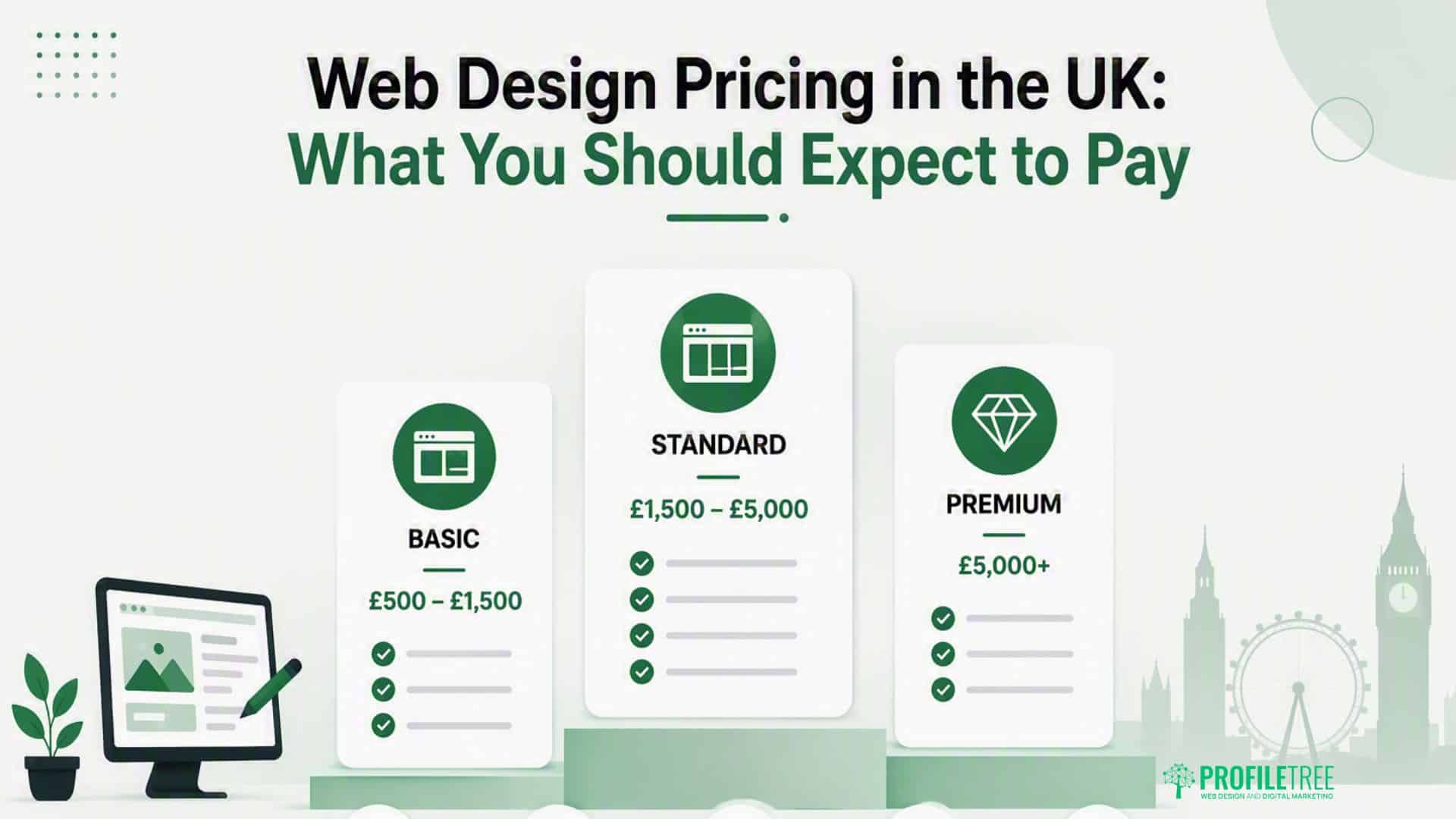
Price is where confusion does the most damage, because the cheapest quote often hides the highest long-term cost. UK web design pricing varies widely by scope, region, and the depth of work included. The tiers below give a realistic picture of what different budgets buy.
Typical Project Tiers and Budgets
A basic brochure site usually runs from £1,500 to £4,000 and covers design, a simple content system and mobile responsiveness. A lead generation site with search setup, content and conversion work typically sits between £5,000 and £15,000. Enterprise and e-commerce builds can run from £20,000 to £100,000 or more, depending on integrations and functionality.
Match the tier to the job rather than the ambition. A local service business that mainly needs to be found and to take enquiries rarely needs an enterprise budget. A retailer moving serious volume online cannot get by on a brochure build. Being honest about which bracket you sit in keeps the conversation grounded and stops an agency from selling you more than the work requires.
Region plays into this, too. A capable team outside the capital can often deliver the mid-range brief at a lower rate without cutting corners, which is one reason so many UK businesses now look beyond London for their build. The right question is not where an agency sits on a map, but whether it can show the results you are paying for.
All prices and figures in this guide are indicative UK examples and correct at the time of writing; use them as a benchmark rather than fixed quotations.
The London Premium Versus Regional Value
Location affects the bill. London agencies often charge around 30 per cent more than equally capable teams in regional hubs such as Belfast, Manchester and Leeds. The name on the door does not always buy better results, and a regional team with strong technical depth frequently delivers better value and closer attention. Belfast in particular has a growing digital sector, and there is plenty to like about the region beyond its cities and coastline.
Hidden Costs and What a Low Quote Leaves Out
The danger at the bottom of the market is not the headline price; it is what gets left out. If an agency quotes £800 for a complete website, ask in writing exactly what that covers and what year two looks like. Hosting, updates, security patches and ongoing search work all carry costs, and a professional team is open about them upfront. The same transparency applies to web development beyond the initial design.
Picture year two. Plugins need updating, the content system needs patching, and small changes crop up as the business shifts. A quote that covers only the build, with no plan for what follows, tends to become a series of awkward invoices later. Ask for the ongoing figure in writing so you can compare like with like across your shortlist.
The Questions and Warning Signs That Reveal the Right Agency
Once you have a shortlist, the discovery call does the heavy lifting. A good agency welcomes hard questions; a weak one deflects them. Knowing what to ask and which answers should worry you turns a sales pitch into a useful assessment.
Five Questions to Ask on the Discovery Call
Keep the questions specific. Can you show three sites you have built, and can I speak with those clients? How do you approach search during design and development? Who is my point of contact, and what does communication look like week to week? What happens after launch with updates, hosting and security? What content management system will my site use, and can I update it myself?
The answers reveal more than any portfolio. An agency that treats SEO services as part of the build, rather than a later upsell, is usually the safer choice.
Add two more to the list before the call ends. How does the agency handle changes in scope or extra requests mid-project, and what does that cost? And who owns the relationship if your main contact leaves? Clear answers to awkward questions early tend to predict a smoother project once the work is underway.
Ownership of Code, Domain and Content
Ownership is a common trap. Confirm in writing, before signing, that the code, design assets and domain transfer to you on completion. Some agencies build on proprietary systems that lock you in, so moving away later means starting over. If a team hesitates on this point, treat it as a red flag rather than a detail.
Warning Signs During the Pitch
A few patterns are worth spotting early. The agency talks only about aesthetics and never mentions speed, performance or search. Timelines are vague or impossible to estimate. The portfolio looks polished, but loads slowly. After-launch support is missing from the proposal. Pricing is unusually low with no clear explanation of what is excluded. Any one of these deserves a direct question before you commit. Trust your read of the conversation as well. If a team is evasive or rushes you toward a signature, that instinct is usually worth listening to, because the pitch is the most attentive an agency will ever be.
Building for AI Search and Long-Term Support
A site built for how search worked five years ago will not hold up. AI-driven results, from Google’s AI Overviews to assistants such as ChatGPT and Perplexity, now shape how customers find services. The agency you choose should design for that shift and stay involved long after launch.
Designing for AI-Driven Search
AI systems favour clear structure, self-contained answers and genuine information gain. That means clean markup, content organised around real questions, and structured data that matches what visitors actually see. An agency that understands this builds pages that can be cited in AI answers, not just listed in traditional results. Pages that answer a real question in the first line, cover several related sub-questions, and back claims with specific figures are the ones these systems tend to quote, so it is worth asking how an agency approaches content structure as well as design. ProfileTree explores the balance between automation and craft in its look at AI web design.
Post-Launch Maintenance and Support
Your website is not a one-off purchase. Search algorithms shift, security issues appear, and your business needs change. Ask how the agency handles updates, how quickly problems get resolved, and what a support agreement includes. Many businesses only notice the gap here after something breaks, so settle the terms before you sign.
Look for the detail, not just the promise of support. A proper agreement sets out response times, what counts as an emergency, how updates are scheduled, and what sits inside the monthly fee versus what is billed separately. Written terms protect both sides and remove the guesswork on the day something actually goes wrong.
In-House Search and Skills That Keep the Site Working
Choosing an agency with in-house search capability removes the handoff friction that causes so many sites to stall after launch. Some teams also help you build internal capability, so your staff can manage day-to-day updates. ProfileTree delivers digital training through Future Business Academy alongside the external support it provides, which suits SMEs that want to keep more control over their own site.
Conclusion
The right web design agency treats your site as an asset that should return more than it costs. Define your goals first, judge agencies on evidence rather than promises, expect transparency on price and ownership, and choose a team that builds for search, and pick one that stays involved once the site is live. For businesses across Northern Ireland, Ireland and the UK ready to move beyond template sites, it is worth having that conversation. Talk to ProfileTree about a site built to perform.
FAQs
How do I find the best web design agency in the UK?
Start by defining your goals and budget, then shortlist agencies on three signals: a portfolio of sites that genuinely perform, verified independent reviews, and whether search work is built into the process rather than sold separately. Speak to two or three past clients at a similar project scale before you decide.
How much does professional web design cost in the UK?
A basic brochure site typically starts from £1,500, a lead generation site from a professional web design company usually runs between £5,000 and £15,000, and enterprise or e-commerce builds start from £20,000 upward. Figures are indicative UK benchmarks rather than fixed quotes.
What is the difference between a web design agency and a web developer?
A web design agency covers strategy, visual design, user experience and often search and content. A developer focuses mainly on code and functionality. Many agencies, ProfileTree included, handle both under one roof, which avoids the gaps that appear when the two are split.
Should my web design agency also handle SEO?
Ideally, yes. Many search decisions are made during design, not after it, so choosing a team with in-house search capability avoids the performance gap that comes from separating the two. Ask how they approach search before design work begins.
How long does it take to build a website?
A professionally built lead generation site usually takes 10 to 16 weeks from briefing to launch. The timeline depends mostly on how ready your content is and how much custom functionality the project needs, so preparing content early keeps things moving.